


AM/cw 12-meter band transmitter
#AM transmitter
#CW transmitter
#12-meter band
#Morse code
#RF circuits
#modulation
#radio communication
#simple transmitter
#frequency space

Description: CW is the simplest form of modulation. The output of the transmitter is switched on and off, typically to form the characters of the Morse code. CW transmitters are simple and inexpensive, and the transmitted CW signal doesn’t occupy much frequency space (usually less than 500 Hz). However, the CW signals will be difficult to hear on a normal receiver; you’ll just hear the faint quieting of the background noise as the CW signals are transmitted. This was the first type of modulation used for communicating signals from one point to another and is still the simplest to understand. A radio frequency current has a constant amplitude in absence of modulation and this constant amplitude RF carries no.
Continuous Wave (CW) modulation is a fundamental technique in radio communications, characterized by its simplicity and effectiveness. In a CW transmitter, the modulation is achieved by turning the radio frequency (RF) signal on and off, which corresponds to the transmission of Morse code. The transmitter generates a constant amplitude RF signal, which is interrupted to create distinct dots and dashes, representing different characters.
The design of a basic CW transmitter involves several key components. The heart of the transmitter is typically an oscillator circuit that generates the RF signal. This oscillator can be a crystal oscillator or a more complex phase-locked loop (PLL) circuit, depending on the desired frequency stability and accuracy. The output of the oscillator is fed into an amplifier stage to boost the signal strength, ensuring it can be transmitted over long distances.
To modulate the RF signal, a keying circuit is employed. The keying circuit can be as simple as a mechanical switch or a more sophisticated electronic switch, such as a transistor or a relay. When the key is pressed, the circuit completes, allowing the RF signal to pass through, and when released, the circuit opens, stopping the transmission. This on-off keying creates the CW signal, which can be transmitted through an antenna.
The antenna used in CW transmission is typically a simple dipole or a vertical antenna, designed to efficiently radiate the RF energy into the surrounding environment. The choice of antenna depends on the operating frequency and the desired radiation pattern.
One of the challenges with CW transmission is that the signal is difficult to detect amidst background noise, particularly on conventional receivers. The faint modulation of the background noise can make it hard for operators to discern the CW signals, necessitating the use of specialized CW receivers or filters to improve signal clarity.
CW remains a popular mode of communication in amateur radio and emergency communication due to its simplicity, low power requirements, and effectiveness over long distances. The ability to transmit information using minimal bandwidth makes CW an efficient choice for various applications, even in the modern era of digital communications.CW is the simplest form of modulation. The output of the transmitter is switched on and off, typically to form the characters of the Morse code. CW transmitters are simple and inexpensive, and the transmitted CW signal doesn`t occupy much frequency space (usually less than 500 Hz).
However, the CW signals will be difficult to hear on a normal receiver; you`ll just hear the faint quieting of the background noise as the CW signals are transmitted. This was the first type of modulation used for communicating signals from one point to another and is still the simplest to understand. A radio frequency current has a constant amplitude in absence of modulation and this constant amplitude RF carries no
Continuous Wave (CW) modulation is a fundamental technique in radio communications, characterized by its simplicity and effectiveness. In a CW transmitter, the modulation is achieved by turning the radio frequency (RF) signal on and off, which corresponds to the transmission of Morse code. The transmitter generates a constant amplitude RF signal, which is interrupted to create distinct dots and dashes, representing different characters.
The design of a basic CW transmitter involves several key components. The heart of the transmitter is typically an oscillator circuit that generates the RF signal. This oscillator can be a crystal oscillator or a more complex phase-locked loop (PLL) circuit, depending on the desired frequency stability and accuracy. The output of the oscillator is fed into an amplifier stage to boost the signal strength, ensuring it can be transmitted over long distances.
To modulate the RF signal, a keying circuit is employed. The keying circuit can be as simple as a mechanical switch or a more sophisticated electronic switch, such as a transistor or a relay. When the key is pressed, the circuit completes, allowing the RF signal to pass through, and when released, the circuit opens, stopping the transmission. This on-off keying creates the CW signal, which can be transmitted through an antenna.
The antenna used in CW transmission is typically a simple dipole or a vertical antenna, designed to efficiently radiate the RF energy into the surrounding environment. The choice of antenna depends on the operating frequency and the desired radiation pattern.
One of the challenges with CW transmission is that the signal is difficult to detect amidst background noise, particularly on conventional receivers. The faint modulation of the background noise can make it hard for operators to discern the CW signals, necessitating the use of specialized CW receivers or filters to improve signal clarity.
CW remains a popular mode of communication in amateur radio and emergency communication due to its simplicity, low power requirements, and effectiveness over long distances. The ability to transmit information using minimal bandwidth makes CW an efficient choice for various applications, even in the modern era of digital communications.CW is the simplest form of modulation. The output of the transmitter is switched on and off, typically to form the characters of the Morse code. CW transmitters are simple and inexpensive, and the transmitted CW signal doesn`t occupy much frequency space (usually less than 500 Hz).
However, the CW signals will be difficult to hear on a normal receiver; you`ll just hear the faint quieting of the background noise as the CW signals are transmitted. This was the first type of modulation used for communicating signals from one point to another and is still the simplest to understand. A radio frequency current has a constant amplitude in absence of modulation and this constant amplitude RF carries no

The Bean-Counter AM Transmitter
The Muntz one-tube design can be significantly enhanced by incorporating an audio preamplifier stage. This modification increases sensitivity, allowing for full modulation with lower-level signal sources, such as certain older CD players and ceramic phono cartridges. Additionally, implementing negative feedback...

8MHz AM radio transmitter circuit
This is an 8MHz amplitude modulated (AM) radio transmitter designed primarily for practical applications and as an educational exercise in electronics. The objective was to create a simple radio transceiver that could be used in future projects requiring basic short-range...

30 Meters CW transmitter
This transmitters' intended purpose is for morse-code only in the 30 meter band (10Mhz). It is a low-power QRP type and needs to be connected to your existing tranceiver. The harmonic rejections on the prototype were measured at 40dB on...

Simple AM Transmitter circuit
This AM transmitter is designed for simplicity, featuring an untapped inductor with a single winding. The inductor can be easily sourced as a standard RF choke, such as the Jaycar Cat LF-1536. To minimize the circuit size, a conventional tuning...

AM power transmitter
The circuit for a powerful AM transmitter using ceramic resonator/filter of 3.587 MHz is presented here. Resonators/filters of other frequencies such as 5.5 MHz, 7 MHz and 10.7 MHz may also be used. Use of different frequency filters/resonators will involve...
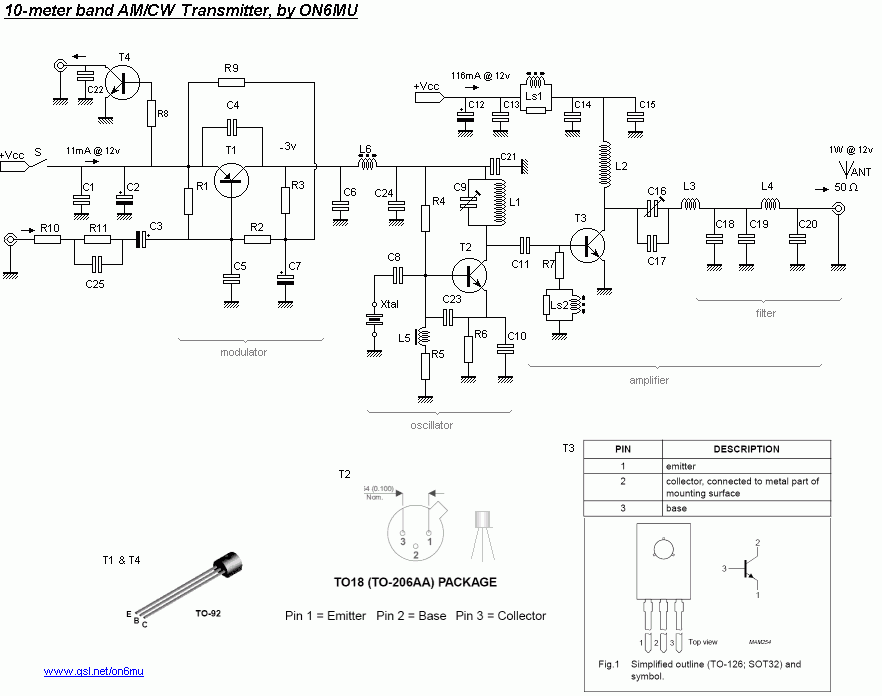
1Watt AM CW Transmitter for 10 Meterband
This project involves constructing a simple 3-stage low-power broadcast-type circuit, utilizing a crystal oscillator integrated circuit and a collector modulated AM oscillator with an amplifier. The circuit can be connected to an electret microphone or an amplified dynamic microphone, although...

Morse Code Beacon Keyer
This circuit stores a single morse code message as bits in an EPROM chip, the message is sent to a relay which can key a CW transmitter. The keyer can output either a one-shot message such as "CQ DX DE...
8MHz AM radio transmitter
This is an 8MHz amplitude modulated (AM) radio transmitter designed primarily for work purposes and as an exercise in electronics. It serves as a simple radio transceiver that may be utilized for various future projects.
The 8MHz AM radio transmitter operates...

Simple AM Transmitter
This AM transmitter is designed for simplicity and ease of construction. It utilizes a single-winding inductor that is not tapped, eliminating the need for custom winding. A readily available RF choke, such as the Jaycar Cat LF-1536, can be used...