


Bimetal thermostat control one circuit
#thermostat
#bimetal
#temperature sensing
#control circuit
#fluorescent starter
#simple circuit
#temperature control
#sensor element

Description: A fluorescent starter bimetal can be utilized as a temperature sensing element for thermostatic control. This component consists of a double metal sheet designed for temperature sensing, resulting in a simple circuit that is easy to manufacture, although it exhibits poor control accuracy. The temperature sensor, made from bimetal, is housed within a neon bulb glass shell, which contains a solid set of U-shaped bimetal and a metal bar. To enhance temperature control accuracy, the upper end of the metal bar should be filed to a point and bent, allowing for precise adjustment of the bimetal's tip distance. This adjustment ensures that the U-shaped bimetal aligns with the tip of the metal rod for contact. It is recommended to observe the incubator temperature and perform the adjustment multiple times for optimal performance.
The fluorescent starter bimetal serves as a practical solution for temperature sensing in various applications, particularly in thermostatic controls. The design incorporates a bimetallic strip that bends in response to temperature changes, allowing for the opening and closing of contacts within the circuit. This mechanism is fundamental in controlling devices such as incubators, where maintaining a specific temperature is crucial.
The construction involves a U-shaped bimetal strip positioned within a glass shell, typically made of neon bulb material. The bimetal strip consists of two different metals bonded together, each with distinct thermal expansion properties. As the temperature rises, the bimetal strip bends, causing the metal bar to make or break contact with the electrical circuit.
For improved accuracy, the tip of the metal bar must be carefully shaped and positioned. This requires precise filing and bending to ensure that the bimetal's movement is effectively translated into the desired electrical response. The adjustment process may involve iterative testing, where the temperature within the incubator is monitored closely to determine the optimal alignment of the bimetal strip with the metal rod.
The overall simplicity of the circuit design allows for easy manufacturing and integration into existing systems, although it is important to note the limitations in control accuracy. Additional calibration may be necessary to achieve the desired performance, particularly in sensitive applications where temperature fluctuations can significantly impact outcomes. Proper installation and maintenance of the bimetal temperature sensor can enhance its reliability and longevity in operation.Use fluorescent starter bimetal can be prepared as a temperature sensing element, as the thermostatic control. Double metal sheet for temperature sensing element, the circuit is simple, easy to manufacture, but poor control accuracy. Circuit shown in Figure 11-39. Temperature sensor (bimetal) the production, lifted starter in neon bulb glass shell, leaving a solid set on the U-shaped glass beads bimetal and a metal bar. In order to more accurately control the temperature, the upper end of the metal bar should file tip, bent, and carefully adjusting the tip of the bimetal of the distance, so that the set temperature, U-shaped bimetal coincides with the tip of the metal rod with contact.
Adjustment should be observed with the incubator temperature within general be repeated several times to adjust the job.
The fluorescent starter bimetal serves as a practical solution for temperature sensing in various applications, particularly in thermostatic controls. The design incorporates a bimetallic strip that bends in response to temperature changes, allowing for the opening and closing of contacts within the circuit. This mechanism is fundamental in controlling devices such as incubators, where maintaining a specific temperature is crucial.
The construction involves a U-shaped bimetal strip positioned within a glass shell, typically made of neon bulb material. The bimetal strip consists of two different metals bonded together, each with distinct thermal expansion properties. As the temperature rises, the bimetal strip bends, causing the metal bar to make or break contact with the electrical circuit.
For improved accuracy, the tip of the metal bar must be carefully shaped and positioned. This requires precise filing and bending to ensure that the bimetal's movement is effectively translated into the desired electrical response. The adjustment process may involve iterative testing, where the temperature within the incubator is monitored closely to determine the optimal alignment of the bimetal strip with the metal rod.
The overall simplicity of the circuit design allows for easy manufacturing and integration into existing systems, although it is important to note the limitations in control accuracy. Additional calibration may be necessary to achieve the desired performance, particularly in sensitive applications where temperature fluctuations can significantly impact outcomes. Proper installation and maintenance of the bimetal temperature sensor can enhance its reliability and longevity in operation.Use fluorescent starter bimetal can be prepared as a temperature sensing element, as the thermostatic control. Double metal sheet for temperature sensing element, the circuit is simple, easy to manufacture, but poor control accuracy. Circuit shown in Figure 11-39. Temperature sensor (bimetal) the production, lifted starter in neon bulb glass shell, leaving a solid set on the U-shaped glass beads bimetal and a metal bar. In order to more accurately control the temperature, the upper end of the metal bar should file tip, bent, and carefully adjusting the tip of the bimetal of the distance, so that the set temperature, U-shaped bimetal coincides with the tip of the metal rod with contact.
Adjustment should be observed with the incubator temperature within general be repeated several times to adjust the job.
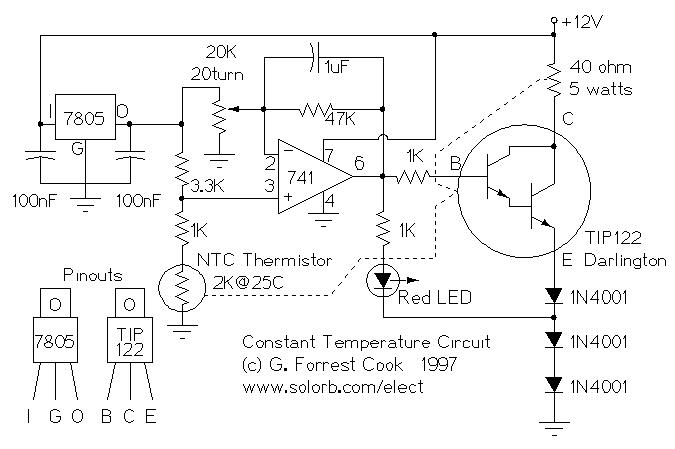
Constant Temperature Circuit
Constant Temperature Circuit. G. Forrest Cook 1997. Introduction: This circuit is a generic low-power temperature controller that can be used for stabilizing temperature.
The constant temperature circuit described is designed to maintain a stable temperature in various applications, utilizing low power...

A control circuit reversing braking and reverse grading speed control function
The circuit depicted in Figure 3-168 utilizes a controller for speed grading and reversing control. A reverse brake is connected to the rotor circuit through an overcurrent relay, labeled KI, for control. The current relay KIi to KI3 serves as...

Temperature-Controlled Soldering Iron
One reason commercial soldering stations are expensive is that they generally require soldering irons with built-in temperature sensors, such as thermocouples. This circuit eliminates the need for a special sensor by sensing the temperature of a soldering iron heating element...

Simple Oscillator / Pipe Locator
Occasionally, there is a requirement to create a very basic oscillator. The circuit illustrated here is remarkably straightforward, utilizing only three components.
The described oscillator circuit typically consists of a resistor, a capacitor, and a single transistor. The operation of this...

Temperature-Controlled Switch circuit
A switch that is controlled by its ambient temperature operates without human intervention, except during the assembly of the electronic thermostat. This thermally controlled switch has numerous practical applications. For instance, if the internal temperature of a computer rises excessively,...

temperature controlled switch
A thermally controlled switch operates based on the surrounding temperature without human intervention, except during the construction of the electronic thermostat. This type of switch has numerous practical applications. For instance, it can activate an additional fan when the internal...

Greenhouse Heater Temperature Control Project
This circuit consists of four 1N4148 diodes connected in series with a thermal anticipation resistor (R1) heat-shrunk together at the end of a three-wire signal cable, which is visible in some photos. The thermal anticipation resistor is an old HVAC...

Automatic temperature control circuit
An automatic temperature control circuit is designed for climate control thermostats. Its primary function is to maintain a constant internal temperature using an electric heater (EH). The control mechanism utilizes a negative temperature coefficient thermistor as the temperature sensing element,...

Temperature Controller
Wine doesn't like subzero temperatures, and during wintertime, my wine cellar got pretty cold. There was an electric heating element, but the thermostat was broken, so it was either full burn or nothing. That's how the temperature monitor/controller came to...