


Geomagnetic field detectors
#geomagnetic
#oscillator
#ferrite rod
#coil
#Earth magnetic field
#medium wave
#beat note
#audio detection
#magnetic sensor
#educational

Description: This basic oscillator detects the Earth's magnetic field. A ferrite rod and coil are repurposed from an old Medium Wave receiver, with a small magnet affixed to one end. The device is tuned to a medium wave commercial station until a beat note is audible. Any movement of the ferrite rod results in a change in the audible note, which is influenced by the prevailing Earth's magnetic field. Proper screening is crucial; a plastic box is used, internally padded with copper wires running parallel to the rod and grounded at a single point. A small hole is made in the box to allow for adjustment of the trimmer capacitor using a plastic screwdriver. The BC337 transistor can be substituted with the 2N2369A, though this alternative has not been tested.
This oscillator circuit operates on the principle of electromagnetic induction and resonance. The ferrite rod serves as a core for the coil, enhancing the magnetic field detection capabilities. The coil and ferrite rod work together to form an inductor, which, when combined with other circuit components, creates a resonant frequency that can be tuned to specific medium wave frequencies.
The small magnet attached to the ferrite rod interacts with the Earth's magnetic field, causing variations in the magnetic flux through the coil. These variations induce an alternating current in the coil, which is amplified by the transistor (BC337 or 2N2369A). The output of the transistor can be connected to a speaker or headphone, allowing the audible beat note to be heard.
The importance of screening is highlighted in this design. The plastic enclosure, lined with grounded copper wires, minimizes electromagnetic interference from external sources, ensuring that the circuit remains sensitive to the Earth's magnetic field. The trimmer capacitor allows for fine-tuning of the oscillator's frequency, ensuring optimal performance in detecting the magnetic field.
In summary, this oscillator circuit is a simple yet effective tool for detecting variations in the Earth's magnetic field, utilizing basic components and principles of electromagnetism. Proper construction, including screening and tuning, is essential for achieving accurate and reliable results.This basic oscillator will detect the Earth magnetic field. The ferrite rod and coil are taken from an old Medium Wave receiver and a small magnet is glued at one end. Tune to a medium wave commercial station until you hear a beat note. Any movement of the ferrite rod will produce an audible note that depends on the prevailing Earth magnetic field
. Screening is essential. Use a plastic box padded, on the inside, with copper wires running parallel to the rod and grounded in one place only. A small hole is made in the box in order to adjust the trimmer capacitor with a plastic screwdriver. An American equivalent to the BC337 could be the 2N2369A but I did not try it out.
This oscillator circuit operates on the principle of electromagnetic induction and resonance. The ferrite rod serves as a core for the coil, enhancing the magnetic field detection capabilities. The coil and ferrite rod work together to form an inductor, which, when combined with other circuit components, creates a resonant frequency that can be tuned to specific medium wave frequencies.
The small magnet attached to the ferrite rod interacts with the Earth's magnetic field, causing variations in the magnetic flux through the coil. These variations induce an alternating current in the coil, which is amplified by the transistor (BC337 or 2N2369A). The output of the transistor can be connected to a speaker or headphone, allowing the audible beat note to be heard.
The importance of screening is highlighted in this design. The plastic enclosure, lined with grounded copper wires, minimizes electromagnetic interference from external sources, ensuring that the circuit remains sensitive to the Earth's magnetic field. The trimmer capacitor allows for fine-tuning of the oscillator's frequency, ensuring optimal performance in detecting the magnetic field.
In summary, this oscillator circuit is a simple yet effective tool for detecting variations in the Earth's magnetic field, utilizing basic components and principles of electromagnetism. Proper construction, including screening and tuning, is essential for achieving accurate and reliable results.This basic oscillator will detect the Earth magnetic field. The ferrite rod and coil are taken from an old Medium Wave receiver and a small magnet is glued at one end. Tune to a medium wave commercial station until you hear a beat note. Any movement of the ferrite rod will produce an audible note that depends on the prevailing Earth magnetic field
. Screening is essential. Use a plastic box padded, on the inside, with copper wires running parallel to the rod and grounded in one place only. A small hole is made in the box in order to adjust the trimmer capacitor with a plastic screwdriver. An American equivalent to the BC337 could be the 2N2369A but I did not try it out.

Micro Power AM Broadcast Transmitter
This circuit utilizes a 74HC14 hex Schmitt trigger inverter as a square wave oscillator to drive a small signal transistor configured in a class C amplifier setup. The frequency of the oscillator can be either fixed using a crystal or...

Wide-range-oscillator
The gain control enables the oscillator to maintain a nearly constant output across its range. The circuit operates within a frequency range of 160 kHz to 12 MHz while producing a consistent amplitude.
The oscillator circuit described utilizes a gain control...

Metal detector circuit diagram 6
The metal detector circuit consists of several key components including the probe oscillator, reference oscillator, oscillation signal processor, mixing amplifier, and ammeter PA. The probe oscillator is made up of the oscillating tube VI, exploration coil L1, capacitors C1 to...

Little dipper
The circuit consists of two fundamental components: the oscillator and the detector. The oscillator employs a Field Effect Transistor (FET) in a Colpitts configuration. The energy circulating within the oscillator's tank is coupled through capacitor C4 to the detector circuit,...

Oscillator-clock generator
This self-starting fixed frequency oscillator circuit provides excellent frequency stability. R1 and C1 form the frequency-determining network, while R2 supplies regenerative feedback. Diode D1 improves stability by compensating for the difference between Voh and Vsupply. In applications requiring a precision...

Sensitive Geomagnetic Sensor circuit
This is a rather sensitive circuit which will detect minute variations of a magnetic field, particularly the Earth magnetic field. The principle is based on an audio beat tone generated by two identical oscillators. These must be built in the...
Oscillator IIV
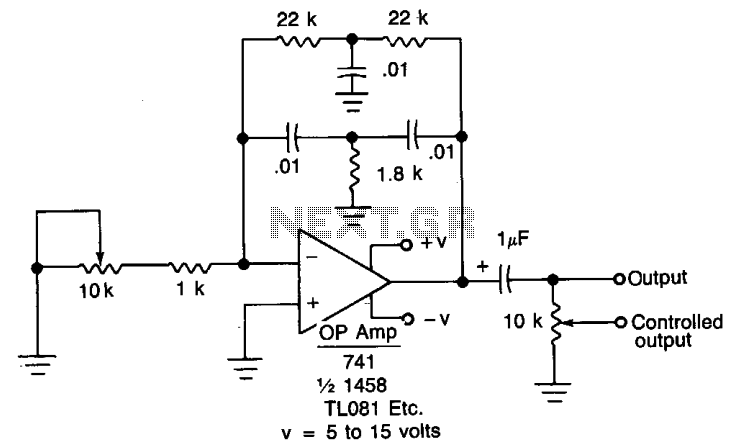
When the oscillator is connected to a DC circuit, a DC blocking capacitor should be connected in series with the potentiometer's wiper arm. For finer output control, a 10 kΩ potentiometer can be added.
In this circuit configuration, the oscillator generates...

Oscillator DesignGuide Reference
The Oscillator Design Guide is integrated into Agilent EEsof's Advanced Design System environment, functioning as a smart library and interactive handbook for the creation of effective designs. It facilitates quick oscillator design, interactive component characterization, and provides in-depth insights into...

Acousto-optic detector circuit to measure the crystal
The circuit consists of a capacitance three-point oscillator, an isolation level, a voltage doubler rectifier circuit, a stereo sound circuit, and a flash display circuit. It can detect the quality of a crystal; a good crystal will emit a "Didi"...