


Whistle Switch Circuit
#whistle switch
#tone detector
#LM567
#relay control
#audio amplifier
#sound sensor
#false triggering prevention
#ac load control
#microphone

Description: The whistle switch features two tone detectors, each based on an LM567 tone decoder, requiring minimal additional components. It is designed to respond to two or more occurrences of a specific tone or sequence of tones within a defined time frame to avoid false triggering. Depending on the relay employed, it can control various AC loads. A microphone (MIC1) captures the sound, which is then amplified by U2 before being sent to the tone decoders U3 and U4. These devices activate U5-a and U5-b, which in turn drive the relay K1 through associated logic circuits.
The whistle switch circuit operates by utilizing the LM567 tone decoder, which is a versatile integrated circuit designed to detect specific frequencies. The circuit is initiated when the microphone (MIC1) captures sound waves, converting them into electrical signals. These signals are then amplified by the operational amplifier U2 to ensure sufficient signal strength for reliable tone detection.
The LM567 tone decoders U3 and U4 are configured to recognize a specific tone or frequency pattern. The design requires that the target tone be detected at least twice within a predetermined time interval, which enhances the circuit's resistance to false triggers caused by environmental noise or unintended sounds. This feature is crucial in applications where reliability is paramount.
Upon successful detection of the tone, the outputs of the tone decoders trigger the logic circuits within U5-a and U5-b. These logic circuits are responsible for processing the signals from the tone decoders and determining whether to activate the relay K1. The relay serves as a switch that can control various AC loads, allowing for versatile applications in automation or signaling systems.
The choice of relay depends on the specific AC load requirements, ensuring compatibility with different voltage and current ratings. This flexibility makes the whistle switch suitable for various applications, from activating alarms to controlling lights or other devices based on sound input. Overall, the circuit exemplifies an efficient and reliable design for sound-activated control systems. At the heart of the whistle swatch are a pair of tone detectors, each of which is built around an LM567 tone decoder, which are supported by a minimum of additional components. This whistle switch is designed to respond to only two or more occurrences of a specific tone, or sequence of tones, within a specified period to prevent false triggering.
Depending on the relay used, various ac loads can be controlled. Microphone MICl picks up the sound and U2 amplifies the signal and feeds it to tone decoders U3 and U4. These devices trigger U5-a and U5-b and the logic circuits that drive relay Kl.
The whistle switch circuit operates by utilizing the LM567 tone decoder, which is a versatile integrated circuit designed to detect specific frequencies. The circuit is initiated when the microphone (MIC1) captures sound waves, converting them into electrical signals. These signals are then amplified by the operational amplifier U2 to ensure sufficient signal strength for reliable tone detection.
The LM567 tone decoders U3 and U4 are configured to recognize a specific tone or frequency pattern. The design requires that the target tone be detected at least twice within a predetermined time interval, which enhances the circuit's resistance to false triggers caused by environmental noise or unintended sounds. This feature is crucial in applications where reliability is paramount.
Upon successful detection of the tone, the outputs of the tone decoders trigger the logic circuits within U5-a and U5-b. These logic circuits are responsible for processing the signals from the tone decoders and determining whether to activate the relay K1. The relay serves as a switch that can control various AC loads, allowing for versatile applications in automation or signaling systems.
The choice of relay depends on the specific AC load requirements, ensuring compatibility with different voltage and current ratings. This flexibility makes the whistle switch suitable for various applications, from activating alarms to controlling lights or other devices based on sound input. Overall, the circuit exemplifies an efficient and reliable design for sound-activated control systems. At the heart of the whistle swatch are a pair of tone detectors, each of which is built around an LM567 tone decoder, which are supported by a minimum of additional components. This whistle switch is designed to respond to only two or more occurrences of a specific tone, or sequence of tones, within a specified period to prevent false triggering.
Depending on the relay used, various ac loads can be controlled. Microphone MICl picks up the sound and U2 amplifies the signal and feeds it to tone decoders U3 and U4. These devices trigger U5-a and U5-b and the logic circuits that drive relay Kl.
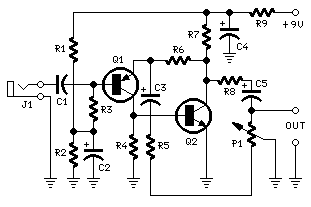
Portable Mic Preamplifier
This circuit is mainly intended to provide common home stereo amplifiers with a microphone input. Using a stereo microphone the circuit must be doubled. In this case, two separate level controls are better than a dual-ganged stereo potentiometer. Low current...

Audio Response with the FT8900 Yaesu MH-48A6J
Carefully use a small screwdriver to work around the microphone element's rubber boot and gently remove it from the microphone's front casing. Take your time, as there is a spot near the top of the microphone housing where the screwdriver...

60 watt audio amplifier
Using the STK4038X audio amplifier IC, can be designed a very simple high power and efficiency audio power amplifier. This circuit is manufactured by Sanyo Corporation and will provide an output power of 60 watts on an 8 ohms load...

Tone detector
The detector circuit consists of a two-amplifier multiple feedback bandpass filter followed by an AC-to-DC detector section and a Schmitt Trigger. The bandpass filter, with a quality factor (Q) greater than 100, allows only 500 Hz inputs, which are subsequently...

Audio Single Chip 25 Watt Mono Class-D Audio Power Amplifier Circuit
This class-D audio amplifier is suitable for TV and home stereo systems. The TDA7882 integrated circuit (IC) provides a class-D audio amplifier solution. Since this IC has a single channel output, two units are required for stereo applications. The power...

OddWatt Audio 5751 SRPP / KT88 Push-Pull Monoblock Tube Amplifier Kits
One of the advantages of hosting a hobby website is the opportunity to connect with individuals via email who share similar interests. Since posting Bruce's initial OddWatt project on the site, communication has occurred with numerous DIY hobbyists who have...

ECM Mic Preamplifier
Cleaned Input: A microphone amplifier that may be used with either Electret Condenser Microphone (ECM) inserts or dynamic inserts, made with discrete components. Both transistors should be low noise types. In the original circuit, BC650C which is an ultra low...

Alternately flashing one of a plurality of sets of high-power lights a chain circuit
The relay control allows for multiple pairs of contacts to be connected in parallel, enabling the circuit to handle a large lamp power. The design is straightforward; by simply changing the capacitance of the capacitor, different flash frequencies can be...

Understanding Mouthpiece or Microphone Earpiece and IHF or Buzzer Speakers Circuit on mobile phones
A mobile phone's microphone or mouthpiece is a component that converts sound signals into electrical signals. The earpiece speaker converts electrical signals back into sound signals, and similarly, the IHF, buzzer, or ringer speaker performs this function as well. A...