


General-purpose-video-switch

Description: The circuit presented offers 40 dB of isolation at a frequency of 6 MHz and is suitable for general-purpose video switching.
The circuit is designed to achieve a high level of isolation, specifically 40 dB, which is critical in applications where signal integrity must be maintained while preventing interference between different channels. The isolation level indicates that the signal from one port will not significantly affect the signal at another port, making this circuit ideal for video switching applications where multiple video sources may be connected to a single output.
At a frequency of 6 MHz, the circuit operates within a range that is commonly used for standard video signals, ensuring compatibility with various video formats. The components selected for this design must exhibit low insertion loss and minimal distortion to preserve the quality of the video signals being switched.
Typically, such a circuit may include RF switches or relays that can handle the specified frequency without introducing significant signal degradation. Additionally, the layout of the circuit is crucial; careful attention must be paid to the trace lengths and impedance matching to minimize reflections and ensure consistent performance across the intended frequency range.
Power supply considerations are also important, as the circuit must be able to maintain performance under varying load conditions. Proper decoupling capacitors should be employed to filter out noise and stabilize the power supply.
Overall, this circuit serves as a robust solution for video switching, providing essential isolation while ensuring that the video quality remains high, thus making it suitable for a variety of applications in video distribution systems.The circuit shown provides 40-dB isolation at 6 MHz and is good for general purpose video switching.
The circuit is designed to achieve a high level of isolation, specifically 40 dB, which is critical in applications where signal integrity must be maintained while preventing interference between different channels. The isolation level indicates that the signal from one port will not significantly affect the signal at another port, making this circuit ideal for video switching applications where multiple video sources may be connected to a single output.
At a frequency of 6 MHz, the circuit operates within a range that is commonly used for standard video signals, ensuring compatibility with various video formats. The components selected for this design must exhibit low insertion loss and minimal distortion to preserve the quality of the video signals being switched.
Typically, such a circuit may include RF switches or relays that can handle the specified frequency without introducing significant signal degradation. Additionally, the layout of the circuit is crucial; careful attention must be paid to the trace lengths and impedance matching to minimize reflections and ensure consistent performance across the intended frequency range.
Power supply considerations are also important, as the circuit must be able to maintain performance under varying load conditions. Proper decoupling capacitors should be employed to filter out noise and stabilize the power supply.
Overall, this circuit serves as a robust solution for video switching, providing essential isolation while ensuring that the video quality remains high, thus making it suitable for a variety of applications in video distribution systems.The circuit shown provides 40-dB isolation at 6 MHz and is good for general purpose video switching.

Automatic-video-switch
Turn on a game console, computer, videodisc player, or any similar device, and its output takes precedence over the antenna-derived signal. The antenna is disconnected, and the alternate source is fed to the monitor. When the alternate video source is...
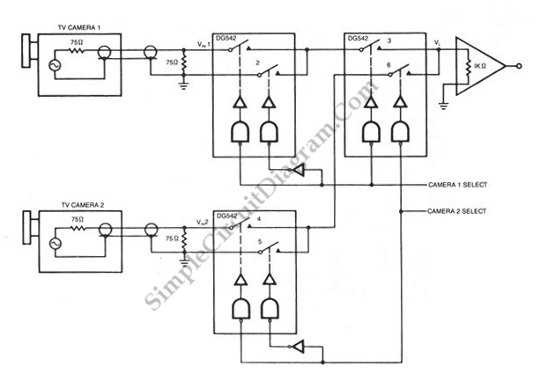
High Off Isolation Video Switch/Multiplexer
A video switch is necessary to multiplex several video sources, allowing multiple cameras to be displayed sequentially on a single monitor. This multiplexing process...
A video switch serves as a critical component in video signal management, particularly in applications where multiple...

Video Switch for Intercom System
Nowadays, many intercom units are equipped with video cameras, allowing users to see as well as hear who is at the door. Unfortunately, the camera lens is...
Intercom systems with integrated video capabilities enhance security and convenience by enabling visual identification...
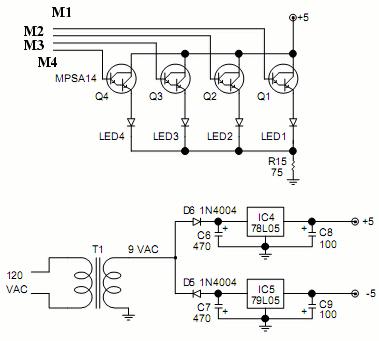
Video Switch Circuit Schematic Diagram
A video switcher circuit is required to display multiple sources on a single monitor. The circuit schematic below features the MAX454, which serves as the core component of this video switcher. The MAX454 is a video multiplexer-amplifier manufactured by MAXIM...

Video Switch for Intercom System
Many modern intercom units are now equipped with video cameras, allowing users to see and hear who is at the door. However, the positioning of the camera lens often serves as a support point for individuals during conversations, resulting in...

High-performance-video-switch
This figure illustrates a one-of-two switch featuring a summing amplifier. The video source's line can be terminated either externally or internally to switch RO. With this termination resistor, a load change of less than 10 ohms will be perceived by...