LMC555CN
LMC555CN CMOS Timer IC Technical Summary
Overview
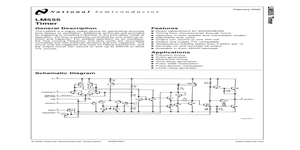
The LMC555CN is a CMOS version of the industry-standard 555 series general-purpose timer, manufactured using National Semiconductor's LMCMOS™ process technology. This device maintains all the functionality of the classic 555 timer while offering significant improvements in power efficiency and performance. The LMC555CN is designed to generate accurate time delays and oscillations with minimal power consumption, making it ideal for battery-powered and energy-sensitive applications.
Available in multiple package options including SOIC, MSOP, MDIP, and a chip-sized 8-bump micro SMD package, the LMC555CN provides design flexibility for various PCB layouts and space constraints. The device operates over a wide voltage range while maintaining stable timing characteristics, offering improved performance compared to traditional bipolar 555 timers.
Key Features
- CMOS version of industry-standard 555 timer functionality
- Ultra-low power consumption: <1mW typical at 5V supply
- Wide operating voltage range: 1.5V to 15V
- Low supply current spikes during output transitions
- Precise timing control in both monostable and astable modes
- Improved timing accuracy over temperature variations
- High output current capability: 50mA sink/source typical
- Available in multiple package options: DIP-8, SOIC-8, MSOP-8, and micro SMD
- Direct replacement for standard 555 timers in most applications
- Improved power supply rejection ratio (PSRR)
Applications
The LMC555CN's combination of low power consumption and precise timing makes it suitable for a wide range of applications across multiple industries:
Consumer Electronics
- Portable electronic devices
- Battery-operated timers
- LED flashers and blinkers
- Toy and game electronics
Industrial Systems
- Precision timing circuits
- Process control timing
- Sequential timing systems
- Sensor signal conditioning
Automotive Electronics
- In-vehicle timing circuits
- Lighting control systems
- Basic engine management functions
Medical Devices
- Portable medical equipment
- Therapeutic device timing
- Diagnostic equipment timing
Electrical Characteristics
The following table summarizes the key electrical characteristics of the LMC555CN (typical values at 25°C, VDD = 5V unless otherwise specified):
Power Supply Characteristics
- Supply Voltage Range: 1.5V to 15V
- Supply Current (Idle): 150µA typical at 5V
- Power Dissipation: <1mW at 5V
Timing Characteristics
- Initial Timing Accuracy: ±2% typical
- Temperature Stability: 50ppm/°C typical
- Power Supply Stability: 0.1%/V typical
Threshold and Trigger Characteristics
- Threshold Voltage: 0.667 × VDD typical
- Trigger Voltage: 0.333 × VDD typical
- Trigger Current: 10pA typical
Output Characteristics
- Output Sink Current: 50mA typical
- Output Source Current: 50mA typical
- Output Voltage Drop: 0.1V typical at 5mA
Package Information
The LMC555CN is available in several package options to accommodate different design requirements:
DIP-8 (Plastic Dual In-Line Package)
- Package Dimensions: 9.81mm × 6.35mm × 3.3mm
- Lead Pitch: 2.54mm
- Operating Temperature: -40°C to +85°C
SOIC-8 (Small Outline Integrated Circuit)
- Package Dimensions: 4.9mm × 3.9mm × 1.25mm
- Lead Pitch: 1.27mm
- Operating Temperature: -40°C to +85°C
MSOP-8 (Mini Small Outline Package)
- Package Dimensions: 3mm × 3mm × 0.86mm
- Lead Pitch: 0.65mm
- Operating Temperature: -40°C to +85°C
Micro SMD (8-Bump Chip-Sized Package)
- Package Dimensions: 1.5mm × 1.5mm × 0.6mm
- Bump Pitch: 0.5mm
- Operating Temperature: -40°C to +85°C
Functional Description
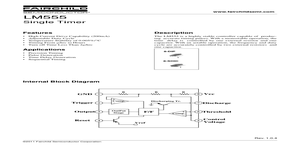
The LMC555CN operates similarly to the standard 555 timer but with CMOS technology advantages. The device contains two comparators, a flip-flop, a discharge transistor, and an output stage. The threshold and trigger comparators monitor the external timing capacitor voltage, while the flip-flop and output stage provide the timing function.
In monostable (one-shot) mode, the timer produces a single pulse of predetermined length when triggered. The pulse duration is determined by a single external resistor and capacitor. In astable (oscillator) mode, the timer produces a continuous stream of rectangular pulses with frequency and duty cycle determined by two external resistors and one capacitor.
Design Considerations
Power Supply Decoupling
While the LMC555CN has improved power supply rejection compared to bipolar 555 timers, proper decoupling is still recommended. A 0.1µF ceramic capacitor should be placed as close as possible to the power supply pin.
Timing Accuracy
For best timing accuracy, use high-quality, stable timing components with low temperature coefficients. Metal film resistors and polystyrene or polypropylene capacitors are recommended for critical timing applications.
Output Loading
While the LMC555CN can source or sink up to 50mA, excessive output current may affect timing accuracy and increase power dissipation. For heavy loads, consider using an external buffer or driver.
Comparison with Standard 555 Timer
The LMC555CN offers several advantages over traditional bipolar 555 timers:
- Lower power consumption (microamps vs. milliamps)
- Higher input impedance (reduced loading on timing network)
- Reduced supply current spikes during output transitions
- Wider operating voltage range (1.5V to 15V vs. 4.5V to 16V)
- Better temperature stability
- Smaller package options available