Coulomb's Law in Electrostatics
1. Definition of Coulomb's Law
1.1 Definition of Coulomb's Law
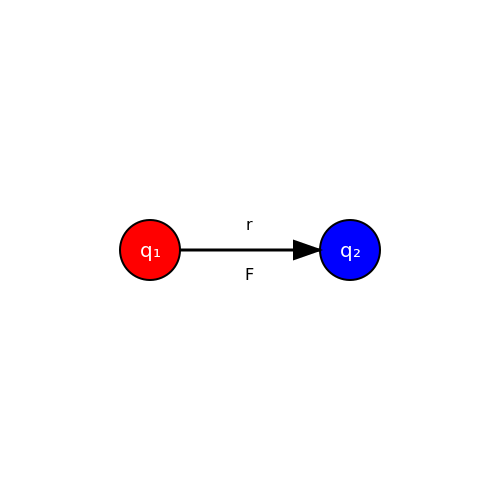
Coulomb's Law is central to the field of electrostatics, describing the force exerted between two charged objects. This law, formulated by the French physicist Charles-Augustin de Coulomb in the late 18th century, quantitatively expresses how charged bodies interact. In its foundational form, Coulomb's Law states that the magnitude of the electrostatic force \( F \) between two point charges \( q_1 \) and \( q_2 \) is directly proportional to the product of the magnitudes of the charges and inversely proportional to the square of the distance \( r \) between them.
This relationship can be mathematically expressed as:
where:
- F is the magnitude of the electrostatic force between the two charges (in newtons, N).
- k is Coulomb's constant, approximately \( 8.99 \times 10^9 \, \text{N m}^2/\text{C}^2 \).
- q1 and q2 are the amounts of the two point charges (in coulombs, C).
- r is the separation distance between the centers of the two charges (in meters, m).
To derive this expression, we start by considering two point charges \( q_1 \) and \( q_2 \) positioned at a distance \( r \) apart. The force acting on \( q_2 \) due to \( q_1 \) can be understood through the contributions from the electric field \( E \) generated by charge \( q_1 \). The electric field at a distance \( r \) from a point charge \( q_1 \) is given by:
The force acting on charge \( q_2 \) in this electric field is given by:
Substituting the expression for the electric field \( E \), we get:
This leads to the rearrangement of terms to yield:
Hence, Coulomb's Law not only establishes a foundation for electrostatics but also serves as an essential tool in understanding atomic and molecular interactions, capacitors, and even in applications such as electric field mapping and electrostatic force microscopy.
The potential application of Coulomb's Law extends far beyond the laboratory. In engineering, it plays a critical role in the design of electrical components, such as capacitors, and is fundamental to electromagnetic theory, affecting everything from the behavior of micro-scale devices to the stability of macro-scale systems like power grids.
1.2 Mathematical Formulation
Coulomb's Law is a cornerstone of electrostatics, elucidating the interaction between charged particles. The law quantifies the electrostatic force and introduces the fundamental principles of electric charge, which can be positive or negative. In this section, we will delve into the mathematical formulation of Coulomb's Law, deriving the equations step by step, and discussing its implications in both theoretical and practical contexts.
Understanding the Electrostatic Force
At the core of Coulomb's Law is the electrostatic force between two point charges, denoted as \( q_1 \) and \( q_2 \). The interaction is dependent on two key factors:
- The magnitudes of the charges (indicating how strong the forces will be)
- The distance between the charges (which inversely affects the force)
According to Coulomb's Law, the electrostatic force (\( F \)) between two point charges is directly proportional to the product of the magnitudes of the charges and inversely proportional to the square of the distance (\( r \)) separating them:
Mathematical Expression
The relationship can be expressed as:
Where:
- F is the magnitude of the electrostatic force between the charges.
- q1 and q2 are the magnitudes of the point charges.
- r is the distance between the centers of the two charges.
- k is Coulomb's constant, approximately \( 8.9875 \times 10^9 \, \text{N m}^2/\text{C}^2 \) in a vacuum.
Direction and Nature of the Force
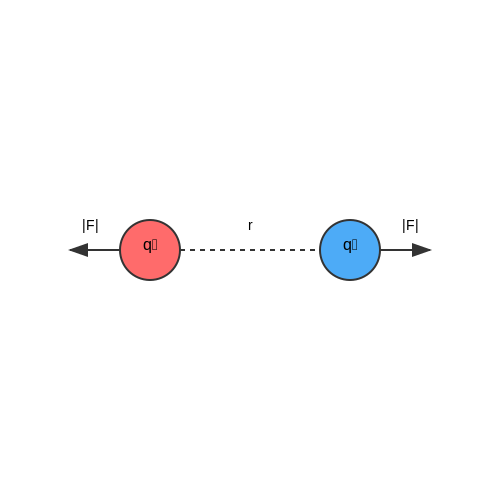
The direction of the force is determined by the nature of the charges. If both charges are of like sign (either both positive or both negative), they repel each other. Conversely, if one charge is positive and the other negative, they attract each other. This can be annotated in vector form:
Here, \( \hat{r} \) is a unit vector pointing from one charge to the other. The expression signifies that the force vector points away from the charge for like charges (repulsion) and towards it for opposite charges (attraction).
Applications in Real-World Scenarios
Coulomb's Law extends well beyond theoretical physics into numerous practical applications, including:
- Electrostatic Precipitators: Used in air pollution control, where charged particles are attracted to oppositely charged plates.
- Capacitors: The law governs the behavior of electric fields in capacitors, crucial components in electronic circuits.
- Nanoelectronic Devices: Understanding charge interactions is vital in designing transistors at nanoscale.
The implications of Coulomb's Law are paramount for advancing technologies in materials science, telecommunications, and energy systems. As we continue to explore the behaviors of electric fields and forces, the universal applicability of this foundational law remains evident.
1.3 Units and Constants
In the study of electrostatics, particularly when applying Coulomb's Law, a precise understanding of units and constants is paramount. This subsection outlines the essential units of charge, distance, and the fundamental constants integral to Coulomb's Law, enabling a deeper grasp of electrostatic interactions.Fundamental Units
Coulomb's Law describes the force between two point charges and lays the groundwork for many electrostatic applications. To understand this law fully, we must first clarify the units involved. The primary unit of electric charge is the coulomb (C), named after the French physicist Charles-Augustin de Coulomb. - The coulomb is defined as the amount of charge transported by a constant current of one ampere in one second. Formally: $$ 1 \, C = 1 \, A \cdot 1 \, s $$ - In SI (International System of Units), the base units for charge can be derived from the unit of current (ampere) and time (seconds). Electric force, as described by Coulomb's Law, is measured in newtons (N), which is derived from the metric base units: $$ 1 \, N = 1 \, \frac{kg \cdot m}{s^2} $$ Here, kilogram (kg) is the unit of mass, meter (m) is the unit of distance, and second (s) is the unit of time.Key Constants
To further elucidate Coulomb's Law, two important constants must be considered: 1. The Coulomb's Constant (k): This constant quantifies the strength of the electrostatic force and is crucial in the formulation of Coulomb's Law. It's defined in vacuum as: $$ k = \frac{1}{4\pi \varepsilon_0} $$ where $$ \varepsilon_0 $$, the *electric permittivity of free space*, is approximately equal to $$ \varepsilon_0 \approx 8.854 \times 10^{-12} \, F/m $$ (farads per meter). The Coulomb's constant has a value of: $$ k \approx 8.988 \times 10^9 \, N \cdot m^2/C^2 $$ This indicates the amount of force exerted by two one-coulomb charges, one meter apart. 2. The Electric Permittivity of Free Space ($$\varepsilon_0$$): As mentioned, this constant addresses the ability of a vacuum to permit electric field lines. It plays an essential role in the relationship between electric field, electric flux, and electric charge, and it varies when dealing with different media. These constants and units result in the mathematical formulation for Coulomb's Law: $$ F = k \frac{|q_1 q_2|}{r^2} $$ Here, F represents the magnitude of the electrostatic force exerted between two point charges q₁ and q₂, separated by a distance r.Practical Relevance
The comprehension of these units and constants is not merely academic; it has vast implications in various fields, including electronics, materials science, and electrical engineering. Understanding charge interactions is pivotal in designing capacitors, insulators, and other electronic components where electrostatic forces play a significant role. Additionally, applications in telecommunications, microelectronics, and even biophysics rely on a thorough grasp of electrostatic principles. For instance, the operation of field-effect transistors (FETs) is fundamentally grounded in these electrostatic concepts. In conclusion, grasping the units and constants associated with Coulomb's Law not only aids in theoretical understanding but also empowers the practical application of these principles in advanced technologies, making it a bedrock of electrostatics.2. Force Between Point Charges
2.1 Force Between Point Charges
In the study of electrostatics, understanding the force between charges is fundamental, and it is encapsulated by Coulomb's Law. This law quantitatively describes the force experienced by two point charges due to their electric fields, laying the groundwork for electrostatics. To comprehend this interaction, we will explore the mathematical formulation of Coulomb's Law, its implications, and its applications, ultimately emphasizing its significance in various real-world contexts. Coulomb's Law states that the force \( F \) between two point charges \( q_1 \) and \( q_2 \) separated by a distance \( r \) in a vacuum can be expressed as follows: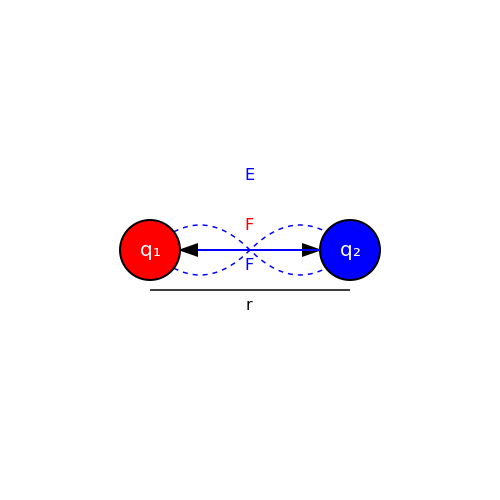
2.2 Electric Field Concept
In the study of electrostatics, understanding the electric field is pivotal for grasping how charged particles interact at a distance. The concept of the electric field, denoted as E, fundamentally redefines our perception of electrostatic forces, allowing us to describe the influence of charge in a space around it, rather than only through direct interaction. The electric field originates directly from Coulomb's Law, which states that the force \( F \) between two point charges is inversely proportional to the square of the distance \( r \) between them and directly proportional to the product of the charges \( q_1 \) and \( q_2 \): $$ F = k \frac{|q_1 q_2|}{r^2} $$ where \( k \) is Coulomb's constant, approximately equal to \( 8.99 \times 10^9 \, \text{N m}^2/\text{C}^2 \). To frame this interaction within the electric field context, we define the electric field produced by a point charge \( Q \) as the force \( F \) experienced by a small positive test charge \( q_0 \) placed in the vicinity of \( Q \): $$ E = \frac{F}{q_0} $$ By substituting for \( F \) from Coulomb's Law, we arrive at the expression for the electric field due to a point charge: $$ E = k \frac{|Q|}{r^2} $$ This equation implies that the electric field vector points away from the charge if \( Q \) is positive and towards \( Q \) if it is negative. Consequently, we can visualize the electric field lines radiating from any charge, effectively mapping the force that would be exerted on a positive test charge introduced into the field. Consider a point charge \( Q \) placed in a vacuum. The electric field at a distance \( r \) will have a strength that decreases with the square of the distance and follows an inverse radial pattern, illustrating the concept of field lines: - The density of these lines depicts the strength of the electric field: closer lines indicate a stronger field. - The direction of the field lines shows the direction of the force on a positive charge. Below is a diagram depicting the electric field of a positive point charge, illustrating the radial nature of electric field lines: Understanding electric fields allows for numerous practical applications and technological advancements. Notably, electric field concepts are foundational in designing capacitors and other electronics, influencing fields such as telecommunications, semiconductor technologies, and electric field mapping in environmental science. Further, it underpins the operations of devices like field-effect transistors (FETs) used in modern circuits. In summary, the electric field concept enriches our understanding of electrostatic interactions, providing a powerful framework to analyze forces and behaviors of charged bodies, extending far beyond the mere mathematical representations of Coulomb's Law. With this foundation, we can delve into the implications of electric fields in more complex configurations, such as those found in dipoles, charge distributions, and further electromagnetic phenomena.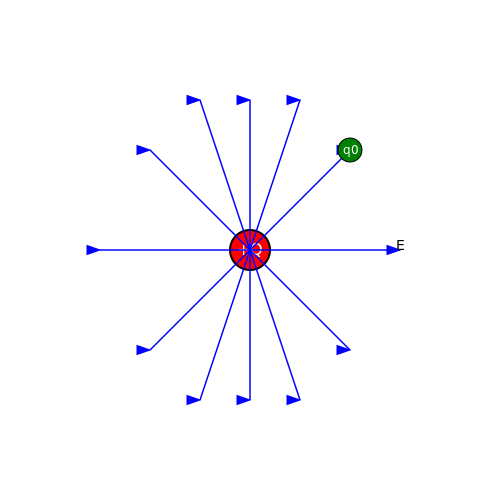
2.3 Superposition Principle
The Superposition Principle serves as a foundational concept in electrostatics, extending the applicability of Coulomb's Law beyond pairs of point charges. This principle asserts that in a system of multiple point charges, the net force acting on any given charge can be determined by vectorially summing the forces due to all other charges individually. Such a multifaceted approach allows for comprehensive analysis of electrostatic interactions in more complex configurations.Understanding the Superposition Principle
To grasp the significance of the Superposition Principle, consider a scenario with three point charges: \( q_1 \), \( q_2 \), and \( q_3 \) located at distinct points in space. The force exerted on \( q_1 \) due to \( q_2 \) and \( q_3 \) can be expressed as: $$ \vec{F}_{1} = \vec{F}_{12} + \vec{F}_{13} $$ where \( \vec{F}_{12} \) is the force on \( q_1 \) due to \( q_2 \), and \( \vec{F}_{13} \) is the force on \( q_1 \) due to \( q_3 \). According to Coulomb's Law, each force is calculated as: $$ \vec{F}_{ij} = k_e \frac{|q_i q_j|}{r_{ij}^2} \hat{r}_{ij} $$ Here, \( k_e \) is Coulomb's constant, \( r_{ij} \) is the distance between charges \( q_i \) and \( q_j \), and \( \hat{r}_{ij} \) is the unit vector directed from charge \( q_j \) to \( q_i \). The contributions from each charge are inherently vector quantities, requiring careful attention to direction during summation. As you can observe, the total electrostatic force on charge \( q_1 \) is the vector sum of all forces due to other charges in the system. This characteristic is essential when calculating electric fields in multi-charge systems and helps in understanding phenomena such as electric dipoles, where two equal and opposite charges are spaced closely together.Mathematical Illustration of the Superposition Principle
Let’s formalize the calculations for the total electrostatic force on \( q_1 \). Assume it resides at the origin, followed by placing \( q_2 \) at coordinates \( (x_2, 0) \) and \( q_3 \) at \( (0, y_3) \). 1. Calculate \( \vec{F}_{12} \): The distance between \( q_1 \) and \( q_2 \) is simply \( r_{12} = x_2 \), thus: $$ \vec{F}_{12} = k_e \frac{|q_1 q_2|}{x_2^2} \hat{x} $$ 2. Calculate \( \vec{F}_{13} \): The distance between \( q_1 \) and \( q_3 \) is \( r_{13} = y_3 \): $$ \vec{F}_{13} = k_e \frac{|q_1 q_3|}{y_3^2} \hat{y} $$ 3. Combine Forces: The total force acting on \( q_1 \): $$ \vec{F}_{1} = k_e \frac{|q_1 q_2|}{x_2^2} \hat{x} + k_e \frac{|q_1 q_3|}{y_3^2} \hat{y} $$ The result is effectively a vector in the plane spanned by \( x \) and \( y \) axes, with magnitudes contributing to the net electrostatic force.Practical Applications of Superposition in Electrostatics
In real-world scenarios, the Superposition Principle is indispensable in fields such as electrical engineering, where it aids in the design and analysis of circuits with multiple capacitors. It can also be utilized in computational physics, where software simulating electric fields in systems with numerous charges relies on this principle to approximate behavior accurately. Furthermore, it plays a crucial role in explaining more complex electrostatic phenomena, like the behavior of conductors under influence from external electric fields, as well as understanding the interactions within molecular systems in chemistry, where intermolecular forces stem from the principles established by electrostatics. In conclusion, the Superposition Principle is not merely a mathematical convenience; it forms the backbone of electrostatic theory, enabling detailed analysis in a variety of practical contexts. Its impact extends to both theoretical exploration and real-world applications, making it an essential concept in advanced studies of physics and engineering.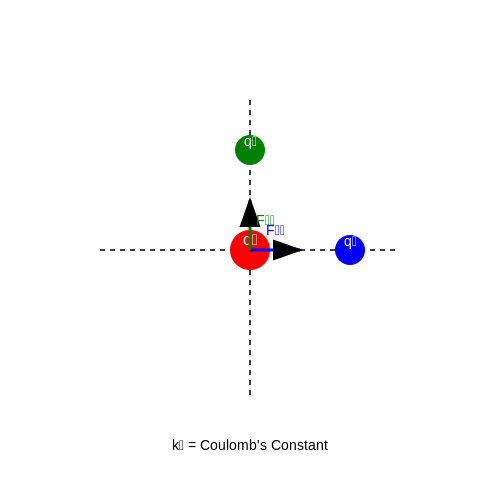
3. Definition of Electric Field
3.1 Definition of Electric Field
In the realm of electrostatics, Coulomb's Law serves as a foundation for understanding the interactions between charged particles. To fully grasp how these interactions manifest in physical space, we must introduce the concept of the electric field.
The electric field, denoted as \(\mathbf{E}\), is a vector field that represents the influence of electric charges on their surrounding environment. Specifically, it quantifies the force experienced by a unit positive test charge placed at a point in space due to the presence of other charges. Mathematically, the electric field is defined as:
Here, \(\mathbf{E}\) is the electric field, \(\mathbf{F}\) is the force exerted on the test charge, and \(q\) is the magnitude of the test charge. This definition encapsulates not only the strength of the field but also its direction, which is defined as the direction that a positive charge would move in the field.
Visualizing the Electric Field
To illustrate the concept of an electric field, envision a point charge \(Q\) generating lines of electric field radiating outward. These lines, known as field lines, indicate both the magnitude and direction of the electric field at any point in space:
1. The density of the field lines corresponds to the strength of the electric field: closer lines indicate a stronger field.
2. The direction of the lines shows the direction of the force on a positive charge; lines point away from positive charges and toward negative charges.
In a two-dimensional plane, consider a positive charge at the origin. The electric field generated can be depicted by radial lines spreading outwards from the charge:
This illustration provides an intuitive grasp of how electric fields operate in the space around a charge.
Mathematical Representation in a Uniform Electric Field
In many practical situations, such as parallel plate capacitors, the electric field is uniform. The electric field \(\mathbf{E}\) in a uniform field can be defined as:
where \(V\) is the potential difference between the plates, and \(d\) is the distance between them. A crucial aspect of the uniform electric field is that the force experienced by a charge within this field remains constant, facilitating various applications in electronic devices and systems.
Practical Applications of the Electric Field
The implications of the electric field extend far beyond theoretical constructs; they play a vital role in numerous applications, including:
- Capacitors: The design and function of capacitors rely heavily on the principles of electric fields to store and release electrical energy.
- Field Effect Transistors (FETs): The operational principles of FETs are grounded in the manipulation of electric fields for controlling current flow.
- Electrostatic Precipitators: In pollution control systems, electric fields are employed to charge and collect particulate matter, thereby cleaning exhaust gas.
- Medical Applications: Techniques like electrophoresis utilize electric fields to separate biological molecules for analysis and therapeutic interventions.
In summary, the electric field is an essential construct in electrostatics, linking the forces exerted by static charges and the resulting effects in their surroundings. It serves as a cornerstone for both theoretical explorations and practical applications across various fields. The understanding of how electric fields operate not only enriches our knowledge of physics but also enhances our ability to innovate in technology and engineering.
3.2 Relation Between Electric Field and Force
The relationship between electric field and force is a key concept in electrostatics that helps us understand how charged particles interact. At the core of this relationship lies Coulomb's law, which quantifies the force between two point charges. To explore the deeper link between electric fields and forces, we start by defining the electric field itself.
Understanding Electric Field
An electric field (E) is defined as a physical field that surrounds electrically charged particles and exerts a force on other charged particles within this field. The electric field can be mathematically described as:
where:
- E is the electric field strength measured in newtons per coulomb (N/C).
- F is the force experienced by a test charge (q) placed in the field.
- q represents the small positive test charge, which helps us measure the strength and direction of the electric field at a point.
In simpler terms, the electric field at a given point can be viewed as the force experienced by a unit positive charge placed at that point. This formulation highlights that the electric field itself is independent of the nature of the charge experiencing it; it is solely a property of the source charge that creates the electric field.
Relation to Coulomb's Law
According to Coulomb's law, the force (F) between two point charges is given by the equation:
where:
- F is the magnitude of the force between the charges.
- k is Coulomb's constant, approximately equal to \( 8.99 \times 10^9 \, \text{N m}^2/\text{C}^2 \).
- q_1 and q_2 are the quantities of the two charges.
- r is the distance between the centers of the two charges.
To connect this to the electric field, let’s isolate one charge and consider its electric field produced at a location in space due to another charge. The electric field (E) at a distance r from a point charge (e.g., q1) can be defined as follows:
This indicates that the electric field depends only on the source charge and its distance from the point of interest but not on any test charge placed within the field.
Now, if we insert our defined expression for electric field into the formula for force, we get an insightful relationship:
Here, q2 is the charge that experiences the force due to the electric field produced by q1. This elegantly illustrates how a charge experiences a force in an electric field: the force acting on the charge is directly proportional to both the induced electric field and the magnitude of the charge itself.
Real-World Applications
The relation between electric field and force has numerous practical applications across various fields:
- Electrostatic Devices: Understanding electric fields is paramount in designing devices such as capacitors and electrostatic precipitators, which are used for air purification.
- Charge Manipulation: In particle accelerators, precise control of electric fields is crucial in accelerating charged particles to high speeds.
- Medical Applications: Techniques such as electrophoresis utilize electric fields to separate biomolecules based on size and charge, integral in laboratories for molecular biology.
Furthermore, the principles derived from this relationship underpin electromagnetic technologies, including electric motors and generators, by influencing how charged particles interact with magnetic fields as well.
As we advance in understanding electrostatics, the interplay between electric fields and forces remains fundamental in developing innovative solutions to complex challenges in engineering and physics.
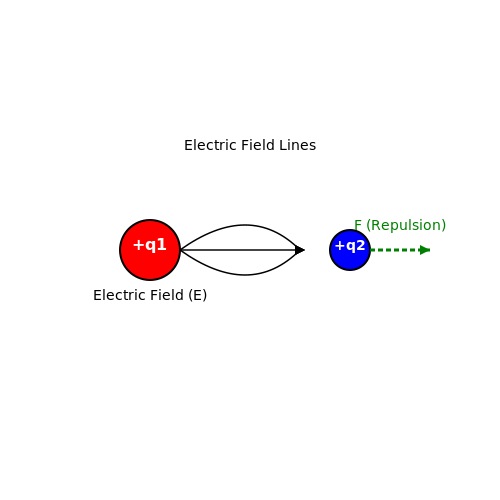
3.3 Field Lines and Their Significance
In the study of electrostatics, the visualization of electric fields through field lines plays a critical role in conveying complex interactions and behaviors surrounding electric charges. Field lines provide intuitive insight into the nature of electric fields, encapsulating both their direction and relative strength in an identifiable manner. The concept of electric field lines originates from the work of Michael Faraday, who utilized this representation to articulate complex electric phenomena in a straightforward manner. Each line denotes the path a positive test charge would follow if placed within the electric field, flowing away from positive charges and towards negative ones. This not only assists in visualizing fields but is also essential in calculating physical properties such as force and potential.Characteristics of Electric Field Lines
To fully appreciate the significance of electric field lines, we must understand their characteristics:- Direction: Field lines point away from positive charges and toward negative charges, indicating the direction a positive test charge would move within the field.
- Density: The density of these lines correlates with the strength of the electric field; closer lines signify a stronger field, while further apart lines indicate a weaker field.
- Non-intersection: Electric field lines never cross each other. If they did, it would imply that a charge located at the intersection could move in two directions simultaneously, which is unphysical.
- Start and End Points: Field lines begin on positive charges and terminate on negative charges, symbolizing the inherent directionality of electric fields.
Mathematical Representation of Electric Fields
The electric field $$\mathbf{E}$$ due to a point charge $$Q$$ can be mathematically represented using Coulomb's law. The electric field at a distance $$r$$ from the charge is given by:Applications and Practical Relevance
The application of electric field lines transcends theoretical discussions; they are fundamental in various fields ranging from electronic devices to high-voltage transmission lines. For instance, in the semiconductor industry, understanding field distributions improves device fabrication and reliability. Similarly, in high-voltage systems, field line analysis plays a critical role in insulator design and safety measures. Moreover, field lines are instrumental in simulations of electromagnetic fields in computational electromagnetism, allowing for the optimization of complex systems such as antennas and waveguides.Conclusion
In summation, field lines serve not only as a pedagogical tool but also as an essential element in the applied physics of electrostatics. Their inherent characteristics and implications drive advancements in technology by enhancing designs in electronics, optimizing performance, and ensuring safety across numerous applications. As we delve deeper into the physics of electromagnetism, the significance of these field lines continues to resonate in both theoretical explorations and practical implementations.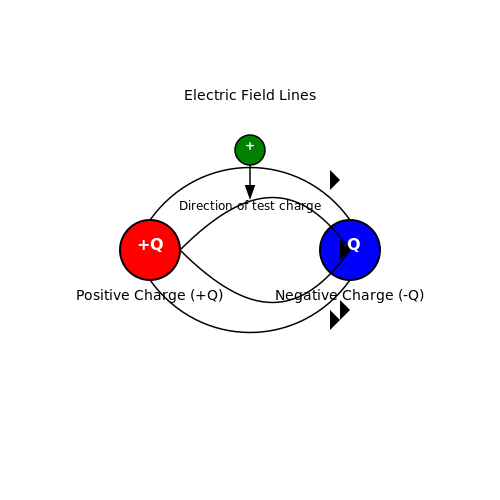
4. Relative Distances and Field Strength
4.1 Relative Distances and Field Strength
In the realm of electrostatics, the relationship between relative distances and field strength is a pivotal concept that forms the basis for understanding how electric forces act in various configurations. The essence of Coulomb's Law is that the electrostatic force between two point charges diminishes with increasing distance. Understanding this principle is not only fundamental to theoretical physics but also has practical implications in numerous engineering disciplines, including capacitor design, particle accelerators, and electrostatic discharge protection. Coulomb's Law states that the electrostatic force \( \vec{F} \) between two point charges \( q_1 \) and \( q_2 \), separated by a distance \( r \), is given by the equation: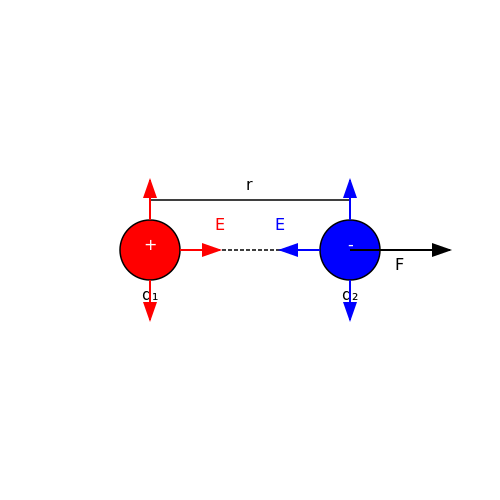
4.2 Medium Effects on Charge Interaction
The interaction between electric charges is governed by Coulomb's Law, which posits that the force between two point charges varies inversely with the square of the distance separating them and directly with the product of their magnitudes. However, this elegant model simplifies the complexities introduced by the presence of various media. Understanding how different materials influence charge interactions is essential for advanced applications in electrostatics, semiconductor design, and materials science.
Understanding the Role of the Medium
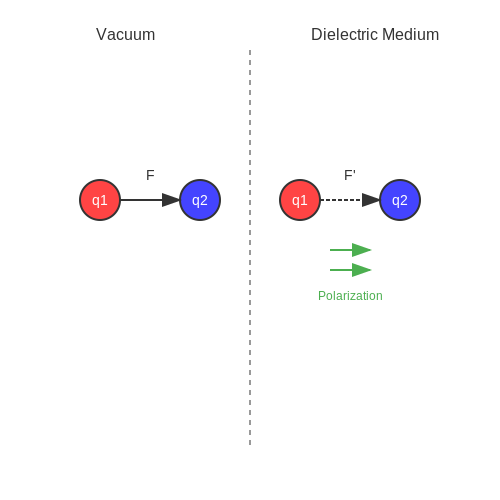
When charges are placed in a vacuum, they experience a force defined strictly by Coulomb’s Law. However, introducing a medium alters this interaction significantly. This occurs primarily due to two phenomena: polarization and the presence of dielectric materials.
Polarization refers to the distortion of the charge distribution within a neutral atom or molecule when it is subjected to an electric field. This distortion results in the formation of induced dipoles that can affect the net force between charges. The more polarizable a medium, the greater its effect on charge interactions.
Dielectrics are insulating materials that, when placed in an electric field, exhibit polarization. The effect of a dielectric medium can be quantitatively described by the relative permittivity (or dielectric constant, denoted as $$\epsilon_r$$). This property dictates how much the electric field is reduced inside the medium compared to the electric field in a vacuum ($$\epsilon_0$$).
Coulomb’s Law in a Medium
In a medium with a dielectric constant, Coulomb's Law is modified as follows:
Where:
- $$F$$ is the electrostatic force between charges,
- $$q_1$$ and $$q_2$$ are the magnitudes of the point charges,
- $$r$$ is the separation distance between the charges,
- and $$\epsilon = \epsilon_0 \epsilon_r$$ is the permittivity of the medium, with $$\epsilon_0$$ being the permittivity of free space.
This implies a reduction of the force compared to that in a vacuum, illustrating the effect of the medium on electrostatic interactions. Specifically, as $$\epsilon_r$$ increases, the force diminishes, demonstrating the critical influence of medium properties in practical scenarios.
Practical Applications
The impact of medium on charge interactions is not merely theoretical; it plays a crucial role in numerous engineering applications:
- Capacitors: Dielectric materials in capacitors increase charge storage capacity, directly influencing electronic device efficiency.
- Insulation: High dielectric materials provide insulation in high-voltage applications, preventing unwanted charge distribution.
- Electronics Manufacturing: Understanding dielectric properties is vital for semiconductor device fabrication, affecting performance and reliability.
In summary, while Coulomb's Law provides foundational insights into electrostatics, the introduction of media and their intrinsic properties complicates this picture but also enables advancements in technology where control of charge interactions is paramount.
4.3 Quantum Considerations
The classical understanding of Coulomb's Law adeptly explains the interactions between charged particles on a macroscopic scale. However, as we delve into the quantum realm, the simplistic view of point charges and continuous fields begins to break down, revealing a more complex underlying physics. In this section, we will explore how quantum mechanics modifies our understanding of electrostatic interactions, particularly through the lens of quantum field theory and the concept of virtual photons.
Quantum Field Theory and Electrostatics
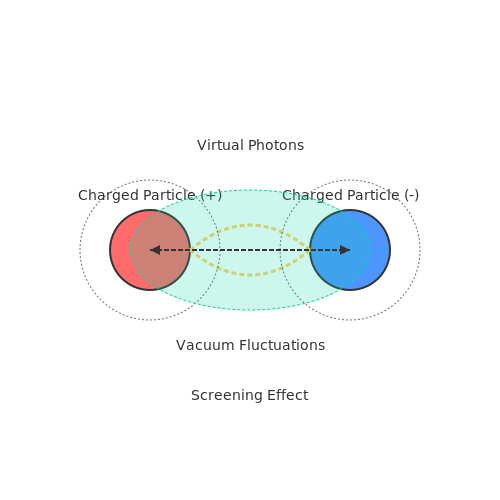
At its core, quantum field theory (QFT) posits that particles are excitations of underlying fields. For electrostatics, the relevant field is the electromagnetic field. According to QFT, the interaction between charged particles is mediated by the exchange of virtual photons. These virtual particles are not directly observable but exist in a probabilistic framework, allowing the forces between charges to be described more accurately than in classical terms.
This exchange of virtual photons leads to a deeper understanding of the Coulomb force. When two charged particles approach each other, they exchange virtual photons, which can be visualized as a "force-carrying" particle that embodies the interaction. The mathematics of quantum field theory expresses this interaction differently from the classical Coulomb's Law, incorporating the concept of renormalization, where infinities arising from point-like interactions are systematically managed to yield physical predictions.
The equation above represents the classical quantum mechanical view but, in QFT, the force includes additional corrections from vacuum fluctuations and the effects of the surrounding electromagnetic field. For practical applications, this leads to an understanding that, under certain conditions such as high-energy settings, the traditional view of Coulomb's Law begins to seamlessly merge with quantum mechanical principles.
Interaction Strength and Quantum Considerations
In quantum mechanics, the interaction strength between charged particles can also be altered by properties of the vacuum, including the presence of virtual particles and their contributions to the overall dynamics. This phenomenon is particularly evident in scenarios involving:
- Particle Creation/Annihilation: High-energy processes can create additional charged particle pairs, thereby altering the effective charge experienced by particles.
- Screening Effects: In materials or plasma, the presence of free charges can effectively 'screen' the Coulomb force, diminishing its strength over short distances.
- Quantum Corrections: QED (Quantum Electrodynamics) introduces corrections that modify interactions and allow for high-precision predictions of phenomena such as the anomalous magnetic moment of the electron.
These factors illustrate that the classical formulations of electrostatics are indeed approximations, becoming less accurate when quantum effects become pronounced, especially under extreme conditions. Understanding these quantum considerations is crucial for advanced applications in fields such as particle physics, condensed matter physics, and nanotechnology.
Practical Implications
Quantum considerations of electrostatics are not merely academic; they provide vital insights in several cutting-edge technologies, including:
- Quantum Computing: Understanding the effective interactions between qubits requires a solid grasp of electrostatic forces at the quantum level.
- Nano-electronics: As devices shrink to the nanoscale, quantum effects often dominate, necessitating a quantum treatment of charge interactions.
- High-Energy Physics Experiments: Experiments at particle colliders fundamentally rely on the principles of QFT to understand the results and interactions observed.
In summary, exploring Coulomb's Law through the prism of quantum mechanics reveals a richer tapestry of interactions, connecting the macroscopic laws of electrostatics with the underlying quantum realm that governs fundamental particles. As we continue evolving in our experimental and theoretical understanding, these insights will pave the way for innovations that leverage quantum principles in practical applications.
5. Coulomb's Law in Different Media
5.1 Coulomb's Law in Different Media
In electrostatics, Coulomb's Law governs the interaction between charged particles. This mathematical foundation, originally expressed in vacuum, undergoes significant variation when introduced to different media. Studying these adjustments is crucial for engineers and physicists, particularly in applications where charges operate within various dielectric or conductive environments. Coulomb's Law in a vacuum is defined as:Permittivity and Its Impact
The permittivity (\( \epsilon \)) of a medium is a measure of how much electric field is reduced relative to that in a vacuum. In a vacuum, the permittivity is denoted as \( \epsilon_0 \). In a dielectric medium, the permittivity is related to \( \epsilon_0 \) by the equation:Polarization in Dielectric Materials
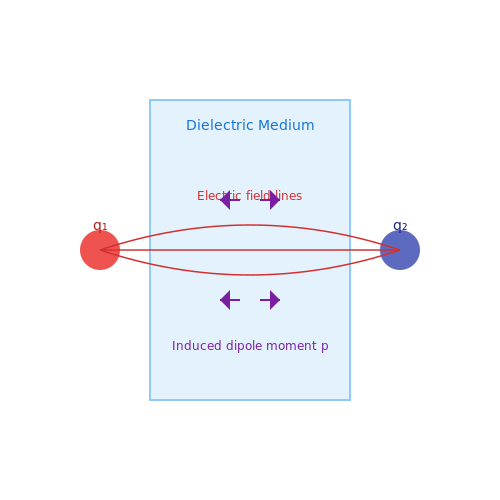
In dielectrics, the phenomenon of polarization occurs when an external electric field induces a slight displacement of bound charges. This results in a net dipole moment within the material, which contributes further to enhancing or attenuating the effective electric field within the medium. This can be understood quantitatively through the concept of dipole moment (\( \mathbf{p} \)):Applications and Device Implications
Understanding the modifications of Coulomb’s Law in different media has been pivotal in the design of a variety of electrostatic devices. For instance:- Capacitors: Their functionality relies heavily on the dielectric materials between their plates to achieve desired charge storage capabilities.
- Semiconductors: The behavior of charge carriers within different semiconductor materials is deeply influenced by the dielectric properties and polarization effects.
- Telecommunications: The efficiency of RF transmission through different media necessitates optimizing the use of materials with appropriate permissivity.
5.2 Comparison with Other Forces (e.g., Gravitational)
In the realm of physics, understanding the various forces that govern motion and interactions is essential. Among these forces, Coulomb's Law delineates electrical interactions between charged particles, while gravitational force describes the attraction between masses. By examining these two fundamental forces, we can draw enlightening comparisons that provide insight into their distinct characteristics and underlying principles.Fundamental Definitions
Coulomb's Law articulates the force (\(F\)) between two point charges (\(q_1\) and \(q_2\)) separated by a distance (\(r\)). This relationship can be mathematically expressed as:Dimensional Analysis
Both forces share a similar dependency on the inverse square of the distance. However, the units convey their differing physical nature. Coulomb's force is measured in Newtons (N), while gravitational force is also measured in Newtons (N), but represents mass interaction rather than charge interaction. When considering dimensionality, charge (\(C\) for coulombs) and mass (\(kg\) for kilograms) introduce significant differences in the magnitudes of forces experienced in practical scenarios. For instance, while electrical forces typically dominate at the atomic scale, gravitational forces are preeminent at macroscopic scales.Magnitude Comparisons
To accentuate the disparity between electrical and gravitational forces, consider a practical example of a proton and an electron, where: - \(q_p = +1.6 \times 10^{-19} \, C\) - \(q_e = -1.6 \times 10^{-19} \, C\) - \(r \approx 10^{-10} \, m\) (size of an atom). By applying Coulomb's Law, we can compute the attractive force between these two particles: $$ F = k \frac{|q_p q_e|}{r^2} \approx (8.99 \times 10^9) \frac{(1.6 \times 10^{-19})(1.6 \times 10^{-19})}{(10^{-10})^2} \approx 2.3 \times 10^{-10} \, N. $$ Conversely, applying Newton’s Law for the gravitational interaction yields: $$ F_g = G \frac{m_p m_e}{r^2} \approx (6.674 \times 10^{-11}) \frac{(1.67 \times 10^{-27})(9.11 \times 10^{-31})}{(10^{-10})^2} \approx 1.0 \times 10^{-46} \, N. $$ This stark comparison reveals that the electrical force between charged particles is significantly greater—by a factor of roughly \(10^{36}\)—than the gravitational force acting between them.Applications and Implications
The predominance of electrical forces over gravitational forces underpins many physical phenomena and technological advancements. For example, in the structure of atoms, it is the electric force that binds electrons to the nucleus, while gravity appears negligible. This has practical implications in fields such as semiconductor physics, where charge transport is fundamental to device operation. In astrophysical scale models, however, gravitational interactions take precedence as masses increase, dictating the cadence of planetary motion. The interplay between electrical and gravitational forces is crucial in the understanding of cosmic structures, as well as in the design of particle accelerators where both forces influence charged particles' trajectories.Conclusion
In summary, Coulomb's Law and gravitational force provide a compelling study in contrasts, revealing that while both follow an inverse-square law format, their magnitudes and effects are profoundly different depending on the context. Their respective influences shape our understanding of atomic interactions versus cosmic phenomena, emphasizing the diverse landscape of forces that govern the universe. Through careful examination, one can appreciate not only the mathematical underpinnings but also the real-world applications that stem from these fundamental concepts.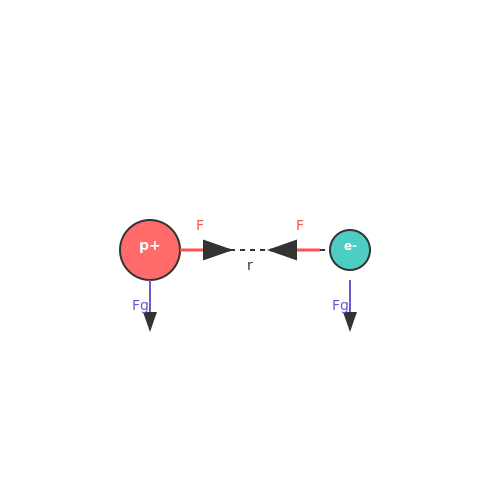
5.3 Application in Modern Technologies
Coulomb's Law, which describes the electrostatic force between charged particles, is not merely a theoretical construct; it is deeply intertwined with the fabric of modern technology. As we explore the applications of this fundamental principle, we see its implications across various domains—ranging from everyday devices to advanced scientific instruments.
Impact on Semiconductor Technology
Semiconductors, which are the backbone of modern electronics, rely heavily on the principles outlined in Coulomb's Law. The operation of diodes, transistors, and integrated circuits involves precise control of charge carriers (electrons and holes). Understanding the interactions dictated by Coulomb's Law allows engineers to design devices that can effectively manage the flow of these carriers, thereby optimizing performance in applications such as computers, smartphones, and LEDs.
Role in Capacitors and Energy Storage
Coulomb's Law is essential in understanding capacitors—devices that store electrical energy in an electric field. When two conductive plates are charged, the electrostatic force between the charges influences the distance they can separate before the repulsive or attractive forces impact performance. This understanding aids engineers in designing more efficient energy storage systems, such as those used in electric vehicles and renewable energy setups.
Application in Electric Field Mapping
Electrostatics principles, grounded in Coulomb's Law, are also applied in electric field mapping technologies. Understanding how electric fields behave around charged objects is crucial for applications in robotics, sensor technology, and telecommunications. Such mapping is vital for ensuring that devices operate within safe and efficient parameters, while also providing insight into potential interference or distortions that could affect performance.
Astrophysics and Plasma Physics
In more advanced fields like astrophysics and plasma physics, Coulomb's Law provides insight into interaction forces within stellar and subatomic phenomena. For instance, understanding the electrostatic forces in plasma can influence theories regarding star formation and the behavior of cosmic rays. Here, the balance of forces that include Coulomb forces becomes critical in simulations and models that predict the life cycles of stars and the dynamics of interstellar mediums.
Nanotechnology and Molecular Electronics
With the advent of nanotechnology, Coulomb's Law takes on a new dimension. At the nanoscale, the properties of materials can change significantly, and the electrostatic interactions between molecules can impact the behavior of nanoscale devices. This is particularly important in molecular electronics, where understanding and controlling these interactions is crucial for developing next-generation electronic components.
Conclusion
The applications of Coulomb's Law span a wide range of technologies that are crucial to our modern life. From the semiconductor industry to nanotechnology, the principles derived from electrostatics are foundational to ongoing innovations. As research progresses, the relevance of these principles will likely expand further, leading to even more sophisticated devices and systems.
6. Textbooks on Electrostatics
6.1 Textbooks on Electrostatics
- Electromagnetism and Electric Circuits by Cambridge University Press — This textbook delves into electrostatics with great depth, covering fundamental principles and advanced concepts suitable for graduate students and researchers.
- Electricity and Magnetism by Edward M. Purcell and David J. Morin — Offering a clear understanding of electrostatics, this book includes well-structured explanations and applications, essential for advanced-level readers.
- Engineering Electromagnetics by William H. Hayt and John A. Buck — A comprehensive guide including solved problems and clear definitions, this textbook is widely used for understanding electrostatic phenomena in practice.
- Foundations of Electromagnetic Theory by John R. Reitz, Frederick J. Milford, and Robert W. Christy — This book provides an in-depth theoretical approach to electrostatics and electromagnetic interactions, essential for research and academic study.
- Classical Electrodynamics by Walter Greiner — Covering both classical and contemporary approaches to electrostatics, this comprehensive text is ideal for physics students and professionals.
- Electrodynamics and Classical Theory of Fields and Particles by Barut Asim O. — This book provides insights into theoretical and classical perspectives, crucial for understanding the interaction of fields and charged particles.
- Introduction to Electrodynamics by David J. Griffiths — A popular choice among students and educators, offering clear explanations, practical examples, and numerous exercises on electrostatic principles.
- Review of ‘Introduction to Electrodynamics’ by David J. Griffiths — An insightful review of Griffiths' influential textbook, providing an overview of its strengths and coverage on electrostatics.
- Physics for the Naive Optimist by David A. B. Miller — Though broader in scope, this book includes a significant section on electrostatics, blending theory with practical applications.
- Advanced Electromagnetics in Wolfram Language — A sophisticated computational approach to exploring electrostatic equations and scenarios using Wolfram Language.
6.2 Research Articles
- Physical Review Letters - Recent Advances in Coulomb's Law — This article explores the cutting-edge developments in the understanding of Coulomb's Law, highlighting its application in modern electrostatics and quantum electrodynamics.
- IOP Science - Electrostatic Force in Complex Systems — A comprehensive study examining the role of Coulombic interactions in complex systems such as colloids and bio-molecules, providing new insights into electrostatic behavior.
- Springer - Modifications of Coulomb's Law at Nanoscale — This research explores the modifications to Coulomb's Law applicable to nanoscale interactions and their implications in nanotechnology and material science.
- Nature Physics - Quantum Corrections to Coulomb's Law — This Nature article discusses the quantum corrections to classical Coulombic interactions, providing a bridge between electrostatics and quantum mechanics.
- ACS Photonics - Coulomb Interactions in Photonic Crystals — Discusses how Coulomb interactions influence the behavior of photonic crystals, offering novel perspectives on their applications in advanced optical devices.
- ScienceDirect - Coulombic Forces in Two-Dimensional Materials — Examines the impact of Coulombic forces in two-dimensional materials such as graphene, proposing potential avenues for future electronic applications.
- Oxford Academic - Anomalous Coulomb's Law Effects in Biological Systems — Investigates peculiar variations of Coulomb's Law observed in biological systems, shedding light on their biological and chemical implications.
6.3 Online Resources
- Electromagnetic Theory by Richard Fitzpatrick — This resource from the University of Texas covers an array of topics in electromagnetic theory, including Coulomb's Law. It provides mathematical insights and advanced explanations suitable for graduate-level study.
- MIT OpenCourseWare: Electromagnetism Lectures — A series of lecture notes from MIT that delve deeply into electromagnetism. Coulomb's Law is expertly discussed in the context of electric fields and electrostatic interactions.
- Electric Force: HyperPhysics — HyperPhysics offers a clear explanation of Coulomb's Law with interactive diagrams to visualize electric forces and their real-world implications.
- Physics Classroom: Coulomb's Law — This resource breaks down the fundamentals of Coulomb's Law with an advanced discussion on vector addition and force interactions in complex charge systems.
- Khan Academy: Coulomb's Law — Khan Academy provides an advanced tutorial on the principles of Coulomb's Law, including quantitative problem-solving approaches that are beneficial for engineers and physicists.
- Coulomb's Law - IIT JEE Preparation — Targeted for competitive exam preparations, this article presents advanced problems involving Coulomb's Law with comprehensive solutions, enhancing your problem-solving skills.
- Classical Electrodynamics: T. Hansson — A downloadable textbook that offers an in-depth theoretical framework for classical electrodynamics, including Coulomb's Law and its pivotable role in electromagnetic field theory.