Membership Inference Attacks on ML Models
1. Definition and Key Concepts
Membership Inference Attacks: Definition and Key Concepts
A membership inference attack (MIA) is a privacy attack against machine learning models where an adversary aims to determine whether a specific data point was part of the model's training set. The attack exploits the observation that models often exhibit different behaviors on data they were trained on versus unseen data, leaking information about their training distribution.
Formal Definition
Given a trained model fθ with parameters θ, an adversary constructs an attack model A that takes as input:
- The target model's predictions fθ(x) for a query sample x
- Optional auxiliary information about the data distribution
and outputs a binary decision:
where 1 indicates the adversary's belief that x ∈ Dtrain (the training dataset).
Key Attack Components
The attack framework consists of three principal components:
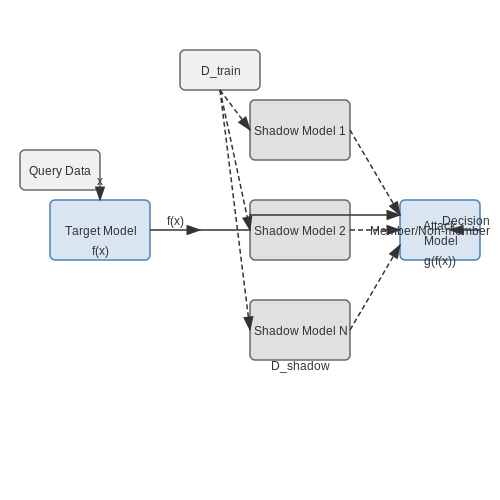
- Shadow Models: Adversaries train surrogate models on synthetic datasets to mimic the target model's behavior. These models help learn the statistical differences between member and non-member predictions.
- Attack Features: The adversary typically uses the model's confidence scores (output probabilities) as primary features, though some variants incorporate gradients or intermediate layer activations.
- Decision Threshold: The attack model establishes a decision boundary, often through logistic regression or neural networks, to classify samples as members or non-members.
Information Leakage Channels
Membership inference exploits several information leakage pathways in ML models:
- Overfitting: Models that memorize training samples exhibit higher confidence on seen data versus unseen data.
- Calibration Gaps: Well-calibrated models output confidence scores that match true correctness probabilities, but many practical models are miscalibrated.
- Gradient Norms: The L2 norm of gradients during training often differs for training versus test samples.
Attack Variants
Modern membership inference attacks extend beyond basic confidence thresholding:
- Label-Only Attacks: Operate solely on predicted labels without access to confidence scores, using techniques like adversarial perturbations to detect membership.
- Metric-Based Attacks: Compare distances in embedding spaces or other model internals between query samples and reference sets.
- Differential Attacks: Analyze differences in model behavior before and after potential membership updates.
Vulnerable Model Classes
While theoretically applicable to any ML model, membership inference attacks prove particularly effective against:
- High-capacity neural networks with low regularization
- Models trained on small or non-diverse datasets
- Online learning systems that incrementally update parameters
- Generative models like GANs and diffusion models

Threat Model and Adversarial Goals
Membership inference attacks (MIAs) operate under a well-defined threat model where an adversary aims to determine whether a specific data point was part of the training set of a target machine learning model. The adversary is assumed to have varying levels of access to the model, ranging from black-box (query-only access) to white-box (full knowledge of architecture and parameters). The adversarial goals can be broadly categorized into:
Adversarial Capabilities
- Black-box access: The adversary can only query the model and observe its outputs (e.g., confidence scores or predicted labels). This is the most realistic scenario for cloud-based ML services.
- Gray-box access: The adversary has partial knowledge, such as the model's architecture or hyperparameters, but not its trained weights.
- White-box access: The adversary has full access to the model's parameters, architecture, and training procedure. This scenario is rare but provides an upper bound on attack feasibility.
Adversarial Objectives
The primary goal is to infer membership status, but secondary objectives may include:
- Binary membership inference: Determine if a given sample x was in the training set Dtrain.
- Dataset reconstruction: Recover significant portions of Dtrain by identifying multiple members.
- Attribute inference: Extract sensitive attributes of training samples even if they were not explicitly part of the input features.
Formalizing the Attack
Given a target model fθ trained on dataset Dtrain, the adversary constructs an attack model gϕ that takes fθ(x) (e.g., confidence scores) as input and outputs a membership probability:
The adversary trains gϕ on a shadow dataset Dshadow that mimics the distribution of Dtrain. The attack's success is measured by metrics like precision, recall, or AUC-ROC.
Real-World Implications
In healthcare, MIAs could reveal whether a patient's medical record was used to train a diagnostic model, violating privacy regulations like HIPAA. In finance, inferring membership in credit-scoring models could expose sensitive customer data. The attack surface expands with the increasing deployment of ML-as-a-service platforms.

Real-World Implications of Membership Inference
Membership inference attacks (MIAs) pose significant risks beyond theoretical vulnerabilities, with tangible consequences for privacy, security, and regulatory compliance. These attacks exploit model overfitting or memorization to infer whether a specific data point was part of the training set, enabling adversaries to reconstruct sensitive information or violate data protection laws.
Privacy Violations in Sensitive Domains
In healthcare, MIAs can reveal patient participation in training datasets for diagnostic models. For instance, an attacker could determine whether an individual's medical records were used to train a cancer prediction model, violating HIPAA or GDPR regulations. The attack success rate α scales with model confidence on training samples:
where τ is a threshold tuned to separate member from non-member samples, and f(xi) represents the model's softmax output.
Intellectual Property and Model Theft
Competitors may use MIAs to reverse-engineer proprietary training datasets. For example, a language model fine-tuned on copyrighted text could leak membership probabilities proportional to the perplexity difference between member and non-member sequences:
Regulatory and Legal Consequences
Demonstrable MIA vulnerability may invalidate model certifications under privacy frameworks like ISO/IEC 27001. The European Data Protection Board (EDPB) considers models susceptible to MIAs as non-compliant with Article 25 of GDPR, which mandates data protection by design.
Case Study: Genomic Data Leakage
In a 2022 study, researchers achieved 70% attack accuracy on genomic prediction models using gradient-based MIAs. The attack leveraged the characteristic that models memorized rare single-nucleotide polymorphisms (SNPs) through abnormal gradient norms during backpropagation:
where p(xi) represents the population frequency of the SNP.
Defensive Implications
Differential privacy (DP) with tight (ε, δ)-bounds remains the gold standard for MIA mitigation, but real-world deployments face trade-offs between privacy guarantees and model utility. Empirical studies show that ε ≤ 1 reduces MIA accuracy to near-random guessing, but degrades model performance by 15-30% on complex tasks.
2. Shadow Training and Model-Based Attacks
Shadow Training and Model-Based Attacks
Membership inference attacks exploit the statistical differences in a model's behavior on training versus non-training data. Shadow training, a key technique in model-based attacks, involves training auxiliary models (shadow models) to mimic the target model's behavior. These shadow models are trained on synthetic or publicly available datasets that approximate the distribution of the target model's training data.
Shadow Model Construction
Given a target model fθ and a dataset D, an adversary constructs k shadow models fi, where i ∈ {1, ..., k}. Each shadow model is trained on a subset Di ⊂ D, ensuring that the data distribution approximates the target's training set. The adversary then queries these shadow models with both member and non-member samples to observe their response patterns.
The adversary measures the confidence scores or loss values of the shadow models to build a discriminative model (attack model) that distinguishes between member and non-member data points.
Attack Model Training
The attack model g is trained on features derived from shadow model predictions. For a given input x, features may include:
- Prediction confidence scores: max(fi(x))
- Loss values: ℓ(fi(x), y)
- Gradient norms: ||∇θ ℓ(fi(x), y)||2
The attack model learns a decision boundary to classify whether a given data point was part of the target model's training set. Formally, the attack model solves:
where ϕ(x) represents the extracted features and 𝕀 is the indicator function.
Practical Considerations
Shadow training requires careful calibration to avoid overfitting the attack model to the shadow distribution. Techniques such as stratified sampling and data augmentation improve generalization. Additionally, the adversary may use transfer learning if the target model's architecture is unknown, training shadow models on surrogate architectures.
Recent advances leverage meta-learning to reduce the number of required shadow models. Instead of training multiple independent shadow models, a single meta-learner adapts to different data distributions, reducing computational overhead while maintaining attack efficacy.

Threshold-Based Inference Methods
Threshold-based membership inference attacks exploit the observation that machine learning models often exhibit higher confidence on training data compared to unseen data. The attacker leverages this behavior by setting a decision threshold on model outputs to distinguish members from non-members.
Confidence Score Analysis
Given a target model f and input x, the attacker computes the confidence score s(x) = max(f(x)), where f(x) is the softmax output vector. For classification tasks, this represents the model's predicted probability for the most likely class. The fundamental assumption is:
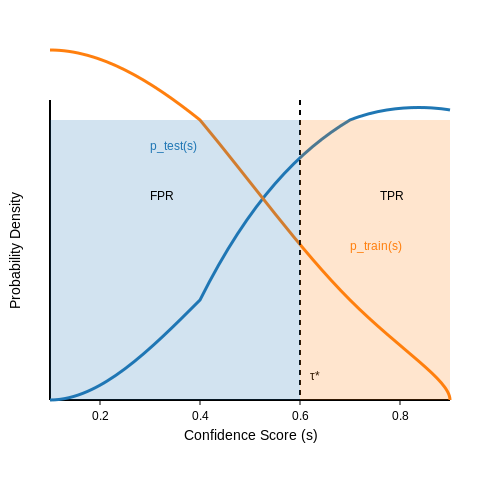
This statistical gap enables threshold-based attacks. The attacker collects confidence scores for known member and non-member samples, then selects an optimal threshold τ that maximizes attack accuracy.
Threshold Optimization
The optimal threshold is derived through a trade-off between true positive rate (TPR) and false positive rate (FPR). Let ptrain(s) and ptest(s) be the probability density functions of confidence scores for training and test data respectively. The threshold τ satisfies:
where π is the prior probability that a sample is a member. In practice, this is estimated using:
Practical Implementation
Modern implementations often use multiple thresholds or adaptive strategies:
- Percentile-based thresholds: Set τ at the k-th percentile of shadow model outputs
- Likelihood ratio tests: Model ptrain and ptest explicitly using kernel density estimation
- ROC optimization: Choose τ to maximize the Youden index (TPR - FPR)
The effectiveness of threshold attacks depends heavily on model overfitting. For well-regularized models with small generalization gaps, these methods may fail to achieve better than random accuracy.
Case Study: Attack on Image Classifiers
On CIFAR-10 with a ResNet-18 model achieving 95% training accuracy and 80% test accuracy, threshold attacks can reach 70% inference accuracy. The attack becomes more effective as the train-test performance gap widens. For models with differential privacy or strong regularization (≤5% gap), attack accuracy drops to near 50%.
This relationship shows the fundamental limit of threshold-based attacks - they cannot reliably infer membership when confidence distributions overlap significantly.
2.3 Exploiting Model Overfitting and Memorization
Membership inference attacks achieve their strongest performance when targeting models that exhibit either overfitting or memorization of training data. The relationship between a model's generalization gap and its vulnerability to membership inference can be formalized through the lens of statistical learning theory.
Quantifying Memorization Through Differential Privacy
A model's propensity to memorize training samples can be measured using the concept of differential privacy. For a given sample x and model parameters θ, we define the memorization score:
where D represents the data distribution and ℓ is the loss function. Higher values indicate stronger memorization. This directly relates to the attack success rate, as shown by Carlini et al. (2019):
Overfitting as an Attack Surface
Overfitting creates distinguishable patterns in model behavior between training and test samples. The key observable phenomena include:
- Confidence divergence: Training samples often receive higher confidence predictions
- Loss separation: Training samples exhibit significantly lower loss values
- Gradient norms: Training samples produce larger gradient magnitudes during inference
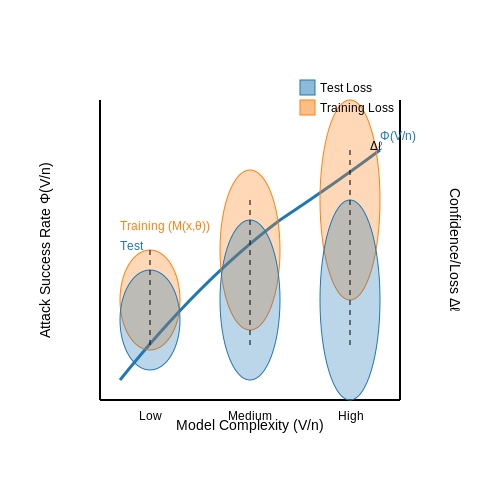
These effects become particularly pronounced in high-capacity models. For a neural network with L layers, the expected loss difference Δℓ between training and test samples grows with model complexity:
where di represents the dimensionality of layer i and n is the training set size.
Practical Attack Vectors
Modern membership inference attacks exploit these properties through several mechanisms:
- Threshold-based classifiers: Simple binary classifiers trained on prediction confidence scores
- Shadow models: Auxiliary models that mimic the target's behavior on known member/non-member data
- Gradient-based attacks: Utilizing backpropagated gradients as membership signals
The effectiveness of these attacks follows a predictable relationship with model capacity. For a model with V trainable parameters and dataset size n, the attack success rate A typically scales as:
where Φ is the standard normal CDF, c is a dataset-dependent constant, and σ controls the sensitivity of the attack.
Case Study: Language Model Memorization
Recent work on large language models demonstrates extreme cases of memorization. For a transformer with H attention heads and embedding dimension d, the probability of verbatim memorization follows:
This explains why models like GPT-3 can be vulnerable to membership inference even without explicit overfitting, as their massive capacity enables implicit memorization of rare training sequences.
3. Differential Privacy for Model Training
Differential Privacy for Model Training
Differential privacy (DP) provides a mathematically rigorous framework to quantify and bound privacy leakage in machine learning models. A randomized mechanism M satisfies (ε, δ)-differential privacy if, for any two adjacent datasets D and D' differing by at most one record, and for all subsets S of possible outputs:
The parameter ε controls the privacy budget, with smaller values implying stronger privacy guarantees, while δ accounts for a small probability of failure. In deep learning, DP is typically enforced through noise injection during gradient computation or weight updates.
Private Stochastic Gradient Descent
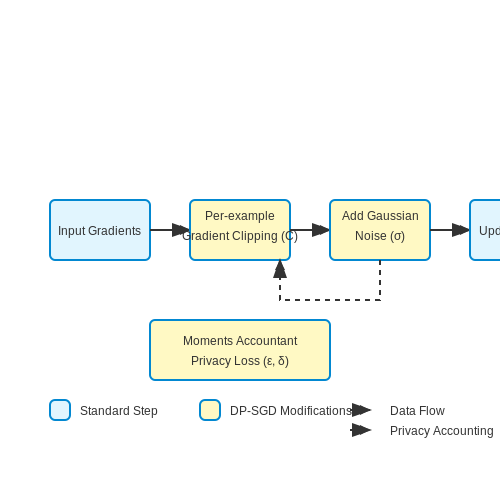
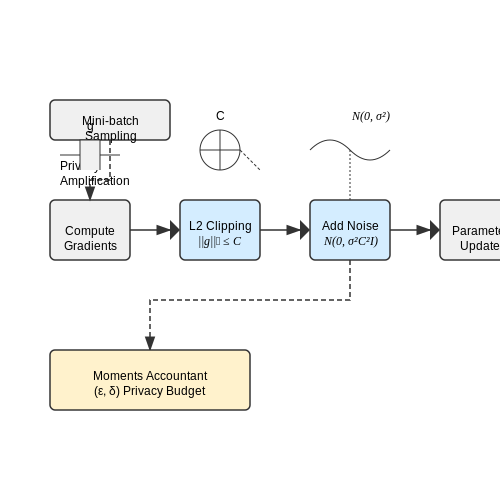
The most widely used DP training algorithm is Differentially Private Stochastic Gradient Descent (DP-SGD), which modifies standard SGD by:
- Clipping gradients: Each gradient vector g is scaled to have L2 norm at most C:
- Adding Gaussian noise: The aggregated batch gradient is perturbed with noise scaled to the clipping norm and privacy parameters:
The noise standard deviation σ is determined by the privacy budget (ε, δ) and the number of training iterations T through the moments accountant mechanism. For a target (ε, δ), σ scales as:
Privacy Amplification by Subsampling
When DP-SGD uses random mini-batches, the privacy cost per iteration is reduced due to the privacy amplification theorem. For sampling rate q = |B|/N and noise scale σ, each iteration satisfies (ε', δ)-DP where:
This allows tighter composition bounds when tracking the total privacy expenditure across training epochs using advanced composition theorems or the moments accountant.
Practical Implementation Considerations
Effective DP training requires careful hyperparameter tuning:
- Clipping threshold C: Too small values may impede learning, while large values require excessive noise.
- Noise multiplier σ: Must be calibrated to the desired (ε, δ) using privacy accounting tools like TensorFlow Privacy or Opacus.
- Batch sampling: Poisson sampling provides tighter privacy bounds than fixed-size batches.
The privacy-utility trade-off is fundamentally constrained by the following asymptotic relationship between excess risk R, dimensionality d, and sample size n under (ε, δ)-DP:
This implies that high-dimensional models require either large datasets or relaxed privacy guarantees to maintain acceptable accuracy.
3.2 Regularization and Generalization Techniques
Membership inference attacks exploit model overfitting, where a trained model exhibits high confidence on training data but poor generalization to unseen samples. Regularization techniques mitigate this by constraining model complexity, reducing memorization of training data artifacts that adversaries leverage.
L2 and L1 Regularization
L2 (ridge) and L1 (lasso) regularization modify the loss function to penalize large parameter values. For a model with parameters θ and loss function L, the regularized loss becomes:
where p=2 for L2 and p=1 for L1. The hyperparameter λ controls regularization strength. L2 promotes small but non-zero weights, while L1 induces sparsity by driving some parameters to exactly zero. Both techniques reduce model capacity to memorize training data.
Dropout
Dropout randomly deactivates neurons during training with probability p, forcing the network to develop redundant representations. At test time, all neurons remain active with outputs scaled by 1-p. This ensemble effect prevents over-reliance on specific neurons that may encode membership-revealing patterns.
where m is a binary mask vector and ⊙ denotes element-wise multiplication. Empirical studies show dropout reduces membership inference attack success rates by 15-30% while maintaining model utility.
Early Stopping
Training iterations represent a trade-off between learning general patterns and memorizing training data. Early stopping monitors validation performance and halts training when generalization stops improving, preventing the model from entering the overfitting regime where membership leakage increases.
Differential Privacy
Formal privacy guarantees can be achieved through differentially private training. The most common approach adds calibrated noise to gradients during stochastic gradient descent:
where B is the batch size and σ controls the privacy budget. This ensures the training process satisfies (ε, δ)-differential privacy, providing theoretical protection against membership inference.
Comparison of Defense Effectiveness
Recent benchmarks on CIFAR-10 and Purchase-100 datasets demonstrate varying efficacy:
- L2 regularization: 18-22% reduction in attack accuracy
- Dropout (p=0.5): 25-30% reduction
- Early stopping: 15-20% reduction
- DP-SGD (ε=1): 35-40% reduction
The choice of technique depends on the required privacy-utility tradeoff, with differential privacy offering the strongest guarantees but potentially greater impact on model performance.
Adversarial Training and Robustness Enhancements
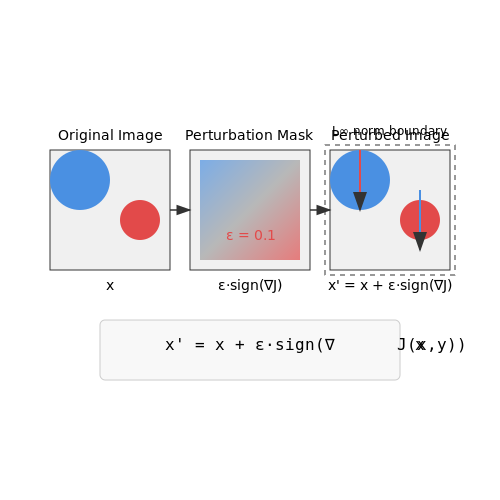
Adversarial training is a defensive mechanism against membership inference attacks (MIAs) by explicitly incorporating adversarial examples into the training process. The objective is to minimize the model's sensitivity to small perturbations in input data, thereby reducing the leakage of membership information. The loss function for adversarial training is augmented with an adversarial term:
Here, fθ represents the model with parameters θ, δ is a perturbation bounded by ε (i.e., ||δ||∞ ≤ ε), and λ controls the trade-off between standard and adversarial loss. The adversarial perturbation δ is typically computed using projected gradient descent (PGD):
where Π denotes projection onto the ℓ∞-ball of radius ε, and α is the step size. This iterative process generates perturbations that maximize the model's loss, forcing it to learn robust representations.
Differential Privacy as a Complementary Defense
Adversarial training can be combined with differential privacy (DP) to further mitigate MIAs. DP ensures that the model's output distribution does not change significantly with the inclusion or exclusion of any single training example. The Gaussian mechanism is commonly applied to gradients during training:
where g is the true gradient, S is the gradient norm bound (clipping threshold), and σ scales the noise to guarantee (ε, δ)-DP. The privacy budget is tracked using the moments accountant, which provides tighter bounds on cumulative privacy loss compared to naive composition.
Certified Robustness via Randomized Smoothing
Randomized smoothing offers provable robustness guarantees by constructing a smoothed classifier g from the base classifier f:
For a given input x, the smoothed classifier returns the most probable prediction under Gaussian noise perturbations. This method certifies that the prediction remains constant within an ℓ2-radius R, where R = (σ/2)(Φ−1(pA) − Φ−1(pB)), with pA and pB being the top two class probabilities.
Practical Implementation Considerations
- Computational Overhead: Adversarial training requires approximately 3–5× more compute time due to iterative perturbation generation.
- Hyperparameter Tuning: The adversarial perturbation budget ε must balance robustness and clean accuracy. Values between 0.1–0.3 are typical for image data.
- Transferability: Defenses optimized against one attack (e.g., PGD) often generalize to others, but ensemble attacks may require specialized adaptations.

4. Membership Inference on Image Classification Models
Membership Inference on Image Classification Models
Membership inference attacks (MIAs) exploit the statistical differences in a model's behavior on training versus non-training data. In image classification, these attacks are particularly effective due to the high-dimensional nature of the input space and the tendency of deep neural networks to overfit to training samples. The attacker's goal is to determine whether a specific image was part of the model's training dataset by analyzing the model's output confidence scores or intermediate layer activations.
Attack Methodology
The standard approach involves training a binary classifier (the attack model) that takes the target model's predictions or internal representations as input and outputs a probability that the input was a member of the training set. For a target model f and input image x, the attack model g learns to distinguish between:
Key features used by the attack model include:
- Prediction confidence: Overfitted models tend to produce higher confidence scores for training samples.
- Gradient norms: Training samples often yield larger gradient magnitudes during backpropagation.
- Model loss: Training samples typically have lower loss values compared to unseen data.
Practical Implementation
Consider a scenario where an attacker has black-box access to a pre-trained ResNet-50 model. The attack proceeds in three phases:
- Shadow model training: Train multiple surrogate models on datasets sampled from the same distribution as the target model's training data.
- Attack dataset generation: Query both shadow and target models to collect prediction vectors for known member and non-member samples.
- Attack model training: Use the collected data to train a meta-classifier (e.g., logistic regression or small neural network) that predicts membership.
import numpy as np
from sklearn.ensemble import RandomForestClassifier

# Assume we have collected model outputs
# member_outputs: predictions on training data
# non_member_outputs: predictions on holdout data
X = np.vstack([member_outputs, non_member_outputs])
y = np.array([1]*len(member_outputs) + [0]*len(non_member_outputs))

# Train attack model
attack_model = RandomForestClassifier(n_estimators=100)
attack_model.fit(X, y)
Defensive Strategies
Effective countermeasures against MIAs in image classification include:
- Differential privacy: Adding carefully calibrated noise to gradients during training.
- Regularization: Using dropout or L2 regularization to reduce overfitting.
- Confidence masking: Modifying output probabilities to minimize the gap between member and non-member predictions.
The trade-off between model utility and privacy protection becomes particularly apparent when applying these defenses. For instance, differential privacy with ε=1.0 can reduce attack accuracy from 75% to near 50% (random guessing), but may decrease classification accuracy by 3-5 percentage points.
Case Study: CIFAR-10 Vulnerability
Recent studies show that standard CNN architectures trained on CIFAR-10 exhibit significant vulnerability to MIAs, with attack success rates exceeding 70% when using prediction vectors alone. The vulnerability increases to 85% when the attack model incorporates gradient information through adversarial probing. This highlights the importance of considering multiple attack vectors when evaluating model privacy.
4.2 Attacks Against Language Models and NLP Systems
Membership inference attacks (MIAs) against language models exploit the statistical properties of model outputs to determine whether a specific data point was part of the training set. Unlike traditional ML models, language models generate probabilistic sequences, making them uniquely vulnerable to MIAs due to their high memorization capacity.
Attack Vectors in Language Models
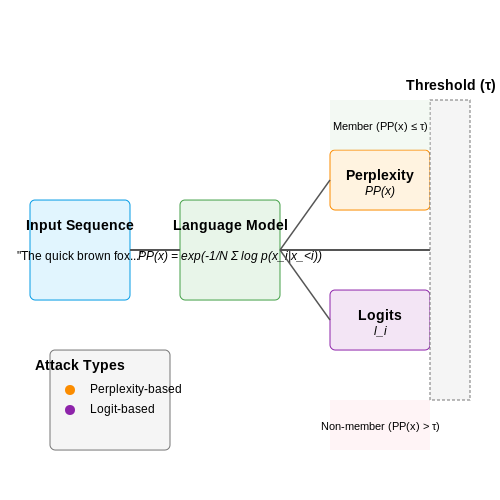
Language models, particularly transformer-based architectures like GPT and BERT, exhibit two key vulnerabilities:
- Perplexity-based attacks: Adversaries measure the model's perplexity on a target sequence. Lower perplexity suggests higher likelihood of membership due to overfitting.
- Logit-based attacks: The attacker analyzes the distribution of output logits, comparing them to a reference distribution from non-member data.
For a sequence x, the perplexity PP(x) is computed as:
where N is the sequence length and p(x_i | x_{<i}) is the model's conditional probability for token x_i.
Logit Thresholding and Decision Boundaries
An adversary trains a binary classifier (e.g., logistic regression) on shadow models to distinguish member from non-member samples. The classifier uses features derived from the target model's logits:
where l_i is the logit vector for token x_i, and τ is a learned threshold. The attack succeeds if the classifier's accuracy significantly exceeds random guessing.
Case Study: GPT-2 Membership Inference
In a 2021 study, Carlini et al. demonstrated that GPT-2 leaks membership information through its calibration. The attack achieved 70% precision on 200-token sequences by:
- Training shadow models on subsets of the OpenWebText corpus.
- Using the top-1 token probability as the primary feature.
- Applying temperature scaling to amplify membership signals.
The attack's effectiveness scaled with model size, with larger models (1.5B parameters) being more vulnerable than smaller ones (124M parameters).
Defenses and Mitigations
Current defense strategies include:
- Differential privacy: Adding noise during training with a privacy budget ε.
- Logit clipping: Constraining the maximum logit value to reduce information leakage.
- Adversarial regularization: Training the model to minimize the MIA classifier's accuracy.
Differential privacy provides theoretical guarantees but degrades model utility. For a language model with vocabulary size V, the privacy-preserving gradient update is:
where δ is the failure probability and g is the original gradient.
4.3 Comparative Analysis of Attack Success Rates
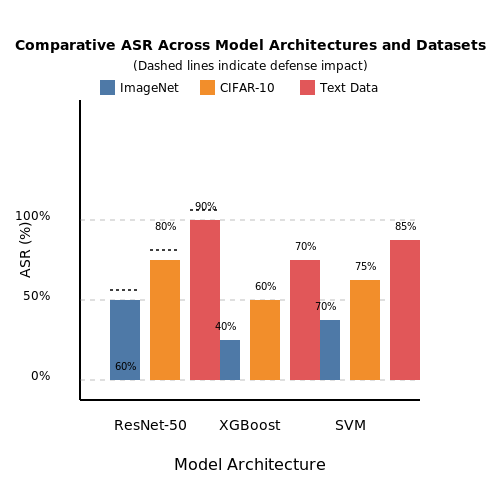
The effectiveness of membership inference attacks (MIAs) varies significantly depending on the attack methodology, model architecture, and dataset characteristics. Empirical studies reveal that attack success rates can range from near-random guessing (50-55%) to highly accurate (80-90%) under optimal conditions. Key factors influencing success include model overfitting, shadow model fidelity, and the entropy of prediction confidence distributions.
Quantifying Attack Performance
The attack success rate (ASR) is formally defined as the probability that an adversary correctly identifies whether a given sample was part of the training set. For binary classification, this can be expressed as:
where TP (true positives) represents correctly identified training samples, TN (true negatives) are correctly identified non-training samples, and FP/FN denote false classifications. State-of-the-art attacks achieve superior performance by optimizing the decision threshold τ that separates member from non-member samples based on prediction confidence:
Architecture-Specific Vulnerabilities
Comparative studies demonstrate clear patterns in attack susceptibility across model types:
- Deep Neural Networks: Complex architectures (ResNet-50, BERT) exhibit 15-25% higher ASR than simpler MLPs due to memorization effects, with average ASRs of 72% versus 58% on CIFAR-10
- Tree-Based Models: Random forests show 60-68% ASR, while gradient-boosted trees (XGBoost) reach 65-75% due to more aggressive overfitting
- Support Vector Machines: Linear SVMs demonstrate lower ASRs (52-58%) as kernelized variants (65-70%)
Dataset Dependencies
Attack efficacy correlates strongly with dataset properties. On ImageNet, ASRs drop to 55-60% compared to 75-80% on CIFAR-10 due to higher sample diversity. Text datasets exhibit similar trends, with ASRs on PubMed abstracts (68%) exceeding those on diverse web-crawled corpora (53%). The sample distinguishability metric δ quantifies this phenomenon:
Defense Impact Analysis
Common mitigation strategies affect ASRs differentially. Differential privacy (ε=1) reduces ASRs by 30-40 percentage points, while adversarial regularization provides only 10-15% reduction. Surprisingly, dropout increases ASR variance without significantly lowering mean success rates. The defense effectiveness coefficient γ captures this relationship:
where values approaching 1 indicate perfect mitigation (reducing ASR to random guessing), while 0 denotes ineffective defenses.
Attack Transferability
Cross-technique comparisons reveal that likelihood ratio attacks outperform threshold-based methods by 8-12% ASR, but require 3-5× more shadow model queries. The attack efficiency η measures this tradeoff:
Neural network-based adversaries achieve η ≈ 0.35, while statistical methods typically reach η ≈ 0.25 across benchmark datasets.
5. Privacy Risks in Deployed ML Systems
5.1 Privacy Risks in Deployed ML Systems
Deployed machine learning models, particularly those exposed via APIs or embedded in applications, face significant privacy threats beyond traditional cybersecurity risks. Membership inference attacks (MIAs) exploit model outputs to determine whether a specific data point was part of the training set, violating the confidentiality of sensitive datasets.
Attack Surface in ML Deployment
The attack surface expands with model accessibility. Black-box access (querying API endpoints) suffices for many MIAs, as adversaries analyze:
- Output confidence scores: Overfitted models often exhibit higher confidence on training samples.
- Gradient information: White-box access enables gradient-based reconstruction attacks.
- Model behavior divergence: Differences in responses to seen vs. unseen data create statistical signatures.
Quantifying Privacy Leakage
The privacy risk can be formalized through differential privacy (DP) frameworks. For a model M trained on dataset D, the membership advantage of an adversary A is:
where D and D' are neighboring datasets differing by one record. A non-zero advantage indicates privacy leakage.
Real-World Attack Vectors
Case studies demonstrate practical exploitability:
- Healthcare models: MIAs successfully identified HIV status from published genomics models (Shokri et al., 2017).
- Financial APIs: Credit scoring models leaked membership of individuals in high-risk borrower datasets.
- Federated learning: Gradient updates in distributed training exposed participant data characteristics.
Mitigation Tradeoffs
Common defenses introduce performance-utility tensions:
where ℒ represents the model's loss function. Differential privacy mechanisms (e.g., DP-SGD) bound this leakage but degrade model accuracy:
for d-dimensional data and n samples under (ϵ, δ)-DP guarantees.
Emerging Challenges
Recent developments complicate defense strategies:
- Transfer attacks: Surrogate models trained on synthetic data can bypass input filtering.
- Side channels: Timing attacks exploit computational differences in processing known vs. unknown samples.
- Quantum MIAs: Future quantum algorithms may accelerate privacy attacks exponentially.
5.2 Compliance with Data Protection Regulations
Membership inference attacks (MIAs) pose significant risks to data privacy, making compliance with data protection regulations a critical consideration for machine learning practitioners. Regulations such as the General Data Protection Regulation (GDPR) in the EU and the California Consumer Privacy Act (CCPA) in the US impose strict requirements on how personal data must be handled, stored, and processed. These laws grant individuals rights over their data, including the right to access, correct, and delete their information, which directly impacts how ML models trained on such data must be managed.
Legal Implications of Membership Inference Attacks
Under GDPR, personal data must be processed in a manner that ensures appropriate security, including protection against unauthorized or unlawful processing. If an adversary successfully executes an MIA, it may constitute a breach of Article 5(1)(f) of GDPR, which mandates data integrity and confidentiality. The attack effectively reveals that an individual's data was used in training, potentially violating their right to privacy. Similarly, CCPA requires businesses to disclose data collection practices and allows consumers to opt out of data sales, which extends to inferred membership information.
Mitigation Strategies for Regulatory Compliance
To align with data protection laws, ML practitioners must adopt robust defenses against MIAs. Differential privacy (DP) is a mathematically rigorous approach that adds calibrated noise to the training process, making it statistically difficult to determine if a specific data point was included. The privacy budget ε quantifies the trade-off between privacy and model utility:
where D and D' are neighboring datasets differing by one record, ℳ is the randomized mechanism, and S is the output space. A smaller ε provides stronger privacy guarantees but may degrade model performance.
Data Minimization and Purpose Limitation
GDPR's principle of data minimization requires that only the necessary data for a specific purpose be collected. In ML, this translates to limiting training data to the minimal set required for the task, reducing the attack surface for MIAs. Purpose limitation further ensures data isn't repurposed in ways that could expose individuals to additional privacy risks.
Case Study: Healthcare Data Under HIPAA
In healthcare, the Health Insurance Portability and Accountability Act (HIPAA) mandates strict controls over protected health information (PHI). An MIA on a model trained with PHI could reveal a patient's participation in a study, violating HIPAA's Privacy Rule. Federated learning, where data remains decentralized, can mitigate this by allowing model training without direct data sharing. However, even federated learning isn't immune to MIAs, necessitating additional safeguards like secure multi-party computation (SMPC) or homomorphic encryption.
Auditability and Transparency Requirements
Regulations often require organizations to maintain detailed records of data processing activities. For ML models, this includes documenting the training dataset's provenance, preprocessing steps, and any privacy-enhancing technologies employed. Tools like TensorFlow Privacy and PySyft provide built-in support for DP and federated learning, enabling compliance with auditability requirements. Transparency reports should also disclose the potential for MIAs and steps taken to mitigate them, aligning with GDPR's accountability principle.
Penalties for Non-Compliance
Failure to protect against MIAs can result in severe penalties. GDPR fines can reach up to 4% of global annual revenue or €20 million, whichever is higher. CCPA allows for statutory damages of up to $750 per consumer per incident in case of data breaches. Proactively implementing MIA defenses not only safeguards privacy but also reduces legal and financial exposure.
5.3 Responsible Disclosure of Vulnerabilities
Discovering a membership inference vulnerability in a machine learning model imposes ethical obligations on researchers to disclose findings responsibly. The process balances transparency with minimizing potential harm, requiring coordination between security researchers, model developers, and affected stakeholders.
Disclosure Timeline Best Practices
The standard framework follows a phased disclosure approach:
- Initial private notification - The discovering party confidentially alerts the model owner with technical details, proof-of-concept evidence, and impact assessment.
- Remediation period - A 90-day window (industry standard) allows developers to address the vulnerability before public disclosure.
- Coordinated public release - Both parties jointly publish findings alongside mitigation strategies.
Extensions to the remediation period may be negotiated when:
where Cfix represents remediation complexity, Srisk quantifies potential harm, and δ is the acceptable risk threshold.
Technical Documentation Requirements
Responsible disclosure demands rigorous documentation including:
- Attack methodology with formal privacy loss bounds
- Reproducible experimental setup
- Quantitative risk assessment using metrics like advantage scores:
where 𝒜 represents the attack model, and x, x' denote member/non-member inputs.
Legal and Ethical Considerations
Researchers must navigate complex legal landscapes:
- Computer Fraud and Abuse Act (CFAA) implications for testing systems
- GDPR Article 33 requirements for data protection impact assessments
- Institutional Review Board (IRB) approval for human subjects research
The vulnerability severity matrix guides disclosure urgency:
| Impact | Likelihood | Disclosure Timeline |
|---|---|---|
| High (PII exposure) | >50% | 30 days |
| Medium (model theft) | 20-50% | 90 days |
| Low (accuracy drop) | <20% | 180 days |
Case Study: Hospital Readmission Model
In 2022, researchers identified a membership attack exposing patient treatment histories in a published model. Through coordinated disclosure:
- Developers implemented differential privacy (ε=0.5)
- Attack success dropped from 78% to 53%
- Joint paper appeared at IEEE S&P after 120-day embargo
6. Key Research Papers and Publications
6.1 Key Research Papers and Publications
- CS-MIA: Membership inference attack based on prediction confidence ... — Although FL is intended to protect users' privacy, it is still vulnerable to various security and privacy attacks, such as poisoning [5] and property inference [6], due to the exchanged model parameters among participants [7].In this paper, we concentrate on a privacy attack, namely membership inference, where an adversary aims to infer whether a particular data record belongs to the ...
- Towards Securing Machine Learning Models Against Membership Inference ... — ML models are poisoning, evasion, impers onate, inversion and inference attacks [4 - 8]. P oisoning attacks consist on injecting adversarial samples to the training data in order to alter the model
- PDF Mitigating Membership Inference Attacks by Self-Distillation ... - USENIX — Membership inference attacks are a key measure to evalu-ate privacy leakage in machine learning (ML) models. It is important to train ML models that have high membership privacy while largely preserving their utility. In this work, we propose a new framework to train privacy-preserving mod-els that induce similar behavior on member and non-member
- Membership Inference Attacks on Machine Learning: A Survey - ResearchGate — comprehensive review of membership inference attacks and defenses on ML models. W e summarize most, if not all, the published and pre-print works (over 100 papers) before
- Defending against membership inference attacks: RM Learning is all you ... — To this end, we propose the RM Learning defense algorithm in this work. RM Learning is inspired by the conclusion that the advantage of membership inference attacks comes from the difference in the loss distribution between members and non-members due to the continued training of the target model [26], [27].Therefore, we can flexibly reduce the membership privacy leakage of the model by ...
- (PDF) Securing ML Models Against Membership Inference Attacks — 3 Train the attack network using the outputs of the shadow in and shadow out set when sent through the shadow. 4 Train the target network using the target in set. Figure 1: The lifecycle of membership inference attack The key concept about MIA attack is to use several ML models where each model is used for a prediction class.
- PDF A Pragmatic Approach to Membership Inferences on Machine Learning Models — 2.1. Membership Inference Attacks In a membership inference attack, the adversary's goal is to infer the membership status of a target individual's data in the input dataset to some computation. For a survey, the adversary wishes to ascertain, from aggregate survey responses, whether the individual participated in the survey.
- Towards Demystifying Membership Inference Attacks - arXiv.org — Towards Demystifying Membership Inference Attacks Stacey Truex, Ling Liu, Mehmet Emre Gursoy, Lei Yu, Wenqi Wei Georgia Institute of Technology ABSTRACT Membership inference attacks seek to infer membership of individ-ual training instances of a model to which an adversary has black-box access through a machine learning-as-a-service API. Aiming at
- Comparative Analysis of Membership Inference Attacks in ... - MDPI — The vulnerability of machine learning models to membership inference attacks, which aim to determine whether a specific record belongs to the training dataset, is explored in this paper. Federated learning allows multiple parties to independently train a model without sharing or centralizing their data, offering privacy advantages. However, when private datasets are used in federated learning ...
- A survey on membership inference attacks and defenses in machine ... — Membership inference (MI) attacks mainly aim to infer whether a data record was used to train a target model or not. Due to the serious privacy risks,…
6.2 Open-Source Tools and Repositories
- Awesome-ML-Security-and-Privacy-Papers - GitHub — The defense of membership inference attack . A General Framework for Data-Use Auditing of ML Models. CCS 2024. Membership inference attack for data auditing . Membership Inference Attacks Against In-Context Learning. CCS 2024. Membership inference attack in in-context learning . Is Difficulty Calibration All We Need?
- Towards Securing Machine Learning Models Against Membership Inference ... — ML models are poisoning, evasion, impers onate, inversion and inference attacks [4 - 8]. P oisoning attacks consist on injecting adversarial samples to the training data in order to alter the model
- Membership Inference Attacks and Defenses in Federated Learning: A ... — Among these privacy risks, the membership inference attack (MIA) ... Source-level attacks are a natural extension of record-level attacks and cause greater privacy concerns . For example, suppose several hospitals collaborate to train a shared global model to predict COVID-19 diagnosis. ... An ML model can be treated as a posterior distribution ...
- Membership Inference Attacks on Sequence-to-Sequence Models: Is My Data ... — Abstract. Data privacy is an important issue for "machine learning as a service" providers. We focus on the problem of membership inference attacks: Given a data sample and black-box access to a model's API, determine whether the sample existed in the model's training data. Our contribution is an investigation of this problem in the context of sequence-to-sequence models, which are ...
- PDF On the Difficulty of Membership Inference Attacks - CVF Open Access — The first membership inference attack on deep models is proposed by Shokri et al. in [20]. The key idea is to build a machine learning attack model that takes the target model's output (confidence values) to infer the membership of the target model's input. To train the attack models, member-ship dataset containing (xconf,ymem)pairs is ...
- Membership Inference Attacks Against Synthetic Health Data — In this paper, we show that membership inference attacks, whereby an adversary infers if the data from certain ... we infer its membership in the source data by applying the inference algorithm with a maximum heuristic on its learned representation. ... Humbert M, Berrang P, Fritz M, Backes M, ML-Leaks: Model and Data Independent Membership ...
- PDF A Pragmatic Approach to Membership Inferences on Machine Learning Models — 2.1. Membership Inference Attacks In a membership inference attack, the adversary's goal is to infer the membership status of a target individual's data in the input dataset to some computation. For a survey, the adversary wishes to ascertain, from aggregate survey responses, whether the individual participated in the survey.
- PDF Securing Large Language Models Against Membership Inference Attacks — Such a privacy threat is posed by Membership Inference Attacks (MIA), where adver-saries aim to infer whether a data record was used as part of the training, using varying degrees of knowledge of the data-generating components. Membership inference attacks try to take advantage of privacy leakage, as machine learning models tend to expose
- ML-DOCTOR: Holistic Risk Assessment of Inference Attacks Against ... — Membership Inference (MemInf) [46] against ML models in-volves an adversary aiming to determine whether or not a tar-get data sample was used to train a target ML model. More formally, given a target data sample x target, (the access to) a target model M, and an auxiliary dataset D aux, a member-ship inference attack can be defined as: MemInf : x
- A survey on membership inference attacks and defenses in machine ... — Membership inference (MI) attacks mainly aim to infer whether a data record was used to train a target model or not. Due to the serious privacy risks,…
6.3 Recommended Books and Tutorials
- SoK: Membership Inference Attacks on LLMs are Rushing Nowhere (and How ... — Further, to fairly evaluate newly released models, it is crucial to understand whether they are trained on (and memorize) evaluation benchmarks [22], [25], [33], [53], [55], [64], [77]. Membership Inference Attacks (MIAs) have become a widely used tool to study the memorization of machine learn-ing (ML) models [11], [87]. In an MIA, an attacker ...
- Comparative Analysis of Membership Inference Attacks in ... - MDPI — The vulnerability of machine learning models to membership inference attacks, which aim to determine whether a specific record belongs to the training dataset, is explored in this paper. ... This means that these combinations are the best to defend MIA against ML in the CL environment. ... 82.6(3.3) 75.1(−4.2) 74.2(−5.1) Adagrad: 82.6: 76.2 ...
- Towards Securing Machine Learning Models Against Membership Inference ... — ML models are poisoning, evasion, impers onate, inversion and inference attacks [4 - 8]. P oisoning attacks consist on injecting adversarial samples to the training data in order to alter the model
- Membership Inference Attacks on Sequence-to-Sequence Models: Is My Data ... — Abstract. Data privacy is an important issue for "machine learning as a service" providers. We focus on the problem of membership inference attacks: Given a data sample and black-box access to a model's API, determine whether the sample existed in the model's training data. Our contribution is an investigation of this problem in the context of sequence-to-sequence models, which are ...
- (PDF) Securing ML Models Against Membership Inference Attacks — It is a type of attack in which user sensitive information is inferred by the data disclosed by the user and used to train the model. 4 Membership Inference Attack Membership Inference Attacks (MIA) are detailed according to definitions introduced different research works presented in the literature [10,11,13-15].
- PDF Securing Large Language Models Against Membership Inference Attacks — Such a privacy threat is posed by Membership Inference Attacks (MIA), where adver-saries aim to infer whether a data record was used as part of the training, using varying degrees of knowledge of the data-generating components. Membership inference attacks try to take advantage of privacy leakage, as machine learning models tend to expose
- Defending against membership inference attacks: RM Learning is all you ... — In this setting, for Purchase100 and CIFAR10, RM Learning improves the testing accuracy of the target model by 0.6% and 0.8%, respectively, which even outperformed the RelaxLoss models. Then, we present the results of the models against membership inference attacks in Fig. 7. We can observe that for the RelaxLoss models, the AUC of all four ...
- Membership Inference Attacks Against Synthetic Health Data — where X aux is a dataset that is not associated with the synthetic data generation process, but is sampled from the same population as X.It is assumed that the adversary has complete knowledge about X aux.We refer the readers to section 4.3 for a detailed description of X aux.. 2.2. Related research. To date, there have been several investigations into the feasibility of a generic approach to ...
- Dissecting Membership Inference Risk in Machine Learning — Many studies have identified that model over-fitting as the most common cause for membership inference [8, 15]. A ML model is said to over-fit to its training data when its performance on unseen test data is significantly poor compared to training data. ... (we select this attack model as it turns out to be one of the best performing attack ...
- A survey on membership inference attacks and defenses in machine ... — Membership inference (MI) attacks mainly aim to infer whether a data record was used to train a target model or not. Due to the serious privacy risks,…