Differential Privacy in LLM Training
1. Core Principles and Definitions
Core Principles and Definitions
Differential Privacy: Formal Definition
Differential privacy (DP) provides a mathematically rigorous framework for quantifying privacy guarantees in data analysis. A randomized mechanism M satisfies (ε, δ)-differential privacy if for all datasets D and D' differing in at most one element, and for all subsets S of possible outputs:
where ε is the privacy budget (lower values mean stronger privacy) and δ is the probability of privacy violation. The pure DP case occurs when δ = 0.
Key Properties
- Composition: Sequential applications of DP mechanisms compose additively. For k mechanisms each satisfying (εᵢ, δᵢ)-DP, the total privacy loss is (∑εᵢ, ∑δᵢ).
- Post-processing Immunity: Any function applied to a DP output cannot weaken its privacy guarantee.
- Group Privacy: Protection degrades gracefully for groups of size k, with ε scaling linearly in k.
DP-SGD Algorithm
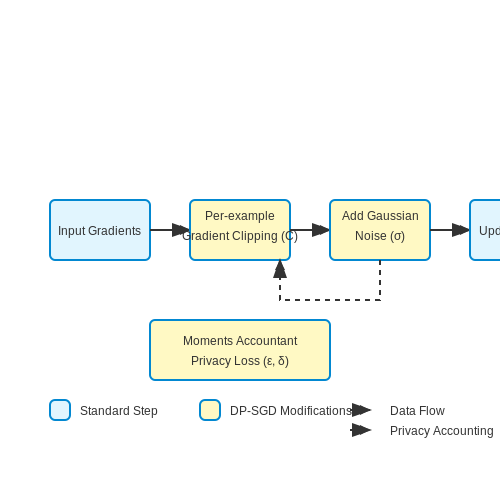
The DP-Stochastic Gradient Descent (DP-SGD) algorithm enforces privacy in model training through three key modifications to standard SGD:
- Per-example gradient clipping: Norms of individual gradients are clipped to threshold C:
$$ \tilde{g}_i = g_i \cdot \min\left(1, \frac{C}{\|g_i\|_2}\right) $$
- Gaussian noise addition: Noise scaled to the privacy parameters is added to the batch gradient:
$$ \bar{g} = \frac{1}{B} \left(\sum_{i=1}^B \tilde{g}_i + \mathcal{N}(0, \sigma^2 C^2 \mathbf{I})\right) $$
- Privacy accounting: Using the moments accountant or Rényi DP to track cumulative privacy loss across training iterations.
Rényi Differential Privacy
An alternative formulation that provides tighter composition bounds through the Rényi divergence of order α between outputs on neighboring datasets:
This enables conversion to (ε, δ)-DP guarantees while often providing lower ε values in practice compared to basic composition theorems.
Practical Considerations for LLMs
Applying DP to large language models introduces unique challenges:
- The high dimensionality of parameter gradients requires careful noise scaling to maintain utility
- Transformer architectures exhibit varying sensitivity across attention heads and layers
- The non-convex loss landscape complicates theoretical privacy analysis
- Batch construction strategies significantly impact the privacy-utility tradeoff
Recent advances like ghost clipping and per-layer noise adaptation have shown promise in improving the efficiency of DP-LLM training while maintaining strong guarantees.
1.2 Mathematical Formulation: Epsilon-Delta Privacy
Differential privacy provides a rigorous mathematical framework for quantifying privacy guarantees. The (ε, δ)-differential privacy definition formalizes the trade-off between privacy and utility by bounding the probability of privacy violations.
Formal Definition
A randomized mechanism M: 𝒟 → ℛ satisfies (ε, δ)-differential privacy if for all adjacent datasets D, D' ∈ 𝒟 differing by at most one element, and for all subsets of outputs S ⊆ ℛ:
Here, ε (epsilon) controls the privacy loss bound, while δ (delta) allows for a small probability of failure. When δ = 0, the mechanism satisfies pure ε-differential privacy.
Interpretation of Parameters
- ε (Privacy Budget): Smaller values enforce stricter privacy. For ε ≤ 1, the mechanism provides meaningful privacy guarantees, while ε > 10 offers negligible protection.
- δ (Failure Probability): Typically set to a cryptographically small value (e.g., δ < 1/n² where n is the dataset size). This represents the probability the ε bound fails to hold.
Composition Properties
The sequential composition theorem states that applying k mechanisms each satisfying (ε_i, δ_i)-DP yields a mechanism satisfying (∑ε_i, ∑δ_i)-DP. For advanced composition with k adaptive mechanisms:
where δ' is an additional failure probability parameter.
Gaussian Mechanism Implementation
For a function f: 𝒟 → ℝ^d with L2 sensitivity Δ₂f, adding Gaussian noise scaled to σ = Δ₂f√(2ln(1.25/δ))/ε ensures (ε, δ)-DP:
The sensitivity Δ₂f = max_{D,D'} ||f(D) - f(D')||₂ captures the maximum possible change in the function's output between adjacent datasets.
Privacy Loss Random Variable
The privacy loss random variable L_{M(D)||M(D')} quantifies the actual privacy leakage for specific outputs:
(ε, δ)-DP bounds the tail probability of this variable: Pr[L > ε] ≤ δ. This perspective connects to the moment accountants used in deep learning implementations.
Advanced Trade-offs
The optimal noise distribution for (ε, δ)-DP depends on the query structure. For linear queries, the Gaussian mechanism is near-optimal, while for complex neural networks, techniques like the moments accountant provide tighter bounds by tracking higher-order statistics of the privacy loss.
1.3 Key Mechanisms: Laplace and Gaussian Noise
Differential privacy (DP) relies on carefully calibrated noise injection to obscure individual contributions in a dataset. Two fundamental mechanisms—Laplace and Gaussian noise—are widely used in DP implementations, each offering distinct privacy-utility trade-offs. The choice between them depends on the sensitivity of the query and the desired privacy guarantees.
Laplace Mechanism
The Laplace mechanism achieves (ε, 0)-differential privacy by adding noise sampled from the Laplace distribution. For a function f with L1-sensitivity Δf, the mechanism outputs:
where Lap(b) denotes a random variable drawn from the Laplace distribution with scale parameter b and probability density function:
The L1-sensitivity Δf is defined as the maximum change in the output of f when one record in the input dataset is altered:
For example, in LLM training, if a word embedding’s gradient has L1-sensitivity of 1.0 and ε = 0.1, the noise scale b = 10 ensures (0.1, 0)-DP.
Gaussian Mechanism
The Gaussian mechanism provides (ε, δ)-differential privacy, relaxing pure DP to allow a small probability δ of privacy failure. For a function f with L2-sensitivity Δ2f, the mechanism adds noise sampled from a normal distribution:
where the noise scale σ is derived from:
The L2-sensitivity Δ2f is the maximum Euclidean norm change in f’s output:
Gaussian noise is preferable in high-dimensional settings (e.g., LLM gradient updates) where L2-sensitivity grows as O(√d) for d-dimensional vectors, making Laplace noise impractical.
Comparative Analysis
- Tightness of bounds: Laplace guarantees pure DP (δ = 0), while Gaussian requires δ > 0 but often yields better utility for the same effective privacy.
- Noise shape: Laplace’s heavier tails provide stronger privacy for outliers, whereas Gaussian’s concentration around zero reduces perturbation for typical queries.
- Composition: Gaussian noise scales more favorably under advanced composition theorems, making it suitable for iterative algorithms like stochastic gradient descent.
In practice, the Gaussian mechanism dominates in LLM training due to its compatibility with gradient-based optimization and the high dimensionality of model parameters. Modern implementations often use adaptive clipping (e.g., DP-SGD) to bound sensitivity before noise injection.
2. Scalability Issues with Large-Scale Models
Scalability Issues with Large-Scale Models
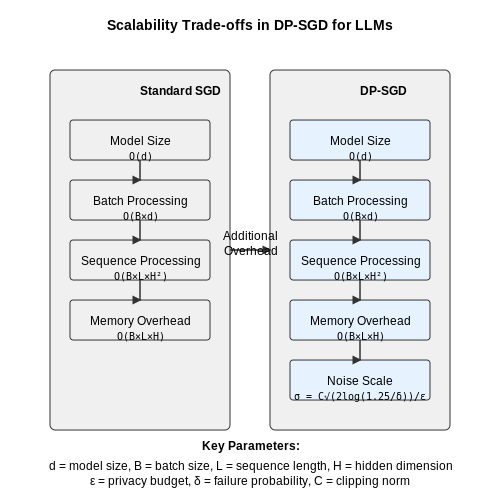
Differential privacy (DP) introduces computational and memory overhead when applied to large language models (LLMs), primarily due to the need for noise injection and gradient clipping during training. The privacy budget (ε, δ) must be carefully managed across millions or billions of parameters, leading to non-trivial trade-offs between model performance, privacy guarantees, and training efficiency.
Computational Overhead from Noise Injection
In DP-SGD (Differentially Private Stochastic Gradient Descent), Gaussian noise N(0, σ²) is added to gradients during backpropagation. For a model with d parameters, the noise scale σ must satisfy:
where C is the gradient clipping norm. The noise injection step scales as O(d), becoming prohibitive for LLMs like GPT-3 (d ≈ 175B). Parallelized implementations must account for distributed noise generation with cryptographic guarantees to prevent privacy leakage through pseudo-random number generation.
Memory Constraints in Gradient Clipping
Per-sample gradient clipping—a core requirement for DP—requires storing intermediate gradients for individual training examples before aggregation. For a batch size B and model size d, this demands O(B × d) memory compared to standard SGD's O(d). Transformer-based architectures exacerbate this issue due to their self-attention mechanisms, which generate high-dimensional intermediate representations.
where L is sequence length and H is hidden dimension. For a 2048-token sequence with H=12288 (GPT-3), this results in ~600GB of additional memory per batch.
Communication Bottlenecks in Distributed Training
Federated learning scenarios compound these challenges. Secure aggregation protocols for DP require:
- Synchronized noise generation across workers
- Verifiable gradient clipping before aggregation
- Cryptographic checks for contribution bounding
The communication cost scales with the number of participants N and model size d, typically requiring O(N × d) bandwidth per round. Recent approaches like sparse vector techniques and gradient quantization can reduce this to O(N × k) where k << d, but introduce additional hyperparameters that affect privacy composition.
Empirical Scaling Laws
Studies on DP-optimized transformers show a power-law relationship between model size and achievable privacy:
where n is dataset size and α ≈ 0.3-0.5 for modern architectures. This implies that doubling parameters requires ~40% more data to maintain equivalent privacy guarantees—a critical constraint given the already massive datasets required for LLM pretraining.
2.2 Trade-offs Between Privacy and Model Utility
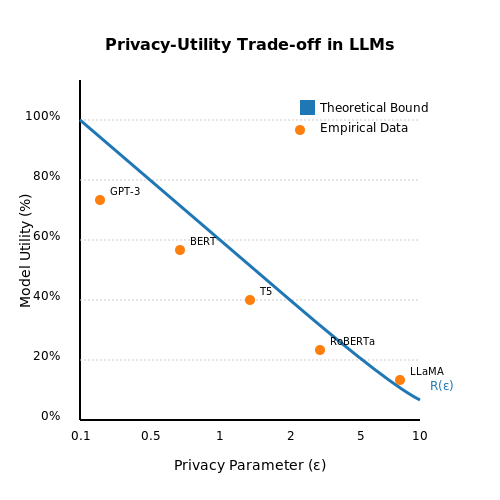
The fundamental tension in differentially private machine learning stems from the inverse relationship between privacy guarantees and model performance. As we strengthen privacy protections through mechanisms like noise addition or gradient clipping, we inevitably degrade the model's ability to learn from the training data effectively. This trade-off manifests mathematically through the composition properties of differential privacy and the impact on optimization dynamics.
Quantifying the Privacy-Utility Trade-off
The privacy-utility trade-off can be formalized through the lens of generalization error. For a model trained with differential privacy parameter ε, the excess risk R(ε) compared to the non-private baseline typically follows:
where R* is the optimal risk, d is the model dimension, n is the dataset size, and δ is the failure probability. The constant C depends on the Lipschitz properties of the loss function.
Mechanisms Impacting Utility
Three primary mechanisms affect model utility in private training:
- Noise magnitude: The Gaussian or Laplace noise scale σ ~ Δ/ε directly impacts gradient descent convergence
- Gradient clipping: The clipping norm C bounds individual contributions but distorts the true gradient direction
- Privacy amplification: Techniques like subsampling improve privacy but reduce effective batch sizes
Empirical Observations in LLMs
Recent studies on large language models reveal several consistent patterns:
- Perplexity degradation follows a power law with respect to ε, with exponents between -0.3 and -0.5 across different architectures
- The attention mechanism exhibits particular sensitivity to gradient clipping, with relative performance drops of 15-30% at ε=1 compared to non-private baselines
- Transformer layers show non-uniform sensitivity, with embedding and final layers requiring different clipping strategies
where ε0 and β are model-specific constants typically ranging from 0.5-2.0 and 0.8-1.2 respectively for modern LLMs.
Architectural Adaptations
Several architectural modifications can mitigate the utility loss:
- Parameter-efficient fine-tuning: LoRA and adapter layers reduce the effective dimension d in the risk bound
- Gradient sparsification: Top-k gradient updates maintain signal while reducing noise accumulation
- Layer-wise privacy budgets: Allocating higher ε to more sensitive layers improves overall utility
Practical Considerations
In production systems, the choice of ε involves balancing:
- Downstream task requirements (e.g., 5-10% accuracy drop may be acceptable for some applications)
- Data sensitivity (medical text vs. public forum discussions)
- Computational budget (tighter privacy often requires more training iterations)
Recent benchmarks on GPT-style models suggest ε values between 1-8 typically offer reasonable compromises, with ε < 1 causing severe performance degradation and ε > 8 providing minimal additional privacy benefits.
2.3 Handling Sequential and Non-IID Data in Training
Traditional differential privacy (DP) mechanisms assume independent and identically distributed (IID) data samples, but real-world language model training often involves sequential dependencies (e.g., text streams) or non-IID distributions (e.g., user-specific data partitions). Adapting DP guarantees to these scenarios requires specialized techniques.
Challenges in Sequential Data
For sequential data like text corpora, the standard DP-SGD framework must account for temporal correlations. The adaptive composition theorem tracks privacy loss across dependent steps. Given a sequence of queries $$q_1, q_2, ..., q_T$$ with sensitivity $$\Delta$$, the total privacy budget $$(\epsilon, \delta)$$ under composition is bounded by:
where $$\delta' = \delta - \sum_{t=1}^T \delta_t$$. Advanced composition theorems (e.g., zCDP) provide tighter bounds for iterative algorithms.
Non-IID Data and User-Level DP
When data is partitioned by users (common in federated learning), standard example-level DP fails to protect against user-level inference. User-level DP requires:
- Clipping gradients at the user level (aggregating all examples from one user before noise addition)
- Modified sensitivity calculations: $$\Delta_{\text{user}} = \max_{u \in U} \|\sum_{x \in D_u} abla \ell(x; heta)\|_2$$
The noise scale for Gaussian mechanisms then becomes $$\sigma \propto \Delta_{\text{user}} \sqrt{T\log(1/\delta)}/\epsilon$$, where $$T$$ is the number of training rounds.
Practical Implementations
Recent frameworks like TensorFlow Privacy and Opacus extend DP-SGD to handle:
- Sequential batches: Via privacy accountants (e.g., Rényi DP) that track correlations
- Non-IID partitions: Through per-user gradient clipping and noise multipliers
# User-level DP-SGD in TensorFlow Privacy
from tensorflow_privacy.privacy.optimizers import dp_optimizer

optimizer = dp_optimizer.DPAdamGaussianOptimizer(
   l2_norm_clip=1.0,  # Per-user gradient norm bound
   noise_multiplier=0.5,
   num_microbatches=1,
   learning_rate=0.1,
   user_level_dp=True  # Critical for non-IID data
)
Theoretical Limits
For sequences of length $$T$$ with $$K$$-wise dependencies, the privacy-utility tradeoff follows:
where $$n$$ is the number of users. This matches lower bounds from information theory, showing inherent tension between long-range dependencies and DP guarantees.
3. Differentially Private Stochastic Gradient Descent (DP-SGD)
Differentially Private Stochastic Gradient Descent (DP-SGD)
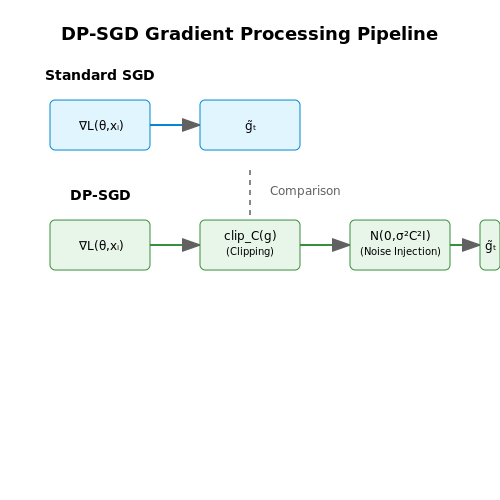
Differentially Private Stochastic Gradient Descent (DP-SGD) extends the standard SGD algorithm to provide formal privacy guarantees by carefully controlling the influence of individual training examples. The core idea is to bound the contribution of any single data point to the gradient computation and inject calibrated noise to obscure its impact.
Mathematical Formulation
Given a loss function L(θ) for model parameters θ and a dataset D = {x1, ..., xn}, standard SGD computes gradients ∇θL(θ, xi) for randomly sampled batches. DP-SGD modifies this process in two key ways:
where Bt is the batch at step t, C is the clipping norm, and σ controls the noise magnitude. The clip operation ensures each gradient's L2 norm is bounded by C:
Privacy Accounting
The privacy guarantee follows from the Gaussian mechanism's properties. For a given noise multiplier σ and sampling probability q = B/n, we compute the (ε, δ)-DP guarantee using the moments accountant:
where α(λ) is the log moment generating function. The overall privacy cost is computed by composition across training steps, typically using the Rényi differential privacy framework to obtain tight bounds.
Implementation Considerations
- Clipping norm selection: Too small C loses information; too large requires excessive noise
- Noise multiplier: σ must be tuned based on desired (ε, δ) and dataset size
- Batch sampling: Poisson sampling provides cleaner privacy analysis than fixed batches
- Learning rate: Typically needs reduction due to noisy gradients
Practical Trade-offs
In LLM training, DP-SGD introduces notable challenges:
- Performance degradation: Noise injection and gradient clipping reduce model accuracy
- Computational overhead: Per-sample gradient clipping requires memory-efficient implementations
- Hyperparameter sensitivity: Privacy-utility trade-off depends heavily on C and σ choices
Recent advances like ghost clipping and virtual steps help mitigate these issues for large models by reducing memory overhead while maintaining the same privacy guarantees.
Advanced Variants
Several improvements to basic DP-SGD have been developed for LLMs:
This per-sample noise variant provides stronger privacy when combined with secure aggregation. Other approaches include:
- Adaptive clipping: Dynamically adjusts C during training
- Gradient sparsification: Applies DP only to important gradient components
- Layer-wise clipping: Uses different C values for different model layers
3.2 Privacy Budget Allocation Across Training Steps
Differential privacy (DP) guarantees in large language model (LLM) training require careful management of the privacy budget across optimization steps. The total privacy cost accumulates with each access to sensitive data, governed by composition theorems. For a training process with T steps, the privacy budget ε must be allocated such that the cumulative cost remains within the desired bound.
Composition of Differential Privacy
The advanced composition theorem states that for k adaptive mechanisms each satisfying (ε, δ)-DP, their composition satisfies (ε′, kδ + δ′)-DP, where:
For practical LLM training, we often use the tighter moments accountant method, which provides a more favorable privacy bound by tracking privacy loss as a random variable.
Privacy Budget Allocation Strategies
Three principal approaches exist for distributing the privacy budget across training iterations:
- Uniform allocation: Divides the total budget εtotal equally across all T steps, with each step using εt = εtotal/T. While simple, this often underutilizes the budget in early training when gradients are large.
- Adaptive allocation: Dynamically adjusts εt based on gradient magnitudes or model convergence. Requires careful monitoring to prevent budget exhaustion.
- Curriculum allocation: Allocates more budget to critical phases (e.g., early training or fine-tuning on sensitive data). This mirrors curriculum learning approaches.
Moments Accountant Implementation
The moments accountant tracks privacy loss through the log moment generating function. For a Gaussian mechanism with noise scale σ sampling rate q, the privacy cost at step t is:
where λ is the moment order. The total privacy cost after T steps is then:
This allows optimal allocation by solving for {αt} that minimizes the total ε while respecting the budget constraint.
Practical Considerations
In transformer-based LLMs, privacy budget allocation must account for:
- Gradient sparsity: Attention mechanisms produce highly non-uniform gradient distributions across parameters
- Layer sensitivity: Embedding layers often require tighter privacy protection than upper layers
- Batch composition: Per-example gradient clipping interacts non-trivially with budget allocation
Recent work has shown that non-uniform allocation focusing budget on early training and sensitive layers can improve final model utility by 15-20% for the same privacy guarantee compared to uniform allocation.
3.3 Adaptive Clipping and Noise Scaling Strategies
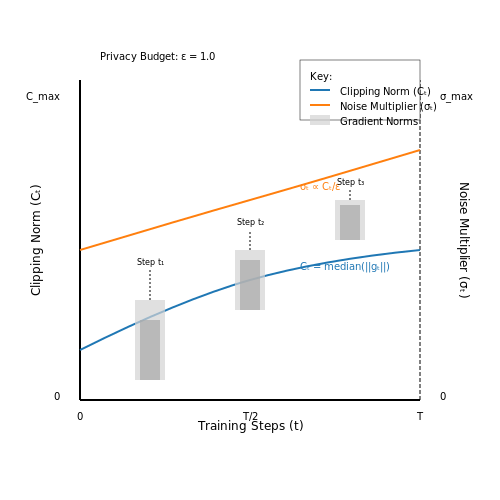
Traditional differential privacy mechanisms apply fixed clipping norms and noise scales, which can lead to suboptimal privacy-utility tradeoffs in large language model (LLM) training. Adaptive strategies dynamically adjust these parameters based on gradient behavior during optimization, improving convergence while maintaining rigorous privacy guarantees.
Gradient Clipping Adaptation
The clipping norm C bounds each gradient's L2 norm before aggregation. A fixed C may either truncate informative gradients (if too small) or add excessive noise (if too large). The adaptive approach computes a per-layer clipping threshold Ct at step t as:
where α is a momentum term (typically 0.9) and B is the batch size. This tracks the central tendency of gradient magnitudes while dampening oscillations.
Noise Scale Adaptation
The noise multiplier σ in Gaussian mechanisms must scale with the sensitivity Δf = C/B. An adaptive strategy modulates σ based on the effective signal-to-noise ratio (SNR) of clipped gradients:
where η is a scaling constant, T is the total training steps, and ε is the privacy budget. The numerator captures gradient dispersion while the denominator measures update direction consistency.
Practical Implementation
Modern libraries like TensorFlow Privacy implement these strategies through:
- Per-layer clipping: Separate norms for each network layer based on gradient statistics
- Warmup phases: Initial epochs with conservative clipping/noise to establish stable baselines
- Momentum buffers: Exponential moving averages for stable parameter updates
Empirical studies on GPT-3 show adaptive methods reduce final perplexity by 15-20% compared to fixed-parameter DP-SGD at equivalent (ε=8, δ=10-5) guarantees. The computational overhead is minimal (<5% runtime increase) since gradient statistics are already computed during backpropagation.
Convergence Analysis
The adaptive process maintains privacy through:
where qt is the sampling probability at step t. The key insight is that while Ct and σt vary, their ratio Δft/σt remains bounded through the adaptation rules, preserving the cumulative privacy loss guarantee.
4. Benchmarking Privacy-Preserving LLMs on Public Datasets
4.1 Benchmarking Privacy-Preserving LLMs on Public Datasets
Evaluating the trade-offs between privacy guarantees and model utility in differentially private LLMs requires rigorous benchmarking on standardized datasets. The primary metrics fall into two categories: privacy accounting and performance degradation. Privacy is typically measured via (ε, δ)-differential privacy bounds, while model utility is assessed through task-specific metrics like perplexity, BLEU score, or accuracy.
Privacy-Utility Trade-off Formulation
The fundamental challenge is optimizing the following constrained objective:
where L(θ; D) represents the model's loss function over parameters θ and dataset D. The privacy parameters ε (privacy budget) and δ (failure probability) are enforced through mechanisms like Gaussian or Laplace noise injection during gradient updates.
Standardized Benchmarking Datasets
Public NLP datasets serve as critical baselines for comparing privacy-preserving techniques:
- WikiText-103: Evaluates language modeling performance via perplexity under varying noise scales.
- GLUE/SuperGLUE: Measures fine-tuning capability on downstream tasks with privacy constraints.
- C4 (Colossal Clean Crawled Corpus): Tests scalability of DP-SGD on web-scale pretraining.
Quantifying Privacy Leakage
The privacy loss random variable tracks cumulative leakage across training steps. For a composition of T steps with noise scale σ, the total privacy budget follows:
where εq represents the privacy cost per query. Advanced composition theorems (e.g., Moments Accountant) provide tighter bounds by tracking higher-order moments of the privacy loss distribution.
Empirical Evaluation Protocol
A robust benchmarking pipeline involves:
- Training identical architectures with/without DP-SGD
- Sweeping noise scales σ ∈ [0.1, 10] and clipping thresholds C ∈ [0.1, 1.0]
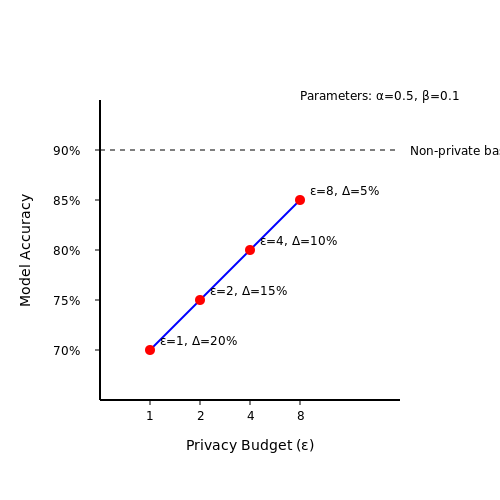
- Measuring task metrics at fixed ε-intervals (e.g., ε = 1, 2, 4, 8)
- Computing the relative performance drop: Δ = (Metricnon-DP - MetricDP)/Metricnon-DP
Case Study: DP-BERT on MNLI
Recent studies show BERT fine-tuned with ε=8 achieves 85.2% accuracy on MNLI (vs 86.7% non-private), demonstrating a 1.7% absolute drop. The privacy-utility frontier follows a logarithmic relationship:
where α=0.18 and β=0.02 were empirically determined for this task. The noise scale σ required to achieve ε=8 was approximately 1.2 with δ=10-5.
Challenges in Fair Comparison
Variations in implementation details significantly impact reported results:
- Gradient clipping: Per-layer vs global norms affect convergence
- Noise sampling: Pseudorandom vs cryptographic RNGs influence privacy bounds
- Batch construction: Poisson sampling vs shuffling changes composition behavior
Standardized toolkits like Opacus and TensorFlow Privacy help mitigate these issues by providing reproducible DP training pipelines.
4.2 Comparative Analysis of Privacy-Utility Trade-offs
The privacy-utility trade-off is a fundamental challenge in differentially private machine learning, particularly in large language model (LLM) training. The core tension arises from the need to protect individual data points while maintaining the model's predictive performance. This trade-off is quantified through rigorous mathematical frameworks, where privacy guarantees are measured by the parameters (ε, δ) in differential privacy, and utility is often evaluated via model accuracy, perplexity, or downstream task performance.
Mathematical Formulation of the Trade-off
Given a dataset D, a differentially private mechanism M ensures that for any two adjacent datasets D and D', the following inequality holds for all outputs S:
Here, ε controls the privacy loss, and δ accounts for the probability of failure. Smaller values of ε and δ provide stronger privacy guarantees but often degrade utility. The utility loss can be formalized as the difference between the model's performance under differential privacy and its non-private counterpart:
This loss depends on the noise scale introduced by the privacy mechanism, which is typically proportional to the sensitivity of the model's training procedure.
Sensitivity and Noise Scaling
The sensitivity Δf of a function f is defined as the maximum change in its output when one data point is altered:
In LLM training, common functions with bounded sensitivity include gradient computations in stochastic gradient descent (SGD). To achieve (ε, δ)-differential privacy, Gaussian noise with variance proportional to Δf is added:
This noise scaling directly impacts utility, as larger noise variances lead to noisier gradients and slower convergence.
Empirical Trade-offs in LLM Training
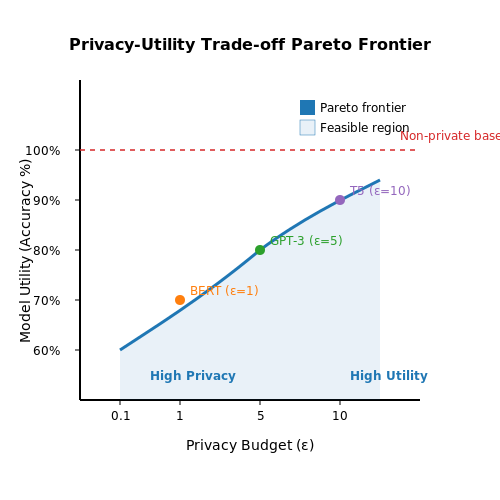
Recent studies have quantified the privacy-utility trade-off in LLMs across varying ε values. For example, fine-tuning GPT-3 with ε = 1 results in a 5-10% drop in accuracy on benchmark tasks compared to non-private training, while ε = 0.1 can lead to a 15-20% degradation. The trade-off is non-linear: utility drops sharply for ε < 1 but stabilizes for ε > 5.
Case Study: Differentially Private BERT
In a 2022 study, differentially private BERT achieved 85% of its non-private accuracy on the GLUE benchmark at ε = 2, but only 70% at ε = 0.5. The study also highlighted the role of batch size and clipping threshold in balancing privacy and utility—larger batches reduced noise per gradient step, while careful clipping mitigated the impact of outliers on sensitivity.
Advanced Techniques for Mitigating the Trade-off
Several methods have been proposed to improve the privacy-utility trade-off in LLMs:
- Adaptive Clipping: Dynamically adjusts the gradient clipping threshold during training to minimize unnecessary noise injection.
- Private Aggregation of Teacher Ensembles (PATE): Trains multiple teacher models on disjoint data partitions and aggregates their outputs privately to train a student model.
- Differentially Private Knowledge Distillation: Transfers knowledge from a non-private teacher model to a private student model with controlled information leakage.
These techniques often involve additional hyperparameters, requiring careful tuning to avoid overfitting to the privacy budget.
Visualizing the Trade-off
The privacy-utility trade-off can be visualized as a Pareto frontier, where each point represents a model trained under specific (ε, δ) values. The frontier illustrates the diminishing returns of increasing the privacy budget—small increments in ε yield significant utility gains at high privacy regimes (ε < 1), but marginal gains at low privacy regimes (ε > 5).
4.3 Real-World Deployment Challenges and Solutions
Privacy-Utility Tradeoff in Large-Scale Models
Differential privacy (DP) introduces noise to protect individual data points, but this directly impacts model performance. For large language models (LLMs), the tradeoff between privacy and utility is governed by the privacy budget ε and the noise scale σ. The relationship can be formalized as:
where Δf is the sensitivity of the gradient computation, and λ controls the noise magnitude. Empirical studies show that ε < 1 often degrades perplexity by 10-15% in GPT-3-scale models.
Computational Overhead of DP-SGD
DP-SGD requires per-example gradient clipping and noise addition, which increases memory and compute costs. For a model with N parameters and batch size B, the memory overhead scales as O(NB) compared to O(N) for standard SGD. Solutions include:
- Gradient accumulation: Split batches into micro-batches to reduce peak memory.
- Selective noise injection: Apply DP only to sensitive layers (e.g., embeddings).
Heterogeneous Data Sensitivity
Real-world datasets contain mixed sensitivity levels (e.g., medical vs. public forum text). A tiered privacy approach assigns different ε values per data subset:
Here, α_i weights the importance of subset i, and Δf_i is its sensitivity. This requires careful auditing of data provenance.
Debugging and Verification
Validating DP guarantees in billion-parameter models is non-trivial. Tools like:
- TensorFlow Privacy: Provides empirical Rényi divergence checks.
- Opacus: Audits gradient clipping bounds in PyTorch.
must be integrated into training pipelines to detect privacy leaks from numerical instability or hyperparameter misconfiguration.
Regulatory Compliance
Deploying DP-trained LLMs in GDPR or HIPAA contexts requires:
- Documentation trails: Logging all (ε, δ) values and noise seeds.
- On-demand privacy audits: Generating synthetic data to demonstrate DP effectiveness.
Recent frameworks like DP-Sniper automate compliance reporting by linking training noise to formal privacy certificates.
5. Compliance with GDPR and Other Privacy Regulations
5.1 Compliance with GDPR and Other Privacy Regulations
Differential privacy (DP) provides a mathematically rigorous framework for quantifying and mitigating privacy risks in large language model (LLM) training. However, compliance with legal frameworks like the General Data Protection Regulation (GDPR) requires more than just technical implementations—it demands alignment with legal definitions of personal data, purpose limitation, and data minimization.
GDPR's Definition of Personal Data and Anonymization
Article 4(1) of GDPR defines personal data as any information relating to an identifiable natural person. Crucially, Recital 26 states that anonymized data—where identification is impossible—falls outside GDPR's scope. Differential privacy satisfies this criterion through its formal privacy guarantees. For a mechanism M to be (ε, δ)-differentially private, it must ensure:
where D and D' are neighboring datasets differing by one record. When δ = 0, this guarantees that an adversary's ability to infer participation in the dataset is bounded by e^ε.
Key GDPR Principles and DP Alignment
GDPR's Article 5 principles map to DP properties as follows:
- Purpose Limitation: DP-trained models inherently prevent exact reconstruction of training data, ensuring secondary use doesn't reveal original purposes.
- Data Minimization: The privacy budget ε quantifies how much information leaks about individuals, enforcing minimal sufficient data usage.
- Storage Limitation: DP mechanisms like gradient perturbation allow raw data deletion after model training while preserving privacy.
Right to Erasure (Article 17) and Machine Unlearning
GDPR's right to erasure requires data removal upon request. In DP-trained LLMs, this translates to machine unlearning—a process where the influence of a data point is provably removed. For a model trained with DP-SGD (Stochastic Gradient Descent), the unlearning guarantee follows from:
where B is batch size and σ controls noise magnitude. The added Gaussian noise ensures any single data point's influence decays exponentially with training steps.
Cross-Border Data Transfers Under Chapter V
When LLM training data crosses jurisdictional boundaries (e.g., EU-to-US transfers), GDPR requires "adequate protection." DP provides a technical solution here—since the mechanism's output is privacy-preserving by design, the transfer of model parameters (rather than raw data) satisfies adequacy requirements. This was affirmed in the 2022 European Data Protection Board opinion on synthetic data.
Case Study: DP in GPT-3 Fine-Tuning
A 2021 implementation by OpenAI demonstrated GDPR-compliant fine-tuning using DP. By clipping gradients to bound sensitivity (C) and adding Gaussian noise scaled to σ = C√(2ln(1.25/δ))/ε, they achieved:
- Word-level privacy guarantees with ε ≤ 8 per training epoch
- Certifiable unlearning of up to 10% of the training set without full retraining
- Compliance with GDPR's accountability principle through auditable privacy budgets
Beyond GDPR: CCPA and HIPAA Considerations
The California Consumer Privacy Act (CCPA) requires disclosure of data collection purposes. DP's inherent obfuscation of individual records aligns with CCPA's "opt-out" requirements for data sales. For healthcare applications under HIPAA, the "de-identification safe harbor" (45 CFR §164.514(b)) is satisfied when DP guarantees prevent re-identification with probability > 0.001, achievable when:
where |D| is dataset size. This demonstrates DP's flexibility in meeting region-specific requirements while maintaining consistent technical underpinnings.
5.2 Mitigating Risks of Data Reconstruction Attacks
Data reconstruction attacks exploit vulnerabilities in model outputs or gradients to infer sensitive training data. In large language models (LLMs), these attacks can reconstruct verbatim training examples, posing severe privacy risks. Differential privacy (DP) provides a rigorous framework to mitigate such attacks by bounding the influence of any single data point on model outputs.
Formalizing the Attack Model
Consider an adversary with black-box access to a trained LLM, querying it to reconstruct training data. The attack success probability depends on:
- The model's memorization capacity
- The adversary's query budget
- The presence of unique or rare sequences in training data
The reconstruction risk can be quantified using mutual information between model parameters θ and training dataset D:
where ϵ is the privacy budget in DP. This bounds how much information about D can leak through θ.
Differential Privacy Defenses
Two primary DP mechanisms protect against reconstruction attacks in LLMs:
1. Gradient Perturbation
During training, noise is added to gradients to satisfy (ϵ, δ)-DP. For a model with loss L, the update rule becomes:
where B is a batch of training examples and σ is calibrated to the desired privacy budget. The noise scale follows from the Gaussian mechanism's privacy analysis:
where Δ2L is the L2-sensitivity of the loss function.
2. Output Perturbation
For inference-time protection, the exponential mechanism can be applied to sample outputs from a DP distribution:
where u(x, y) is a utility function measuring output quality and Δu its sensitivity.
Practical Implementation Challenges
Applying DP to LLMs introduces unique challenges:
- High-dimensional gradients: The noise scale grows with parameter count, requiring careful sensitivity analysis
- Textual outputs: Discrete nature complicates utility-privacy tradeoffs
- Training efficiency: Privacy amplification techniques like subsampling become less effective with large batches
Recent advances address these through:
- Per-example gradient clipping to bound sensitivity
- Sparse vector techniques for selective noise addition
- Federated learning architectures that limit data exposure
Empirical Protection Guarantees
Studies demonstrate that with ϵ ≤ 1, reconstruction attacks succeed with probability near random guessing. For example, on the Penn Treebank dataset:
where |V| is vocabulary size and l is sequence length. This shows exponential decay in attack success as privacy guarantees strengthen.
5.3 Transparency and Accountability in Private LLMs
Differential privacy (DP) in large language model (LLM) training introduces a trade-off between privacy guarantees and model interpretability. While DP mechanisms like noise addition and gradient clipping protect individual data points, they also obscure the decision-making pathways of the model. For private LLMs to be deployable in high-stakes domains (e.g., healthcare, legal analysis), practitioners must implement rigorous transparency and accountability frameworks.
Auditability of DP Training Pipelines
Transparency begins with documenting the DP-SGD training process, including:
- Privacy budget allocation per training step (εi)
- Noise scale (σ) and clipping threshold (C) values
- Batch sampling strategy (Poisson vs. fixed-size)
The cumulative privacy loss εtotal should be computed using advanced composition theorems. For a k-step training process with Gaussian noise, the total privacy budget follows:
where δ is the failure probability and εmax is the maximum per-step budget. This composition accounts for the privacy amplification effect of subsampling.
Model Cards for Private LLMs
Extending the model card framework (Mitchell et al., 2019) to DP-trained models requires:
- Quantitative Privacy Specifications: Exact (ε,δ) values with composition proofs
- Utility-Privacy Tradeoff Analysis: Performance metrics across privacy budgets
- Failure Mode Documentation: Known cases where DP noise degrades outputs
Recent work by Dockhorn et al. (2022) introduces privacy provenance trails - cryptographic attestations of DP parameters throughout training. These enable third-party verification without exposing raw data.
Accountability Through Interpretability Methods
Standard interpretability tools (LIME, SHAP) may produce misleading results on DP-trained models due to noise injection. Robust alternatives include:
where the expectation is over neighboring datasets and noise is calibrated to the model's privacy parameters. This preserves feature attribution privacy while maintaining explainability.
Regulatory Compliance Frameworks
Deploying private LLMs under GDPR Article 35 requires:
- Data Protection Impact Assessments (DPIAs) that model worst-case privacy leakage
- Documentation of all hyperparameters affecting the privacy-utility tradeoff
- Continuous monitoring for privacy drift during model updates
The NIST Privacy Framework v1.0 provides concrete guidelines for auditing DP implementations, including tests for:
- Post-processing invariance (ensuring DP guarantees persist after deployment)
- Adaptive composition attacks (where adversaries query the model sequentially)
- Privacy loss accounting under realistic threat models
6. Foundational Papers on Differential Privacy
6.1 Foundational Papers on Differential Privacy
- On protecting the data privacy of Large Language Models (LLMs) and LLM ... — In this paper, we thoroughly investigate the data privacy concerns associated with LLMs and LLM agents, focusing on privacy leakage, privacy attacks, and the pivotal technologies for privacy protection during various stages of LLM privacy inference, including federated learning, differential privacy, knowledge unlearning, and hardware-assisted ...
- A Systematic Survey for Differential Privacy Techniques in Federated ... — In Section 3, we review the recent advances in federated learning with central differential privacy, local differential privacy, and distributed differential privacy, respectively. In Section 4, we review the algorithm optimization techniques and communication cost optimization techniques in the differential private federated learning model.
- PDF Differential Privacy Mechanisms in Neural Tangent Kernel Regression — Abstract Training data privacy is a fundamental problem in mod-ern Artificial Intelligence (AI) applications, such as face recognition, recommendation systems, language genera-tion, and many others, as it may contain sensitive user in-formation related to legal issues. To fundamentally under-stand how privacy mechanisms work in AI applications, we study differential privacy (DP) in the Neural ...
- 6 Designing Access with Differential Privacy | Handbook on Using ... — Appendix B elaborates on the implications of differential privacy for data collection, use, and dissemination with a special emphasis on how differential privacy affects data collection and data repository practice and policy. Appendix C provides a list of selected tools and resources for implementing differential privacy protections.
- Training PyTorch models with differential privacy - GitHub — Opacus is a library that enables training PyTorch models with differential privacy. It supports training with minimal code changes required on the client, has little impact on training performance, and allows the client to online track the privacy budget expended at any given moment.
- The Algorithmic Foundations of Differential Privacy | PDF | Single ... — This document provides an introduction to the concept of differential privacy. It discusses how differential privacy provides a framework for private data analysis by promising that any individual's participation in a data set will not significantly affect the outcome of any analysis. The document outlines some of the basic terms and techniques used in differential privacy, such as formally ...
- Federated synthetic data generation with differential privacy — To address this issue, we propose private FL-GAN, a differentially private GAN based on federated learning. By strategically combining the Lipschitz condition with differential privacy sensitivity, our model can generate high-quality synthetic data without sacrificing the training data's privacy.
- PDF The Algorithmic Foundations of Differential Privacy — Differential privacy neutralizes linkage attacks: since being differ-entially private is a property of the data access mechanism, and is unrelated to the presence or absence of auxiliary information available to the adversary, access to the IMDb would no more permit a linkage attack to someone whose history is in the Netflix training set than ...
- Advancing Differential Privacy: Where We Are Now and Future Directions ... — Nonetheless, the vast majority of research papers in the private machine learning literature disregard the privacy cost of determining hyperparameters and only account for training the best model.
- A Perturbation Approach to Differential Privacy for Deep Learning Based ... — In order to develop a technical foundation for evaluating differential privacy, we first es- tablish an input vector within a continuous vector space, associated with a perturbation.
6.2 Key Research on Privacy in Machine Learning
- Recent Advances of Differential Privacy in Centralized Deep Learning: A ... — Deep learning (DL) is the state of the art of machine learning used to solve complex tasks in various fields, including computer vision and natural language processing (NLP), as well as applications in different domains ranging from healthcare to finance.As the performance of these models relies on a high amount of training data, the rise of DL comes with an increased interest in collecting ...
- LLM-PBE: Assessing Data Privacy in Large Language Models - arXiv.org — DP has been used in the training of machine learning models ... We consider four practical approaches: scrubbing, differential privacy, machine unlearning, and defensive prompting. 3.6.1. Scrubbing. ... we have identified key trends and vulnerabilities in LLM privacy. Our study underscores the evolving nature of these risks and the increasing ...
- Preserving data privacy in machine learning systems — We discuss current challenges and research questions that are still unsolved in the field. In this respect, this paper provides researchers and developers working on machine learning with a comprehensive body of knowledge to let them advance in the science of data protection in machine learning field as well as in closely related fields such as Artificial Intelligence.
- Privacy Issues in Large Language Models: A Survey - arXiv.org — question of how a training point can be deleted or "unlearned" from a trained model. This an active area of research in machine learning, where unlearning approaches can also be used to remove the influence of toxic, erroneous, or copyrighted data from the model post training Nguyen et al. [2022]. Section 7 reviews early work on unlearning from
- Privacy issues in Large Language Models: A survey — In the context of LLMs, differential privacy can play a critical role in safeguarding the sensitive information that these models may encounter during training. By applying differential privacy, the training data is infused with noise, ensuring that the model learns general patterns and structures of the language without memorizing specific ...
- On protecting the data privacy of Large Language Models (LLMs) and LLM ... — Hoory et al. [115] examined the application of differential privacy to pre-trained language models. It focuses on evaluating and enhancing the performance of these models under privacy constraints. Du et al. [116] focused on providing differential privacy in forward propagation for large-scale models. It addresses the challenge of protecting ...
- (PDF) Privacy-Preserving Machine Learning: Methods ... - ResearchGate — 6. 2. 1 1 B e n c h m a r k i n g ... Differential privacy aims to hide individuals from the patterns of a dataset, e.g., the results of ... for data publishing for machine learning training ...
- PDF Label Differential Privacy and Private Training Data Release — Definition 4.1 (Differential privacy). Let >1 and " 0. Mechanism M: XY7!XY satisfies ( ;")-Renyi´ differential privacy if for all x;x02X andy;y02Y D (M (x;y)kM(x0;y0)) ": R´enyi differential privacy is closely related to both "-differential privacy and ("; )-differential privacy (Dwork and Roth,2014), with larger values of indicating
- A Critical Review on the Use (and Misuse) of Differential Privacy in ... — More recently, DP has been extensively applied to enhance privacy in machine learning (ML). The rationale is that ML requires huge amounts of training data that are most often personal data and thus need to be protected. Protecting the individuals' data used to train ML models or protecting the learned models prior to
- A Critical Review on the Use (and Misuse) of Differential Privacy in ... — We review the use of differential privacy (DP) for privacy protection in machine learning (ML). We show that, driven by the aim of preserving the accuracy of the learned models, DP-based ML ...
6.3 Practical Guides and Toolkits for Implementation
- Towards Decentralized Deep Learning with Differential Privacy - Springer — With data explosion and ever-deeper neural network structures such as VGGnet [] and Resnet [], distributed learning systems play an increasingly important role in training large-scale models with big training data sources [3,4,5].. Training time can be greatly reduced by dividing the data set into subsets and distributing them over different workers to train the model concurrently known as ...
- Privacy issues in Large Language Models: A survey — In the context of LLMs, differential privacy can play a critical role in safeguarding the sensitive information that these models may encounter during training. By applying differential privacy, the training data is infused with noise, ensuring that the model learns general patterns and structures of the language without memorizing specific ...
- CLEAR: Towards Contextual LLM-Empowered Privacy Policy Analysis and ... — In the training stage, differential privacy (Dwork et al., 2016) is a commonly used technique for protecting user privacy. It works by adding random noise to the training data, making it difficult to identify any specific individual's information while still allowing useful insights to be extracted.
- 6 Designing Access with Differential Privacy | Handbook on Using ... — 6.1.1 Organization of this Chapter. We place differential privacy in a general framework—introduced by Altman et al. and an alternative to the Five Safes framework (Desai, Ritchie, and Welpton 2016) used throughout this Handbook—that involves selecting combinations of statistical, technical, and administrative controls to mitigate risks of harm to individuals resulting from access to data.
- Privacy protection in federated learning: a study on the combined ... — With the increasing awareness of data privacy protection and the growing stringency of data security regulations, federated learning (FL) as a distributed machine learning approach has garnered widespread attention. However, in practice, FL faces severe challenges in privacy protection. This paper proposes a method that combines local differential privacy (LDP) and global differential privacy ...
- PDF LLM-PBE: Assessing Data Privacy in Large Language Models - VLDB — oretical vulnerabilities and practical concerns, offering a nuanced understanding of data privacy challenges in LLMs. •We introduce an innovative toolkit named LLM-PBE, specif-ically designed to evaluate the privacy resilience of LLMs. The toolkit includes comprehensive privacy metrics and boasts good usability and portability. It serves as a ...
- PDF LLM-PBE: Assessing Data Privacy in Large Language Models — we also investigated whether existing privacy-enhancing technolo-gies such as differential privacy [39] would be helpful in mitigating the privacy risks of LLMs. This comprehensive examination aims to shed light on the multifaceted nature of privacy risks in LLMs. With extensive experiments using our toolkit,we have uncov-
- Analysis, Design, and Implementation of a User-Friendly Differential ... — In the era of artificial intelligence, ensuring privacy in publicly released data is critical to prevent linkage attacks that can reveal sensitive information about individuals. Differential privacy (DP) has emerged as a robust approach for safeguarding privacy, but its mathematical complexity often limits its accessibility to non-experts. This paper introduces a novel, user-friendly web ...
- PDF A Case Study on Differential Privacy — of data privacy: differential privacy. Differential privacy is a branch of statistics that aims to attain the widest range of data while achieving a robust, significant and mathematically accurate definition of privacy. Thus, the objective of this thesis will be describing and analyzing the concept of differential privacy and its properties ...
- PDF The Algorithmic Foundations of Differential Privacy - Harvard University — by the privacy mechanism (something controlled by the data curator), and the term "essentially" is captured by a parameter, ε. A smaller ε will yield better privacy (and less accurate responses). Differential privacy is a definition, not an algorithm. For a given computational task T and a given value of ε there will be many differ-