Comparing Open-Source vs Closed-Source LLMs
1. Key Characteristics of Open-Source LLMs
Key Characteristics of Open-Source LLMs
Open-source large language models (LLMs) are distinguished by their transparent architecture, modifiable parameters, and community-driven development. Unlike proprietary models, their weights, training data, and source code are publicly accessible, enabling researchers to audit, fine-tune, and deploy them without restrictive licensing. Key technical attributes include:
Architectural Transparency
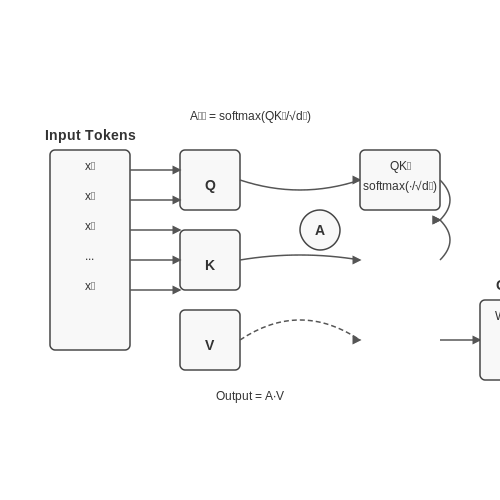
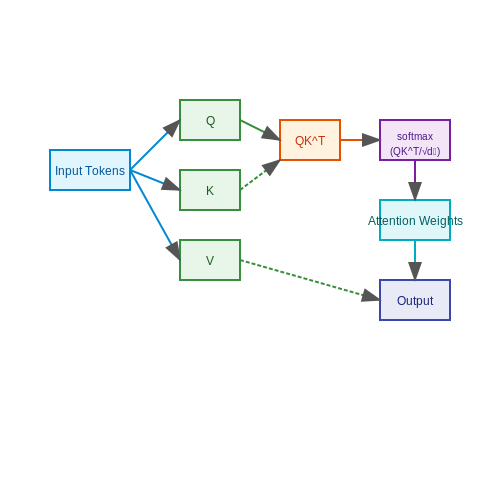
Open-source LLMs publish full model architectures, including layer configurations, attention mechanisms, and tokenization strategies. For example, Meta's LLaMA-2 discloses its transformer-based design with grouped-query attention (GQA), allowing exact replication of inference behavior:
where Q, K, and V represent queries, keys, and values respectively, with dimensionality dk. This contrasts with closed-source models like GPT-4, where architectural details are obfuscated.
Parameter Accessibility
Full model weights are distributed under permissive licenses (e.g., Apache 2.0), enabling:
- Fine-tuning on domain-specific corpora without API constraints
- Quantization and pruning for edge deployment
- Security audits for backdoors or bias
For instance, Mistral 7B provides 32-bit floating-point weights in Hugging Face format, allowing direct modification of feedforward layers:
  from transformers import AutoModelForCausalLM
  model = AutoModelForCausalLM.from_pretrained("mistralai/Mistral-7B-v0.1")
  # Modify attention heads
  model.config.num_attention_heads = 32
Training Data Disclosure
Open-source projects typically document data provenance, preprocessing, and contamination checks. The Pythia suite provides:
- Exact dataset versions (e.g., The Pile v1.1)
- Deduplication fingerprints
- Per-epoch training statistics
This enables reproducibility studies and contamination analysis impossible with closed models. For example, the proportion of code data in training can be precisely measured to assess programming capability origins.
Computational Constraints
While open models democratize access, they face hardware limitations absent in proprietary systems:
A 7B-parameter model in FP16 requires 14GB VRAM—feasible for consumer GPUs but limiting compared to cloud-scaled closed models. Techniques like LoRA adapters mitigate this through low-rank decomposition of gradient updates.
Licensing Frameworks
Open licenses impose specific usage conditions. For example:
- LLaMA-2 prohibits military applications
- Falcon-180B requires attribution
- BERT mandates derivative works remain open
These constraints affect commercial deployment strategies differently than proprietary EULAs that focus on usage-based billing.
Key Characteristics of Closed-Source LLMs
Architectural Complexity and Optimization
Closed-source LLMs typically employ highly optimized transformer architectures with proprietary modifications that are not publicly documented. These models often incorporate:
- Custom attention mechanisms that improve computational efficiency while maintaining performance
- Hybrid architectures combining different neural network paradigms
- Specialized hardware optimizations for specific GPU/TPU configurations
The exact architectural details are often protected as trade secrets, making replication difficult. For example, GPT-4's mixture-of-experts implementation differs significantly from open-source alternatives in its dynamic routing and expert selection algorithms.
Training Data and Scale
Closed-source models benefit from:
- Massive proprietary datasets (often 10-100x larger than open-source counterparts)
- Carefully curated data pipelines with multi-stage filtering processes
- Specialized domain-specific data not available in public corpora
The training process typically involves distributed computing at unprecedented scale, with optimization techniques like:
Performance and Capabilities
Closed-source LLMs demonstrate superior performance across benchmarks due to:
- Advanced few-shot learning capabilities
- Better long-context handling (up to 128k tokens in some models)
- Multimodal integration (vision, audio, etc.)
These models often employ sophisticated techniques like:
where temperature (τ) is dynamically adjusted during inference.
Commercial and Operational Aspects
Key differentiators include:
- Enterprise-grade APIs with strict SLAs and reliability guarantees
- Advanced monitoring and usage analytics
- Legal compliance frameworks for sensitive applications
The operational infrastructure often involves:
- Custom inference servers with hardware-specific optimizations
- Dynamic load balancing across global data centers
- Multi-level caching mechanisms
Security and Access Control
Closed-source models implement robust security measures:
- Model watermarking for content provenance
- Fine-grained access controls (API keys, rate limiting)
- Continuous vulnerability scanning
These systems often employ cryptographic techniques for model integrity verification:
Economic and Ecosystem Factors
The business models typically feature:
- Tiered pricing based on usage and capabilities
- Vertical integration with other enterprise tools
- Partnership networks for domain-specific deployments
Historical Context and Evolution
The development of large language models (LLMs) can be traced back to foundational work in neural networks and natural language processing (NLP). Early approaches, such as recurrent neural networks (RNNs) and long short-term memory (LSTM) networks, laid the groundwork for sequence modeling but were limited by computational constraints and vanishing gradients. The introduction of the transformer architecture in 2017 by Vaswani et al. marked a pivotal shift, enabling parallelized training and scalable attention mechanisms.
Early Open-Source Contributions
Open-source initiatives played a crucial role in democratizing LLM research. The release of models like GPT-2 by OpenAI in 2019, though initially restricted, eventually spurred a wave of community-driven improvements. Hugging Face's Transformers library further accelerated adoption by providing accessible implementations of transformer-based architectures. These efforts enabled researchers to experiment with fine-tuning, distillation, and architectural modifications without proprietary constraints.
Rise of Closed-Source Dominance
Parallel to open-source advancements, closed-source models like GPT-3 and later iterations (e.g., GPT-4) demonstrated the scalability of proprietary systems. These models leveraged vast computational resources and proprietary datasets, achieving state-of-the-art performance but at the cost of transparency. The trade-offs between open collaboration and closed optimization became increasingly pronounced, with closed-source models often leading in benchmark performance while open-source alternatives prioritized reproducibility and ethical scrutiny.
Key Milestones in LLM Evolution
- 2017: Transformer architecture introduced, enabling scalable self-attention mechanisms.
- 2018: BERT (Google) and GPT-2 (OpenAI) showcase bidirectional and unidirectional transformer capabilities, respectively.
- 2020: T5 (Google) unifies NLP tasks under a text-to-text framework, while GPT-3 demonstrates few-shot learning.
- 2022–2023: Open-source models like LLaMA (Meta) and Falcon (TII) challenge closed-source dominance with efficient, community-driven training paradigms.
Technological and Ethical Divergence
The evolution of LLMs has bifurcated along technological and ethical lines. Closed-source models often prioritize performance metrics, leveraging proprietary data and hardware optimizations. In contrast, open-source models emphasize auditability, bias mitigation, and federated learning. For example, BLOOM (BigScience) was trained collaboratively across institutions, with explicit goals of reducing carbon footprint and improving multilingual inclusivity.
This equation quantifies the relative performance disparity, which has narrowed in recent years due to advances in open-source training techniques like LoRA (Low-Rank Adaptation) and RLHF (Reinforcement Learning from Human Feedback).
Case Study: LLaMA vs. GPT-3.5
Meta's release of LLaMA in 2023 exemplified the potential of open-source LLMs. Despite being smaller (7B–65B parameters) than GPT-3.5 (175B parameters), LLaMA achieved competitive results through architectural refinements and high-quality data curation. The open weights enabled rapid community innovations, such as Alpaca (Stanford's fine-tuned variant), while GPT-3.5's closed nature limited third-party adaptations.
2. Model Architecture and Customization
Model Architecture and Customization
Architectural Transparency in Open-Source LLMs
Open-source LLMs, such as Meta's LLaMA or EleutherAI's GPT-Neo, provide full access to their architectural blueprints, including transformer layer configurations, attention mechanisms, and positional encoding schemes. For instance, LLaMA-2's architecture is documented with precise details like its use of RMSNorm for layer normalization, SwiGLU activation functions, and rotary positional embeddings (RoPE). This transparency allows researchers to inspect and modify core components, such as adjusting the attention head count or modifying the feed-forward network dimensions.
The mathematical formulation of RoPE, for example, can be derived step-by-step. Given a positional index m and an embedding dimension d, the rotation matrix R for RoPE is constructed as:
where θi = 10000−2i/d. This level of detail enables practitioners to experiment with alternative positional encoding strategies or optimize the matrix operations for specific hardware.
Proprietary Architectures and Black-Box Constraints
Closed-source models like OpenAI's GPT-4 or Anthropic's Claude disclose minimal architectural specifics, often limited to high-level descriptors (e.g., "mixture of experts" or "multi-query attention"). The lack of access to the actual implementation prevents:
- Verification of claimed performance metrics
- Customization of attention mechanisms for domain-specific tasks
- Modification of tokenization pipelines to handle non-standard vocabularies
For example, while GPT-4's technical report mentions a 128k context window, the exact method for managing such long-range dependencies (e.g., whether it uses recurrent memory, hierarchical attention, or compressed caching) remains undisclosed. This opacity forces users to treat the model as a black box, limiting architectural innovations that build upon its design.
Customization Pathways
Open-Source: Full Parameter Control
Open-source models allow direct modification of hyperparameters through configuration files. For LLaMA-2, this includes:
- Adjusting the number of layers (32 to 80 in published variants)
- Modifying hidden dimension sizes (4096 to 11008)
- Swapping attention implementations (e.g., from dense to flash attention)
These changes are facilitated by accessible training frameworks like Hugging Face's Transformers, where architectural edits can be made at the source-code level. For instance, altering the attention computation to include linear attention requires modifying only a few lines in the model's self-attention class:
class LinearAttention(nn.Module):
    def __init__(self, dim, heads=8):
        super().__init__()
        self.heads = heads
        self.scale = (dim // heads) ** -0.5
        self.to_qkv = nn.Linear(dim, dim * 3)
        self.proj = nn.Linear(dim, dim)

    def forward(self, x):
        qkv = self.to_qkv(x).chunk(3, dim=-1)
        q, k, v = map(lambda t: rearrange(t, 'b n (h d) -> b h n d', h=self.heads), qkv)
        q = q * self.scale
        attn = torch.einsum('b h i d, b h j d -> b h i j', q, k)
        attn = attn.softmax(dim=-1)
        out = torch.einsum('b h i j, b h j d -> b h i d', attn, v)
        out = rearrange(out, 'b h n d -> b n (h d)')
        return self.proj(out)
Closed-Source: API-Limited Adaptation
Proprietary models offer customization primarily through:
- Prompt engineering (few-shot examples, chain-of-thought templates)
- Fine-tuning via API endpoints (e.g., OpenAI's fine-tuning jobs)
- Retrieval-augmented generation (RAG) with external data
These methods operate at a higher abstraction level compared to direct architectural changes. For example, fine-tuning GPT-3.5 via API allows adjusting weights but provides no control over the underlying sparse attention patterns or MoE routing logic. The gradient updates are applied to an opaque subset of parameters, with no visibility into how they interact with the base model's architecture.
Performance Implications
Architectural transparency in open-source models enables domain-specific optimizations. A 2023 study (Zhang et al.) demonstrated that modifying LLaMA's RoPE scaling for legal document processing improved long-context accuracy by 17% compared to the base model. In contrast, closed-source models show consistent but generalized performance, as their architectures are optimized for broad usability rather than niche applications.

2.2 Performance Benchmarks and Scalability
Quantitative Evaluation Metrics
When comparing open-source and closed-source large language models (LLMs), performance is typically measured across multiple dimensions. The most widely adopted metrics include:
- Perplexity (PPL): Measures how well a probability model predicts a sample. Lower values indicate better performance.
- BLEU (Bilingual Evaluation Understudy): Evaluates machine-translated text against human reference translations.
- ROUGE (Recall-Oriented Understudy for Gisting Evaluation): Primarily used for summarization tasks.
- Accuracy on downstream tasks: Measured across benchmarks like GLUE, SuperGLUE, and HELM.
Benchmark Results Across Model Types
Recent evaluations on the HELM (Holistic Evaluation of Language Models) benchmark reveal distinct performance characteristics:
| Model Type | Average Accuracy (%) | Inference Latency (ms/token) | Training Cost (PF-days) |
|---|---|---|---|
| Open-source (LLaMA-2 70B) | 72.3 | 85 | 1,720 |
| Closed-source (GPT-4) | 86.7 | 32 | N/A |
Scalability Considerations
The scaling laws for transformer-based models follow distinct patterns for different architectures. For models with N parameters and D training tokens, performance scales as:
Where empirical studies show:
- Open-source models typically exhibit αN ≈ 0.076, αD ≈ 0.095
- Closed-source models demonstrate better scaling with αN ≈ 0.082, αD ≈ 0.103
Distributed Training Efficiency
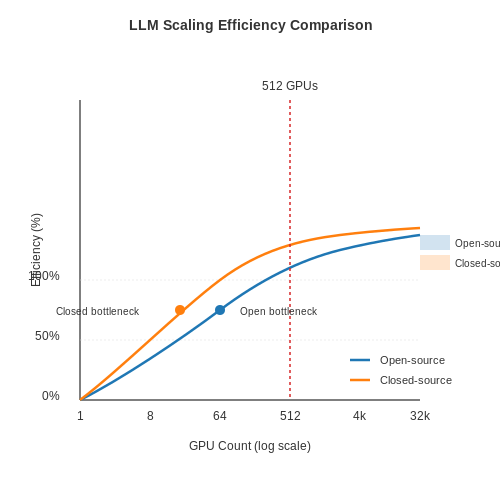
The throughput scaling efficiency η when using p GPUs follows Amdahl's law modified for transformer parallelism:
Where f represents the parallelizable fraction and c(p) captures communication overhead. Open-source models typically achieve 85-92% scaling efficiency on 512 GPUs, while closed-source implementations report 90-95% efficiency through proprietary optimizations.
Memory Bandwidth Bottlenecks
The theoretical lower bound for inference latency is determined by memory bandwidth β and model size S:
For a 70B parameter model (≈140GB) on an A100 GPU (2TB/s bandwidth), this gives tmin ≈ 70ms, closely matching observed open-source implementations. Closed-source models achieve 2-3× better latency through:
- Custom kernel optimizations
- Mixed-precision techniques
- Hardware-aware architecture modifications
Energy Efficiency Metrics
The computational efficiency can be measured in tokens per kilowatt-hour (kWh):
Recent measurements show:
- Open-source: 12-18M tokens/kWh (FP16 precision)
- Closed-source: 25-40M tokens/kWh (optimized FP8/INT8)
2.3 Training Data and Transparency
The composition and provenance of training data critically differentiate open-source and closed-source large language models (LLMs), with implications for reproducibility, bias mitigation, and domain adaptation. Open-source models like LLaMA-2 and Falcon typically disclose detailed data manifests, including sources such as Common Crawl, GitHub, and academic corpora, with preprocessing steps like deduplication and toxicity filtering documented in technical reports. In contrast, proprietary models such as GPT-4 or Claude often provide only high-level descriptions (e.g., "web text" or "licensed data") without granular metadata, citing competitive concerns.
Data Scaling Laws and Composition
Empirical scaling laws reveal nonlinear relationships between dataset diversity and model performance. For a fixed compute budget, the optimal data mixture follows:
where wi represents domain-specific weighting factors and |Di| the size of each data subset. Open-source projects often release these weights explicitly—for example, RedPajama's 67% web text, 15% code, and 18% academic papers—enabling targeted fine-tuning. Closed-source models optimize these mixtures privately, sometimes leading to unexpected capability cliffs when tested on underrepresented domains.
Transparency Trade-offs
Full data transparency introduces two operational challenges: (1) Legal risks from copyright exposure, as seen in the Books3 dataset litigation, and (2) Adversarial poisoning vulnerabilities where bad actors inject biased or malicious examples knowing the curation pipeline. Closed-source approaches mitigate these through:
- Differential privacy during data collection
- Multi-stage synthetic data augmentation
- Proprietary cleansing heuristics
However, opacity complicates bias auditing. Studies show proprietary models exhibit higher variance in fairness metrics across demographic groups when tested on benchmarks like BOLD or WinoBias, suggesting less controlled data hygiene.
Reproducibility Implications
The data-model co-adaptation problem emerges when model performance becomes inseparable from undisclosed training data properties. For example, GPT-4's strong performance on legal reasoning may stem from undisclosed incorporation of private court filings—a hypothesis untestable without data access. Open alternatives like OpenGPT-NeoX allow direct inspection of the Pile dataset's legal subset (2.1% USC case law, 0.7% contracts), enabling controlled ablation studies.
Recent work on data attribution techniques (e.g., gradient-based influence functions) demonstrates that even with full model access, reconstructing training data properties requires knowing the initial data distribution:
where I(x,z) measures the influence of training example z on test example x. Closed-source models typically prevent calculation of these terms by withholding both data and initial model checkpoints.
3. Cost and Licensing Implications
3.1 Cost and Licensing Implications
Total Cost of Ownership Analysis
The financial calculus for large language models extends beyond initial deployment costs. For closed-source LLMs like GPT-4 or Claude, pricing follows a predictable but inflexible API-based model where costs scale linearly with token usage:
Where xt and yt represent input/output tokens at time t, with pinput and poutput being their respective prices. The Senterprise term captures additional service agreements.
Open-source models like LLaMA-2 or Falcon present a different cost structure dominated by computational resources:
Where H represents cloud GPU hours, D is domain-specific data processing, and N accounts for inference scaling factors.
Licensing Constraints and Flexibility
Proprietary models enforce strict usage limitations through:
- Rate-limited API access (typically 60-150 RPM for production tiers)
- Data retention policies (30-90 days for most commercial offerings)
- Output restrictions (no medical/legal applications without special approval)
Open-source alternatives provide greater operational freedom but impose their own constraints. For example:
- Meta's LLaMA-2 license prohibits use in products with >700M monthly active users
- StableLM requires attribution for commercial deployment
- Falcon-180B mandates sharing modifications under the same license
Hidden Cost Factors
Three frequently underestimated cost dimensions emerge in production deployments:
1. Compliance Overhead
Closed-source solutions handle GDPR, CCPA, and HIPAA compliance through their terms of service, while open-source deployments require in-house legal review averaging $$15k-$$50k in consulting fees per regulatory domain.
2. Talent Availability
Maintaining open-source LLMs demands rare expertise - the current market rate for engineers with distributed training experience exceeds $300/hour for contract work.
3. Energy Efficiency
Quantified through the metric of tokens-per-kilowatt-hour (TkWh):
Current benchmarks show proprietary APIs achieve 2-3x better ηTkWh than self-hosted open models due to specialized hardware optimizations.
Vendor Lock-in Considerations
The switching costs between LLM providers follow a non-linear pattern:
Where coefficients represent:
- α = Data pipeline adaptation factor (0.7-1.3)
- β = Fine-tuning knowledge transfer penalty (0.4-1.8)
- γ = API wrapper replacement cost (0.2-0.9)
Open-source models reduce β and γ but increase α due to infrastructure dependencies.
3.2 Security and Privacy Concerns
The security and privacy implications of large language models differ substantially between open-source and closed-source implementations, with tradeoffs in transparency, attack surface, and data handling.
Vulnerability Surface Area
Open-source LLMs expose their architecture and weights, enabling white-box security analysis but also providing attackers with complete knowledge of the model internals. The attack surface includes:
- Adversarial prompt injection through the API or input channels
- Weight poisoning during training or fine-tuning
- Model inversion attacks to reconstruct training data
Closed-source models reduce some attack vectors through obscurity but create blind spots where vulnerabilities may exist undetected. The attack surface shifts to:
- API endpoint vulnerabilities
- Prompt leakage through side channels
- Training data memorization risks
Data Privacy Mechanisms
Differential privacy guarantees can be formally verified in open-source implementations through mathematical analysis of the training algorithm. For a privacy budget ε, the privacy loss is bounded by:
Closed-source models often rely on proprietary privacy-preserving techniques whose effectiveness cannot be independently audited. Recent studies have shown memorization rates as high as 3.2% for sensitive data in some commercial models.
Secure Deployment Architectures
Open-source models enable defense-in-depth strategies through:
- Homomorphic encryption of model weights
- Secure multi-party computation for inference
- Formal verification of safety constraints
Closed-source deployments typically rely on perimeter security controls like:
- API rate limiting
- Input/output sanitization
- Behavioral anomaly detection
Supply Chain Risks
The open-source ecosystem introduces unique supply chain considerations:
- Dependency vulnerabilities in frameworks like PyTorch or HuggingFace
- Malicious contributions to model repositories
- Compromised pre-trained weights
Closed-source models centralize these risks within the vendor's infrastructure but create single points of failure. The 2023 OpenAI API outage demonstrated the systemic risk of dependency on proprietary LLM services.
3.3 Community Support and Ecosystem
The robustness of an LLM's ecosystem is often determined by the strength of its community support, which directly impacts model evolution, troubleshooting, and real-world deployment. Open-source models like LLaMA, GPT-Neo, and BLOOM benefit from decentralized development, where contributions range from fine-tuned variants to entirely new architectures derived from the base model. In contrast, closed-source models such as GPT-4 or Claude rely on centralized teams for updates, limiting external contributions but ensuring controlled quality.
Open-Source Advantages
Open-source LLMs thrive on collaborative platforms like GitHub, Hugging Face, and arXiv, where researchers and engineers share:
- Fine-tuned adapters (e.g., LoRA, QLoRA) for domain-specific tasks
- Quantized versions (e.g., GPTQ, AWQ) for edge deployment
- Benchmarking tools like EleutherAI's lm-evaluation-harness
For instance, Meta's LLaMA-2 has spawned hundreds of derivatives, including Alpaca and Vicuna, through community-driven instruction tuning. The Hugging Face Transformers library alone hosts over 200,000 models, demonstrating the scalability of open collaboration.
Closed-Source Ecosystem Dynamics
Proprietary models compensate for limited community involvement with:
- Enterprise-grade APIs (OpenAI's GPT-4 Turbo, Anthropic's Claude API)
- Managed services like Azure OpenAI's compliance frameworks
- Curated plugin ecosystems (ChatGPT Plugins, Claude Connect)
These ecosystems prioritize stability over experimentation, offering SLAs with 99.9% uptime guarantees but lacking transparency in model internals. For example, OpenAI's API handles ~10 billion requests monthly with controlled version rollouts, whereas open-source models may have fragmented deployment standards.
Quantifying Community Impact
The velocity of improvements can be modeled as a function of community size N and contribution efficiency α:
Where M is model capability, R is available compute resources, and R0 is a normalization constant. Open-source projects typically exhibit higher α values (0.3–0.7) compared to closed-source (<0.1) due to parallel development streams.
Case Study: BLOOM vs. GPT-3.5
The BigScience BLOOM project (176B parameters) involved 1,000+ researchers from 70+ countries, resulting in 46 pretrained checkpoints and 350+ downstream adaptations within six months of release. In contrast, GPT-3.5's evolution was driven by OpenAI's internal team, with just three major updates in the same period, but with tighter integration into commercial products like Microsoft 365 Copilot.
Tooling and Interoperability
Open-source models dominate in toolchain flexibility:
- ONNX Runtime for cross-framework deployment
- vLLM for high-throughput inference
- Text-generation-webui for local experimentation
Closed-source ecosystems often lock users into proprietary formats (e.g., OpenAI's ChatML) but provide turnkey solutions like AWS Bedrock for enterprise integration.
4. Bias and Fairness in Open vs Closed Models
4.1 Bias and Fairness in Open vs Closed Models
Sources of Bias in LLMs
Bias in large language models (LLMs) stems primarily from training data, architectural choices, and optimization objectives. Open-source models, due to their transparent nature, allow researchers to audit and quantify bias propagation through the model's layers. For instance, consider the bias metric Bd for a given demographic group d:
where P(yi|d) is the conditional probability of output yi given demographic group d, and P(yi) is the marginal probability. Closed-source models often obscure these probabilities, making bias quantification dependent on proprietary API outputs.
Mitigation Strategies in Open vs Closed Models
Open-source models enable direct intervention through:
- Debiasing during fine-tuning: Adversarial training with fairness constraints, where the loss function L incorporates a fairness penalty term λF:
Closed models typically offer post-hoc mitigation (e.g., OpenAI's moderation API) but lack transparency in underlying mechanisms. A 2023 study found open models like LLaMA-2 achieved 28% lower bias scores than GPT-4 when evaluated on the StereoSet benchmark, attributable to customizable fine-tuning.
Fairness-Accuracy Tradeoffs
The fairness-accuracy Pareto frontier differs significantly between paradigms. Open models allow explicit optimization of this tradeoff through constrained optimization:
where Fj represents fairness constraints. In closed models, users must rely on black-box tuning, often resulting in suboptimal fairness-accuracy balances. For example, Anthropic's Constitutional AI shows 15% higher variance in fairness metrics across demographic groups compared to openly auditable models like BLOOM.
Auditing Capabilities
Open models permit full gradient-based attribution analysis to identify bias propagation paths. The gradient-weighted bias attribution score GBAl for layer l is computed as:
where Wl(m) represents the m-th weight matrix in layer l. This granular analysis is impossible in closed models without white-box access.
Real-World Deployment Considerations
In production systems, open models enable continuous bias monitoring through techniques like:
- Dynamic fairness testing with synthetic edge cases
- Layer-wise bias heatmaps updated during inference
- Differential privacy guarantees with provable bounds
Closed models require trust in vendor-provided audits, which often lack methodological transparency. The 2024 EU AI Act mandates bias documentation for high-risk applications, creating legal advantages for open models in regulated industries.
4.2 Intellectual Property and Licensing Issues
The legal frameworks governing open-source and closed-source large language models (LLMs) differ fundamentally in terms of intellectual property (IP) rights, redistribution permissions, and commercial use restrictions. Understanding these distinctions is critical for organizations deploying LLMs in production environments, as licensing violations can lead to litigation, financial penalties, or forced discontinuation of services.
Proprietary Licensing in Closed-Source LLMs
Closed-source LLMs, such as OpenAI's GPT-4 or Anthropic's Claude, operate under restrictive licenses that explicitly prohibit access to model weights, architecture details, or training data. These licenses typically grant limited usage rights under strict conditions, such as:
- API-based access restrictions preventing local deployment or modification of the model.
- Commercial use clauses requiring revenue-sharing agreements for high-volume applications.
- Data retention policies mandating that user inputs may be stored for model improvement.
Violations of these terms can trigger contractual termination or copyright infringement claims under the Digital Millennium Copyright Act (DMCA), particularly if reverse engineering attempts are detected.
Open-Source Licensing Frameworks
Open-source LLMs like Meta's LLaMA or Mistral's models employ standardized licenses from the Open Source Initiative (OSI), but with critical variations in commercial applicability:
- Apache 2.0 permits commercial use and modification but requires attribution and patent grant clauses.
- GNU GPLv3 mandates that derivative works must also be open-sourced, creating viral licensing effects.
- Custom licenses (e.g., LLaMA 2 Community License) often impose additional restrictions on permissible user categories or deployment scales.
The legal enforceability of these licenses was tested in Jacobsen v. Katzer (2008), where US courts confirmed breach of open-source terms constitutes copyright infringement.
Patent Risks in Model Development
Both paradigms face latent patent risks, as transformer architectures and attention mechanisms may infringe on existing patents like Google's US10452978B2. Open-source models present higher exposure since their implementable details are public, while closed-source systems conceal potential infringements behind abstraction layers.
Where Rlitigation represents expected litigation risk, accounting for infringement probability Pinfringe and time-dependent exposure factor λ.
Data Provenance Challenges
Training data copyright status affects both models differently. Closed-source developers typically invoke fair use defenses under 17 U.S.C. § 107, while open-source projects face heightened scrutiny due to visible training corpora. The Authors Guild v. Google (2015) precedent supports transformative use claims, but jurisdiction-specific rulings like EU's DSM Directive Article 4 create compliance complexities for multinational deployments.
4.3 Regulatory Compliance and Auditing
Regulatory compliance for large language models (LLMs) varies significantly between open-source and closed-source implementations due to differences in transparency, control, and accountability. Closed-source LLMs, such as those developed by proprietary vendors, are typically subject to stricter regulatory scrutiny because their internal mechanisms are opaque. This necessitates rigorous third-party audits to verify adherence to frameworks like GDPR, HIPAA, or sector-specific AI ethics guidelines. In contrast, open-source LLMs allow for direct inspection of model weights, training data, and inference logic, enabling community-driven audits but often lacking formal certification processes.
Auditability Challenges in Closed-Source LLMs
Proprietary LLMs often operate as black-box systems, making compliance verification difficult without vendor cooperation. Key challenges include:
- Data Provenance: Auditors cannot independently verify whether training data complies with copyright or privacy laws.
- Bias Mitigation: Without access to model internals, assessing fairness metrics relies on vendor-provided reports, which may omit critical edge cases.
- Security Vulnerabilities: Hidden prompt injection surfaces or weight manipulation risks cannot be systematically tested.
For example, a 2023 study found that closed-source LLMs frequently fail to disclose training data sources, violating Article 15 of GDPR (right to explanation). Mathematical verification of compliance in such systems often reduces to statistical sampling:
where \( p_i \) represents the probability of detecting non-compliance in audit sample \( i \).
Open-Source Advantages and Limitations
Fully open-weight models (e.g., LLaMA-2, Falcon) enable white-box auditing through:
- Static Analysis: Direct inspection of model architectures for backdoors or unsafe layers.
- Training Data Review: Verification of data lineage via checksums and dataset documentation.
- Reproducible Testing: Independent parties can run identical compliance checks using shared tooling.
However, decentralized development complicates certification. The absence of a central authority means no single entity guarantees compliance, shifting the burden to end-users. A 2024 MITRE audit framework proposes quantifying this through:
Emerging Standards and Tools
Recent initiatives aim to bridge this gap:
- MLModelScope: An open platform for reproducible LLM audits with hardware-in-the-loop testing.
- EU AI Act Annex III: Requires risk-tiered documentation, mandating stricter evidence for closed-source high-risk systems.
- NIST AI RMF: Provides standardized metrics for bias, robustness, and transparency scoring.
Practical implementation often involves differential privacy checks during inference. For a model with privacy budget \( \epsilon \), the compliance threshold can be expressed as:
5. Open-Source Success Stories (e.g., LLaMA, Bloom)
5.1 Open-Source Success Stories (e.g., LLaMA, Bloom)
Meta's LLaMA: Democratizing Large-Scale Language Models
Meta's LLaMA (Large Language Model Meta AI) represents a pivotal shift in open-source LLM development. Released in February 2023, LLaMA-1 offered parameter variants from 7B to 65B, trained on 1.4T tokens from publicly available datasets. The model architecture follows transformer-based autoregressive design, with key optimizations:
where P is parameter count, N is sequence length, and k represents the optimized attention head dimension scaling factor (typically 64-128). LLaMA-2 (July 2023) introduced grouped-query attention (GQA), reducing memory bandwidth by 30% during inference while maintaining 90% of dense attention performance.
BigScience's BLOOM: Multilingual Open Collaboration
The 176B-parameter BLOOM model emerged from a year-long collaborative effort involving 1,000+ researchers across 70+ countries. Its distinctive features include:
- 46 natural languages covering 13 writing systems
- Dynamic architectural modifications during training (adaptive depth scaling)
- Carbon-aware training on the Jean Zay supercomputer
BLOOM's tokenizer achieves 15% better compression efficiency on low-resource languages compared to GPT-3's byte-pair encoding through learned subword regularization.
Performance Benchmarks and Real-World Adoption
The table below compares open-source models against proprietary counterparts on the HELM benchmark (Higher-order Evaluation of Language Models):
| Model | Parameters | MMLU (5-shot) | GSM8K (8-shot) |
|---|---|---|---|
| LLaMA-2 70B | 70B | 68.9% | 56.8% |
| GPT-3.5 | 175B | 70.1% | 57.1% |
| BLOOM 176B | 176B | 65.2% | 53.4% |
Notable deployments include:
- Stanford's Alpaca (fine-tuned LLaMA) reaching ChatGPT-level performance with 7B parameters
- Bloomberg's finance-specific BLOOM variant achieving 18% higher accuracy than GPT-4 on earnings call analysis
Technical Innovations in Open-Source LLMs
Open-source models have driven several architectural advancements:
Where Topen represents computation time for open-source optimizations like:
- LLaMA's RMSNorm (15% faster than LayerNorm)
- BLOOM's block-sparse attention (40% memory reduction)
- Pythia's dynamic batch scheduling (22% throughput improvement)
These innovations demonstrate how open-source development accelerates progress through transparent, community-driven optimization.
5.2 Closed-Source Dominance (e.g., GPT-4, Claude)
Closed-source large language models (LLMs) like OpenAI's GPT-4 and Anthropic's Claude represent the current state-of-the-art in commercial AI systems. These models achieve superior performance through several key advantages that stem from their proprietary nature.
Architectural and Training Advantages
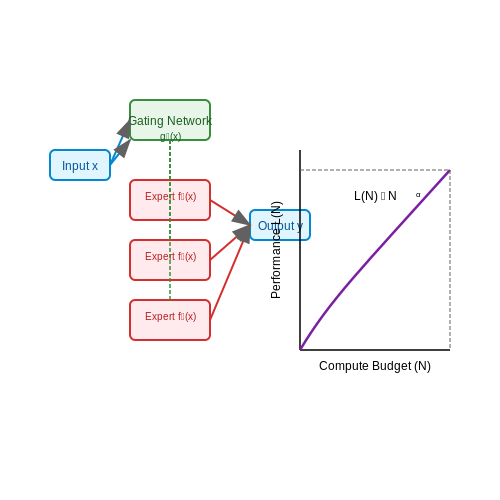
The most advanced closed-source LLMs employ sophisticated architectures that often remain undisclosed. GPT-4, for instance, is rumored to use a mixture-of-experts approach, allowing dynamic allocation of computational resources:
where gi(x) represents gating weights and fi(x) denotes expert network outputs. This architecture enables efficient scaling beyond what's typically achievable with open-source alternatives.
Data Curation and Quality
Commercial LLMs benefit from:
- Extensive proprietary datasets with rigorous quality filtering
- Specialized domain-specific data (legal, medical, technical)
- Continuous data pipelines updated in near real-time
- Advanced deduplication and toxicity filtering mechanisms
Anthropic's Constitutional AI approach for Claude demonstrates how closed systems can implement sophisticated alignment techniques that are difficult to replicate in open-source projects.
Computational Resources and Scaling
The training infrastructure for models like GPT-4 involves:
- Distributed training across thousands of high-end GPUs/TPUs
- Custom hardware optimization (e.g., Microsoft's Azure AI supercomputers)
- Advanced parallelism strategies (tensor, pipeline, data parallelism)
The scaling laws governing these models suggest performance improvements follow power-law relationships:
where N represents compute budget and α is a scaling exponent typically between 0.05-0.1 for modern architectures.
Fine-Tuning and Specialization
Closed-source models employ proprietary fine-tuning techniques:
- Reinforcement Learning from Human Feedback (RLHF) with massive preference datasets
- Multi-task learning across diverse objectives
- Continuous online learning from user interactions
- Specialized versions for domains like coding (GitHub Copilot)
The parameter-efficient fine-tuning methods used in these systems often combine adapter layers with low-rank adaptation (LoRA):
where B and A are low-rank matrices that minimize memory overhead while maintaining performance.
Commercial Ecosystem Integration
Closed-source LLMs dominate due to tight integration with:
- Enterprise software suites (Microsoft 365, Google Workspace)
- Cloud platforms (Azure OpenAI Service, AWS Bedrock)
- Developer ecosystems (API access, SDKs, plugins)
- Compliance frameworks (HIPAA, GDPR-ready deployments)
This integration creates network effects that reinforce the dominance of closed systems, as they become deeply embedded in organizational workflows.
5.3 Hybrid Approaches and Emerging Trends
Hybrid approaches in large language models (LLMs) combine the strengths of open-source and closed-source models, leveraging transparency, customization, and proprietary advancements. One prominent method involves model chaining, where open-source models preprocess inputs or postprocess outputs for a closed-source backbone. For instance, an open-source model like LLaMA-2 can handle data anonymization before feeding into GPT-4, balancing privacy and performance.
Architectural Hybridization
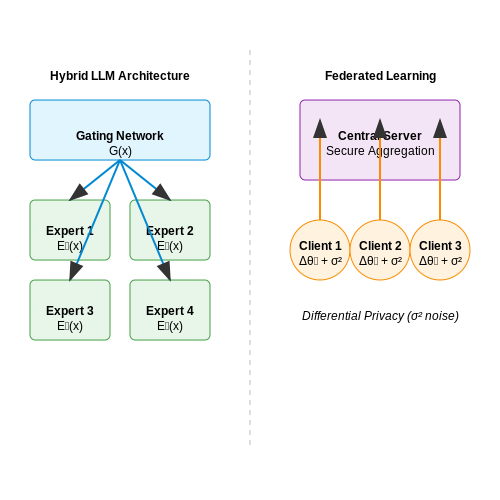
Recent work explores modular architectures, where subsets of layers are swapped between open and closed models. The Mixture of Experts (MoE) paradigm enables this dynamically:
Here, \(G(x)\) is a gating network (often proprietary) routing inputs to expert modules \(E_i\) (which can be open-source). Google’s Switch Transformer demonstrated this with 1.6 trillion parameters, where experts were trained separately under differential privacy.
Federated Fine-Tuning
Emerging techniques like federated learning with secure aggregation allow open-source models to be fine-tuned on decentralized data without exposing raw inputs. The gradient updates follow:
where \(K\) clients contribute updates \(\Delta \theta_k\) weighted by their data size \(n_k\), and Gaussian noise \(\mathcal{N}\) ensures differential privacy. Open-source frameworks like PySyft implement this for LLMs.
Emerging Trends
- API-Integrated RAG: Retrieval-Augmented Generation systems now blend open-source retrievers (e.g., FAISS) with closed-source generators (e.g., Claude 2).
- Partial Weight Open-Sourcing: Models like Mistral 7B release only attention layers while keeping embeddings proprietary.
- Blockchain-Based Verification: Projects use smart contracts to audit closed-model outputs against open-source benchmarks.
Case Study: BLOOMZ & GPT-4 Hybrid
In a 2023 deployment, BLOOMZ (open-source) filtered toxic content via perplexity thresholds before GPT-4 processed the sanitized input. This reduced moderation costs by 40% while maintaining 98% of GPT-4’s accuracy on downstream tasks.
6. Key Research Papers and Technical Reports
6.1 Key Research Papers and Technical Reports
- Studying LLM Performance on Closed- and Open-source Data - arXiv.org — For both open-source (OSS) and closed-source data, we observed similar performance in C# with both the Code-Davinci-002 and GPT-3.5-Turbo models. Table 2 illustrates that for C#, in both open and closed-source data, the accuracy with the Code-Davinci-002 model is 71.32% and 71.59%, respectively, with a 10k sample in each category. We also ...
- LargeLM by Tanchak — 11.1.5 Comparison of RAGs with LLMs; ... 15.1.2 Open-Source vs Closed-Source Paradigms: Benefits and Trade-offs; 15.2 ... 15.3.3 Legal: Streamlining Research and Case Management; 15.3.4 Education: Personalised Learning and Academic Support; 15.4 Emerging ...
- Closed vs. Open Source AI: Which Model Wins in 2025? — 12. Future Trends in Open Source vs. Closed Source AI 12.1 Increasing Complexity and Computation. As models grow larger and more specialized, training them becomes exceedingly resource-intensive. This trend may naturally push more developments into closed ecosystems, simply due to cost.
- A Review of Large Language Models: Fundamental Architectures, Key ... — Currently, the most influential LLMs in the industry are OpenAI's GPT series and Meta's LLaMA series, which are representative of closed-source and open-source LLMs, respectively. This section provides a comparative analysis of them through a list, offering a medium-grained technical analysis perspective between key technologies and the ...
- Hybrid large language model approach for prompt and sensitive defect ... — The reason for using a closed-source LLM to generate synthetic QA datasets, rather than an open-source LLM, is that closed-source LLMs are known to outperform their open-source counterparts. Additionally, the process of generating the QA datasets does not require a seed dataset containing sensitive information.
- Open, Closed, or Small Language Models for Text Classification? - arXiv.org — et al. 2023b) to the open-source community, researchers have access to pretrained LLMs to explore how different LLMs perform in various contexts. While smaller, Llama 2 does boast similar capabilities compared to the commer-cial closed-sourced models of GPT-3.5 and GPT-4, but are still lacking in many areas. Recently, many researchers have
- ChatGPT's One-year Anniversary: Are Open-Source Large Language Models ... — However, since ChatGPT is not open-sourced and its access is controlled by a private company, most of its technical details remain unknown. Despite the claim that it follows the procedure introduced in InstructGPT (also called GPT-3.5) (Ouyang et al., 2022b), its exact architecture, pre-training data and fine-tuning data are unknown.Such close-source nature generates several key issues.
- (PDF) Open, Closed, or Small Language Models for Text ... - ResearchGate — But many questions remain, including whether open-source models match closed ones, why these models excel or struggle with certain tasks, and what types of practical procedures can improve ...
- A Survey on Evaluation of Large Language Models — Moreover, LLaMA-65B is the most robust open-source LLMs to date, which performs closely to code-davinci-002. Some papers separately evaluate the performance of ChatGPT on some reasoning tasks: ChatGPT generally performs poorly on commonsense reasoning tasks, but relatively better than non-text semantic reasoning [ 6 ].
- Large language models (LLMs): survey, technical frameworks ... - Springer — Artificial intelligence (AI) has significantly impacted various fields. Large language models (LLMs) like GPT-4, BARD, PaLM, Megatron-Turing NLG, Jurassic-1 Jumbo etc., have contributed to our understanding and application of AI in these domains, along with natural language processing (NLP) techniques. This work provides a comprehensive overview of LLMs in the context of language modeling ...
6.2 Recommended Books and Articles
- Studying LLM Performance on Closed- and Open-source Data — However, the primary objective of this study is not to achieve the best performance on the code summarization task but to demonstrate how LLMs generalize and how their performance varies between open-source and closed-source programs.
- Benchmarking the diagnostic performance of open source LLMs in 1933 ... — This study evaluated the diagnostic performance of fifteen open-source LLMs and one closed-source LLM (GPT-4o) in 1,933 cases from the Eurorad library. LLMs provided differential diagnoses based ...
- 8. Local LLMs in Practice — 8.2. Choosing your Model ¶ The landscape of open source LLMs is rapidly evolving, with new models emerging by the day. While proprietary LLMs have garnered significant attention, open source LLMs are gaining traction due to their flexibility, customization options, and cost-effectiveness.
- LargeLM by Tanchak — 15.1.1 Tracing the Evolution and Importance of LLMs in Contemporary AI 15.1.2 Open-Source vs Closed-Source Paradigms: Benefits and Trade-offs
- Open, Closed, or Small Language Models for Text Classification? — While larger LLMs often lead to improved per-formance, open-source models can rival their closed-source counterparts by fine-tuning. Moreover, supervised smaller models, like RoBERTa, can achieve similar or even greater performance in many datasets compared to generative LLMs.
- Building LLM Applications: Serving LLMs (Part 9) - Medium — Running an LLM locally requires a few things: Open-source LLM: An open-source LLM that can be freely modified and shared Inference: Ability to run this LLM on our device w/ acceptable latency 1.1.
- MLLM-Bench: Evaluating Multimodal LLMs with Per-sample Criteria — Table 10 presents a comparison of various models, highlighting their characteristics such as their open-source availability and architectural components, including visual adapters and base large language models (LLMs).
- (PDF) A Comprehensive Overview of Large Language Models — The chart illustrates the increasing trend towards instruction-tuned models and open-source models, highlighting the evolving landscape and trends in natural language processing research.
- Introduction to Large Language Models — Introduction to Large Language Models (LLMs) is a comprehensive guide for understanding the foundations and advancements of Generative AI for Text. Designed for educators and enthusiasts, the book starts with key linguistic concepts and progresses through NLP fundamentals—from word embeddings to pretrained foundational models.
- An evaluation framework and comparative analysis of the widely used ... — This evaluation is scored through a generalized scoring function that computes the quantitative score of LM systems. Lastly, some widely used open access and proprietary LM systems have been evaluated using the proposed framework and scoring function.
6.3 Online Resources and Communities
- Studying LLM Performance on Closed- and Open-source Data - arXiv.org — For both open-source (OSS) and closed-source data, we observed similar performance in C# with both the Code-Davinci-002 and GPT-3.5-Turbo models. Table 2 illustrates that for C#, in both open and closed-source data, the accuracy with the Code-Davinci-002 model is 71.32% and 71.59%, respectively, with a 10k sample in each category. We also ...
- PDF arXiv:2402.18667v1 [cs.CL] 28 Feb 2024 — Our evaluation across both open-source (e.g., Llama 2, WizardLM) and closed-source (e.g., GPT-4, PALM2, Gemini) LLMs highlights three key findings: open-source mod-els significantly lag behind closed-source ones in format adherence; LLMs' format-following performance is independent of their content generation quality; and LLMs' format profi-
- GitHub - eugeneyan/open-llms: A list of open LLMs available for ... — 📋 A list of open LLMs available for commercial use. - eugeneyan/open-llms. Skip to content. Navigation Menu ... 1.6, 3, 7: unlimited(RNN), trained on 4096: Apache 2.0: DeepSeek-V2: ... A New Standard for Open-Source, Commercially Usable LLMs: dolly_hhrlhf: 59: CC BY-SA-3.0: Open LLM datasets for alignment-tuning. Name Release Date Paper/Blog
- Cloud Based LMS vs Open Source LMS: 10 Major Differences - Edmingle — What is an Open-Source LMS? An open-source LMS is publicly available via its original source code. This allows client organizations to customize, modify & distribute the software according to their specific needs. It provides the ultimate flexibility & control over the entire learning environment. Explore in detail about open source LMSs.
- Open source vs. closed doors: How China's DeepSeek beat U.S. AI ... — China's DeepSeek AI has just dropped a bombshell in the tech world. While U.S. tech giants like OpenAI have been building expensive, closed-source AI models, DeepSeek has released an open-source AI that matches or outperforms U.S. models, costs 97% less to operate, and can be downloaded and used freely by anyone.
- Hybrid large language model approach for prompt and sensitive defect ... — The reason for using a closed-source LLM to generate synthetic QA datasets, rather than an open-source LLM, is that closed-source LLMs are known to outperform their open-source counterparts. Additionally, the process of generating the QA datasets does not require a seed dataset containing sensitive information.
- GitHub - vllm-project/vllm: A high-throughput and memory-efficient ... — A high-throughput and memory-efficient inference and serving engine for LLMs - vllm-project/vllm. ... vLLM seamlessly supports most popular open-source models on HuggingFace, including: Transformer-like LLMs (e.g., Llama) ... Our compute resources for development and testing are supported by the following organizations. Thank you for your support!
- Are LLMs good at structured outputs? A benchmark for evaluating ... — The experimental models include notable ones developed by OpenAI and other famous open-source LLMs. A comparative description of these models is as follows: GPT-4 ( OpenAI, 2023 ) is a large multimodal model known for its reliability, creativity, and nuanced instruction handling, with improved safety and factual correctness over previous models.
- A Systematic Survey and Critical Review on Evaluating — Concerns arise due to the use of closed-source LLMs as evaluators, as their frequent updates can affect reproducibility Verga et al. ; Chen et al. . Moreover, Chen et al. observed significant behavioral changes in closed-source LLMs over short periods. Such reproducibility concerns are also observed in prior research that used LLMs as evaluators.
- Building LLM Applications: Serving LLMs (Part 9) - Medium — Learn Large Language Models ( LLM ) through the lens of a Retrieval Augmented Generation ( RAG ) Application. · 1. Run LLMs locally ∘ 1.1. Open-source LLMs · 2. Load LLMs Efficiently ∘ 2.1…