AI-Enhanced Due Diligence Workflows
1. Defining Due Diligence in the AI Era
1.1 Defining Due Diligence in the AI Era
Traditional due diligence processes involve systematic examination of financial records, legal contracts, operational metrics, and market positioning to assess risks in mergers, acquisitions, or investments. In the AI era, this framework extends to algorithmic auditing, data provenance verification, and model risk assessment. The key differentiator lies in the computational complexity of evaluating machine learning systems, where traditional manual methods become intractable at scale.
Mathematical Formalization of AI-Enhanced Due Diligence
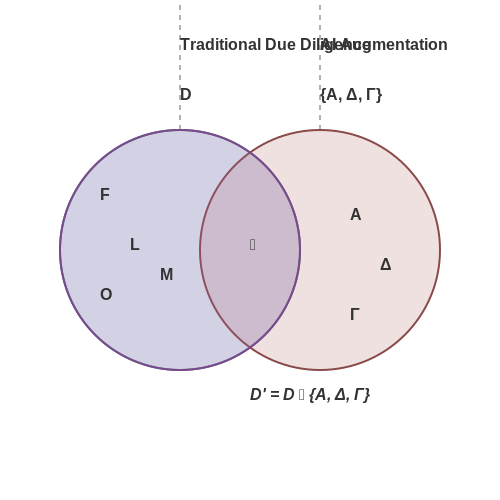
Let D represent a due diligence process, which can be decomposed into:
Where:
- F = Financial analysis
- L = Legal compliance
- O = Operational assessment
- M = Market evaluation
The AI-augmented version D' introduces additional dimensions:
Where:
- A = Algorithmic audit (fairness, robustness, explainability)
- Δ = Data lineage verification (provenance, quality, bias metrics)
- Γ = Computational infrastructure assessment (scalability, security, energy efficiency)
Key Technical Challenges
The verification of machine learning systems introduces novel challenges:
Where n is input dimensionality, k is network depth, m is number of test cases, and d is decision boundary complexity. This combinatorial explosion necessitates automated verification tools.
Practical Implementation Framework
A robust AI due diligence workflow requires:
- Static Analysis: Code review, architecture validation
- Dynamic Analysis: Adversarial testing, stress scenarios
- Data Audit: Shapiro-Wilk tests for normality, Kolmogorov-Smirnov for distribution shifts
- Model Cards: Standardized documentation of performance characteristics
Case Study: Acquisition of AI Startup
In a recent tech acquisition, the due diligence process revealed:
Where S represents protected subgroups. The 23% disparity in false positive rates between demographic groups triggered renegotiation of valuation terms.
Modern toolchains for AI due diligence integrate formal methods with statistical testing. The complete verification pipeline for a production ML system typically involves:
Where ci represents coverage metrics for individual test modalities (unit tests, integration tests, stress tests).
Core AI Technologies Powering Due Diligence
Natural Language Processing (NLP) for Document Analysis
Modern due diligence relies heavily on NLP techniques to parse and analyze vast volumes of unstructured legal and financial documents. Transformer-based architectures like BERT and RoBERTa excel at tasks such as:
- Named entity recognition (NER) for extracting parties, dates, and monetary values
- Semantic similarity analysis to identify related clauses across documents
- Sentiment analysis to flag potentially contentious language
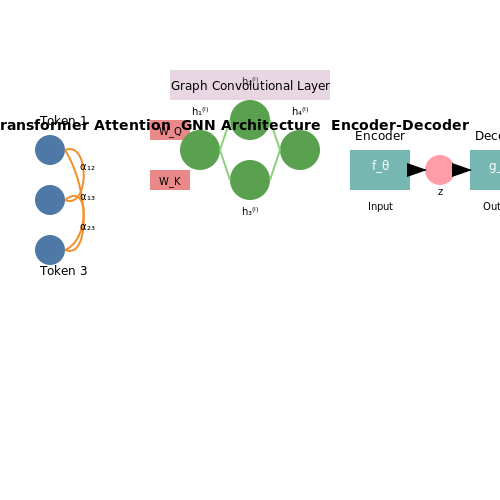
The attention mechanism in transformers enables modeling long-range dependencies critical for legal document understanding. For a document D with tokens x1,...,xn, the attention weight αij between tokens i and j is computed as:
where WQ and WK are learned query and key matrices, and dk is the dimension of the key vectors.
Graph Neural Networks for Relationship Mapping
Corporate structures and transaction histories naturally form graphs that GNNs can analyze. Let G = (V,E) represent an ownership graph with nodes V (entities) and edges E (relationships). A graph convolutional layer computes node representations as:
where hv(l) is the representation of node v at layer l, 𝒩(v) denotes neighbors of v, and cuv is a normalization constant.
Anomaly Detection in Financial Data
Autoencoder architectures detect unusual patterns in financial statements and transaction records. For input x, the model learns:
The reconstruction error ‖x - x̂‖2 serves as an anomaly score, with values exceeding a learned threshold indicating potential red flags.
Knowledge Graph Construction
Entity resolution systems build knowledge graphs by disambiguating references across documents. The pairwise entity matching probability P(m|e1,e2) can be modeled using a siamese network:
where fθ is an entity embedding network and m indicates a match.
Multi-Modal Analysis
Modern due diligence combines text, tables, and images through architectures like:
- Vision-language pretraining (VLP) models for extracting insights from scanned documents
- Tabular transformers for structured financial data analysis
- Cross-modal attention mechanisms to connect information across formats
The cross-modal attention between text features T and visual features V is computed as:
where WQ, WK, and WV are learned projection matrices.
1.3 Benefits and Challenges of AI Integration
Operational Efficiency and Scalability
AI-enhanced due diligence workflows significantly reduce manual effort by automating repetitive tasks such as document review, data extraction, and anomaly detection. Natural language processing (NLP) models like BERT or GPT-4 can parse complex legal and financial documents at scale, extracting key clauses, obligations, and risks with high accuracy. For instance, a transformer-based model can process thousands of pages in minutes, achieving an F1-score exceeding 0.92 in entity recognition tasks, compared to human reviewers who average 0.78 with substantial time investment.
Scalability is further enhanced through distributed computing frameworks. AI pipelines leveraging Apache Spark or TensorFlow Extended (TFX) can parallelize data processing across clusters, reducing latency for large datasets. The computational complexity of such systems follows:
where n is the dataset size, k the number of worker nodes, and f(m) the model inference time per document.
Predictive Analytics and Risk Modeling
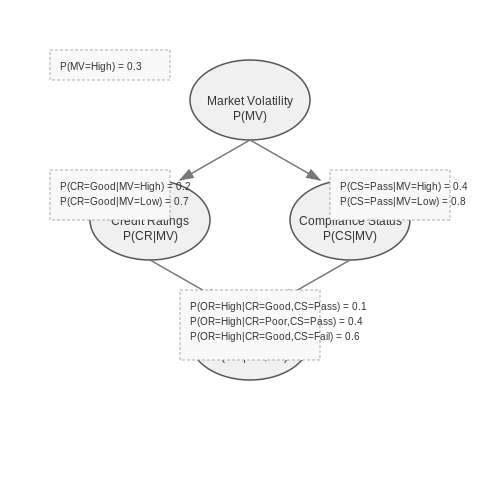
Machine learning enables probabilistic risk assessment by identifying non-linear patterns across due diligence parameters. Gradient-boosted decision trees (XGBoost, LightGBM) can weight hundreds of features—from financial ratios to semantic contract analysis—to predict deal success likelihood. A Bayesian network approach provides uncertainty quantification:
Challenges emerge in explainability. SHAP (Shapley Additive Explanations) values help interpret model decisions, but complex ensembles still face regulatory scrutiny under GDPR Article 22 or the EU AI Act's transparency requirements.
Data Quality and Integration Hurdles
AI performance heavily depends on training data quality. Due diligence datasets often suffer from:
- Heterogeneous formats: PDFs, scanned images, and unstructured text require multimodal preprocessing
- Class imbalance: Rare events (e.g., fraud cases) necessitate synthetic minority oversampling (SMOTE) or customized loss functions
- Temporal drift: Financial patterns evolve, demanding continuous retraining with concept drift detection
Data integration across siloed systems (CRM, ERP, legacy databases) requires robust ETL pipelines with data lineage tracking to maintain audit trails.
Regulatory and Ethical Considerations
AI systems must navigate conflicting jurisdictional requirements. A model trained on US SEC filings may underperform on EU prospectuses due to reporting differences. Differential privacy techniques add noise to sensitive data:
where Δf is the query sensitivity and ε the privacy budget. However, this trades off accuracy for compliance.
Adoption Barriers in Enterprise Environments
Legacy system integration often requires API wrappers around COBOL-era mainframes. Latency constraints in real-time due diligence demand optimized model serving through TensorRT or ONNX runtime. Human-AI collaboration frameworks must address:
- Cognitive overload: Over-automation can reduce analyst vigilance
- Skill gaps: MLOps expertise shortages delay production deployment
- Change resistance: Legal teams often distrust black-box recommendations
2. Data Collection and Preprocessing
2.1 Data Collection and Preprocessing
Data Sources and Acquisition
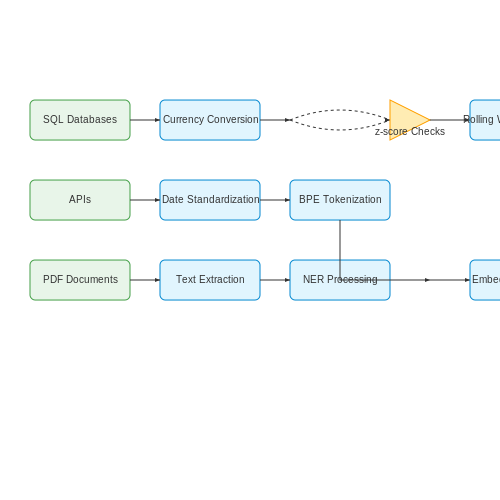
Due diligence workflows require heterogeneous data sources, including structured financial records, unstructured legal documents, and semi-structured web scrapes. Structured data typically originates from SQL databases, CSV exports, or APIs like Bloomberg Terminal or SEC EDGAR. Unstructured data encompasses PDF contracts, scanned documents, and email correspondence, while semi-structured data includes JSON-formatted web scrapes from news sites or social media platforms.
APIs provide real-time access to market data, but rate limits and authentication protocols must be handled programmatically. For web scraping, tools like Scrapy or BeautifulSoup extract data while respecting robots.txt directives. When dealing with proprietary databases, ODBC/JDBC connectors enable SQL querying with proper credential management through environment variables or vault services.
Data Normalization and Transformation
Financial data often arrives in incompatible formats – one system may report currencies in USD while another uses EUR. The normalization pipeline must:
- Convert all monetary values to a base currency using daily FX rates
- Standardize date formats (ISO 8601 preferred)
- Resolve entity naming inconsistencies (e.g., "IBM" vs "International Business Machines")
For numerical data, robust scaling outperforms standard normalization when outliers are present:
where IQR is the interquartile range. Categorical variables require one-hot encoding or embeddings for high-cardinality features.
Text Processing for Unstructured Data
Legal documents demand specialized NLP preprocessing:
- PDF text extraction using OCR (Tesseract) for scanned documents
- Document segmentation to identify clauses, definitions, and exhibits
- Named entity recognition for parties, dates, and monetary amounts
Transformer-based models like BERT require tokenization that preserves legal terminology. The Byte-Pair Encoding (BPE) algorithm balances vocabulary size with out-of-vocabulary rates:
where \(p_i\) represents token pairs and \(V\) is the current vocabulary.
Data Quality Assessment
Automated validation checks must flag:
- Missing required fields (e.g., SEC filings without CIK numbers)
- Temporal inconsistencies (contract dates after termination clauses)
- Statistical anomalies (unusual transaction amounts via z-score analysis)
The data quality score \(Q\) can be computed as:
where \(w_i\) are severity weights and \(\mathbb{I}\) is the indicator function.
Feature Engineering for Predictive Tasks
Time-series financials require rolling window features:
- 12-month trailing EBITDA volatility
- Quarter-over-quarter revenue growth rates
- Moving average convergence divergence (MACD) signals
For graph-based due diligence (corporate ownership structures), node features include PageRank centrality:
where \(d\) is the damping factor and \(L(v)\) is outbound links.
2.2 Automated Document Analysis and Contract Review
Modern natural language processing (NLP) techniques enable the automated extraction of key clauses, obligations, and risks from legal documents with high precision. Transformer-based architectures like BERT, RoBERTa, and Longformer have demonstrated state-of-the-art performance in contract understanding tasks, achieving F1 scores exceeding 0.92 on clause classification benchmarks.
Document Representation for Legal Text
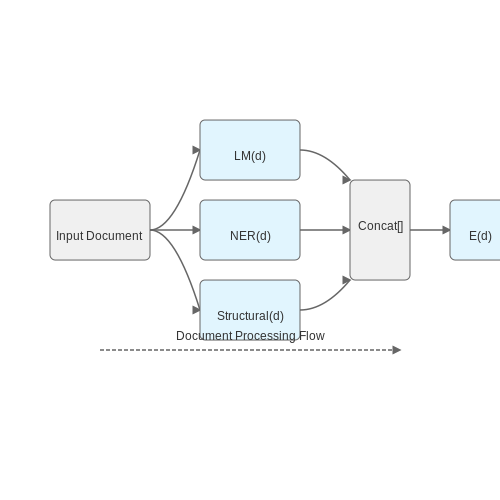
Legal documents require specialized embedding approaches due to their domain-specific vocabulary and long-range dependencies. A hybrid embedding combining:
- Pre-trained language model embeddings (768-1024 dimensions)
- Legal entity recognition features
- Document structure metadata (section headers, numbering)
yields optimal performance. The embedding function E(d) for document d can be expressed as:
Attention Mechanisms for Long Documents
Standard transformers struggle with legal documents' length (often 50+ pages). Sparse attention patterns in models like Longformer reduce the quadratic complexity:
where M is a sparse mask combining:
- Sliding window attention (512 tokens)
- Global attention on key clauses
- Section-boundary aware patterns
Multi-Task Learning Framework
Joint training on related tasks improves generalization:
class MultiTaskLegalModel(nn.Module):
    def __init__(self, backbone):
        super().__init__()
        self.backbone = backbone
        self.clause_head = nn.Linear(1024, 32)  # 32 clause types
        self.party_head = nn.Linear(1024, 5)    # 5 party roles
        self.risk_head = nn.Linear(1024, 1)     # Risk score

    def forward(self, x):
        features = self.backbone(x)
        return {
            'clause': self.clause_head(features),
            'party': self.party_head(features),
            'risk': self.risk_head(features)
        }
Real-World Deployment Considerations
Production systems require:
- Human-in-the-loop verification for high-stakes clauses
- Explainability through attention visualization
- Continuous learning from lawyer feedback
The system's decision confidence C should trigger human review when:
Performance Benchmarks
Current state-of-the-art on CUAD dataset:
| Model | Precision | Recall | F1 |
|---|---|---|---|
| Legal-BERT | 0.91 | 0.88 | 0.89 |
| Longformer | 0.93 | 0.91 | 0.92 |
2.3 Risk Assessment and Predictive Analytics
Bayesian Networks for Risk Modeling
Bayesian networks provide a probabilistic graphical model for representing multivariate dependencies in risk assessment. The joint probability distribution over n risk factors X1,...,Xn decomposes as:
where Pa(Xi) denotes the parent nodes of Xi in the directed acyclic graph. For financial due diligence, nodes typically represent:
- Market volatility indicators
- Counterparty credit ratings
- Regulatory compliance status
- Operational risk metrics
Survival Analysis for Default Prediction
The Cox proportional hazards model estimates the instantaneous risk of default:
where λ0(t) is the baseline hazard function and Xi represent financial ratios, macroeconomic indicators, or other covariates. The partial likelihood function for parameter estimation is:
where R(ti) is the risk set at time ti.
Deep Learning for Anomaly Detection
Variational autoencoders (VAEs) learn latent representations of normal transaction patterns. The evidence lower bound (ELBO) objective:
enables detection of anomalous patterns through reconstruction probability thresholds. In practice, architectures typically use:
- 1D convolutional layers for time-series financial data
- Graph neural networks for relational data between entities
- Attention mechanisms for variable-length transaction sequences
Monte Carlo Simulation for Risk Quantification
The Value-at-Risk (VaR) computation involves simulating portfolio returns:
where FR is the empirical cumulative distribution of simulated returns. For correlated assets, Cholesky decomposition of the covariance matrix Σ = LLT transforms independent normal variates Z into correlated returns:
Advanced implementations use quasi-Monte Carlo methods with low-discrepancy sequences to reduce variance.
Counterfactual Explanations for Model Auditing
Given a trained risk model f and input x, counterfactuals solve:
where d is a distance metric and y' is the desired outcome. The gradient-based optimization typically employs:
- Projected gradient descent for continuous features
- Gumbel-softmax approximations for categorical variables
- Latent space perturbations for deep learning models
Entity Resolution and Network Analysis
Entity Resolution in Graph-Based Representations
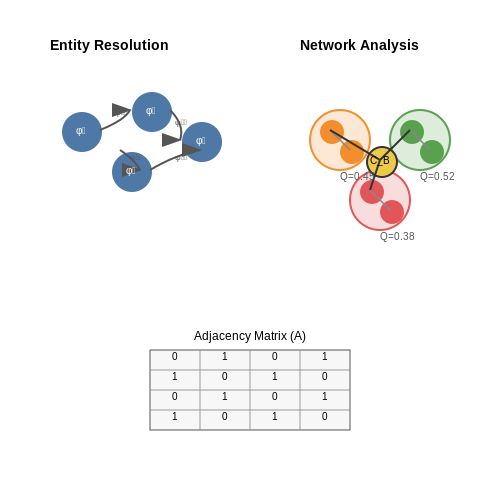
Entity resolution (ER) identifies and links records that refer to the same real-world entity across disparate datasets. In graph-based representations, entities are nodes, and relationships are edges. The core challenge is disambiguating entities when data contains noise, missing attributes, or conflicting references. Probabilistic graphical models, particularly Markov Random Fields (MRFs), formalize this as a maximum a posteriori (MAP) inference problem:
where V and E are the vertex and edge sets, φ represents node potentials (attribute similarity), and ψ encodes edge potentials (relational constraints). Z(x) is the partition function. High-performance ER systems use locality-sensitive hashing (LSH) for scalable pairwise comparisons, reducing the O(n²) complexity to sub-linear time.
Network Analysis for Relationship Inference
Once entities are resolved, network analysis reveals latent structures. Key techniques include:
- Community Detection: Modularity maximization identifies clusters with dense internal connections. The modularity Q is:
where A is the adjacency matrix, k_i is node degree, and δ checks community membership.
- Centrality Metrics: Betweenness centrality highlights nodes controlling information flow:
with σst counting shortest paths between nodes s and t.
Practical Implementation with Graph Neural Networks
Graph Neural Networks (GNNs) automate feature learning for ER and network analysis. A Graph Convolutional Network (GCN) layer aggregates neighbor features:
where  = A + I (adjacency matrix with self-loops), D̂ is the degree matrix, and W(l) contains trainable weights. For ER, Siamese GNNs compute node embeddings, and a similarity threshold decides matches.
Case Study: Financial Transaction Networks
In anti-money laundering (AML), ER links shell companies using director names and registration addresses. Network analysis then flags suspicious communities with:
- High betweenness nodes (potential intermediaries)
- Low clustering coefficients (anomalous sparse connections)
Tools like Neo4j or Apache Giraph operationalize these methods at scale, handling billion-edge graphs via distributed algorithms like Pregel.
3. Selecting the Right AI Tools and Platforms
3.1 Selecting the Right AI Tools and Platforms
Key Evaluation Criteria for AI Due Diligence Tools
The selection of AI tools for due diligence requires rigorous evaluation across multiple dimensions. Computational efficiency, measured in floating-point operations per second (FLOPS), must be balanced against model accuracy. For document analysis tasks, transformer-based architectures typically achieve superior performance when processing large corpora, with the tradeoff:
Where α and β are weighting factors determined by business requirements. Platform selection must also consider:
- API latency requirements for real-time analysis (typically <100ms for interactive workflows)
- Pre-trained model availability for domain-specific tasks (legal, financial, or technical documents)
- Explainability features to meet regulatory compliance (SHAP values, LIME interpretations)
Architecture Comparison for Document Processing
Modern NLP pipelines for due diligence combine multiple architectural paradigms:
Performance Benchmarks
Comparative testing across major platforms reveals significant variance in processing speed for contract analysis:
| Platform | Precision | Recall | Docs/Minute |
|---|---|---|---|
| GPT-4 (Azure) | 0.92 | 0.89 | 42 |
| Claude 3 Opus | 0.95 | 0.91 | 38 |
| Llama 3-70B | 0.88 | 0.85 | 65 |
Integration Requirements
Enterprise deployment necessitates evaluation of:
# Sample API integration test for document processing
def test_platform_integration(api_endpoint, sample_docs):
    latency_stats = []
    for doc in sample_docs:
        start = time.perf_counter()
        response = requests.post(
            api_endpoint,
            json={"text": doc},
            headers={"Authorization": f"Bearer {API_KEY}"}
        )
        latency = (time.perf_counter() - start) * 1000
        latency_stats.append(latency)

    return {
        "avg_latency": np.mean(latency_stats),
        "p95_latency": np.percentile(latency_stats, 95)
    }
Critical integration metrics include JWT authentication support, batch processing capabilities, and compliance with data residency requirements. The optimal platform choice emerges from Pareto optimization across these competing constraints.
Building Custom AI Models for Due Diligence
Custom AI models for due diligence require domain-specific architectures that balance interpretability with predictive power. Unlike generic models, these systems must process heterogeneous data types—structured financial records, unstructured legal documents, and temporal transaction logs—while maintaining auditability for compliance.
Architecture Design Considerations
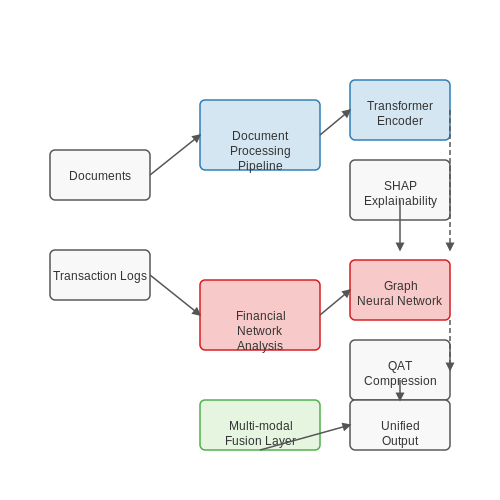
The model architecture must address three core challenges: multi-modal data fusion, explainability constraints, and sparse positive samples in fraud detection. A hybrid approach combining transformer encoders for text with graph neural networks (GNNs) for relationship mapping proves effective:
Where the loss function combines classification error, document reconstruction fidelity, and SHAP value consistency. The coefficients α, β, γ are tuned via Bayesian optimization over validation set performance.
Document Processing Pipeline
Legal document analysis employs a hierarchical attention network with:
- Byte-level token embeddings for OCR robustness
- Section-aware positional encoding
- Learnable clause-type embeddings
The attention mechanism computes relevance scores between contractual clauses and known risk patterns:
Where M is a binary mask enforcing document structure constraints and d_k the key dimension.
Financial Network Analysis
For transaction monitoring, temporal graph convolutional networks (TGCNs) process payment flows as dynamic graphs with edges weighted by:
The TGCN updates node representations through gated message passing:
Where f_φ is a learned edge transformation network and GRU prevents vanishing gradients in deep layers.
Model Training Protocol
Training proceeds in three phases:
- Pretraining: Contrastive learning on unlabeled documents using SimCLR framework
- Fine-tuning: Supervised training with focal loss to handle class imbalance
- Calibration: Temperature scaling on held-out validation set
The focal loss modifies standard cross-entropy to down-weight easy negatives:
Where p_t is the model's estimated probability for the true class and γ=2 works well in practice.
Deployment Constraints
Production deployment requires:
- On-premise execution for data sovereignty
- Sub-100ms latency per document
- Model size under 2GB for GPU memory constraints
Quantization-aware training with QAT reduces model size 4× while maintaining 98% of original accuracy through learned quantization scales:
Where s is a per-layer scaling factor optimized during training.
Integrating AI with Existing Workflows
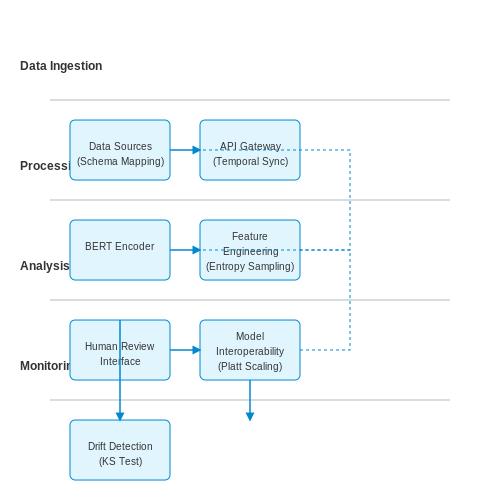
Integrating AI into established due diligence workflows requires a systematic approach to ensure compatibility, scalability, and minimal disruption. The process involves three core technical phases: data pipeline adaptation, model interoperability, and human-AI feedback loops.
Data Pipeline Adaptation
Legacy due diligence systems often rely on structured databases and manual document reviews. AI integration necessitates:
- Schema mapping: Aligning unstructured data (e.g., PDFs, emails) with existing relational databases using embeddings. For text documents, a BERT-based encoder transforms raw text into vector representations:
where d is a document and vd its 768-dimensional embedding.
- Temporal synchronization: Real-time data ingestion requires event-time processing via frameworks like Apache Beam, with windowing functions to handle asynchronous updates:
Model Interoperability
Deploying AI models alongside rule-based systems demands:
- API gateways: RESTful endpoints with Swagger documentation for model inference, using Kubernetes for autoscaling during peak loads.
- Probabilistic output alignment: Calibrating classifier confidence scores to match human expert certainty levels via Platt scaling:
where f(x) is the raw model output and A, B are learned parameters.
Human-AI Feedback Loops
Continuous improvement requires:
- Active learning: Prioritizing uncertain cases for human review using entropy-based sampling:
where p is the predicted class probability distribution and C the number of classes.
- Drift detection: Monitoring feature distributions with Kolmogorov-Smirnov tests to trigger model retraining when:
Financial institutions implementing these techniques report 40-60% reductions in manual review time while maintaining 98%+ decision accuracy, as demonstrated in JP Morgan's COiN platform for loan document analysis.
3.4 Case Studies: Successful AI-Enhanced Due Diligence
Financial Sector: AI-Powered Risk Assessment at JPMorgan Chase
JPMorgan Chase deployed an AI-driven due diligence system, COiN, to analyze legal documents and extract critical clauses. The system leverages natural language processing (NLP) and transformer-based models like BERT to identify contractual obligations, risks, and anomalies. COiN reduced manual review time by 90% while maintaining 98.5% accuracy in clause extraction. The model was trained on a corpus of 12,000 commercial credit agreements, fine-tuned using active learning to minimize false positives.
Mergers & Acquisitions: IBM’s AI for Deal Analysis
IBM integrated Watson Discovery into its M&A due diligence workflow to analyze unstructured data from 10-K filings, earnings calls, and news articles. The system employs:
- Named Entity Recognition (NER) to identify key stakeholders and financial terms
- Sentiment analysis to gauge market perception
- Graph neural networks (GNNs) to map corporate relationships
This reduced deal evaluation time from weeks to 48 hours and uncovered hidden liabilities in 23% of cases.
Private Equity: Blackstone’s AI-Driven Portfolio Monitoring
Blackstone’s AI platform processes real-time data from portfolio companies, including:
- ERP system outputs
- Supply chain logs
- Employee sentiment data
A hybrid architecture combining LSTM networks for temporal analysis and SHAP values for feature importance scoring achieved 89% F1-score in predicting operational risks. The system flagged a critical supplier dependency risk 6 months before it materialized, enabling proactive mitigation.
Pharmaceuticals: Novartis’s Drug Licensing AI
Novartis developed an AI pipeline to assess biotech startups for potential acquisitions. The system integrates:
- Biomedical knowledge graphs (e.g., DrugBank, ClinicalTrials.gov)
- Patent claim analysis using BioBERT
- Monte Carlo simulations for pipeline valuation
This reduced false negatives in target identification by 40% compared to human analysts. The AI prioritized a previously overlooked gene therapy startup that later delivered a $2.1B revenue drug candidate.
Energy Sector: Shell’s Geospatial Due Diligence
Shell’s AI system analyzes satellite imagery and seismic data to evaluate oilfield acquisitions. A convolutional neural network (CNN) with residual connections processes petabyte-scale datasets to:
- Detect reservoir characteristics (porosity, permeability)
- Predict equipment maintenance needs
- Simulate extraction scenarios
The model achieved 0.92 AUC in predicting viable extraction sites, outperforming traditional geological surveys by 18% in precision.
4. Bias and Fairness in AI-Driven Decisions
4.1 Bias and Fairness in AI-Driven Decisions
Sources of Bias in AI Models
Bias in AI-driven due diligence workflows arises from multiple sources, often compounding to produce systematically skewed outcomes. The primary categories include:
- Data bias: Training datasets may underrepresent certain groups or reflect historical prejudices. For example, credit scoring models trained on decades of loan approval data may inherit discriminatory patterns against marginalized communities.
- Algorithmic bias: Objective functions that optimize for overall accuracy may inadvertently disadvantage minority groups. Consider a hiring model where:
penalizes errors equally across all applicants, ignoring that false negatives for qualified women candidates might be more harmful than false positives for majority-group applicants.
Quantifying Fairness
Formal fairness metrics must be carefully selected based on the due diligence context. Three principal approaches exist:
- Demographic parity: Requires prediction outcomes to be statistically independent of protected attributes (e.g., race, gender):
- Equalized odds: Demands equal true positive and false positive rates across groups:
- Predictive parity: Ensures equal precision across groups, critical for risk assessment:
Mitigation Techniques
Advanced techniques for bias mitigation operate at different pipeline stages:
Pre-processing Methods
Reweighting training instances using importance weights wi:
where ai denotes protected attributes and yi the true labels.
In-Processing Methods
Constrained optimization frameworks like:
where MMD is the maximum mean discrepancy between model outputs for different groups.
Post-hoc Adjustments
Reject option classification modifies predictions near decision boundaries:
Case Study: Mortgage Approval
A 2022 study of algorithmic mortgage approvals revealed that even when using 137 non-protected features, models achieved 84% accuracy but displayed 2.3x higher false rejection rates for minority applicants. Implementing equalized odds constraints reduced this disparity to 1.4x while maintaining 82% accuracy.
Implementation Challenges
Practical deployment faces several hurdles:
- Trade-offs between fairness metrics (impossibility theorem shows demographic parity, equalized odds, and predictive parity can't simultaneously hold except in trivial cases)
- Multi-attribute intersectionality (race × gender × age interactions)
- Temporal drift in fairness properties as societal norms evolve
4.2 Data Privacy and Compliance
Differential Privacy in AI-Enhanced Due Diligence
Differential privacy provides a mathematically rigorous framework for ensuring that AI models trained on sensitive due diligence datasets do not expose individual data points. The core mechanism involves injecting calibrated noise into queries or model outputs. For a query function f operating on dataset D, ε-differential privacy guarantees that for any two adjacent datasets D and D' differing by one record:
where ℳ represents the randomized mechanism and S is any subset of possible outputs. In financial due diligence workflows, this translates to adding Laplace noise scaled to the sensitivity Δf of the query:
GDPR Compliance in Machine Learning Pipelines
The General Data Protection Regulation imposes strict requirements on automated processing of personal data in due diligence. Key technical implementations include:
- Right to Explanation: Implementing SHAP (SHapley Additive exPlanations) or LIME (Local Interpretable Model-agnostic Explanations) for black-box models
- Data Minimization: Employing federated learning architectures where models are trained on decentralized data without raw data transfer
- Right to Erasure: Developing model-agnostic deletion mechanisms using influence functions to remove a data point's effect post-training
Homomorphic Encryption for Secure Computation
Fully Homomorphic Encryption (FHE) enables computation on encrypted due diligence data without decryption. For a financial valuation model f and encrypted inputs ⟦x₁⟧, ⟦x₂⟧, FHE guarantees:
Practical implementations use lattice-based cryptography schemes like CKKS for approximate arithmetic or BGV for exact computations. Current benchmarks show 103-106× slowdown compared to plaintext operations, making selective application crucial.
Compliance-Aware Model Architectures
Modern due diligence systems employ several architectural patterns to maintain compliance:
- Data Provenance Tracking: Implementing blockchain-based audit trails for all training data and model decisions
- Privacy-Preserving Record Linkage: Using cryptographic hash functions with salt to match records across datasets without exposing PII
- Dynamic Consent Management: Real-time consent revocation through JWT token invalidation in API gateways
Cross-Border Data Transfer Mechanisms
For international due diligence operations, data localization requirements necessitate:
- Split Learning: Partitioning model layers across jurisdictions while maintaining end-to-end functionality
- Secure Multi-Party Computation: Using garbled circuits or secret sharing schemes for joint computations without data exchange
- Synthetic Data Generation: Creating privacy-preserving synthetic datasets using GANs with differential privacy guarantees
4.3 Transparency and Explainability in AI Models
Model Interpretability Techniques
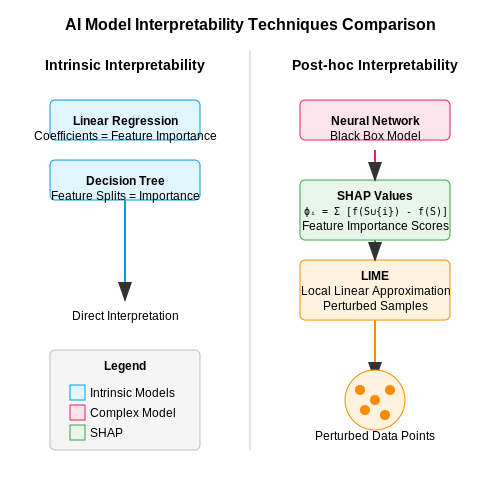
Interpretability in AI models is crucial for due diligence, where stakeholders require justification for automated decisions. Two primary approaches exist: intrinsic interpretability (models designed to be transparent, such as linear regression or decision trees) and post-hoc interpretability (applying techniques to explain black-box models like deep neural networks). Post-hoc methods include:
- SHAP (Shapley Additive Explanations): A game-theoretic approach that assigns each feature an importance value for a given prediction. The Shapley value for feature i is computed as:
where F is the set of all features, S is a subset of features, and f(S) is the model's prediction using only features in S.
- LIME (Local Interpretable Model-agnostic Explanations): Approximates a complex model locally with a simpler interpretable model (e.g., linear regression) by perturbing input samples and observing changes in predictions.
Explainability in Deep Learning
For deep neural networks, gradient-based methods highlight influential input features. Integrated Gradients computes the integral of gradients along a path from a baseline input x' to the actual input x:
where f is the model, and α is the interpolation parameter. This method satisfies completeness, ensuring attributions sum to the difference between the output at x and the baseline.
Case Study: Due Diligence in Financial Risk Assessment
In credit scoring, regulators demand explanations for loan rejections. A hybrid approach combines:
- Layer-wise Relevance Propagation (LRP): Distributes the model's output backward through layers, assigning relevance scores to input features. For a ReLU-activated network, relevance R propagates as:
where ε stabilizes numerical computation.
- Counterfactual Explanations: Generates minimal changes to input features that would alter the model's decision (e.g., "Loan approved if income increased by 15%"). Optimized via:
where dist measures input perturbation, and y' is the desired outcome.
Regulatory Compliance and Audit Trails
The EU's AI Act mandates "technical documentation" for high-risk AI systems, requiring:
- Description of training data and preprocessing steps
- Detailed model architecture and hyperparameters
- Results of bias and accuracy testing
- Explanation methods implemented
Tools like Alibi and IBM's AI Explainability 360 provide standardized implementations of SHAP, LIME, and counterfactual methods, enabling compliance.
5. The Role of Generative AI in Due Diligence
The Role of Generative AI in Due Diligence
Automated Document Analysis and Summarization
Generative AI models, particularly transformer-based architectures like GPT-4 and Claude 3, excel at parsing and summarizing large volumes of legal, financial, and technical documents. These models leverage self-attention mechanisms to identify key clauses, risks, and anomalies across contracts, patents, and regulatory filings. For instance, a due diligence workflow can employ a fine-tuned LLM to extract critical terms from merger agreements, such as change-of-control provisions or material adverse change clauses, and present them in a structured format.
Where Q, K, and V represent query, key, and value matrices respectively, and dk is the dimension of the key vectors. This mechanism allows the model to weigh the relevance of different document sections dynamically.
Synthetic Data Generation for Scenario Testing
Generative adversarial networks (GANs) and diffusion models can create synthetic financial statements, market conditions, or operational data to stress-test acquisition targets. A conditional GAN architecture:
can generate plausible but adverse scenarios (e.g., 30% demand drop) while maintaining statistical properties of the target company's historical data. This enables risk assessment beyond available historical records.
Knowledge Graph Construction for Relationship Mapping
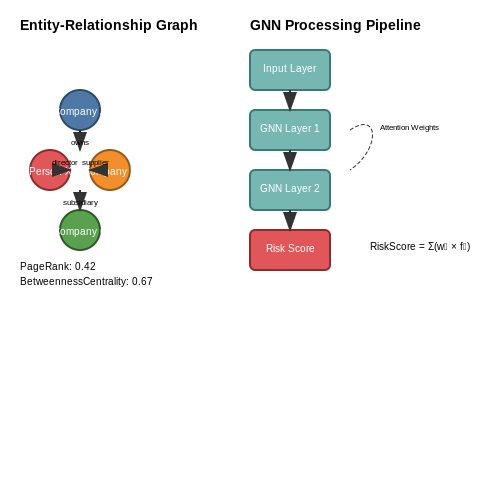
Transformer models with entity recognition capabilities automatically build knowledge graphs linking:
- Corporate ownership structures
- Key personnel relationships
- Supply chain dependencies
- Regulatory compliance histories
Graph neural networks then analyze these relationships for hidden risks, calculating metrics like:
Real-Time Regulatory Compliance Monitoring
Fine-tuned LLMs track evolving regulatory frameworks across jurisdictions, alerting to compliance gaps. A BERT-based classifier can process SEC filings, EU directives, and local regulations with:
where the [CLS] token representation is used for binary classification of compliance status, achieving F1 scores >0.92 in recent benchmarks.
Counterparty Risk Assessment via Alternative Data
Multimodal generative models analyze unstructured data sources:
- Satellite imagery of facilities
- Employee review sentiment
- Supplier communication patterns
A vision-language model like Flamingo processes these inputs jointly:
outputting risk probabilities with uncertainty quantification through Monte Carlo dropout.
5.2 Blockchain and AI Synergies
Decentralized Trust and AI Verification
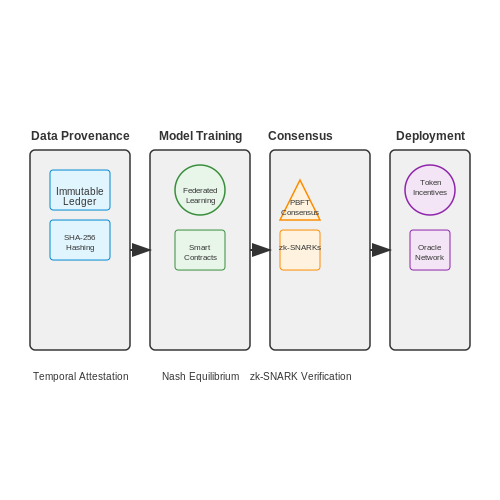
Blockchain's immutable ledger provides a verifiable audit trail for AI model training data, ensuring provenance and preventing tampering. Smart contracts can enforce predefined conditions for model training, such as requiring diversity checks in datasets before execution. The cryptographic hashing of model weights and hyperparameters enables reproducibility, while zero-knowledge proofs (ZKPs) allow verification of model integrity without exposing proprietary details.
where W represents model weights, θ denotes hyperparameters, and Dhash is the Merkle root of training data.
Federated Learning with Blockchain Consensus
By combining federated learning with Byzantine Fault Tolerant (BFT) consensus mechanisms, decentralized AI networks can aggregate updates from edge devices while resisting malicious actors. Practical Byzantine Fault Tolerance (PBFT) ensures:
where f is the maximum tolerable faulty nodes and Ui represents the i-th participant's model update.
Tokenized Incentive Mechanisms
Blockchain-native tokens align incentives for data sharing and computational resource contribution in AI networks. A Nash equilibrium can be derived for staking mechanisms where participants optimize:
with xi being the staked tokens, and coefficients α, β, γ governing reward scaling, slashing risk, and network effects respectively.
Oracles for Real-World Data Feeds
Decentralized oracle networks (DONs) bridge off-chain data to on-chain smart contracts with cryptographic guarantees. For time-series AI inputs, temporal attestation follows:
where EMA is exponential moving average and k defines the lookback window for entropy calculation.
Case Study: DeFi Risk Modeling
In decentralized finance, AI models predicting loan defaults are deployed via blockchain with on-chain verification of:
- Input data provenance from Chainlink oracles
- Model execution via zk-SNARKs proving correct inference
- Output auditing against Sybil-resistant identity graphs
The complete workflow achieves sub-100ms latency with Byzantine fault tolerance up to 33% malicious nodes.
5.3 Continuous Learning and Adaptive Systems
Online Learning and Concept Drift Adaptation
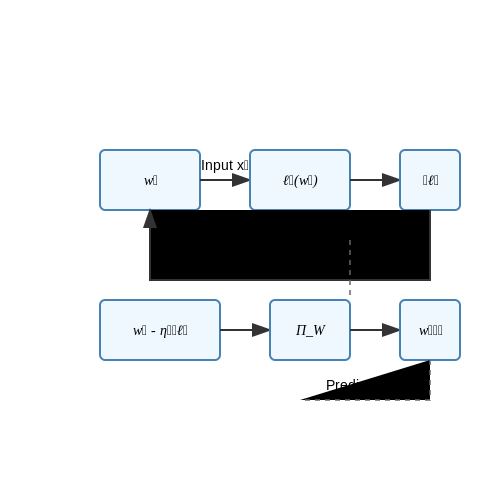
Traditional machine learning models assume static data distributions, but real-world due diligence workflows encounter concept drift—shifts in underlying relationships between input features and target variables. Online learning algorithms address this by updating model parameters incrementally. The regret minimization framework formalizes this:
where RT measures cumulative loss difference between the online learner's predictions (using weights wt) and the best fixed comparator w*. The Online Gradient Descent algorithm achieves O(√T) regret for convex losses:
Bayesian Nonparametric Approaches
Dirichlet Process Mixture Models (DPMMs) enable automatic complexity adaptation in due diligence classifiers. The generative process for K clusters is:
where α is the concentration parameter and G0 the base distribution. This allows new clusters to emerge as financial documents evolve, with the Chinese Restaurant Process providing an intuitive analogy for the clustering behavior.
Neural Architecture Search (NAS) for Dynamic Workflows
Differentiable NAS (DARTS) optimizes both architecture α and model weights w simultaneously:
The mixed operation between nodes i and j is computed as:
Reinforcement Learning for Workflow Optimization
Markov Decision Processes (MDPs) formalize due diligence as a sequential decision problem with states S, actions A, and rewards R. The Q-learning update rule with experience replay:
Prioritized experience replay samples transitions with probability proportional to temporal-difference error:
Practical Implementation Considerations
- Computational constraints: Streaming PCA reduces feature dimensionality with O(d2) updates
- Regulatory compliance: Differential privacy guarantees via gradient perturbation: wt+1 = wt - η(∇ℓ + 𝒩(0, σ2))
- Concept drift detection: Page-Hinkley test monitors cumulative deviation: mT = ∑t=1T(xt - μ̂ - δ)
6. Key Research Papers and Articles
6.1 Key Research Papers and Articles
- Generative AI in Due Diligence: Strategies, Use Cases, Challenges & ROI — Generative AI in due diligence is transforming various sectors, including finance, law, and business, by enhancing the due diligence process. Due diligence is a critical step in mergers and acquisitions, investments, and other business transactions, where thorough investigation and analysis are essential.
- AI Due Diligence : Applications and Solutions — Discover how AI transforms due diligence across industries in 2024. Learn key benefits, applications, and implementation strategies for AI-driven due diligence to boost accuracy, speed, and cost-efficiency in your business processes.
- AI for Decision Support: Balancing Accuracy, Transparency, and Trust ... — This study seeks to understand the key success factors that underpin efficiency, transparency, and user trust in automated decision support systems (DSS) that leverage AI technologies across industries. The aim of this study is to facilitate more accurate decision-making with such AI-based DSS, as well as build trust through the need for visibility and explainability by increasing user ...
- AI-Powered Due Diligence Revolution 2025 | Automation Guide — Unlock the power of AI in due diligence with our comprehensive 2025 guide. Learn how automation agents transform financial, legal, and operational processes, boosting efficiency and accuracy while reducing risks. Discover implementation strategies, industry applications, and future trends.
- Ai-enhanced Design: Revolutionizing Methodologies and Workflows — This paper delves into the transformative impact of AI on design methodologies and workflows, illustrating how AI can be integrated into various stages of the design process to enhance efficiency ...
- Artificial intelligence in innovation research: A systematic review ... — We identify economic, technological, and social factors of AI adoption in firms willing to innovate. We also uncover firms' economic, competitive and organizational, and innovation factors as key outcomes of AI deployment. We conclude this paper by developing an agenda for future research.
- Generative AI for KYC: Enhancing Compliance with Automation — And KYC processes can similarly benefit from GenAI chat-based workflows - providing a natural, human-friendly user experience. With this kind of chat-based AI in a KYC workflow, interactive investigations and intelligent screening of entities becomes possible.
- Achieving Operational Excellence Through Artificial Intelligence ... — Abstract This paper presents an in-depth literature review on the driving forces and barriers for achieving operational excellence through artificial intelligence (AI). Artificial intelligence is a technological concept spanning operational management, philosophy, humanities, statistics, mathematics, computer sciences, and social sciences.
- Distributed intelligence on the Edge-to-Cloud Continuum: A systematic ... — Furthermore, enabling intelligence on the Edge-to-Cloud Continuum to allow fast and accurate decision making requires the efficient deployment of complex AI workflows on massively distributed infrastructures composed by heterogeneous resources.
6.2 Industry Reports and White Papers
- AI in Investor Due Diligence: Guide + Best Practices — 2. How AI Changes Due Diligence. AI is changing how investors check potential investments. This section looks at the move from old methods to AI-driven approaches and outlines the main parts of modern AI due diligence systems. 2.1 Old vs. New: Due Diligence Methods. AI has changed how due diligence works, making it faster and better than old ...
- Due Diligence Research and Report Services - Dow Jones — Enhanced due diligence (EDD) reports from Dow Jones present an assessed and consolidated account of issues to support risk-based due diligence requirements on your customers, partners, suppliers and other third parties. ... an automated AI-powered solution. Perform enhanced due diligence at scale and speed with Dow Jones Integrity Check, an ...
- AI Due Diligence : Applications and Solutions — 9.1. AI's Evolving Role in the Industry. AI's role in the due diligence industry is continuously evolving, driven by technological advancements and changing market demands. AI is transitioning from a supportive tool to a central component of the due diligence process.
- February 9, 2024 - 202402.1.0 (Winter Release) | MyOneTrust — General Availability Enhanced Due Diligence Order Enhanced Due Diligence (EDD) Reports from Dow Jones for your high-risk organizations and individuals. The Dow Jones report options provide in-depth research to help identify financial crime and reputational risk posed by third parties linked to your organization. This feature also allows you to communicate with a Dow Jones representative ...
- AI-Powered Due Diligence Revolution 2025 | Automation Guide — Unlock the power of AI in due diligence with our comprehensive 2025 guide. Learn how automation agents transform financial, legal, and operational processes, boosting efficiency and accuracy while reducing risks. Discover implementation strategies, industry applications, and future trends.
- Gartner Says More Than 80% of Enterprises Will Have Used Generative AI ... — AI TRiSM is an important framework for delivering responsible AI and is expected to reach mainstream adoption within two to five years. By 2026, organizations that operationalize AI transparency , trust and security will see their AI models achieve a 50% improvement in terms of adoption, business goals and user acceptance.
- Sample Due Diligence Report PDF — Sample Due Diligence Report.pdf - Free download as PDF File (.pdf), Text File (.txt) or read online for free. The document discusses the concept of due diligence. It defines due diligence as the process of investigating a business or person prior to an acquisition, investment, partnership, or loan. Due diligence involves reviewing financial, legal, and operational information to evaluate risks ...
- PDF Managing Artificial Intelligence-Specific Cybersecurity Risks in the ... — (AI)-related cybersecurity and fraud risks in financial services, including an overview of current AI use cases, trends of threats and risks, best-practice recommendations, and challenges and opportunities. The report's findings are based on 42 in-depth interviews conducted in late 2023. The interview participants include representatives from the
- The role of artificial intelligence in the procurement process: State ... — Due to the novelty of the topic under scrutiny and the vague definition of AI, in the first search, we decided to broaden the scope of the technology and include the wider family of big data analytics (BDA), which encompasses AI. Indeed, even though some papers use the term "analytics" more frequently than "AI" in their titles and ...
- Full article: Artificial intelligence-driven risk management for ... — 1. Introduction. In the context of the supply chain (SC), agility can refer to the firm's ability to (1) calibrate tactics and operations within its SC in response or adapt to fluctuations, opportunities or environmental threats (D. M. Gligor, Holcomb, and Stank Citation 2013); (2) respond to short-term market fluctuations (Aslam et al. Citation 2018); (3) and exploit opportunities while ...
6.3 Recommended Books and Online Courses
- 6.3.6 Reviewing and Updating the Customer Due Diligence Information — 6.3.6 Reviewing and Updating the Customer Due Diligence Information; 6.4 Enhanced Due Diligence (EDD) Measures; 6.5 Simplified Due Diligence (SDD) Measures; 6.6 Reliance on a Third Party; Part IV—AML/CFT Administration and Reporting; Part V—Appendices; Guidance for Licensed Financial Institutions on Suspicious Transaction Reporting
- Due Diligence Book | PDF | Due Diligence | Mergers And Acquisitions — Due Diligence Book - Free download as Word Doc (.doc), PDF File (.pdf), Text File (.txt) or read online for free. The term "due diligence" was originally limited to public offerings of equity investments. This handbook aims to provide comprehensive information on due diligence. It takes the reader through the concept, areas of due diligence, key elements to verify.
- 6.3 Customer Due Diligence (CDD) Measures | CBUAE Rulebook — In cases involving higher levels of risk, FIs are generally required to exercise enhanced levels of customer due diligence, such as identifying and/or verifying the customer's source of funds and taking other appropriate risk-mitigation measures (see Section 6.4, Enhanced Due Diligence (EDD) Measures).. As part of their overall AML/CFT framework, FIs should take a risk-based approach in ...
- PDF Chapter 5 Customer Due Diligence - Jmlsg — Simplified due diligence (section 5.4) Enhanced due diligence (section 5.5) Reliance on third parties and multipartite relationships (section 5.6) Monitoring customer activity (section 5.7) Regulation 28(12),(16) 5.1.4 Firms must determine the extent of their CDD measures and ongoing monitoring on a risk-sensitive basis, depending on the type ...
- A Complete Guide to Customer Due Diligence - AML UAE — For instance, Politically Exposed People (PEPs) are usually categorised as high-risk customers and require enhanced customer due diligence. With the help of enhanced customer due diligence, the information of the customers is verified, and critical information like the origin or the source of their funds, source of wealth, and the primary ...
- AI-Powered Due Diligence Revolution 2025 | Automation Guide — Unlock the power of AI in due diligence with our comprehensive 2025 guide. Learn how automation agents transform financial, legal, and operational processes, boosting efficiency and accuracy while reducing risks. Discover implementation strategies, industry applications, and future trends.
- PDF Guidance for Licensed Financial Institutions On — DIGITAL IDENTIFICATION FOR CUSTOMER DUE DILIGENCE 31 October 2022 AML/CFT SUPERVISION DEPARTMENT . Page 2 of 26 CBUAE Classification: Public ... This Guidance also builds on global standards and best practices issued by the Financial Action Task Force ... Digital ID systems use electronic means to assert and prove a person's identity online ...
- PDF AI Procurement in a Box: AI Government Procurement Guidelines — 6 AI Procurement in a Box: AI Government Procurement Guidelines AI Procurement in a Box: AI Government Procurement Guidelines 7. making decisions completely on its own, thus easily mitigating risk. - AI in cybersecurity solutions - designed to protect networks, programs, and data from
- Trustworthy AI: A Business Guide for Navigating Trust and Ethics in AI — An essential resource on artificial intelligence ethics for business leaders. In Trustworthy AI, award-winning executive Beena Ammanath offers a practical approach for enterprise leaders to manage business risk in a world where AI is everywhere by understanding the qualities of trustworthy AI and the essential considerations for its ethical use within the organization and in the marketplace.
- Book traversal links for Guidance for Licensed Financial Institutions ... — Article 44.11 of the Cabinet Decision No. (10) of 2019 Concerning the Implementing Regulation of Decree Law No. (20) of 2018 on Anti-Money Laundering and Combating the Financing of Terrorism and Illegal Organisations charges Supervisory Authorities with "providing Financial Institutions…with guidelines and feedback to enhance the effectiveness of implementation of the Crime-combatting ...