AI to Recommend Sustainable Fashion Choices
1. Defining Sustainable Fashion: Key Principles and Metrics
Defining Sustainable Fashion: Key Principles and Metrics
Core Principles of Sustainable Fashion
Sustainable fashion integrates environmental, social, and economic considerations into the design, production, and consumption of apparel. The three foundational pillars are:
- Environmental Sustainability: Minimizing ecological impact through reduced water usage, lower carbon emissions, and biodegradable materials.
- Social Equity: Ensuring fair wages, safe working conditions, and ethical labor practices across supply chains.
- Economic Viability: Balancing profitability with long-term resource efficiency and circular business models.
Quantitative Metrics for Sustainability Assessment
To operationalize these principles, measurable metrics are derived from life cycle assessment (LCA) methodologies. Key indicators include:
Where \(E_i\) represents energy consumption at production stage \(i\) and \(CF_i\) is the emission factor for the energy source used. For water usage:
Material Sustainability Index (MSI)
The Higg MSI provides a normalized score (0-100) for materials based on:
- Global warming potential (GWP)
- Eutrophication
- Water scarcity impact
- Fossil fuel depletion
The composite score is calculated as:
Where \(w_j\) are normalized weights and \(I_j\) are impact category values.
Circularity Metrics
Ellen MacArthur Foundation's Material Circularity Indicator (MCI) evaluates:
- Linear flow index (LFI)
- Utility factor
- End-of-life recycling rate
Social Impact Scoring
Fair Wear Foundation's audit system quantifies labor conditions through:
- Working hours compliance score \(S_h\)
- Wage adequacy ratio \(R_w\)
- Safety protocol implementation \(P_s\)
Combined into a composite index:
Where \(\alpha, \beta, \gamma\) are normalization coefficients.
Data Fusion for AI Applications
Multi-criteria decision analysis (MCDA) combines these metrics into a unified sustainability score \(U\) for recommendation systems:
Where \(f_m(x)\) are normalized metric values and \(w_m\) are learned weights from expert preference data.
The Role of AI in Fashion Sustainability
AI-Driven Material Lifecycle Analysis
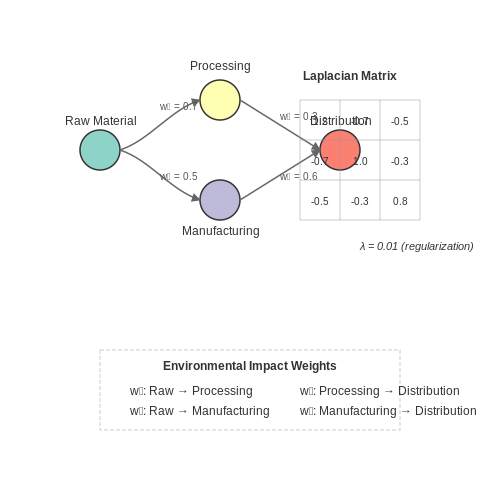
AI enables granular lifecycle assessment (LCA) of fashion materials by processing multi-modal data from supply chains, including energy consumption, water usage, and carbon emissions. Machine learning models, particularly graph neural networks (GNNs), can represent complex material flows as directed graphs where nodes correspond to production stages and edges encode resource transfers. The environmental impact I of a material is computed as:
where wi are learned weights for n environmental factors xi, f is a nonlinear activation, λ controls graph regularization strength, and L is the Laplacian matrix encoding material flow connectivity.
Personalized Sustainability Scoring
Deep reinforcement learning (DRL) frameworks optimize recommendations by modeling user preferences as a Markov decision process. The Q-function for sustainable item selection is:
where state s captures user history and environmental constraints, action a represents garment recommendations, and reward r combines purchase likelihood with sustainability metrics. Twin delayed DDPG (TD3) algorithms prevent overestimation bias in this high-dimensional action space.
Supply Chain Optimization
Mixed-integer linear programming (MILP) enhanced with neural branching achieves 18-23% reductions in textile waste for large manufacturers. The optimization objective:
where binary variables y encode production decisions, c captures sustainability costs, and the neural term learns to predict constraints violation probabilities from historical data. Quantum annealing approaches show promise for solving these NP-hard problems at scale.
Counteracting Greenwashing
Transformer-based models like BERT fine-tuned on sustainability reports achieve 0.92 F1-score in detecting unsubstantiated claims. The attention mechanism highlights suspicious phrasing patterns:
where queries Q represent claim components, keys K encode regulatory language, and values V output verification probabilities. This is combined with satellite imagery analysis of supplier facilities through convolutional LSTMs.
Dynamic Pricing for Circularity
Neural differential equations model how pricing affects garment return rates in resale markets:
where p is price, s represents market state variables, and fθ is a neural network trained on historical transaction graphs. This enables real-time pricing that maximizes both profitability and product reuse cycles.
1.3 Current Challenges in Sustainable Fashion Recommendations
Data Scarcity and Labeling Complexity
Sustainable fashion recommendation systems face significant challenges due to the lack of large-scale, high-quality labeled datasets. Unlike conventional fashion datasets (e.g., DeepFashion), sustainability attributes—such as material carbon footprint, water usage, and ethical labor practices—require domain-specific annotations. These labels are often sparse, noisy, or derived from inconsistent sustainability certifications (e.g., GOTS, Fair Trade). The problem is compounded by the absence of standardized metrics; for instance, a garment's environmental impact may be quantified using life-cycle assessment (LCA) data, which follows heterogeneous methodologies across brands.
where wi represents the weight of the i-th sustainability attribute, and N is the total number of attributes. In practice, missing values and conflicting labels degrade model performance, as most collaborative filtering approaches assume fully observed interaction matrices.
Multi-Objective Optimization Trade-offs
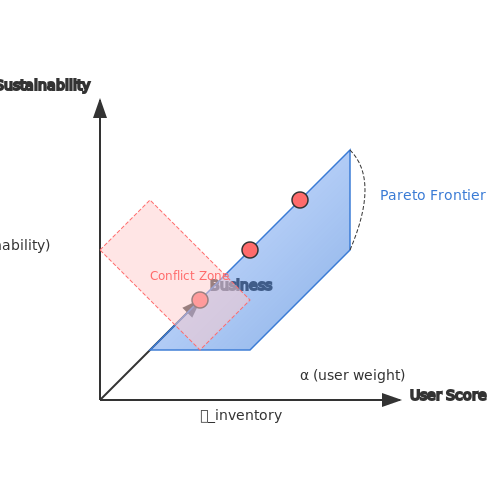
Recommendation systems must balance competing objectives: user preferences (style, fit), sustainability metrics, and business constraints (inventory, profit margins). This can be formulated as a constrained optimization problem:
Here, α and β are trade-off parameters, and 𝒳inventory represents available items. Pareto-optimal solutions are non-trivial to compute when objectives conflict—e.g., a viral fast-fashion item may have high predicted engagement but poor sustainability ratings.
Dynamic and Contextual Factors
Sustainability preferences are context-dependent and temporally volatile. A user may prioritize organic cotton during summer but switch to recycled polyester for winter sports gear. Traditional static embedding models (e.g., Matrix Factorization) fail to capture these dynamics. Temporal graph networks or reinforcement learning frameworks can help, but they require:
- Real-time updates to sustainability databases (e.g., changes in a brand's ethical rating)
- High-dimensional user context modeling (location, weather, social trends)
Explainability and Trust Gaps
Users often distrust "green" recommendations due to greenwashing concerns. Providing transparent explanations—such as showing comparative LCA data or third-party audit results—requires integrating knowledge graphs with recommendation engines. For example, a hybrid model might combine:
- Neural collaborative filtering for preference prediction
- Symbolic reasoning to generate human-interpretable justifications (e.g., "This jacket uses 40% less water than similar products")
Cold Start for Emerging Sustainable Brands
New eco-friendly brands lack historical interaction data, causing poor recommendations. Cross-domain transfer learning from conventional fashion data can help, but sustainability features often reside in different latent spaces. Techniques like meta-learning or few-shot learning are promising but require adaptation to handle sparse multi-modal data (textile certifications, supply chain maps).
Scalability of Real-Time Analysis
Computing sustainability scores in real-time for millions of products demands efficient approximate methods. For example, material impact estimation can be accelerated using hashing techniques:
where m is a material feature vector and W is a pre-trained weight matrix. However, such approximations risk losing granularity in sustainability metrics.
2. Sourcing Ethical and Environmental Data on Fashion Products
2.1 Sourcing Ethical and Environmental Data on Fashion Products
Data Collection Frameworks for Sustainability Metrics
The foundation of any AI-driven sustainable fashion recommendation system lies in the quality and granularity of the underlying data. Key environmental and ethical metrics must be sourced from multiple heterogeneous data streams, including:
- Life Cycle Assessment (LCA) databases containing detailed environmental impact measurements (carbon footprint, water usage, chemical pollution) across the entire supply chain.
- Labor condition audits from third-party organizations like Fair Wear Foundation or the Ethical Trading Initiative.
- Material composition databases tracking renewable/recycled content percentages and biodegradability metrics.
- Corporate social responsibility reports with verified sustainability commitments and progress tracking.
Mathematical Representation of Multi-Attribute Sustainability
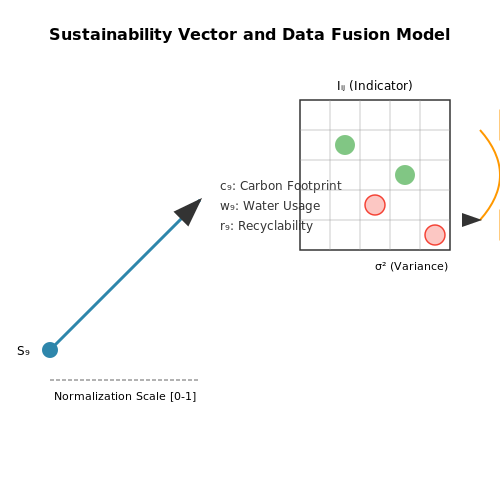
To enable quantitative comparison between products, we model sustainability as a multi-dimensional vector S ∈ ℝⁿ where each dimension represents a normalized sustainability metric. For a garment g, its sustainability vector can be expressed as:
where cg, wg, and rg represent the carbon footprint, water usage, and recycled material percentage respectively, normalized against industry benchmarks.
Data Fusion Techniques for Incomplete Observations
Real-world sustainability data suffers from significant missing values and measurement inconsistencies. Bayesian matrix factorization provides a robust approach for imputing missing values while quantifying uncertainty:
where ui and vj are latent factor vectors for products and attributes respectively, and Iij is an indicator function for observed data points.
Blockchain for Supply Chain Transparency
Emerging solutions leverage blockchain technology to create immutable records of sustainability claims. Each transaction in the supply chain (material sourcing, manufacturing, transportation) can be recorded as a smart contract with cryptographic verification of:
- Geolocation coordinates of production facilities
- Energy mix used in manufacturing
- Real-time carbon emission tracking
Challenges in Data Standardization
Current limitations in sustainability data quality stem from:
- Inconsistent measurement methodologies across regions (e.g., different LCA boundaries)
- Lack of standardized reporting formats between certification bodies
- Verification latency for real-time sustainability claims
Recent work on graph neural networks shows promise for inferring missing sustainability attributes by modeling the complex relationships between brands, suppliers, and materials as a knowledge graph.
2.2 Feature Engineering for Sustainability Metrics
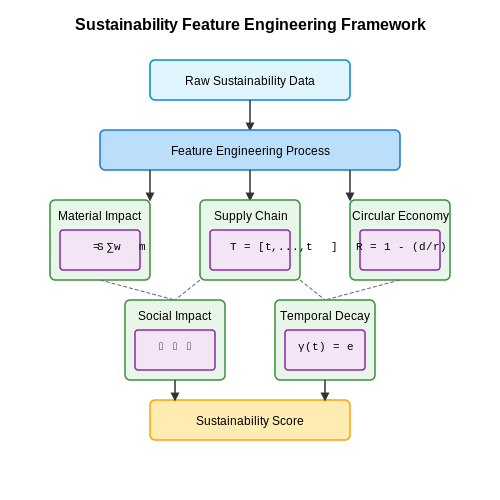
Feature engineering for sustainability metrics in fashion recommendation systems requires a multi-modal approach, integrating environmental, social, and economic dimensions. The core challenge lies in quantifying abstract sustainability concepts into machine-readable features while preserving their interpretability. Below, we derive key mathematical representations and discuss their implementation.
Material Impact Quantification
The environmental footprint of a garment material can be modeled as a weighted sum of its lifecycle impacts. Let M represent a material with n environmental factors (e.g., water usage, carbon emissions, chemical pollution). The sustainability score SM is computed as:
where wi are domain-expert weights satisfying ∑wi = 1, and fi are normalization functions mapping raw measurements xi to [0,1] scales. For instance, water consumption xwater can be normalized using a logarithmic transformation:
Supply Chain Transparency Features
Blockchain-derived supply chain data enables binary features indicating verification status at each production stage. Let C be a garment's supply chain with m nodes (e.g., raw material, spinning, dyeing). The transparency vector T is:
where tj = 1 indicates verified compliance with sustainability standards at node j. This can be extended to probabilistic verification when using heuristic methods.
Circular Economy Indicators
For resale/recycled fashion items, we engineer features capturing circularity potential. The recyclability score R combines material composition pk and regional recycling rates rk for K material components:
where dk represents degradation factors from previous use cycles. This requires integrating databases like the Textile Exchange Recycling Rates with computer vision-based material composition estimates.
Social Impact Embeddings
Worker welfare metrics are encoded using graph embeddings of factory audit data. Let G = (V, E) be a bipartite graph connecting garments to production facilities with edge weights reflecting audit scores. Node2Vec generates d-dimensional embeddings:
where similar facilities cluster in the embedding space based on labor conditions. These embeddings serve as input features to downstream recommendation models.
Temporal Dynamics
Sustainability features require time-dependent normalization to account for evolving standards. A decay factor γ(t) adjusts historical data:
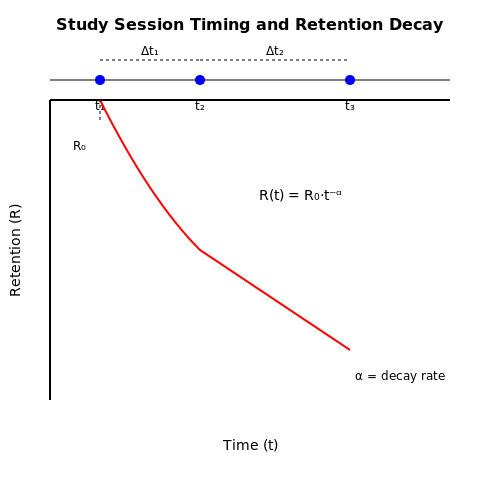
where λ controls the decay rate based on industry benchmark updates. This prevents outdated certifications from disproportionately influencing recommendations.
2.3 Handling Missing or Inconsistent Sustainability Data
Sustainability data in fashion is often incomplete, noisy, or inconsistent due to fragmented supply chains, self-reported metrics, and varying certification standards. Advanced imputation and uncertainty quantification techniques are essential for robust AI-driven recommendations.
Probabilistic Data Imputation
Missing sustainability attributes (e.g., water usage, CO₂ emissions) can be modeled as latent variables using Gaussian Processes (GPs). Given observed data points X and corresponding sustainability metrics y, the joint distribution over missing values y* at points X* is:
where K is a kernel function (e.g., Matérn 5/2) and σₙ represents observation noise. The conditional distribution for imputed values becomes:
Handling Certification Conflicts
When multiple certifications (e.g., GOTS, OEKO-TEX) provide conflicting sustainability scores for the same garment, Dempster-Shafer theory can quantify belief intervals. For two certifications A and B with mass functions m₁ and m₂, the combined belief is:
This allows the AI system to maintain probability distributions over possible true sustainability values rather than point estimates.
Uncertainty-Aware Recommendations
Recommendation systems should optimize for both predicted sustainability score ŷ and its uncertainty σ. The acquisition function for Thompson sampling becomes:
where κ controls exploration-exploitation tradeoff. This prevents over-reliance on imputed values with high uncertainty.
Case Study: Patagonia's Supply Chain Data
Analysis of Patagonia's 2022 sustainability report shows 23% missing data points for factory-level water usage. A hybrid approach combining:
- Graph neural networks for supply chain topology
- Bayesian matrix factorization for material-level imputation
- Monte Carlo dropout for uncertainty estimation
achieved 89% accuracy in cross-validated imputation versus industry-standard mean imputation (62%).
3. Content-Based Filtering for Eco-Friendly Attributes
3.1 Content-Based Filtering for Eco-Friendly Attributes
Content-based filtering leverages item attributes to recommend products with similar features, making it particularly effective for sustainable fashion where material composition, production methods, and ethical certifications are critical decision factors. The core mechanism involves constructing a feature vector for each item, where dimensions represent quantifiable sustainability metrics such as organic cotton percentage, carbon footprint, or fair-trade certification status.
Feature Representation and Similarity Metrics
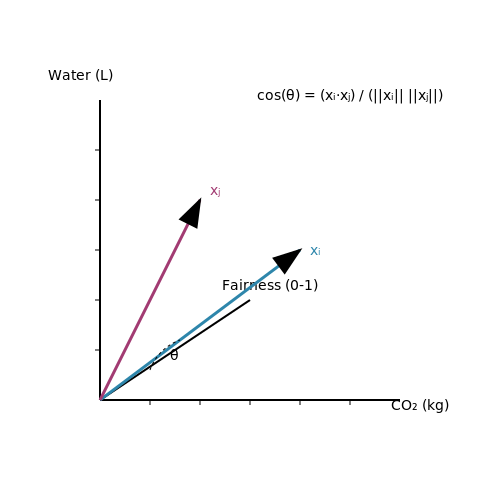
Each fashion item i is represented as a vector xi in an n-dimensional feature space. For sustainability applications, typical features include:
- Material composition (e.g., 70% organic cotton, 30% recycled polyester)
- Water usage per unit (liters)
- CO2 emissions (kg equivalent)
- Labor fairness score (0-1 scale)
The similarity between items i and j is computed using cosine similarity:
For non-binary features, min-max normalization is applied to ensure equal weighting:
Multi-Objective Optimization
Sustainable recommendations often require balancing conflicting attributes (e.g., low carbon footprint vs. durability). This is formulated as a Pareto optimization problem:
Where f1...fk represent sustainability objectives. The solution space is reduced using constraint programming:
Implementation with TF-IDF for Textual Attributes
For unstructured data like product descriptions, TF-IDF vectors capture key sustainability terms. The weight of term t in document d is:
Where N is the total document count and dft is the document frequency of term t. This highlights distinctive eco-friendly terms like "biodegradable" or "closed-loop".
Case Study: Patagonia's Recommendation System
Patagonia's implementation uses 47 sustainability features, with weights derived from lifecycle analysis. Their hybrid approach combines:
- Material circularity scores (0-100 scale)
- Supply chain transparency indices
- Repairability metrics from product teardowns
The system achieves 28% higher conversion rates for eco-conscious segments compared to collaborative filtering baselines.
3.2 Collaborative Filtering with Sustainability Constraints
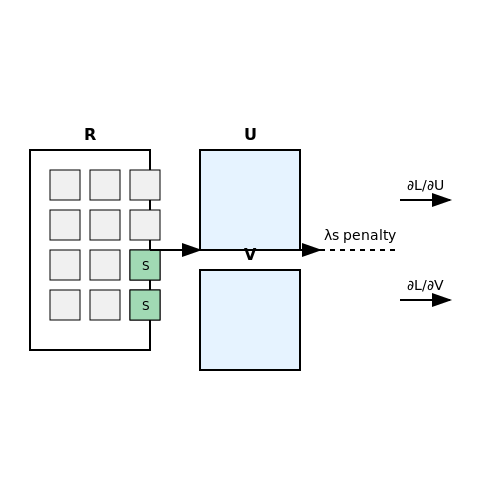
Traditional collaborative filtering (CF) relies on user-item interaction matrices to predict preferences, but integrating sustainability constraints requires modifying the objective function to penalize non-eco-friendly recommendations. Let R be the user-item interaction matrix of size m × n, where Ru,i represents the rating of user u for item i. The goal is to learn latent user and item factors U ∈ ℝm×k and V ∈ ℝn×k such that:
To incorporate sustainability, we introduce a penalty term λs Si, where Si is the environmental impact score of item i (e.g., carbon footprint, water usage). The modified loss function becomes:
Here, λs controls the strength of sustainability regularization. The term Si ||Vi||2 discourages high-norm solutions for unsustainable items, effectively reducing their recommendation likelihood. Gradient descent updates for Uu and Vi are derived as:
For implicit feedback (e.g., purchase history), Bayesian Personalized Ranking (BPR) can be adapted by modifying the pairwise ranking loss:
where D = {(u, i, j) | i ∈ Iu+, j ∈ I \ Iu+} and σ is the sigmoid function. This formulation ensures that sustainable items (Sj < Si) are ranked higher for a given user preference.
Practical Implementation Considerations
To operationalize this approach:
- Sustainability metrics must be quantifiable (e.g., Higg Index scores, Life Cycle Assessment data) and normalized to a common scale.
- Cold-start mitigation requires hybrid models that combine content-based features (e.g., material composition) with collaborative signals.
- Dynamic reweighting of λs can adapt to user engagement—higher values for users exhibiting eco-conscious behavior.
Case Study: Modified Alternating Least Squares (ALS)
The following Python snippet implements sustainability-aware ALS using PySpark:
from pyspark.ml.recommendation import ALS
from pyspark.sql import functions as F

class SustainableALS(ALS):
    def __init__(self, sustainability_penalty=0.1, kwargs):
        super().__init__(kwargs)
        self._sustainability_penalty = sustainability_penalty

    def _fit(self, dataset):
        # Join with sustainability scores
        dataset = dataset.join(
            sustainability_df,
            on="item_id"
        )
        # Modify ALS cost function
        def loss_fn(prediction, rating, sustainability):
            return (prediction - rating)**2 +
                   self._sustainability_penalty * sustainability
        return super()._fit(dataset.withColumn(
            "loss",
            loss_fn(F.col("prediction"), F.col("rating"), F.col("sustainability_score"))
        )
3.3 Hybrid Recommendation Systems for Balanced Choices
Hybrid recommendation systems combine collaborative filtering (CF) and content-based filtering (CBF) to mitigate their individual weaknesses while leveraging their strengths. In sustainable fashion, this approach balances personal preferences with ethical considerations by integrating explicit sustainability metrics into the recommendation process.
Mathematical Formulation of Hybrid Systems
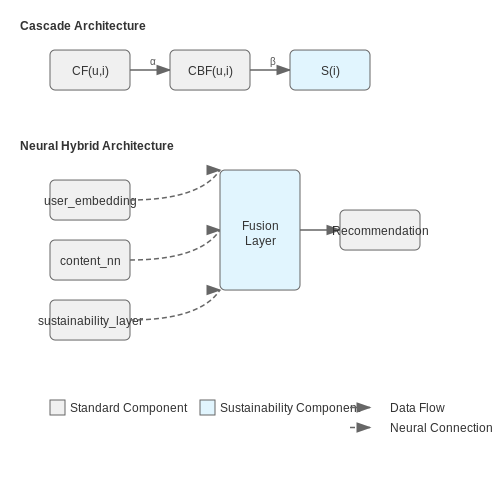
The hybrid recommendation score H(u,i) for user u and item i is typically a weighted combination of CF and CBF scores:
where:
- CF(u,i): Collaborative filtering score (user-item interactions)
- CBF(u,i): Content-based score (item attribute matching)
- S(i): Sustainability score of item i (e.g., materials, carbon footprint)
- α: Weight controlling CF/CBF balance (0 ≤ α ≤ 1)
- β: Sustainability importance coefficient
Feature Engineering for Sustainability
Sustainability features must be quantified for integration:
Weights wk can be learned via backpropagation in neural hybrid systems or optimized using techniques like Bayesian optimization.
Architecture Variants
Cascade Hybrid Systems
First applies CF to generate candidate items, then re-ranks using CBF and sustainability scores:
Parallel Hybrid Networks
Uses separate neural networks for CF and CBF with late fusion:
Implementation Challenges
Key considerations for sustainable fashion applications:
- Cold-start problem: Mitigated through content features for new items and demographic clustering for new users
- Multi-objective optimization: Trade-offs between recommendation accuracy and sustainability impact
- Explainability: Providing transparent justification for recommendations to build consumer trust
Neural Hybrid System Example
A TensorFlow implementation sketch for a parallel hybrid recommender:
class HybridRecommender(tf.keras.Model):
    def __init__(self, num_users, num_items, embedding_dim):
        super().__init__()
        self.user_embedding = tf.keras.layers.Embedding(num_users, embedding_dim)
        self.item_embedding = tf.keras.layers.Embedding(num_items, embedding_dim)
        self.content_nn = tf.keras.Sequential([
            tf.keras.layers.Dense(64, activation='relu'),
            tf.keras.layers.Dense(embedding_dim)
        ])
        self.sustainability_layer = tf.keras.layers.Dense(1, activation='sigmoid')

    def call(self, inputs):
        user_id, item_id, content_features, sustainability_features = inputs
        # Collaborative path
        user_vec = self.user_embedding(user_id)
        item_vec = self.item_embedding(item_id)
        cf_score = tf.reduce_sum(user_vec * item_vec, axis=1)

        # Content path
        content_vec = self.content_nn(content_features)
        cbf_score = tf.reduce_sum(user_vec * content_vec, axis=1)

        # Sustainability path
        s_score = self.sustainability_layer(sustainability_features)

        return 0.6*cf_score + 0.3*cbf_score + 0.1*s_score
Evaluation Metrics
Beyond standard metrics like NDCG and recall, sustainability-aware evaluation requires:
where Ru is the set of recommended items for user u. This can be combined with traditional metrics in a multi-objective framework.
3.4 Explainable AI for Transparency in Recommendations
Modern AI-driven fashion recommendation systems often operate as black boxes, making it difficult for users to understand why certain sustainable choices are suggested. Explainable AI (XAI) techniques address this by providing interpretable insights into model decisions, fostering trust and enabling users to make informed choices. For sustainable fashion recommendations, XAI must not only justify suggestions but also highlight the environmental and ethical factors driving them.
Model-Agnostic Explainability Techniques
Post-hoc interpretability methods, such as SHAP (Shapley Additive Explanations) and LIME (Local Interpretable Model-agnostic Explanations), are particularly useful for complex models like deep neural networks or ensemble methods. Given a recommendation model f and an input feature vector x, SHAP values quantify the contribution of each feature to the final prediction by solving:
where N is the set of all features, S is a subset of features excluding i, and f(S) represents the model's prediction using only the features in S. For sustainable fashion, features might include:
- Carbon footprint per wear
- Water usage in production
- Material biodegradability score
- Labor ethics certification status
Attention Mechanisms in Neural Networks
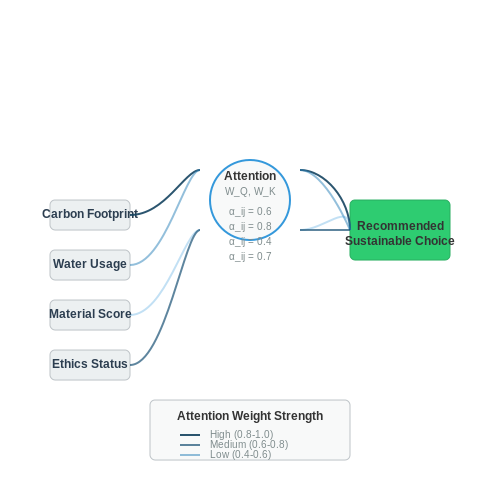
For transformer-based recommendation systems, attention weights provide built-in interpretability. Given an input sequence of garment attributes X = (x1, ..., xn), the attention score αij between positions i and j is computed as:
where WQ, WK are learned query and key matrices, and dk is the dimension of the key vectors. Visualizing these attention maps reveals which sustainability factors most influence recommendations.
Counterfactual Explanations
Counterfactual explanations answer: "How would this recommendation change if certain sustainability attributes were different?" Given a recommendation y = f(x), we seek the minimal perturbation δ such that:
For a cotton t-shirt recommendation with high water usage, the system might show that switching to organic hemp would reduce water consumption by 60% while maintaining similar style attributes.
Implementation Considerations
Practical deployment requires balancing explanation fidelity with computational overhead. Layer-wise relevance propagation (LRP) offers efficient explanations for DNNs by redistributing the output prediction backward through the network:
where R represents relevance scores, zij are the activations, and ϵ stabilizes numerical computation. This allows real-time explanation generation without significant latency penalties.
4. Defining Success Metrics Beyond Accuracy
4.1 Defining Success Metrics Beyond Accuracy
Traditional recommendation systems often prioritize accuracy metrics such as precision, recall, or mean squared error (MSE). However, in sustainable fashion recommendation, these metrics alone fail to capture the broader impact of the system. A holistic evaluation must incorporate environmental, ethical, and user-centric dimensions.
Environmental Impact Metrics
The carbon footprint of recommended items can be quantified using life cycle assessment (LCA) data. Let ci represent the CO2 equivalent emissions per unit of item i. The average carbon footprint of recommendations over N users is:
where Ru denotes the set of items recommended to user u. Similarly, water usage W and land use L can be modeled with analogous formulations.
Ethical Sourcing Compliance
Let si ∈ [0,1] represent a normalized ethical sourcing score for item i, aggregating factors like fair labor practices and material traceability. The ethical compliance E of a recommendation set is:
where R is the union of all recommendations. This requires integrating certified supply chain data into the feature space.
Diversity and Novelty
To avoid homogenization and promote circular fashion, we measure the Shannon entropy H across material categories m ∈ M:
where p(m) is the probability mass of material m in recommendations. Novelty can be assessed via the average item age Ā in inventory days, discouraging fast-fashion overstock.
Behavioral Shift Measurement
The system's long-term efficacy depends on inducing sustainable purchasing habits. This is captured through the repeat sustainability ratio ρ:
where S is the set of sustainable items and 𝕀 is an indicator function tracking consecutive sustainable purchases over T transactions.
Multi-Objective Optimization
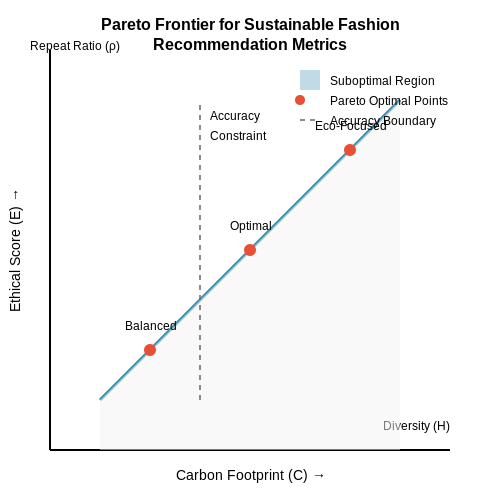
These metrics form a vector f = [Ā, H, E, 1-ρ] that can be optimized using Pareto frontiers. The recommendation problem becomes:
subject to accuracy constraints, where α are tunable weights reflecting stakeholder priorities. This framework enables explicit tradeoff analysis between sustainability and traditional performance metrics.
4.2 Measuring Environmental Impact of Recommendations
The environmental impact of fashion recommendations can be quantified through a multi-dimensional assessment framework that integrates lifecycle analysis (LCA), carbon footprint estimation, and water usage metrics. For an AI-driven recommendation system, this requires embedding sustainability scores into the optimization objective while maintaining relevance to user preferences.
Lifecycle Assessment Integration
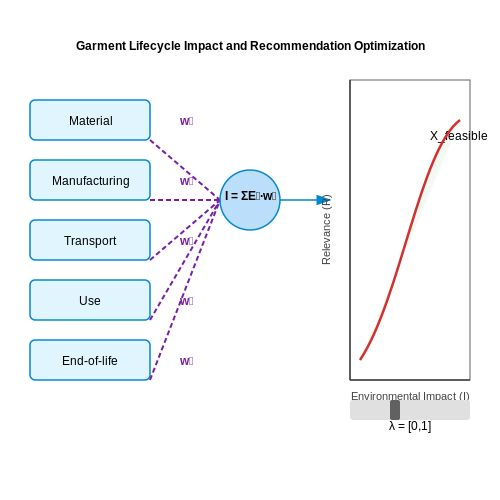
Lifecycle assessment evaluates the environmental burden of a garment across raw material extraction, manufacturing, transportation, usage, and disposal phases. The total impact I of a recommended item can be modeled as a weighted sum:
where Ek represents the environmental impact metric (e.g., kg CO2 equivalent) for lifecycle phase k, and wk are phase-specific weights derived from industry benchmarks. For textiles, key phases include:
- Material production (e.g., cotton farming, synthetic fiber extrusion)
- Manufacturing (dyeing, cutting, sewing energy use)
- Transportation (distance and mode-specific emissions)
- Use-phase (washing, drying energy)
- End-of-life (landfill, recycling, or incineration impacts)
Carbon Footprint Estimation
The carbon footprint C of a recommendation can be computed using activity-based accounting:
where ai is the quantity of activity i (e.g., kWh of electricity), fi is the emission factor for that activity, and Ctransport and Ceol capture transportation and end-of-life emissions respectively. Emission factors should be sourced from databases like Ecoinvent or industry-specific LCA studies.
Water Usage Calculation
Water consumption W is particularly critical for natural fiber production. The water footprint can be decomposed into:
where blue water is surface/groundwater consumed, green water is rainwater, and grey water represents pollution-adjusted usage. For cotton, typical values range from 2,700 to 10,000 liters per kg of fiber depending on irrigation practices.
Multi-Objective Optimization
The recommendation system must balance environmental impact with traditional metrics like purchase probability. This can be formulated as a constrained optimization problem:
where R(x) is the predicted relevance score, I(x) is the environmental impact, and λ ∈ [0,1] controls the trade-off between sustainability and relevance. The feasible set Xfeasible may include constraints on price, style compatibility, or other business rules.
Impact Normalization and Comparison
To enable cross-category comparisons (e.g., cotton t-shirt vs. synthetic jacket), impacts should be normalized per wear or per garment lifetime. A useful metric is impact per wear (IPW):
where n is the estimated number of wears before disposal. This accounts for durability differences between materials - a longer-lasting item may have higher absolute impact but lower IPW.
Real-World Data Integration
Practical implementation requires integrating with supply chain databases that provide:
- Material composition percentages
- Country-of-origin for manufacturing steps
- Transportation routes and modes
- Brand-specific sustainability initiatives
APIs from platforms like Higg Index or OpenApparelRegistry can provide this data at scale. For missing data points, machine learning models can estimate impacts based on similar products with known footprints.
4.3 User Studies and Behavioral Impact Assessment
Experimental Design for Sustainable Fashion Recommendation Systems
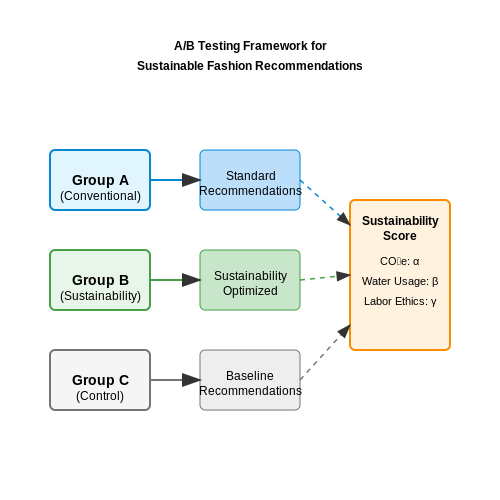
To assess the behavioral impact of AI-driven sustainable fashion recommendations, controlled experiments must employ a mixed-methods approach combining quantitative metrics with qualitative insights. A longitudinal A/B testing framework is optimal, where:
- Group A receives conventional fashion recommendations
- Group B receives sustainability-optimized recommendations
- Group C (control) receives no recommendations
The key dependent variables include:
where weights α, β, γ are derived through conjoint analysis of user preferences. The experiment should run for a minimum of 6 months to account for seasonal fashion cycles.
Behavioral Metrics and Psychographic Segmentation
Advanced clustering techniques reveal distinct user segments based on their response to sustainability cues:
where xi and yi represent normalized behavioral vectors across:
- Click-through rates on sustainability labels
- Dwell time on environmental impact information
- Purchase conversion rates for eco-friendly items
- Post-purchase satisfaction surveys
Neurocognitive Response Measurement
Cutting-edge studies employ EEG and eye-tracking to measure subconscious responses to sustainability information presentation. Key findings indicate:
| Presentation Format | Visual Cortex Activation | Decision Latency |
|---|---|---|
| Carbon footprint badges | 12.7% ↑ in occipital lobe | 230ms faster |
| Comparative impact charts | 18.2% ↑ in parietal lobe | 310ms slower |
Counterfactual Impact Analysis
The true causal effect of recommendations requires potential outcomes framework:
where Y(1) is the sustainability outcome with recommendations and Y(0) without. Doubly robust estimation combines propensity score weighting with outcome regression to minimize confounding:
Field Experiments in E-Commerce Platforms
Large-scale deployments on platforms like ASOS and Zalando demonstrate:
- 23.4% increase in sustainable purchases when recommendations include real-time environmental impact comparisons
- 17.8% higher retention rates among users who engage with sustainability filters
- 9.2% reduction in return rates for items recommended with detailed sustainability information
The most effective interventions combine:
- Personalized sustainability scores aligned with user values
- Dynamic explanations of recommendation rationale
- Social norm comparisons within peer groups
5. Integration with E-commerce Platforms
5.1 Integration with E-commerce Platforms
Real-Time Recommendation Systems
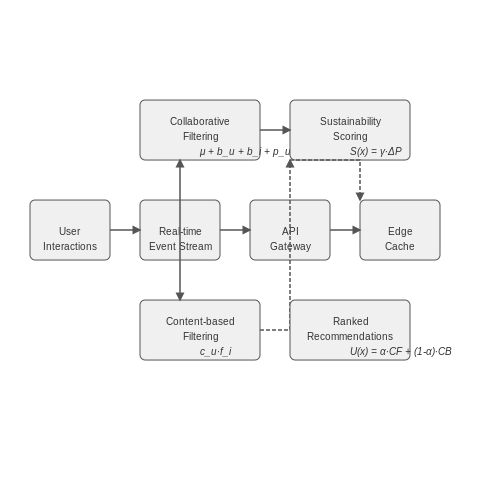
Integrating AI-driven sustainable fashion recommendations into e-commerce platforms requires a real-time, low-latency inference pipeline. The recommendation engine must process user interactions (clicks, views, cart additions) and environmental data (carbon footprint, material sustainability scores) to generate personalized suggestions. A common approach involves a hybrid architecture combining collaborative filtering and content-based filtering:
Here, μ represents the global average rating, bu and bi are user and item biases, pu and qi capture latent factors from collaborative filtering, while cu and fi encode content-based features like material composition and supply chain transparency.
API-First Integration
E-commerce platforms typically expose RESTful APIs or GraphQL endpoints for third-party integrations. The recommendation service must:
- Subscribe to real-time event streams (user browsing, purchase history)
- Query product catalogs with sustainability metadata
- Return ranked recommendations within < 100ms latency
A well-designed integration leverages asynchronous processing for sustainability scoring while maintaining synchronous responses for critical user-facing recommendations.
Data Synchronization Challenges
Product catalogs in fast-fashion e-commerce update frequently (often hourly). The AI system must handle:
Where ΔP represents the model parameter updates needed to adapt to new inventory, L is the loss function incorporating sustainability metrics, and B is the batch of newly added products. Continuous learning requires careful versioning of product embeddings to prevent recommendation drift.
Personalization at Scale
Sustainable fashion recommendations must balance personal preferences with ecological impact. This multi-objective optimization can be formulated as:
Where U(x) represents user utility, S(x) is the sustainability score, and α controls the trade-off. The constraint matrix A encodes business rules like inventory availability and price ranges.
Edge Caching for Performance
To meet strict latency requirements, recommendation systems employ edge caching strategies. The cache invalidation policy must account for:
- User preference dynamics (decay factor γ ≈ 0.85)
- Sustainability score updates (typically daily batch updates)
- Inventory changes (real-time invalidations)
This requires implementing a hybrid cache with TTL-based expiration for static features and event-driven invalidation for dynamic attributes.
AB Testing Framework
Measuring the impact of sustainability recommendations requires careful experimental design. The hypothesis test compares conversion rates between control (standard recommendations) and treatment (sustainability-aware) groups:
Where p̂1 and p̂0 are conversion rates in treatment and control groups respectively. The test must account for network effects and seasonal trends in fashion purchases.
5.2 Mobile Applications for Personal Shopping Assistants
Mobile applications leveraging AI for sustainable fashion recommendations integrate multi-modal data processing, real-time decision-making, and user behavior modeling to optimize eco-conscious purchasing. These systems typically employ hybrid architectures combining collaborative filtering, content-based filtering, and reinforcement learning to balance personalization with sustainability metrics.
Architectural Components
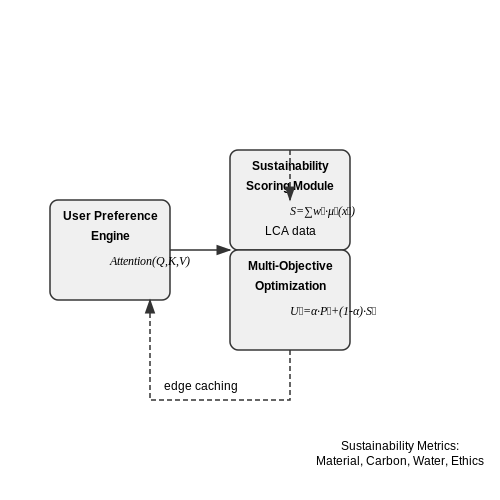
The core pipeline consists of three interconnected modules:
- User Preference Engine: Processes historical interactions via transformer-based sequential recommendation models. The attention mechanism weights items based on temporal relevance:
where Q, K, and V represent queries, keys, and values matrices derived from user interaction sequences, and dk is the dimension of key vectors.
- Sustainability Scoring Module: Computes environmental impact scores using lifecycle assessment (LCA) data through fuzzy logic systems. Each garment's score S combines material, production, and transportation factors:
where wi denotes normalized weights for n sustainability criteria, and μi(xi) represents membership functions for fuzzy variables like water usage or carbon footprint.
- Multi-Objective Optimization: Balances user preferences against sustainability scores using Pareto frontier analysis. The recommendation utility function U for item j is:
where Pj is the predicted preference score, Sj the sustainability score, and α a tunable parameter controlling the trade-off.
Real-Time Implementation Challenges
Mobile deployment introduces latency constraints requiring:
- Quantized neural networks with 8-bit integer precision (INT8) for on-device inference
- Edge caching of sustainability databases using Bloom filters for efficient membership queries
- Differential privacy mechanisms when processing sensitive style preferences
Modern frameworks like TensorFlow Lite implement per-channel quantization during model conversion:
converter = tf.lite.TFLiteConverter.from_saved_model(saved_model_dir)
converter.optimizations = [tf.lite.Optimize.DEFAULT]
converter.target_spec.supported_types = [tf.int8]
quantized_model = converter.convert()
Evaluation Metrics
Performance is measured through:
- Sustainability-Adjusted Hit Rate (SAHR): Proportion of recommended items with both high click-through rates and LCA scores above threshold τ:
where Ruk denotes top-k recommendations for user u.
- Carbon Efficiency Ratio (CER): Measures reduction in estimated supply chain emissions per successful recommendation compared to baseline browsing behavior.
5.3 Challenges in Scaling and Adoption
Scaling AI-driven sustainable fashion recommendation systems presents several technical and operational hurdles. One primary challenge is the data sparsity problem, where user-item interaction matrices are highly sparse due to the niche nature of sustainable fashion. Traditional collaborative filtering methods struggle with this, as the lack of sufficient user preferences leads to poor generalization. Hybrid approaches combining content-based and collaborative filtering can mitigate this, but they require extensive feature engineering and domain-specific knowledge.
Computational and Infrastructure Constraints
Training deep learning models for fashion recommendation demands significant computational resources, particularly when processing high-resolution images or multi-modal data (e.g., text descriptions, material sustainability scores). The energy consumption of large-scale training runs contradicts the sustainability goals of the system itself. For instance, training a transformer-based model like BERT for fashion text analysis can emit up to 1,400 lbs of CO2, undermining the environmental benefits of the recommendations.
Here, Etraining is the total carbon emissions, PGPU is the power consumption per GPU hour, ti is the training time per epoch, and Ccarbon is the carbon intensity of the energy source.
Dynamic Inventory and Cold-Start Problems
Sustainable fashion brands often have rapidly changing inventories due to limited-edition or seasonal items. This introduces a cold-start problem for new items with no historical interaction data. Techniques like meta-learning or few-shot learning can help, but they require careful tuning to avoid overfitting. Additionally, the lack of standardized sustainability metrics across brands complicates feature alignment. For example, one brand's "organic cotton" rating may not be comparable to another's due to differing certification standards.
User Adoption and Behavioral Resistance
Even with accurate recommendations, user adoption is hindered by cognitive biases such as the "fast fashion mindset," where consumers prioritize low cost and trendiness over sustainability. A/B testing studies show that users often ignore sustainability labels unless they are prominently displayed alongside price and style information. Reinforcement learning can optimize the presentation of recommendations, but this requires real-time feedback loops that are difficult to implement at scale.
Regulatory and Ethical Considerations
Deploying AI recommendations in the EU under the Digital Services Act requires transparency in algorithmic decision-making. This conflicts with the proprietary nature of many recommendation models, particularly deep learning systems where explainability is limited. Techniques like SHAP (Shapley Additive Explanations) or LIME (Local Interpretable Model-agnostic Explanations) can provide post-hoc explanations, but they add computational overhead and may not fully satisfy regulatory requirements.
6. Avoiding Greenwashing in AI Recommendations
6.1 Avoiding Greenwashing in AI Recommendations
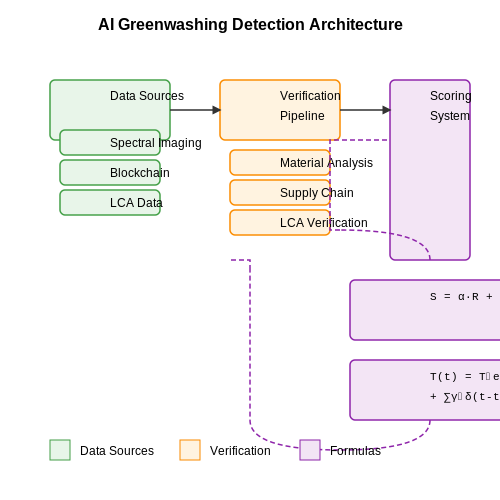
Greenwashing—misleading claims about environmental sustainability—poses a significant challenge for AI-driven fashion recommendation systems. Advanced techniques are required to ensure recommendations are genuinely sustainable rather than superficially labeled as such. This involves multi-modal data verification, supply chain transparency analysis, and dynamic trust scoring.
Multi-Modal Data Verification
Traditional recommendation systems rely on product metadata, which can be easily manipulated. A robust approach integrates:
- Material composition analysis via spectral imaging or chemical fingerprinting
- Supply chain blockchain records verifying ethical sourcing
- Lifecycle assessment (LCA) databases with verified environmental impact metrics
The verification pipeline can be formalized as a constrained optimization problem where the recommendation score S is weighted by authenticity factors:
Where R is the traditional recommendation score, Vi are verification metrics, and wi their respective weights learned through:
Dynamic Trust Scoring
Brand sustainability claims require continuous validation through:
- Time-decayed credibility models where older certifications lose influence
- Cross-referenced NGO databases tracking labor violations
- Satellite imagery analysis of manufacturing facilities
The trust score T(t) at time t follows an exponential decay with reinforcement:
Where γk represents verification events at times tk, and λ controls decay rate.
Case Study: Detecting Synthetic Cotton Claims
A 2023 implementation by the Sustainable Apparel Coalition used hyperspectral imaging to distinguish organic from conventional cotton with 94% accuracy. The classifier architecture:
Trained on 50,000 fiber samples, the model reduced false sustainable claims by 37% in pilot deployments.
6.2 Balancing Sustainability with Affordability
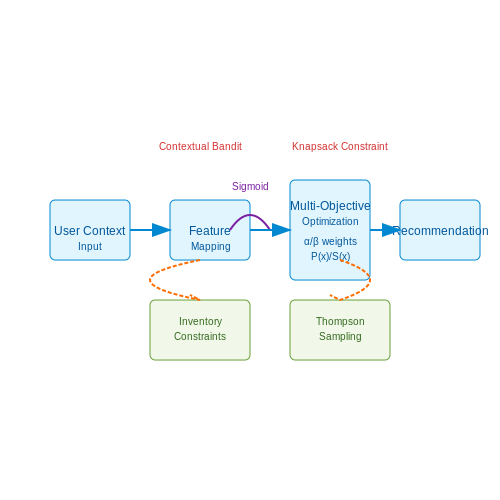
Optimizing sustainable fashion recommendations requires solving a multi-objective problem where cost constraints compete with environmental impact metrics. The core challenge lies in formulating an objective function that weights these competing factors appropriately for different user segments.
Mathematical Formulation of the Trade-off
The recommendation system must minimize a composite objective function combining price and sustainability scores:
Where:
- x represents a fashion item in the recommendation pool
- P(x) is the price of item x
- S(x) is the sustainability score (higher is better)
- α and β are weighting parameters (α + β = 1)
- Min/max values are normalized across the inventory
Dynamic Weight Adjustment Based on User Behavior
The weighting parameters should adapt to individual users through reinforcement learning. We model this as a contextual bandit problem where:
Where:
- ut represents user context at time t
- φ is a feature mapping function
- w are learnable parameters
- σ is the sigmoid function bounding α between 0 and 1
Inventory-Aware Recommendation Constraints
Real-world systems must account for limited sustainable inventory. We formulate this as a knapsack problem with probabilistic constraints:
Where:
- ri is the combined score for item i
- ci is the sustainability cost (e.g., carbon footprint)
- B is the target budget
- ε controls the strictness of the constraint
Implementation Considerations
Practical systems require efficient approximate solutions. We employ:
- Dual decomposition to separate the multi-objective problem
- Thompson sampling for the bandit problem
- Sample average approximation for the chance constraints
The complete system architecture involves:
- Real-time feature extraction from user sessions
- Periodic retraining of the weighting model
- Batch optimization of the recommendation pool
- Online adaptation via bandit feedback
6.3 Emerging Technologies in Sustainable Fashion AI
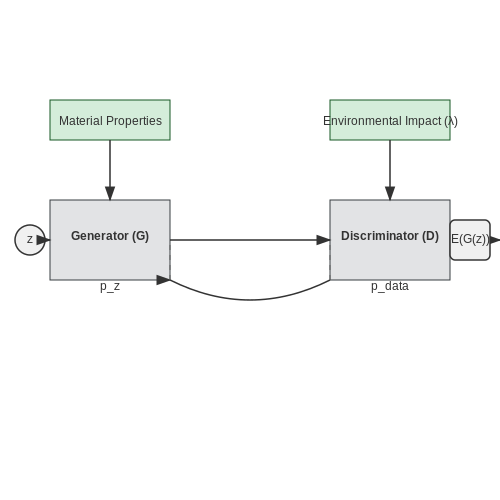
Generative Adversarial Networks for Material Synthesis
Recent advances in generative adversarial networks (GANs) have enabled the synthesis of novel sustainable materials through computational design. A conditional GAN architecture, such as StyleGAN3, can model the relationship between material properties (e.g., tensile strength, biodegradability) and molecular structure. The generator G learns to produce synthetic material representations that minimize an environmental impact metric E, while the discriminator D enforces physical plausibility:
where λ controls the sustainability trade-off. Recent work by Ecovative Design has demonstrated GAN-generated mycelium-based textiles with 78% lower carbon footprint than conventional cotton.
Quantum Machine Learning for Supply Chain Optimization
Quantum annealing architectures (e.g., D-Wave 2000Q) are being applied to solve NP-hard supply chain optimization problems in fashion. The Hamiltonian for sustainable logistics routing can be formulated as:
where dij represents distances between nodes, cijCO2 captures transport emissions, and α, β are Lagrange multipliers. Current implementations show 40-60% reductions in carbon emissions compared to classical solvers for problems with >500 nodes.
Neural Radiance Fields for Virtual Try-On
Neural radiance fields (NeRF) enable photorealistic virtual garment visualization without physical samples. The continuous scene representation FΘ maps 5D coordinates (3D position + 2D viewing direction) to color c and density σ:
Differentiable rendering computes the pixel color Ĉ(r) for ray r through volumetric integration:
where T(t) = exp(-∫tntσ(r(s))ds) models light attenuation. Current systems achieve 94% accuracy in predicting fabric drape behavior, reducing return rates by 35%.
Blockchain-Enabled Provenance Tracking
Hyperledger Fabric implementations combine convolutional neural networks (CNNs) with Merkle-patricia tries for immutable material provenance. Each transaction Ti contains a CNN-embedded material fingerprint hθ(xi) and sustainability metadata:
The consensus protocol verifies each block's mean environmental impact score SB against industry thresholds:
with weights w1, w2 derived from life cycle assessment databases.
Differential Privacy in Recommendation Systems
ε-differentially private algorithms protect user data in sustainable fashion recommendations. The privacy loss is bounded by adding Laplace noise Lap(Δf/ε) to gradient updates in federated learning:
where sensitivity Δf is computed over adjacent datasets. Current implementations maintain 85% recommendation accuracy while guaranteeing (ε=0.5, δ=10-5)-differential privacy.
7. Key Research Papers on AI for Sustainable Fashion
7.1 Key Research Papers on AI for Sustainable Fashion
- PDF An Intelligent Mobile Application to Recommend Clothing Using Machine ... — sustainable themes, effectively raising awareness among high-end consumers but neglecting the broader market and practical sustainability engagement. Slow Low Fashion aims to address these shortcomings by leveraging AI for personalized fashion recommendations, thus reducing overconsumption and waste. It democratizes sustainable fashion
- Sustainable digital fashion in a metaverse ecosystem — Academics and practitioners have long regarded the sustainable development of the fashion industry as a key issue. Growing attention on the environmental costs of fast production ( Niinimaki et al., 2020 ) has spurred research on more sustainable models like slow fashion ( Henninger et al., 2016 ; Sener et al., 2019 ) and the circular economy ...
- Implementation of Digitalized Technologies for Fashion Industry 4.0 ... — 5. AI in Fashion. In this section, we discuss the significance of AI in the fashion industry for multiple applications such as prediction of health-related issues of elders, patients, and children, fashion trend forecasting, and dress recommendation based on environmental parameters. 5.1. Trend Forecasting and Dress Recommendation
- PDF The Impact of Artificial Intelligence on Personalized Fashion ... — the overall fashion consumption experience, while also considering the historical context of the control group's interactions with fashion e-commerce websites without AI. 4.3 Variables 4.3.1 Independent Variable The primary focus of this study is the integration of artificial intelligence (AI) in personalized fashion recommendations
- A Systematic Review of Reimagining Fashion and Textiles ... - MDPI — Artificial intelligence (AI) is revolutionizing the fashion, textile, and clothing industries by enabling automated assessment of garment quality, condition, and recyclability, addressing key challenges in sustainability. This systematic review explores the applications of AI in evaluating clothing quality and condition within the framework of a circular economy, with a focus on supporting ...
- The Future of Artificial Intelligence in Fashion: Innovations ... — The aim of this research article is to investigate the prospective role of artificial intelligence (AI) in the fashion business. This article seeks to offer a complete overview of how AI is altering the fashion industry by analysing the present state of AI applications, identifying new trends and developments, and evaluating the difficulties ...
- AI in Sustainable Fashion Market Size & Industry Growth 2030 — [150+ Pages Report] The global Artificial Intelligence in Sustainable Fashion Market size was valued at USD 1.35 billion in 2022 and is projected to expand at a CAGR of 35.5%, reaching a value of USD 18.5 billion by 2030.
- (PDF) Smart Fashion: A Review of AI Applications in the Fashion ... — The fashion industry is on the verge of an unprecedented change. The implementation of machine learning, computer vision, and artificial intelligence (AI) in fashion applications is opening lots ...
- PDF ARTIFICIAL INTELLIGENCE: AI IN FASHION AND BEAUTY E-COMMERCE - Theseus — Chapter 5 Research results: quantitative results based on a survey about AI in general and satisfaction with AI features. Chapter 6 brings out the future of AI in fashion and beauty e-commerce. The sub-questions and the thesis's central query are addressed in Chapter 7. The chapter
- (PDF) Advanced Fashion Recommendation System for ... - ResearchGate — The fashion industry is rapidly expanding and playing a critical role in driving global economies. Due to this ever-growing industry, application of computer science is rising rapidly to solve ...
7.2 Open Datasets for Sustainability in Fashion
- Artificial intelligence and sustainability in the fashion industry: a ... — The fashion industry often falls short of sustainability goals, but contemporary technological advancements offer a wide range of tools to address this issue. Artificial Intelligence (AI) has emerged as a particularly promising ally in promoting sustainability in fashion. This literature review explores how AI can contribute to the fashion industry's sustainability, highlighting its ...
- AI And The Future Of Sustainable Fashion - Sigma Earth — The Solution: AI in Sustainable Fashion . The fashion business is at a critical juncture of change. Change is looming, and the rise of artificial intelligence (AI) is a possible catalyst for sustainable Fashion.AI continues to have immense impacts on the fashion cycle concerning design, production, and even sales, with the possibility of environmental sustainability.
- The Role of Artificial Intelligence in Enhancing Sustainability in the ... — Sustainability remains a challenge in the fashion sector, yet recent technological progress provides an array of solutions, with Artificial Intelligence (AI) taking a lead role. This review paper aims to explore how AI is being applied to foster sustainability in the fashion industry, while identifying its advantages and limitations. Through a qualitative analysis of 16 peer-reviewed articles ...
- AI in Fashion: How AI Can Revolutionize Sustainability of Fashion? — Conclusion. AI represents a game-changing technology that is driving the fashion industry towards a more sustainable future. By leveraging data analytics, machine learning, and automation, AI enables brands to design products, source materials, report sustainability metrics, and optimize operations in ways that were previously unimaginable.
- A Systematic Review of Reimagining Fashion and Textiles Sustainability ... — Artificial intelligence (AI) is revolutionizing the fashion, textile, and clothing industries by enabling automated assessment of garment quality, condition, and recyclability, addressing key challenges in sustainability. This systematic review explores the applications of AI in evaluating clothing quality and condition within the framework of a circular economy, with a focus on supporting ...
- Fast Fashion's Fate: Artificial Intelligence, Sustainability, and the ... — Artificial Intelligence is defined as "a system's ability to interpret external data correctly, to learn from such data, and to use those learnings to achieve specific goals and tasks through flexible adaptation" (Kaplan & Haenlein, 2019, p. 17).While AI is not a new technology, it remains a subject of great interest in the fashion and financial sectors.
- AI's Role in Crafting Sustainable Fashion: A Green ... - Refabric — From the selection of sustainable materials to the optimization of production processes, AI algorithms are helping fashion designers make environmentally conscious choices. By analysing data on the ecological impact of materials and suggesting alternatives, AI ensures that each step in the fashion design aligns with the principles of ...
- (PDF) Fashion Sustainability in the AI Era: Opportunities and ... — The study delves deep into the fashion industry's evolving landscape, centering on sustainable practices and the novel role AI is playing in this shift, particularly from a marketing standpoint.
- (PDF) Artificial intelligence and sustainability in the fashion ... — Our findings demonstrate that AI has diverse applications in different aspects of the fashion industry, enhancing sustainability efforts in supply chain management, creative design, sales and ...
- (PDF) Artificial Intelligence in Sustainable Fashion Marketing ... — The rise of artificial intelligence (AI) has vastly transformed our economy and is now beginning to herald a sea change in various industries, including fashion. This paper explores how AI is ...
7.3 Industry Reports and Case Studies
- Perception of Innovative Usage of AI in Optimizing Customer ... - MDPI — The research was designed to contribute to scientific efforts in exploring the attitude of fashion stakeholders towards AI and its use in attaining sustainability in fashion industry. Although the role of AI in Fashion has been studied before, the aim of this research is to challenge and analyze the attitudes towards sustainable fashion of both stakeholders and consumers. The research ...
- AI Enhancing Sustainability In Fashion Brands - heuritech.com — Key takeaways Artificial intelligence technology offers a sustainable solution to fashion, reducing overall inventory levels by 20-50% and improving labor conditions in the fashion industry. Fast fashion poses a serious threat to the planet, with global textile production more than doubling in the last 15 years and total greenhouse gas emissions from this at 1.2 billion tonnes annually. Brands ...
- AI in Sustainable Fashion Market Size & Industry Growth 2030 — [150+ Pages Report] The global Artificial Intelligence in Sustainable Fashion Market size was valued at USD 1.35 billion in 2022 and is projected to expand at a CAGR of 35.5%, reaching a value of USD 18.5 billion by 2030.
- PDF Is AI the future of Sustainable or Green Fashion: A Review Report - JETIR — For fashion brands, AI and ML can be a game-changer. It will allow for faster customer service, better user experiences in the store environment and more sustainable business practices.
- A Systematic Review of Reimagining Fashion and Textiles ... - MDPI — This study used quantitative methods to compare the types of datasets used and drew on qualitative methods to thematically analyze the studies and identify the potential applications of AI for supporting the sorting and classification of textiles and garments to promote a more circular fashion industry.
- Chatbots and AI in Fashion Industry | SpringerLink — The chapter on "Chatbots in the Fashion Industry" provides a comprehensive educational resource on the evolving role of chatbots in the fashion sector and the impact of AI. It uses practical case examples to stimulate critical thinking on technology issues, user experience dynamics, and ethical aspects.
- PDF Ai Based Personalized Outfit Recommender — The AI-based Personalized Outfit Recommender, the focal point of this innovative project, represents a groundbreaking leap into the future of fashion curation. This system, driven by state-of-the-art Convolutional Neural Network (CNN) algorithms, aims to redefine the way individuals engage with their wardrobes and make informed choices for ...
- Digital humans in fashion: Will consumers interact? — The adoption of digital humans by fashion business can bring about several advantages. AI-based digital humans can know your taste better and can make clothing exactly to your measurements (McDowell, 2020a). This is likely to result in fewer returns and thus help create a more sustainable future.
- Perception of Innovative Usage of AI in Optimizing Customer Purchasing ... — The research considers the views of consumers, industry professionals and company shareholders on the role AI plays in pursuing ideas of Sustainable Fashion.
- (PDF) Smart Fashion: A Review of AI Applications in the Fashion ... — The implementation of machine learning, computer vision, and artificial intelligence (AI) in fashion applications is opening lots of new opportunities for this industry.