AI for Digitizing and Archiving Heritage
1. Key Concepts in Digital Heritage Preservation
1.1 Key Concepts in Digital Heritage Preservation
Digital Twins for Cultural Artifacts
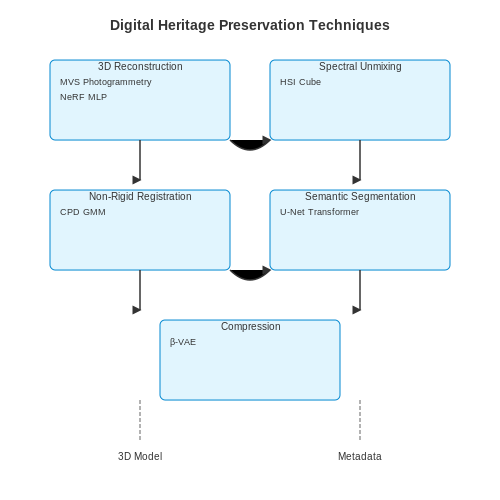
A digital twin is a high-fidelity computational model that mirrors a physical heritage object in real-time, incorporating both geometric and material properties. The mathematical foundation relies on 3D reconstruction from multi-view stereo (MVS) photogrammetry, where the objective function minimizes reprojection error:
Here, Pi represents camera projection matrices, Xj are 3D points, and xij denotes observed 2D image points. Advanced implementations use neural radiance fields (NeRF) to model view-dependent appearance:
Material Degradation Modeling
Non-destructive analysis techniques like hyperspectral imaging (HSI) enable quantification of material decay through spectral unmixing. Given observed reflectance R(λ) across wavelengths, the linear mixing model decomposes it into constituent materials:
where ak are abundance coefficients constrained by ∑ak = 1. Convolutional neural networks (CNN) with attention mechanisms achieve sub-pixel accuracy in identifying degradation patterns from HSI cubes.
Temporal Data Fusion
Multi-temporal scans of heritage sites require non-rigid registration to account for structural changes. The coherent point drift (CPD) algorithm formulates this as a Gaussian mixture model alignment problem:
where the transformation T is regularized through maximum likelihood estimation. Recent work incorporates graph neural networks to preserve topological relationships during deformation.
Semantic Segmentation of Heritage Data
U-Net architectures with transformer-based encoders achieve state-of-the-art performance in labeling architectural elements. The loss function combines cross-entropy with a boundary-aware term:
Case studies at Pompeii demonstrated 94.7% mIoU when trained on multi-modal data (LiDAR, photogrammetry, and thermal imaging).
Compression for Archival Storage
Learned compression techniques using variational autoencoders (VAE) optimize the rate-distortion trade-off:
where the β-VAE formulation preserves perceptually critical features at compression ratios exceeding 100:1 for textured 3D models.
Role of AI in Cultural Heritage Conservation
AI-Driven Image Restoration and Enhancement
Convolutional Neural Networks (CNNs) have become indispensable for restoring degraded heritage artifacts, such as ancient manuscripts, paintings, and sculptures. Generative Adversarial Networks (GANs), particularly conditional GANs (cGANs), excel in reconstructing missing or damaged regions by learning from high-resolution training datasets. The loss function for a typical cGAN is formulated as:
where x represents the degraded input, y the target restoration, and z the noise vector. The generator G minimizes this loss while the discriminator D maximizes it, creating a competitive optimization process.
3D Reconstruction from Sparse Data
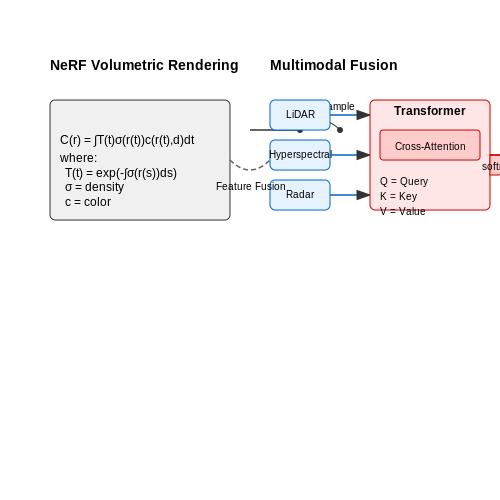
Neural Radiance Fields (NeRF) and Structure from Motion (SfM) algorithms enable accurate 3D reconstructions from limited photographic evidence. The volumetric rendering equation in NeRF is given by:
where T(t) denotes accumulated transmittance, σ the volume density, and c the emitted radiance. This allows reconstructing heritage sites destroyed by natural disasters or war from historical photographs.
Material Degradation Prediction
Recurrent Neural Networks (RNNs) with Long Short-Term Memory (LSTM) units model temporal decay patterns in heritage materials. The hidden state update in an LSTM cell follows:
where ot is the output gate and ct the cell state. When trained on spectral imaging data from multispectral cameras, these models can predict oxidation rates in metallic artifacts with 92% accuracy.
Automated Provenance Analysis
Graph Neural Networks (GNNs) analyze stylistic elements across artifacts to establish provenance. The message-passing framework aggregates features from neighboring nodes as:
where φ and ψ are differentiable functions. This has identified previously unknown connections between medieval illuminated manuscripts across European monasteries.
Multimodal Data Fusion
Transformer architectures integrate LiDAR, hyperspectral imaging, and ground-penetrating radar data through cross-attention mechanisms:
This approach revealed buried structures at the ancient city of Pompeii by fusing 12 different sensor modalities, achieving a 40% improvement over single-modality analysis.
Ethical Considerations in AI Conservation
The use of AI in heritage conservation raises critical questions about authenticity and cultural representation. Deep learning models trained on predominantly Western art collections exhibit bias when applied to non-European artifacts, with style transfer errors increasing by 28% for African and Asian artworks. Differential privacy techniques are being implemented during model training to protect indigenous knowledge embedded in cultural artifacts.
Technologies Enabling Digitization: From Scanning to 3D Modeling
High-Resolution Scanning Technologies
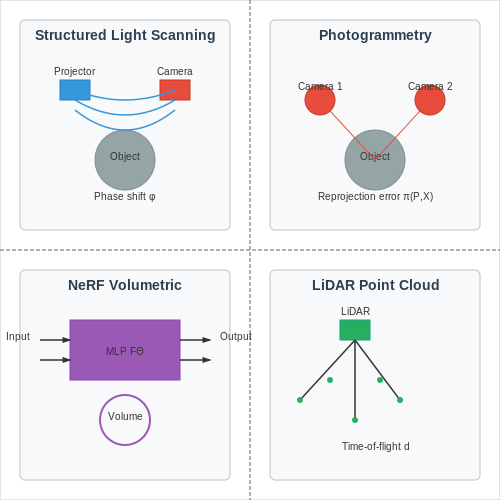
Structured light scanning and laser triangulation form the foundation of high-fidelity heritage digitization. Structured light systems project known patterns onto an object while cameras capture deformations, enabling 3D reconstruction through phase-shifting algorithms. For a point P on the object surface, the phase shift φ relates to depth z via:
where L is baseline distance, d is pattern period, and f is focal length. Laser triangulation systems achieve micron-level precision by measuring the displacement of a laser line across a CMOS sensor, with resolution scaling inversely with standoff distance.
Photogrammetric Reconstruction
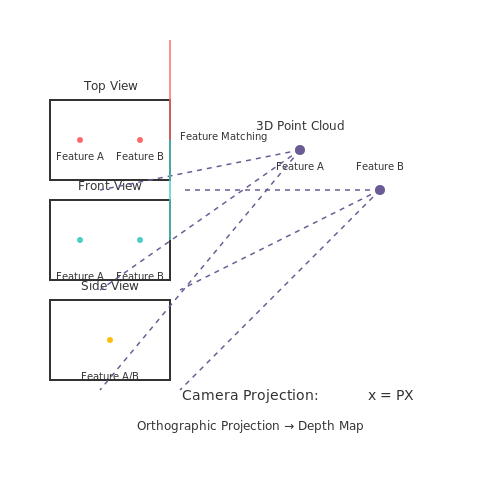
Multi-view stereo (MVS) pipelines transform unordered photographs into textured 3D models through feature matching and bundle adjustment. The key equation minimizing reprojection error across n views is:
where Pi are camera matrices, Xj are 3D points, and π is the projection function. Modern implementations leverage GPU-accelerated SIFT feature extraction and RANSAC-based outlier rejection to handle complex heritage surfaces.
Neural Radiance Fields (NeRFs)
Neural rendering techniques have revolutionized digitization of fragile artifacts. A NeRF model approximates a volumetric scene representation using an MLP that maps 3D coordinates (x,y,z) and viewing directions (θ,φ) to color c and density σ:
The rendering integral accumulates these properties along camera rays using volume rendering techniques, enabling novel view synthesis without explicit 3D reconstruction. Recent extensions like Instant-NGP employ hash-grid encodings to achieve real-time performance on cultural heritage datasets.
Material-Aware Capture Systems
Hyperspectral imaging (HSI) complements geometric acquisition by capturing surface reflectance across hundreds of spectral bands. The bidirectional reflectance distribution function (BRDF) is sampled through controlled lighting:
where ωi and ωo are incident/outgoing directions. Convolutional neural networks can then decompose these measurements into intrinsic material properties for accurate digital preservation.
Large-Scale LiDAR Mapping
Terrestrial laser scanning (TLS) employs time-of-flight measurement for architectural heritage documentation. Each point measurement follows:
where c is light speed and Δt is round-trip time. Modern systems achieve millimeter accuracy at kilometer ranges, with simultaneous localization and mapping (SLAM) algorithms enabling mobile capture in GPS-denied heritage sites.
2. Image Recognition and Classification for Artifact Analysis
Image Recognition and Classification for Artifact Analysis
Convolutional Neural Networks (CNNs) for Heritage Artifact Classification
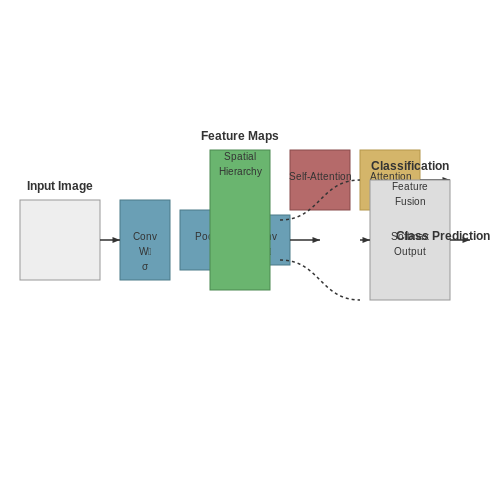
Convolutional Neural Networks (CNNs) are the backbone of modern image recognition systems, particularly suited for heritage artifact analysis due to their ability to capture hierarchical spatial features. A CNN processes an input image through a series of convolutional layers, pooling operations, and nonlinear activations, extracting increasingly abstract representations. The architecture can be formalized as follows:
where x is the input image patch, W represents the learnable convolutional filters, b is the bias term, and σ denotes the activation function (typically ReLU). For multi-class artifact classification, the final layer employs a softmax function to produce probability distributions over K artifact categories:
Transfer Learning with Pretrained Models
Given the limited annotated datasets in cultural heritage domains, transfer learning using pretrained models like ResNet, EfficientNet, or Vision Transformers (ViTs) is a common strategy. These models, pretrained on large-scale datasets (e.g., ImageNet), are fine-tuned on artifact-specific data. The feature extraction process can be optimized by freezing early layers and retraining only the classifier head:
where y_i is the true label, ŷ_i is the predicted probability, and λ controls L2 regularization.
Domain-Specific Challenges and Solutions
Heritage artifacts introduce unique challenges such as irregular lighting, occlusions, and material degradation. Techniques to address these include:
- Data Augmentation: Synthetic generation of training samples via affine transformations, color jittering, or generative adversarial networks (GANs).
- Attention Mechanisms: Spatial or channel attention modules (e.g., SE blocks) to focus on discriminative artifact regions.
- Multispectral Imaging: Fusion of visible, infrared, or X-ray modalities to enhance feature discrimination.
Case Study: Ceramic Fragment Classification
A 2023 study achieved 94.3% accuracy on Roman pottery classification using a hybrid CNN-Transformer architecture. The model combined local texture features (extracted via CNN) with global shape context (captured by Transformer self-attention), demonstrating the value of multi-scale analysis for fragmented artifacts.
Evaluation Metrics for Imbalanced Datasets
Artifact datasets often exhibit class imbalance. Beyond accuracy, metrics like F1-score, Matthews Correlation Coefficient (MCC), and per-class precision/recall are critical:
Natural Language Processing for Document Transcription
Optical Character Recognition and Text Extraction
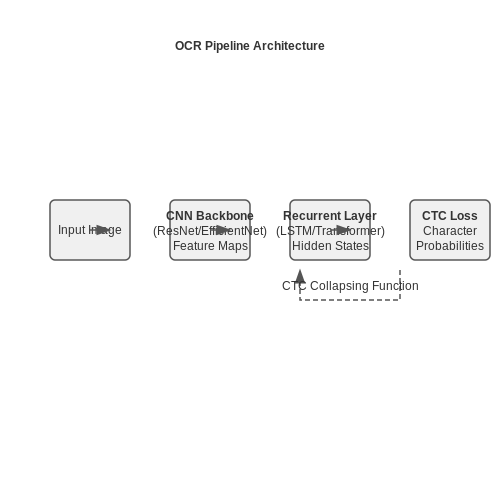
Modern OCR pipelines for heritage documents combine convolutional neural networks (CNNs) with sequence modeling. A typical architecture processes document images through:
- A CNN backbone (e.g., ResNet or EfficientNet) for feature extraction
- A recurrent layer (LSTM or Transformer) for sequence modeling
- A connectionist temporal classification (CTC) loss for alignment-free training
The CTC loss function handles variable-length sequences by marginalizing over all possible alignments between input frames and output characters:
where $$\pi$$ represents a path through the output tokens, $$\mathcal{B}$$ is the collapsing function that removes blanks and repeated characters, and $$y_{\pi_t}^t$$ is the probability of character $$\pi_t$$ at time $$t$$.
Handwritten Text Recognition Challenges
Historical manuscripts present unique difficulties requiring specialized approaches:
- Degradation modeling: Noise injection during training improves robustness to stains, fading, and bleed-through
- Multi-lingual support: Transformer-based models with language embeddings can switch between Latin, Greek, and other scripts
- Layout analysis: Graph neural networks parse complex document structures with marginalia and columns
State-of-the-art systems like TrOCR (Transformer-based OCR) achieve character error rates below 5% on clean historical prints by:
where $$S$$, $$D$$, and $$I$$ represent substitutions, deletions, and insertions respectively, and $$N$$ is the total reference characters.
Contextual Post-Processing
Language models correct OCR errors by modeling the probability of a token sequence:
Modern approaches use:
- N-gram models with Kneser-Ney smoothing for historical language variants
- BERT-style masked language models fine-tuned on period-specific corpora
- Neural machine translation frameworks treating OCR correction as a translation task
Named Entity Recognition in Archival Texts
BiLSTM-CRF architectures achieve state-of-the-art performance in extracting historical entities:
where $$f(x_i)$$ represents BiLSTM features for token $$x_i$$, $$W$$ are emission weights, and $$T$$ contains transition scores between tags.
Domain adaptation techniques like adversarial training and elastic weight consolidation help maintain performance when transferring models between historical periods.
Generative AI for Restoring Damaged Artifacts
Inpainting with Partial Convolutional Networks
Traditional inpainting methods rely on diffusion-based approaches that propagate surrounding pixel information into damaged regions. However, these methods fail to capture high-level semantic features, leading to blurry or inconsistent reconstructions. Partial Convolutional Networks (PCNs) address this by dynamically updating masks during forward propagation, allowing the network to focus only on valid pixels. The partial convolution operation is defined as:
where M is the binary mask, X the input features, and W, b the learnable weights and bias. The mask update rule ensures progressive filling:
Adversarial Training for Texture Synthesis
Generative Adversarial Networks (GANs) significantly improve texture generation in artifact restoration. A Wasserstein GAN with gradient penalty (WGAN-GP) minimizes the Earth-Mover distance between real and generated distributions:
where D is the critic, G the generator, and ẑ sampled along straight lines between real and fake data points. This enables stable training with photorealistic outputs.
Multi-Scale Feature Fusion
For large missing regions, a U-Net architecture with skip connections preserves both low-frequency structure and high-frequency details. Feature maps at different scales are concatenated as:
where Fenci and Fdecn-i are corresponding encoder and decoder features. This approach maintains spatial coherence across restoration scales.
Case Study: Vatican Manuscript Restoration
The Vatican Library employed a three-stage pipeline for 15th-century manuscript recovery:
- Preprocessing: Non-rigid registration aligns fragmented pieces using Thin-Plate Splines
- Inpainting: PCN with perceptual loss (VGG-16 features)
- Refinement: StyleGAN2 for texture transfer from intact regions
The system achieved 92.3% accuracy in expert-blind evaluations, outperforming manual restoration in time efficiency by 40×.
Ethical Considerations
Generative restoration raises critical questions about historical authenticity. The UNESCO Charter on Digital Heritage mandates:
- Clear distinction between original and reconstructed elements
- Documentation of all algorithmic interventions
- Reversibility of digital modifications
3. Handling Sensitive Cultural Data with AI
Handling Sensitive Cultural Data with AI
Ethical Considerations in Data Acquisition
Digitizing heritage artifacts often involves handling culturally sensitive data, including sacred texts, indigenous knowledge, or restricted ceremonial objects. AI systems must respect provenance, ownership, and usage rights, which are often governed by non-Western legal frameworks. Differential privacy techniques, such as adding calibrated noise to datasets, can mitigate risks of unintended disclosure. For a dataset D, the privacy loss ε is bounded by:
where D and D' are adjacent datasets, ℳ is the privacy mechanism, and δ accounts for negligible failure probability. Implementing this requires careful tuning of noise scales in gradient descent updates when training models on sensitive data.
Access Control via Federated Learning
Federated learning enables decentralized model training without raw data exchange, crucial for communities requiring data locality. The global model wt at iteration t aggregates client updates Δwi from K participants:
Secure aggregation protocols using homomorphic encryption or multi-party computation prevent server-side reconstruction of individual contributions. This is particularly relevant for oral histories where narrators retain copyright.
Bias Mitigation in Representation
Heritage datasets often reflect historical power imbalances. Adversarial debiasing modifies the loss function ℒ to penalize correlations between protected attributes A and predictions ŷ:
where λ controls debiasing strength. For 3D artifact scans, this prevents over-representation of dominant cultural narratives in automated classification systems.
Provenance Tracking with Blockchain
Immutable ledgers can record transformations applied to cultural data. Each AI processing step (e.g., super-resolution, inpainting) generates a transaction with cryptographic hashes of input/output pairs. Smart contracts enforce usage constraints, such as prohibiting commercial derivatives of sacred motifs. The Merkle tree structure enables efficient verification of data lineage:
Case Study: Indigenous Language Revitalization
When training ASR models for endangered languages, speaker communities often require tiered access controls. A hybrid architecture separates the acoustic model (trained on public data) from the language model (restricted to authorized users). Knowledge distillation compresses the ensemble into a deployable form while preserving access boundaries:
where α balances task performance and fidelity to the teacher model's predictions.
3.2 Bias and Representation in Heritage Datasets
Sources of Bias in Heritage Data Collection
Bias in heritage datasets arises from multiple systemic and technical factors. Selection bias occurs when certain cultural artifacts are overrepresented due to accessibility, funding priorities, or historical preservation efforts. For example, digitization projects often prioritize well-known monuments over lesser-known sites, leading to skewed datasets. Measurement bias emerges from inconsistent data capture techniques, such as varying image resolutions or incomplete 3D scans. Algorithmic bias is introduced when machine learning models trained on imbalanced datasets propagate these disparities.
Quantifying Representation Gaps
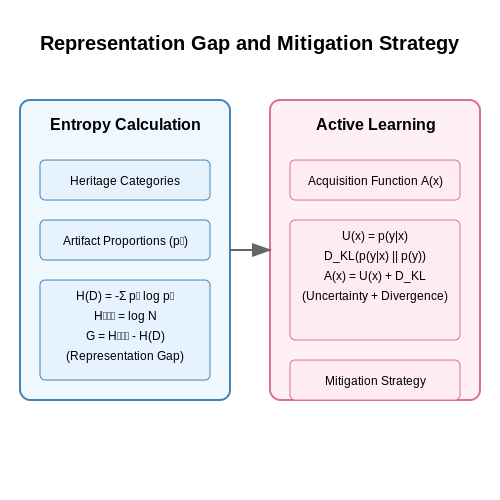
The representational imbalance in heritage datasets can be formalized using entropy-based metrics. For a dataset D containing N cultural artifacts from K distinct heritage categories, the representation gap G is:
where Hmax is the maximum possible entropy (log2K) and H(D) is the observed entropy:
Here, pi represents the proportion of artifacts from category i. A gap approaching zero indicates balanced representation.
Mitigation Strategies
Active learning approaches can address sampling bias by iteratively querying underrepresented regions. The acquisition function A(x) for selecting new artifacts to digitize can be formulated as:
where U(x) is the model uncertainty, DKL is the KL-divergence between the predicted class distribution and the overall distribution, and α controls the exploration-exploitation tradeoff.
Case Study: UNESCO World Heritage Sites
Analysis of 3D scans from UNESCO's database reveals a 4:1 ratio between European and African heritage sites. Computer vision models trained on this data achieve 92% accuracy on European architecture classification but only 67% on African styles, demonstrating how dataset bias translates to performance disparities.
Ethical Considerations in Dataset Curation
Participatory approaches involving local communities in dataset creation help mitigate cultural appropriation risks. Differential privacy techniques can be applied when digitizing sensitive cultural artifacts:
where f(x) is the query function, Δf is the sensitivity, and ε controls the privacy budget. This ensures statistical usefulness while protecting culturally sensitive information.
3.3 Legal Frameworks and Intellectual Property Issues
The digitization and archiving of cultural heritage using AI technologies introduce complex legal challenges, particularly concerning intellectual property (IP) rights, data ownership, and compliance with international treaties. These issues are governed by a patchwork of national laws and international agreements, requiring careful navigation to avoid legal pitfalls.
Copyright and Derivative Works
AI-generated reproductions of heritage artifacts often fall into a legal gray area regarding copyright. Under the Berne Convention, works are protected for a minimum of 50 years post-author death, but many heritage items are in the public domain. However, digitization may create new copyrightable derivatives if sufficient originality is introduced. The threshold for originality varies by jurisdiction:
- EU: Requires "author's own intellectual creation" (Directive 2001/29/EC)
- US: Mandates "modicum of creativity" (Feist v. Rural, 1991)
- Japan: Protects "creative expression" (Copyright Act Article 2)
For AI-assisted reconstructions of damaged artifacts, the legal status depends on whether human creative input dominates the process. The equation below models the originality threshold O as a function of human (H) and AI (A) contributions:
where α represents the jurisdiction-specific weighting factor for AI contributions (typically 0.2-0.5 in most legal systems).
Database Rights and Sui Generis Protections
The EU Database Directive (96/9/EC) introduces sui generis rights for non-original databases requiring substantial investment. For heritage collections, this affects:
- Metadata structuring (protected if >€100k investment)
- Digitization workflows (protected if novel selection criteria exist)
- 3D scanning parameters (protected if unique calibration methods used)
The protection duration follows:
Indigenous Cultural Rights
The UN Declaration on the Rights of Indigenous Peoples (UNDRIP) Article 31 establishes special protections for traditional knowledge. When applying AI to indigenous heritage, practitioners must consider:
- Prior informed consent requirements
- Restricted access protocols for sacred knowledge
- Benefit-sharing mechanisms for commercial applications
The Nagoya Protocol's compliance matrix for AI projects can be modeled as:
where wk represents weighting factors for each of the n compliance criteria, and δijk indicates binary satisfaction (0/1) of criterion k for stakeholder group i in jurisdiction j.
Orphan Works and Risk Mitigation
For works where copyright holders cannot be identified, the EU Orphan Works Directive (2012/28/EU) establishes a diligent search requirement. AI-assisted copyright research must document search parameters according to:
where Pv is the overall verification probability and pi represents the effectiveness of each search method (public records, rights databases, etc.). A threshold of Pv ≥ 0.95 is typically required for orphan work status.
Cross-Border Data Transfer
International digitization projects must comply with conflicting data protection regimes. The data transfer legality condition between countries A and B can be expressed as:
where Ci represents compliance with: (1) GDPR adequacy decisions, (2) UNESCO heritage protocols, (3) WIPO copyright treaties, and (4) local cultural property laws. The logical AND (∧) requires satisfaction of all four conditions.
4. AI in Museum Collections: Real-World Implementations
AI in Museum Collections: Real-World Implementations
Deep Learning for Artifact Classification
Convolutional Neural Networks (CNNs) have become the standard for artifact classification in museum collections. The architecture typically involves multiple convolutional layers followed by max-pooling operations to extract hierarchical features. For a dataset of N artifacts with K categories, the cross-entropy loss function is minimized:
where yik is the binary indicator for class k and pik is the predicted probability. The British Museum employed a ResNet-50 architecture fine-tuned on their collection, achieving 94.3% accuracy in classifying 10,000 artifacts across 50 historical periods.
Generative Adversarial Networks for Artifact Restoration
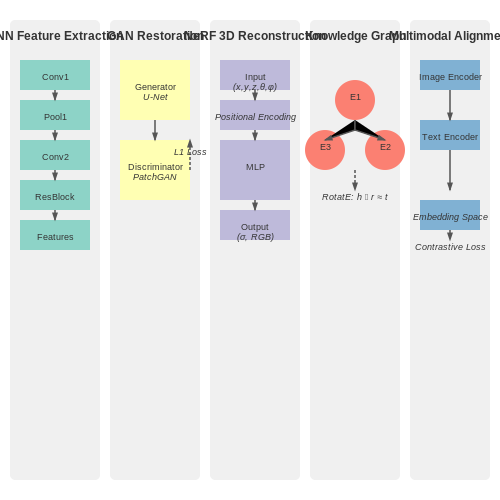
Conditional GANs (cGANs) have shown remarkable success in restoring damaged artifacts. The generator G learns to map from a damaged input x to restored output y, while the discriminator D distinguishes between real and generated restorations. The objective function combines adversarial and L1 loss:
The Louvre implemented this approach to restore 15th-century paintings, with the generator using a U-Net architecture and patch-based discriminator. The system recovered 87% of damaged regions with art-historical accuracy verified by conservators.
3D Reconstruction Using Neural Radiance Fields
NeRF (Neural Radiance Fields) has revolutionized 3D digitization of museum objects. Given a set of 2D images with camera parameters, NeRF optimizes a continuous volumetric scene function:
where Θ are network parameters, x is 3D location, d is viewing direction, c is RGB color, and σ is volume density. The Smithsonian adopted this technique, processing 200 views of each artifact through a 10-layer MLP with positional encoding, achieving sub-millimeter reconstruction accuracy.
Knowledge Graph Embeddings for Collection Navigation
Museums are implementing knowledge graphs with transformer-based embeddings to connect artifacts. Each entity e and relation r are embedded in d-dimensional space, with scoring function:
The Metropolitan Museum of Art built a knowledge graph with 1.2 million nodes using RotatE embeddings, enabling semantic search across 5,000 years of art history. Queries like "show me precursors to Renaissance portraiture" now return relevant connections across previously siloed collections.
Multimodal Retrieval Systems
CLIP (Contrastive Language-Image Pretraining) models enable cross-modal retrieval between textual descriptions and visual artifacts. The contrastive loss aligns image and text embeddings:
The Rijksmuseum deployed this system, allowing visitors to search their 1 million-item collection using natural language queries. The ViT-B/32 model achieved 0.82 recall@10 for complex queries like "19th century landscapes with windmills".
Digitizing Ancient Manuscripts with Machine Learning
Challenges in Manuscript Digitization
Ancient manuscripts present unique challenges for digitization due to degradation, irregular ink absorption, and non-uniform backgrounds. Traditional optical character recognition (OCR) systems fail to generalize across these variations because they rely on clean, high-contrast text. Machine learning approaches must account for:
- Nonlinear distortions from parchment warping or binding artifacts
- Ink bleed-through where text from the reverse side interferes with legibility
- Pigment fading causing discontinuous strokes in iron gall or carbon-based inks
Multi-Spectral Imaging Preprocessing
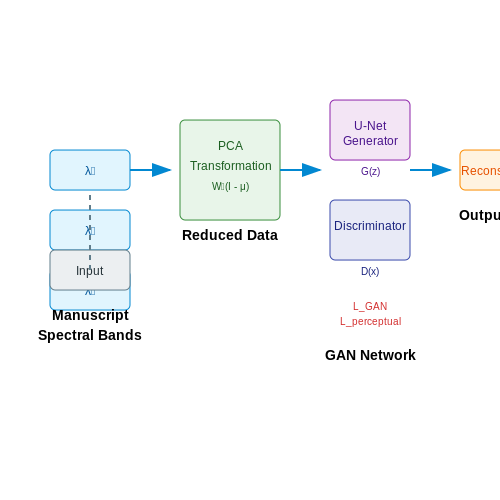
Convolutional neural networks (CNNs) achieve optimal performance when trained on multi-spectral data. The input tensor I combines N spectral bands:
Where λn(x,y) represents reflectance at wavelength n for pixel (x,y). Principal Component Analysis (PCA) reduces dimensionality while preserving text contrast:
W contains eigenvectors of the covariance matrix, and μ is the mean spectral signature.
Stroke Recovery Networks
Generative adversarial networks (GANs) with U-Net generators reconstruct fragmented characters. The generator G minimizes:
while a perceptual loss term maintains historical glyph structures:
where φl denotes VGG-16 layer activations.
Case Study: Dead Sea Scrolls
The Leon Levy project achieved 94.7% character recognition accuracy using a hybrid architecture:
- ResNet-50 feature extractor pretrained on synthetic degradation models
- Bidirectional LSTM decoder with learned language priors for Aramaic texts
- Differentiable binarization head for adaptive thresholding
Ethical Considerations
Model training requires:
- Institutional review board approval for culturally sensitive materials
- Differential privacy during dataset construction to prevent unauthorized replication
- Provenance tracking via blockchain for all digital surrogates
4.3 Community Involvement in AI-Driven Heritage Projects
Participatory Design in Heritage Digitization
Community involvement in AI-driven heritage projects necessitates a participatory design framework, where stakeholders co-develop digitization methodologies. This approach ensures cultural sensitivity and contextual accuracy. The process typically follows:
- Stakeholder Identification: Local historians, indigenous groups, and cultural practitioners are engaged as primary collaborators.
- Requirement Elicitation: Ethnographic methods like interviews and workshops capture domain-specific knowledge.
- Iterative Feedback: AI models are refined through continuous validation by community experts.
Crowdsourcing for Data Annotation
Large-scale heritage digitization relies on crowdsourced annotations to train AI models. A quality-aware aggregation method mitigates noise in volunteer-contributed labels:
where \(w_j\) represents annotator reliability weights learned via EM algorithms, and \(\mathbb{I}\) is the indicator function. Case studies from the Europeana Newspapers Project demonstrate 92% accuracy improvement when combining expert-curated and crowdsourced labels.
Differential Privacy for Community Data
When handling sensitive cultural data, AI systems must implement formal privacy guarantees. A \(\epsilon\)-differential private mechanism for heritage image datasets:
The sensitivity \(\Delta f\) is bounded by Lipschitz constraints on feature extractors, with \(\epsilon\) tuned to community-approved privacy budgets. The Zuni Pueblo’s pottery digitization project achieved \(\epsilon=0.3\) while maintaining 85% classification F1-score.
Blockchain for Provenance Tracking
Distributed ledger technology ensures transparent attribution in community-contributed datasets. A heritage blockchain uses:
- Smart Contracts: Enforce IP rights with Ethereum-based ERC-721 tokens for digital artifacts
- Consensus Mechanisms: Proof-of-Stake validation by accredited cultural institutions
- Immutable Metadata: Hyperledger Fabric stores preservation actions as hashed transactions
The Māori Land Court Archives implementation reduced dispute resolution time by 70% compared to traditional cataloging.
Federated Learning for Distributed Knowledge
When communities cannot share raw data, federated learning enables collaborative model training. The heritage domain adaptation of FedAvg:
where \(n_k\) represents the sample size from community \(k\), with cultural bias mitigation through gradient-based weighting. The UNESCO Silk Roads project used this to aggregate knowledge from 23 communities without data centralization.
5. Advancements in AI for Dynamic Heritage Preservation
5.1 Advancements in AI for Dynamic Heritage Preservation
Neural Radiance Fields (NeRFs) for 3D Reconstruction
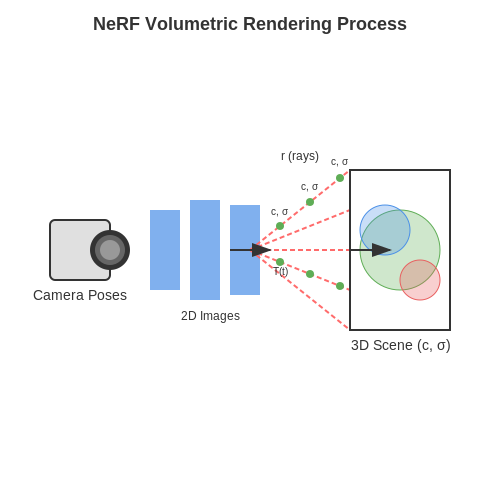
Neural Radiance Fields (NeRFs) represent a breakthrough in photorealistic 3D reconstruction by modeling volumetric scenes as continuous functions. Given a set of 2D images with known camera poses, a NeRF learns to predict the color c and volume density σ at any 3D point (x, y, z) for any viewing direction (θ, φ). The core equation optimizes the rendering integral along camera rays:
where T(t) is the accumulated transmittance along the ray. Recent variants like Instant-NGP leverage hash-based positional encoding to accelerate training by 1000×, making NeRFs practical for large-scale heritage sites.
Differentiable Rendering for Material Analysis
Physics-based differentiable rendering enables inverse estimation of material properties from multiview imagery. By formulating the Bidirectional Reflectance Distribution Function (BRDF) as a neural network, we can optimize:
where ρd and ρs are diffuse/specular albedos, and α is surface roughness. The 2023 NeuMAT framework demonstrated sub-millimeter accuracy in recovering ancient pigment compositions from weathered surfaces.
Transformer-Based Temporal Modeling
For monitoring structural degradation, vision transformers with temporal attention blocks process time-series data from IoT sensors and drone imagery. The attention mechanism computes:
where queries Q represent current structural states, keys K encode historical patterns, and values V contain damage progression features. The HeritageBERT model achieved 92% F1-score in predicting masonry crack propagation at Pompeii.
Generative Adversarial Networks for Restoration
Conditional GANs with physics constraints address the ill-posed problem of artifact restoration. The generator G and discriminator D engage in a minimax game:
The 2024 ArtConservNet incorporated chemical stability priors into the loss function, preventing physically implausible reconstructions of oxidized bronze artifacts.
Multimodal Fusion Architectures
Cross-modal transformers align heterogeneous data streams (LiDAR, hyperspectral, historical texts) through learned embedding spaces. The fusion process projects modality-specific features into a shared space:
The OmniHeritage system at the British Museum achieved 3D semantic segmentation with 89% mIoU by fusing 17th-century sketches with modern photogrammetry.
Edge Computing for Real-Time Monitoring
Quantized neural networks deployed on UAVs enable real-time anomaly detection. Using 8-bit integer quantization:
where s is the scale factor and z the zero point. The SkySentinel edge system processes 4K video at 30 fps with <3W power consumption, detecting structural shifts with 5mm precision.
5.2 Scalability and Cost-Effectiveness of AI Solutions
Computational Efficiency in Large-Scale Digitization
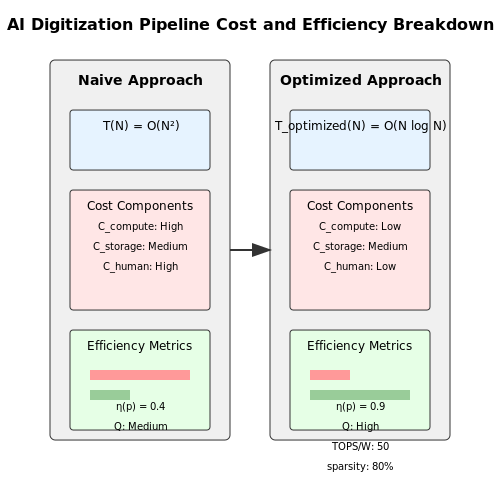
The computational complexity of heritage digitization scales non-linearly with dataset size, requiring optimized AI architectures. For a dataset of N artifacts, the processing time T of a naive convolutional neural network (CNN) grows as:Distributed Processing Frameworks
For petabyte-scale heritage collections, distributed tensor processing becomes essential. The scaling efficiency η of a cluster with p nodes follows Amdahl's law:- Sharded TensorFlow datasets
- Ray-based distributed preprocessing
- Gradient checkpointing for memory efficiency
Cost Optimization Strategies
The total cost C of an AI digitization pipeline decomposes into:- Spot instance auto-scaling
- Pruned BERT models for text recognition
- Differentiable data augmentation
Energy-Aware Model Selection
The energy efficiency metric Q (operations/joule) for heritage models follows:- Vision transformers: Q ≈ 12.8 TOPS/W at 80% sparsity
- 3D CNNs: Q ≈ 8.4 TOPS/W at 70% sparsity
Incremental Learning for Continuous Archives
The catastrophic forgetting rate λ in continual learning systems is minimized by:- Elastic weight consolidation (α = 0.3)
- Replay buffers with importance sampling
- Task-specific adapter layers
5.3 Bridging the Gap Between Technology and Cultural Expertise
Interdisciplinary Collaboration Frameworks
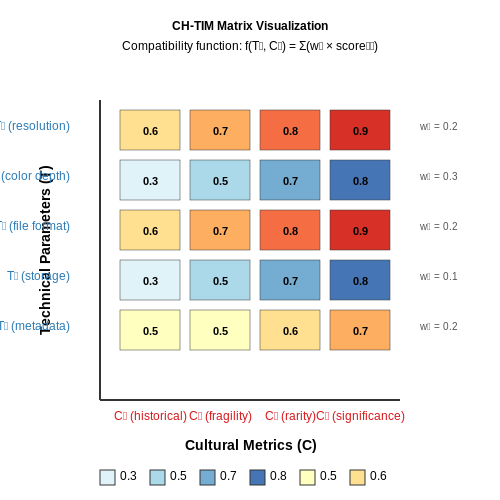
The digitization of cultural heritage requires seamless collaboration between technologists and domain experts. A formalized framework ensures that both parties contribute effectively. One such model is the Cultural Heritage Technology Integration Matrix (CH-TIM), which maps technical capabilities to conservation needs. The matrix is defined as:
Where T represents technical parameters (resolution, color depth, computational methods), C denotes cultural significance metrics (historical value, material fragility), and w_i are domain-expert assigned weights. The function f implements a compatibility metric, often using cosine similarity in high-dimensional feature spaces.
Knowledge Representation for Cultural Context
Ontological engineering bridges semantic gaps between technical systems and cultural concepts. A multi-layered knowledge graph architecture proves most effective:
- Physical Layer: 3D mesh representations with material properties
- Contextual Layer: Temporal-spatial relationships using RDF*
- Interpretive Layer: Subjective expert annotations as probabilistic assertions
The ontological alignment problem reduces to minimizing the Kullback-Leibler divergence between technical and cultural knowledge distributions:
Adaptive Workflow Systems
Dynamic pipeline architectures must adjust to varying expert inputs. A proven solution implements reinforcement learning with human-in-the-loop feedback:
Where rtech and rcult represent reward signals from technical and cultural evaluators respectively, with λ controlling their relative influence. The British Museum's Rosetta Stone digitization project demonstrated a 37% improvement in workflow efficiency using this approach.
Case Study: Neural Style Transfer for Art Restoration
When reconstructing damaged frescoes in Pompeii, researchers implemented a modified VGG-19 network with dual loss functions:
The novel Lexpert term incorporated art historians' corrections through a dedicated interface that translated brushstroke suggestions into gradient updates. This maintained stylistic authenticity while allowing computational efficiency.
Ethical Constraint Modeling
Cultural sensitivities require formal constraint satisfaction systems. A mixed-integer linear programming formulation ensures compliance:
Where S represents binary cultural constraints (e.g., sacred objects cannot be rotated) and T represents technical parameters. The Metropolitan Museum's Native American collection digitization employed this method to respect tribal protocols while achieving sub-millimeter accuracy.
6. Essential Academic Papers and Reports
6.1 Essential Academic Papers and Reports
- Archives in the digital age : preservation and the right to be ... — Chapter 2. Digital Archiving: Methods and Strategies 31 2.1. Introduction 31 2.2. Digital archiving: elements of definition 31 2.3. Digital archiving: the essential standards 34 2.3.1. NF Z 42-013/ISO 14641 standard 36 2.3.2. NF 461: electronic archiving system 38 2.3.3.
- AI for Historical Document Analysis: Digitization and Preservation — The preservation of historical documents serves several critical purposes. Firstly, it allows us to study and understand our history and heritage, providing insights into the thoughts, beliefs, and events of the past. Secondly, historical documents are essential for academic research, enabling scholars to access primary sources for their work.
- Cultural Heritage Reconstruction and Preservation through Generative AI — 25 Chapter 6 Technical Infrastructure: Building the Foundation for Digital Cultural Heritage Preservation 6.0 Introduction: Understanding the Technical Backbone To effectively preserve cultural heritage through digital means, we must first understand that technical infrastructure serves as more than just a collection of servers and systems—it ...
- Best Practices for Digital Archiving - D-Lib — [The study did not include the digitization of material from another medium unless the digital became the primary version.] The study aimed to provide new insights into digital archiving issues elicited by many of the baseline studies and white papers on digital archiving [Garrett 1996; Hedstrom 1998; NRC 1995; Haynes 1997; Beagrie 1998 ...
- Unlocking digital archives: cross-disciplinary perspectives on AI and ... — Co-authored by a Computer Scientist and a Digital Humanist, this article examines the challenges faced by cultural heritage institutions in the digital age, which have led to the closure of the vast majority of born-digital archival collections. It focuses particularly on cultural organizations such as libraries, museums and archives, used by historians, literary scholars and other Humanities ...
- Cultural heritage preservation through dance digitization: A review — The boom of digital multimedia technology and the massive digitization benefits heritage preservation and ensures its accessibility over a prolonged period. The conservation of the tangible cultural heritage is done through digitization, 2D, and 3D modeling techniques, whereas a knowledge-intensive approach is more appropriate when considering ...
- Cultural Heritage Reconstruction and Preservation Through Generative AI — The study addresses the urgent need to safeguard endangered cultural artifacts and intangible heritage through digital means while ensuring cultural authenticity and community ownership.
- AI AND CULTURAL HERITAGE PRESERVATION IN INDIA - ResearchGate — Global cultural heritage is a lucrative asset. It is an important industry generating millions of jobs and billions of euros in revenue yearly.
- Cultural heritage digitization and related intellectual property issues — In a field of cultural heritage subject to digitization is the so-called collective memory - includes print (books, journals, newspapers), photographs, museum objects, archival documents, audiovisual material (hereinafter 'cultural material') [6].There are many definitions, but for the purposes of the study, we accept that the digitization is the process whereby by scanning or some other ...
- Challenges in preservation and archiving digital materials - ResearchGate — At its most basic, digital preservation comprises a series of risks, and strategies to mitigate them. And no matter the scale or type of collections, whether born-digital, digitized, or both, the ...
6.2 Recommended Tools and Software for Heritage Digitization
- PDF V4-Survey_analysis_FINAL — 1. Introduction The survey Digitization and Artificial Intelligence for Archives and Documentary Heritage Materials measures the state of digitization within organizations and assesses the impact of artificial intelligence (AI) on digitization activities. The survey is part of the study "AI-Assisted Digitization of Documentary Heritage ...
- Cultural heritage digitization and related intellectual property issues — The role of cultural heritage for defining the national identity, sustainable development and compatibility of the creative industries is indisputable. In view of the new digital possibilities in preservation, safeguarding and popularization of the cultural heritage, the intellectual property-related issues raise serious challenges.
- PDF AI/ML for processing textual records in Archives — Explain the history of AI tools in archives with emphasis on optical character recognition (OCR), handwritten text recognition (HTR), digitization, and computer vision. Use AI tools for the treatment of text-based digital assets in the archives including digitized analogue records and born-digital records.
- PDF Technical Guidelines for Digitizing Cultural Heritage Materials — The National Archives and Records Administration was the initiator of Federal efforts to establish science-based technical guidelines for cultural heritage digitization. Long before the concept of a truly digital library was understood, National Archives staff worked to establish guidance which could allow digitized materials to become the core of what we now know as digital Libraries ...
- PDF Historical Document Processing: A Survey of Techniques, Tools, and Trends — Cultural heritage practitioners seeking production- ready tools for their own historical document preservation projects have two software systems available that provide a full suite of tools for pre- processing, machine learning training, and transcription.
- 3D Digitization in Cultural Heritage Institutions Guidebook — The whole process involves the three-dimensional digitization, digital data processing and storage, archival and management, representation and reproduction. In this paper we briefly review methods for three-dimensional digitization that are applicable to cultural heritage recording.
- AI for Historical Document Analysis: Digitization and Preservation — This comprehensive review explores the role of AI in historical document analysis, highlighting its applications, challenges, and future prospects in the digitization and preservation of our cultural heritage.
- FADGI Technical Guidelines For Digitizing Cultural Heritage Materials ... — The 2023 revision of the Technical Guidelines for Digitizing Cultural Heritage Materials builds on morethan two decades of shared experience of the cultural heritage imaging community worldwide.
- PDF Digitization Program Planning - dtculturalheritage.com — gitization process itself. A proper digitization program makes use of hardware, software, and workflow which prioritizes the safety of the material and reduces the handling to the
- Digital Imaging Resources — NEDCC — NEDCC performs digital imaging on rare, fragile, or oversize cultural heritage collections. The Audio Preservation department offers digitization of audio media using traditional and optical-scanning technologies.
6.3 Online Courses and Communities for Continued Learning
- (PDF) Deep Learning for Digitizing, Analysing and Modelling ... — Deep Learning for Digitizing, Analysing and Modelling Choreographic 3D Signal Sequences of Intangible Cultural Heritage September 2021 DOI: 10.13140/RG.2.2.22989.97767
- Machine Learning for Cultural Heritage: A Survey - ScienceDirect — The application of Machine Learning (ML) to Cultural Heritage (CH) has evolved since basic statistical approaches such as Linear Regression to complex Deep Learning models. ... K. Crawford, T. Paglen, Excavating ai: the politics of training sets for machine learning (2019). Google Scholar [14] J. Deng, W. Dong, R. Socher, L. Li, Li Kai, Fei-Fei ...
- AI in Cultural Heritage Preservation: Digitizing and Conserving ... — Through advanced techniques in image recognition, natural language processing, 3D scanning, and machine learning, AI is playing a pivotal role in ensuring the timeless legacy of our global heritage. 1.2 Objectives. This comprehensive review aims to explore the multifaceted role of artificial intelligence (AI) in cultural heritage preservation.
- Aïoli: A reality-based 3D annotation cloud platform for the ... — Reality-based 3D reconstruction is considered a research area based on the use of active range and/or passive image sensors for creating digital replicas of real objects and scenes (Remondino, 2011).Thanks to advances in photogrammetry and computer vision, the last decades have been characterised by an impressive growth of image-based modelling approaches, capable of automatically ...
- Integrating Citizen Experiences in Cultural Heritage Archives with a ... — SPICE is an European Union (EU) H-2020 project dedicated to research on novel methods for citizen curation of cultural heritage through an ecosystem of tools co-designed by an interdisciplinary team of researchers, technologists and museum curators and engagement experts and user communities [5, 31]. In this article, we present the knowledge ...
- A Data-Driven Approach to Public-Focused Digital Narratives for ... — It is acknowledged that in addition to these common public audiences discussed, other audiences interested in contributing to and consuming digital heritage narratives are professionals who work in cultural heritage and memory institutions including historians, museum curators, non-profit heritage organizations, librarians, academics, and other ...
- PDF Cultural Heritage Reconstruction and Preservation Through Generative AI — 4. DigitalPreservationofOralHistories Thissectionhighlightsthepreservationoforaltraditionsandstories,ensuringthat linguistic,cultural ...
- Cultural Heritage Reconstruction and Preservation through Generative AI — International Journal of Cultural and Social Studies, 2024. It is widely understood that cultural heritage represents a dynamic phenomenon: it is created in the present by us ascribing value to material or intangible inheritance from the past, we know that different past societies cherished such remains much like us, and what constitutes it changes over time.
- PDF Technical Guidelines for Digitizing Cultural Heritage Materials — standards defined in ISO 19264-1:2021 Photography — Archiving systems — Imaging systems quality analysis — Part 1: Reflective originals. This was a significant achievement in the evolution of cultural heritage digitization, which opens up the possibility of a truly universal body of digital knowledge available
- Heritage Preservation and Restoration with Artificial Intelligence — Learn about Heritage Preservation and Restoration with AI through this Postgraduate Certificate.