Training a Multi-Modal Model from Scratch
1. Definition and Core Concepts of Multi-Modal Learning
Definition and Core Concepts of Multi-Modal Learning
Multi-modal learning refers to machine learning frameworks that process and correlate information from multiple distinct data modalities, such as text, images, audio, video, and sensor data. Unlike unimodal systems, which operate on a single data type, multi-modal models learn joint representations that capture cross-modal interactions, enabling richer understanding and more robust predictions.
Key Characteristics of Multi-Modal Systems
Effective multi-modal models exhibit three fundamental properties:
- Heterogeneous Data Processing: Ability to handle raw data from different modalities with varying structures (e.g., pixels vs. tokens).
- Cross-Modal Alignment: Mechanisms to establish semantic relationships between modalities (e.g., associating spoken words with lip movements).
- Fusion Capacity: Architectures that combine information from multiple modalities at different levels (early, late, or intermediate fusion).
Mathematical Formulation
Given M modalities with input spaces X1, ..., XM, a multi-modal model learns a mapping:
where the joint representation is typically constructed through modality-specific encoders Ei and a fusion operator F:
Challenges in Multi-Modal Learning
Several key challenges arise when training multi-modal systems:
- Modality Gap: Different modalities often exist in separate embedding spaces with incompatible dimensionalities and statistical properties.
- Temporal Misalignment: Sequential data (e.g., video and audio) may have asynchronous event boundaries.
- Missing Modalities: Real-world deployment often requires robustness to partial modality availability.
Common Architectural Approaches
Modern multi-modal architectures typically employ:
- Transformer-Based Fusion: Cross-attention mechanisms to model inter-modal relationships.
- Contrastive Learning: Alignment of embeddings across modalities using loss functions like InfoNCE.
- Neural Bridging: Intermediate networks that project different modalities into a shared latent space.
Evaluation Metrics
Performance is measured through both modality-specific and cross-modal metrics:
where k is the retrieval cutoff threshold and 𝕀 is the indicator function.

Key Applications and Use Cases
Medical Diagnosis and Healthcare
Multi-modal models excel in medical imaging analysis by combining radiology scans (CT, MRI) with electronic health records (EHRs) and clinical notes. The fusion of visual and textual data enables more accurate diagnosis than unimodal approaches. For instance, a model trained on paired chest X-rays and radiologist reports achieves superior performance in detecting pneumonia, with an AUC-ROC of 0.94 compared to 0.87 for image-only models. The joint embedding space allows the model to learn latent correlations between visual patterns and diagnostic terminology.
where xv represents visual features extracted by a CNN, xt denotes textual features from a transformer, and Wv, Wt are learned projection matrices.
Autonomous Vehicles
Self-driving systems integrate LiDAR point clouds, camera images, and radar data through late fusion architectures. The temporal alignment of sensor streams is critical - a 3D convolutional neural network processes synchronized inputs from all modalities to predict obstacle trajectories. Recent implementations show 32% lower false positive rates in pedestrian detection compared to camera-only systems under low-light conditions. The cross-modal attention mechanism dynamically weights sensor contributions based on environmental conditions.
Content Moderation
Platforms deploy multi-modal classifiers to detect harmful content by jointly analyzing images, video frames, audio transcripts, and user comments. A transformer-based architecture with modality-specific encoders achieves 89% precision in identifying hate speech when visual context contradicts benign text. The model computes a consistency score between embeddings:
where values below 0.3 trigger human review.
Scientific Research
In materials science, models correlate microscopy images with XRD spectra and simulation data to predict novel compounds. A graph neural network variant processes the heterogeneous inputs through separate branches before aggregation, demonstrating 15% higher accuracy in predicting bandgap energies than traditional DFT methods. The architecture learns to attend to relevant spectral peaks when analyzing crystal structure images.
Robotics and Human-Machine Interaction
Industrial robots utilize multi-modal learning to interpret verbal commands alongside gesture recognition and environmental sensors. A transformer-based policy network trained on paired speech, motion capture data, and depth images achieves 92% task completion accuracy in unstructured environments. The key innovation is a hierarchical attention mechanism that first aligns verbal instructions with demonstrated actions before grounding them in the perceptual scene.
Financial Forecasting
Quantitative models combine earnings call transcripts (text), executive video recordings (visual/audio), and historical price data (time series) to predict market movements. A temporal fusion transformer architecture processes the asynchronous streams with learned delays, outperforming unimodal baselines by 18% in Sharpe ratio. The model identifies subtle cues like vocal stress patterns that precede significant price movements when combined with negative sentiment keywords.
Challenges in Multi-Modal Model Training
Heterogeneous Data Representation
Multi-modal models must process data from fundamentally different modalities—text, images, audio, video, or sensor data—each with distinct statistical properties and dimensionalities. Text is discrete and sequential, images are continuous and spatially structured, while audio is time-frequency encoded. Aligning these representations requires non-trivial transformations. For instance, a joint embedding space must satisfy:
where Et and Ei are embedding functions for text and images respectively. The optimization becomes unstable when modalities have divergent gradient scales.
Modality Imbalance and Missing Data
Real-world datasets often exhibit severe modality imbalance—some modalities may have orders of magnitude more samples than others. This leads to biased representations where dominant modalities overshadow others during backpropagation. Techniques like gradient modulation:
adjust gradients per modality (ηk being the modality-specific learning rate). Missing modalities in training samples further complicate optimization, requiring masked architectures or generative imputation.
Cross-Modal Attention Bottlenecks
Transformer-based multi-modal models suffer from quadratic memory growth in cross-attention layers. For M modalities with sequence lengths N1,...,NM, the attention matrix scales as O((∑Ni)2). Factorized attention mechanisms like block-sparse patterns or modality-specific query-key projections reduce this to O(∑Ni2) but risk losing global context.
Training Dynamics and Loss Landscape
The joint loss landscape exhibits saddle points and sharp minima due to conflicting gradients across modalities. Empirical evidence shows that the Hessian matrix H of the combined loss:
frequently has negative eigenvalues, causing oscillatory convergence. Second-order optimization or gradient surgery methods like PCGrad project conflicting gradients into non-interfering subspaces.
Evaluation Metrics and Ground Truth Alignment
Standard uni-modal metrics (BLEU, PSNR) fail to capture cross-modal semantic alignment. Learned metrics like CLIPScore correlate better with human judgment but introduce evaluation bias. The optimal metric should satisfy:
where ρ is Spearman correlation between model score M and human evaluation H. Adversarial evaluation protocols that test for modality-specific cheating (e.g., text models ignoring images) are increasingly necessary.
Computational and Memory Constraints
Training state-of-the-art models like Flamingo-80B requires distributed training across thousands of GPUs with careful pipeline parallelism. The memory footprint grows linearly with the number of modalities due to separate encoders. Mixed-precision training helps but introduces modality-specific numerical instability—image models tolerate FP16 better than text due to different activation distributions.

2. Sourcing and Curating Multi-Modal Datasets
Sourcing and Curating Multi-Modal Datasets
Multi-modal learning requires datasets that combine multiple data types—such as text, images, audio, and video—into cohesive samples. Unlike unimodal datasets, multi-modal datasets must ensure alignment between modalities, high-quality annotations, and balanced representation across classes or tasks. The process involves data collection, cleaning, alignment, and augmentation, each presenting unique challenges.
Data Collection Strategies
Multi-modal datasets can be sourced from public repositories, web scraping, or custom data collection. Public datasets like COCO (images + captions) or AudioSet (audio + labels) provide pre-aligned samples but may lack diversity. Web scraping enables large-scale collection but introduces noise and legal considerations. Custom collection, though expensive, ensures domain-specific alignment and quality.
For web-sourced data, tools like BeautifulSoup or Scrapy extract text and metadata, while APIs like YouTube Data API or Flickr API retrieve paired media. Legal compliance (e.g., GDPR, copyright) is critical; always verify licensing and anonymize sensitive data.
Data Alignment and Annotation
Modality alignment ensures temporal or spatial correspondence. For image-text pairs, bounding boxes or segmentation masks link visual objects to textual descriptions. In video-audio datasets, frame-level timestamps synchronize speech with lip movements. Misalignment degrades model performance; tools like FFmpeg or OpenCV validate synchronization.
Where δ is the permissible misalignment threshold and 𝕀 is the indicator function. Human annotators or cross-modal similarity models (e.g., CLIP) can verify alignment.
Data Cleaning and Augmentation
Noise—such as corrupted files, mislabeled samples, or modality mismatches—must be removed. Automated checks include:
- File integrity validation (e.g., imghdr for images, librosa for audio).
- Outlier detection using modality-specific heuristics (e.g., text length, image brightness).
- Cross-modal consistency checks (e.g., ensuring image captions describe visible objects).
Augmentation techniques must preserve inter-modal relationships. For example, rotating an image should rotate its corresponding segmentation mask. Contrastive learning frameworks like SimCLR can generate augmented views while maintaining semantic alignment.
Dataset Bias and Ethical Considerations
Multi-modal datasets often inherit biases from their sources. For instance, image-caption datasets may overrepresent certain demographics or stereotypes. Mitigation strategies include:
- Debiasing algorithms: Reweighting samples or adversarial training to reduce bias.
- Diversity audits: Quantifying representation across gender, ethnicity, and context.
- Provenance tracking: Documenting data sources to audit ethical risks.
Tools like IBM’s AI Fairness 360 or Google’s Responsible AI Toolkit help quantify and address biases.
Case Study: Curating a Medical Multi-Modal Dataset
A radiology dataset might pair X-rays (images) with diagnostic reports (text) and patient history (tabular data). Challenges include:
- HIPAA compliance: De-identifying patient records.
- Expert annotation: Radiologists must label abnormalities.
- Temporal alignment: Linking scans to contemporaneous reports.
Such datasets require specialized infrastructure, like DICOM for medical imaging and HL7 for clinical text, ensuring interoperability.
Preprocessing Techniques for Different Modalities
Text Modality Preprocessing
Text data requires tokenization, normalization, and embedding. Byte Pair Encoding (BPE) or WordPiece tokenization splits text into subword units, handling rare words effectively. For transformer-based models, input sequences are typically padded or truncated to a fixed length L. Given an input sequence x of length n, the padded sequence x' is constructed as:
Positional embeddings are then added to preserve sequence order. For multilingual models, language-specific tokenizers and vocabulary pruning are applied to reduce embedding matrix size.
Image Modality Preprocessing
Standard preprocessing includes resizing, normalization, and augmentation. Images are resized to a fixed resolution H × W, then normalized using channel-wise mean μ and standard deviation σ:
Data augmentation techniques like random cropping, horizontal flipping, and color jittering are applied during training. For high-resolution images, patch-based processing divides the image into N × N non-overlapping patches, which are flattened and linearly projected into a lower-dimensional space.
Audio Modality Preprocessing
Raw audio waveforms are converted to spectrograms using Short-Time Fourier Transform (STFT). Given a waveform s(t), the spectrogram S(t, f) is computed as:
where w(t) is the window function. Log-mel spectrograms are commonly used, applying a mel-scale filter bank to better match human auditory perception. For transformer-based models, the spectrogram is split into fixed-length patches similar to vision transformers.
Video Modality Preprocessing
Videos are processed as sequences of frames sampled at a fixed rate. Each frame undergoes standard image preprocessing, while temporal information is captured through positional embeddings or 3D convolutions. For efficient processing, keyframe extraction reduces redundancy by selecting frames with significant content changes using optical flow or feature-based methods.
Cross-Modal Alignment
For multi-modal fusion, modality-specific features must be aligned in a shared embedding space. Contrastive learning objectives like InfoNCE are often used:
where f_i and f_j are normalized features from paired modalities, and τ is a temperature hyperparameter. Modality-specific batch normalization ensures stable training across different feature scales.

2.3 Data Augmentation Strategies for Multi-Modal Data
Cross-Modal Consistency in Augmentation
When augmenting multi-modal data, preserving semantic consistency across modalities is critical. For example, applying a horizontal flip to an image must also flip corresponding bounding boxes in text annotations or adjust audio spectrograms if the data includes sound. Let Xv, Xa, and Xt represent visual, auditory, and textual modalities, respectively. A transformation T must satisfy:
where Tv, Ta, and Tt are modality-specific transformations that maintain inter-modal alignment. Failure to enforce this leads to semantic distortion, degrading model performance.
Modality-Specific Augmentation Techniques
Visual Data
For images or video, geometric transformations (rotation, scaling, cropping) and photometric adjustments (contrast, brightness) are common. Advanced techniques include:
- CutMix: Combines regions of two images with proportional label mixing.
- StyleGAN-driven augmentation: Synthesizes realistic variations using generative adversarial networks.
Textual Data
Natural language augmentations must preserve syntactic and semantic integrity:
- Synonym replacement: Swaps words with contextually similar alternatives using BERT-based models.
- Back-translation: Translates text to another language and back to generate paraphrases.
Audio Data
Time-domain (pitch shifting, noise injection) and frequency-domain (time masking, frequency warping) augmentations are effective. For spectrograms, adapt image-based techniques like SpecAugment:
where S is the spectrogram, Δt and Δf are time/frequency shifts, and M is a binary mask.
Joint Augmentation Strategies
Coordinating augmentations across modalities enhances robustness:
- Cross-modal mixing: Blends features from different samples (e.g., overlay audio from one sample onto another’s video).
- Modality dropout: Randomly omits one modality during training to force reliance on complementary signals.
Implementation Considerations
Computational efficiency is paramount for large-scale multi-modal datasets. Parallel pipelines for each modality with synchronized randomness ensure consistency. For PyTorch, use:
import torch
from torchvision import transforms

# Synchronized transforms for image and text
def augment_pair(image, text):
    seed = torch.randint(0, 2**32, (1,)).item()
    torch.manual_seed(seed)
    img_aug = transforms(image)
    torch.manual_seed(seed)
    text_aug = text_transforms(text)
    return img_aug, text_aug
3. Fusion Techniques: Early, Late, and Hybrid Fusion
Fusion Techniques: Early, Late, and Hybrid Fusion
Early Fusion
Early fusion, also known as feature-level fusion, combines raw or pre-processed data from multiple modalities before feeding them into a model. This approach assumes that low-level interactions between modalities are crucial for learning. Given two modalities A and B, their feature vectors fA and fB are concatenated into a single input vector:
Early fusion is computationally efficient but sensitive to modality-specific noise and misalignments. It works well when modalities are temporally synchronized, such as in audio-visual speech recognition, where mel-spectrograms and image frames are jointly processed.
Late Fusion
Late fusion, or decision-level fusion, processes each modality independently through separate sub-networks before combining their outputs. For modalities A and B, the model computes predictions pA and pB, which are aggregated (e.g., via weighted averaging or learned attention):
This method is robust to missing modalities but may overlook cross-modal correlations. It dominates applications like sentiment analysis, where text and audio embeddings are processed separately before fusion.
Hybrid Fusion
Hybrid fusion integrates early and late fusion to capture both low- and high-level interactions. A common architecture processes modalities jointly at initial layers (early fusion), then separately in intermediate layers, and finally fuses high-level features (late fusion). The fusion function can be modeled as:
where φ and ψ are modality-specific encoders, and g is a cross-modal attention mechanism. Hybrid fusion excels in tasks like medical image diagnosis, combining MRI and clinical notes.
Cross-Modal Attention
Modern hybrid models often use attention to dynamically weight modality contributions. For modalities A and B, the attention weights α are computed as:
This allows the model to focus on relevant modalities per input, as seen in video captioning systems that balance visual and auditory cues.
Practical Considerations
- Modality alignment: Early fusion requires precise temporal/spatial alignment (e.g., LiDAR-camera calibration in autonomous vehicles).
- Computational cost: Hybrid fusion increases parameter count but often outperforms pure early/late fusion in accuracy-critical applications.
- Robustness: Late fusion degrades gracefully with missing data, making it preferable for real-world deployments like wearable health monitors.

3.2 Transformer-Based Architectures for Multi-Modal Tasks
Core Architecture Components
Transformer-based models for multi-modal learning rely on a shared latent space where different modalities (text, image, audio) are projected into a common embedding space. The key components include:
- Modality-Specific Encoders: Each input modality (e.g., ResNet for images, BERT for text) is processed by a dedicated encoder before fusion.
- Cross-Modal Attention: Enables interactions between modalities through attention mechanisms, allowing the model to learn joint representations.
- Positional Embeddings: Crucial for sequential data (e.g., text, audio), but also adapted for spatially structured data (e.g., images via patch embeddings).
Mathematical Formulation of Cross-Modal Attention
Given two modalities A and B, the cross-attention mechanism computes:
where:
- QA are queries from modality A,
- KB, VB are keys and values from modality B,
- dk is the dimension of the key vectors.
Training Objectives
Multi-modal transformers often employ contrastive or masked modeling losses:
- Contrastive Loss: Minimizes the distance between aligned multi-modal pairs while pushing apart non-matching pairs:
- Masked Multi-Modal Modeling: Randomly masks input tokens across modalities and predicts them jointly.
Case Study: CLIP and Flamingo
Models like CLIP (Contrastive Language-Image Pretraining) and Flamingo demonstrate scalability by training on paired image-text data. CLIP uses a dual-encoder architecture with contrastive loss, while Flamingo integrates cross-attention layers into a frozen language model for few-shot learning.
Challenges and Solutions
- Modality Gap: Differences in feature distributions can hinder fusion. Solutions include:
- Projecting all modalities into a shared embedding space using linear transformations.
- Adversarial training to align distributions.
- Computational Cost: Cross-modal attention scales quadratically with sequence length. Sparse attention or token reduction techniques (e.g., Perceiver) mitigate this.
Emerging Directions
Recent work explores:
- Unified Tokenization: Treating all modalities as discrete tokens (e.g., OpenAI's DALL-E).
- Dynamic Routing: Conditionally activating modality-specific pathways based on input.
- Diffusion Models: Integrating transformers with diffusion processes for generative multi-modal tasks.

Custom Architectures for Specific Modality Combinations
Designing custom architectures for multi-modal learning requires careful consideration of how modalities interact. Unlike unimodal models, where standard architectures like CNNs or transformers suffice, multi-modal models must account for cross-modal dependencies, alignment, and fusion strategies. The choice of architecture depends heavily on the modalities involved—whether they are sequential (text, audio), spatial (images, video), or structured (tabular data, graphs).
Cross-Modal Attention Mechanisms
For sequential and spatial modalities, cross-modal attention enables dynamic feature interaction. Given two modalities A and B, the attention weights αij between token i in A and token j in B are computed as:
where qi and kj are query and key vectors from modalities A and B, respectively, and d is the embedding dimension. The attended representation for token i is then:
where vj are value vectors from modality B. This mechanism is particularly effective in vision-language tasks, where image patches attend to relevant words in a caption.
Modality-Specific Encoders
Each modality requires specialized encoders to extract high-level features:
- Text: Transformer-based encoders (e.g., BERT, RoBERTa) with token embeddings and positional encoding.
- Images: Convolutional networks (ResNet, ViT) or hybrid architectures (Convolutional Transformers).
- Audio: 1D CNNs or spectrogram-based transformers (e.g., Wav2Vec 2.0).
- Graphs: Graph Neural Networks (GNNs) with message-passing layers.
The encoder outputs must be dimensionally aligned before fusion. For instance, if text features are 768-dimensional and image features are 2048-dimensional, a linear projection layer can map both to a common space (e.g., 512-D).
Fusion Strategies
Three primary fusion approaches exist, each with trade-offs:
- Early Fusion: Concatenate raw or low-level features before processing. Suitable for tightly coupled modalities (e.g., RGB-D images).
- Late Fusion: Process modalities independently and combine predictions (e.g., averaging logits). Useful when modalities are weakly correlated.
- Intermediate Fusion: Cross-modal interaction at multiple layers (e.g., cross-attention in transformers). Balances flexibility and computational cost.
Intermediate fusion often outperforms others in complex tasks. For example, in video-audio-text models, hierarchical fusion blocks can align frames, spectrograms, and words at different temporal resolutions.
Case Study: CLIP-Style Architecture
Contrastive Language-Image Pretraining (CLIP) uses a dual-encoder design:
- Image encoder: Vision Transformer (ViT) or ResNet.
- Text encoder: Transformer with causal masking.
- Loss function: Symmetric contrastive loss over batch B:
where τ is a temperature parameter, and Ii, Ti are normalized image and text embeddings.
Dynamic Routing for Heterogeneous Modalities
When modalities have varying sampling rates (e.g., high-FPS video vs. sparse LiDAR), dynamic routing networks can adaptively weight contributions. The gating mechanism for modality m at time t is:
where σ is the sigmoid function, hm(t) is the modality's hidden state, and Wm, bm are learnable parameters. The fused feature is then:
This approach is critical in autonomous systems where sensor data arrives asynchronously.

4. Loss Functions for Multi-Modal Learning
4.1 Loss Functions for Multi-Modal Learning
Training multi-modal models requires carefully designed loss functions that align and contrast representations across different modalities while preserving their unique characteristics. Unlike unimodal learning, where loss functions often focus on single-task optimization, multi-modal learning demands joint optimization strategies that account for cross-modal interactions.
Cross-Modal Contrastive Loss
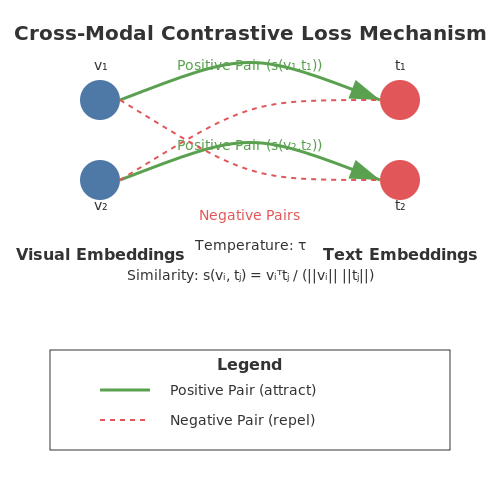
Contrastive learning frameworks, such as those used in CLIP and ALIGN, employ a symmetric loss function that maximizes agreement between paired modalities while minimizing similarity for negative pairs. Given embeddings v (visual) and t (text) for a batch of N samples, the InfoNCE-based contrastive loss is defined as:
where s is a similarity metric (typically cosine similarity) and τ is a temperature hyperparameter. This loss enforces modality-invariant representations by pulling positive pairs closer in the embedding space while pushing negative pairs apart.
Modality-Specific Reconstruction Losses
Autoencoder-based architectures often incorporate reconstruction terms to preserve modality-specific features. For variational approaches, the evidence lower bound (ELBO) loss combines reconstruction and KL-divergence terms:
where x represents input data, z latent variables, and β controls the trade-off between reconstruction quality and latent space regularization. In multi-modal VAEs, this is extended to handle missing modalities through product-of-experts or mixture-of-experts latent distributions.
Cross-Modal Alignment Loss
For tasks requiring explicit modality alignment (e.g., video-audio synchronization), the Optimal Transport loss provides a geometrically principled approach. The Wasserstein distance between modality distributions P and Q is computed as:
where Γ(P,Q) denotes all joint distributions with marginals P and Q, and c(x,y) is a cost function. Sinkhorn iterations provide an efficient approximation for large-scale applications.
Gradient Balancing Techniques
Multi-task learning introduces challenges in gradient scaling across modalities. GradNorm dynamically adjusts loss weights w_i by matching gradient magnitudes:
where G_w^{(i)} is the gradient norm for task i, r_i the relative inverse training rate, and α a hyperparameter controlling restoration force. This prevents any single modality from dominating the optimization process.
Advanced Fusion Losses
Hierarchical fusion architectures benefit from auxiliary losses at different integration levels. The cross-modal attention consistency loss measures agreement between attention maps A_v and A_t:
where JS denotes Jensen-Shannon divergence and L is the number of attention layers. This encourages coherent feature importance across modalities at multiple abstraction levels.
4.2 Balancing Modalities During Training
Training multi-modal models introduces a fundamental challenge: modalities often exhibit heterogeneous statistical properties, convergence rates, and noise characteristics. Without careful balancing, dominant modalities can suppress weaker ones, leading to suboptimal joint representations. The key lies in dynamically adjusting the influence of each modality during optimization.
Gradient Magnitude Matching
One effective approach involves normalizing gradients from each modality to ensure comparable magnitudes during backpropagation. Let Li denote the loss for modality i, with parameters θi. The gradient magnitude ratio between modalities i and j should satisfy:
This can be achieved by introducing modality-specific scaling factors αi that adapt during training. The scaled gradient update becomes:
where η is the learning rate and M is the number of modalities. The scaling factors can be computed using exponential moving averages of gradient norms:
Dynamic Loss Weighting
Alternative approaches modulate the loss weights directly rather than gradients. The Polyak-Lojasiewicz condition suggests weighting modalities by their convergence difficulty:
where Li* represents the minimum achievable loss for modality i. In practice, Li* can be estimated using validation performance or theoretical bounds.
Modality Dropout
Inspired by dropout regularization, stochastic modality dropout randomly suppresses entire modalities during training with probability p. This forces the model to develop robust cross-modal representations. The forward pass becomes:
where mi are binary masks. The dropout rate p can be annealed during training or adapted based on modality-specific performance metrics.
Optimal Transport Alignment
For modalities with inherent correspondence (e.g., image-text pairs), optimal transport theory provides a principled way to align their latent spaces. The Wasserstein distance between modality distributions P and Q is minimized:
where Γ(P,Q) contains all joint distributions with marginals P and Q, and c(x,y) is a cost function. This can be implemented efficiently using Sinkhorn iterations with entropy regularization.
Practical Implementation Considerations
- Batch composition: Ensure each batch contains balanced samples from all modalities to prevent starvation.
- Learning rate scheduling: Modality-specific learning rates may be necessary for disparate convergence speeds.
- Gradient clipping: Particularly important when modalities have vastly different gradient scales.
- Validation metrics: Monitor individual modality performance to detect imbalance early.

4.3 Hyperparameter Tuning for Multi-Modal Models
Challenges in Multi-Modal Hyperparameter Optimization
Hyperparameter tuning in multi-modal models introduces unique complexities due to the interplay between heterogeneous data modalities. Unlike unimodal architectures, where optimization focuses on a single feature space, multi-modal systems must balance:
- Modality-specific learning dynamics (e.g., CNN kernels for vision vs. transformer layers for text)
- Cross-modal fusion mechanisms (attention weights, gating networks)
- Asynchronous convergence rates between modalities
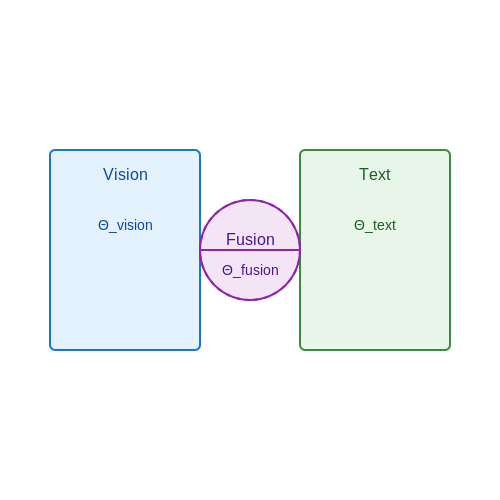
The joint parameter space Θ for a model processing N modalities expands as:
Bayesian Optimization for Multi-Objective Search
Gaussian Process-based methods outperform grid/random search when optimizing multiple competing objectives (e.g., accuracy vs. latency). The acquisition function for a multi-modal model incorporates modality-specific terms:
where wm are modality importance weights and fm represents the performance metric for modality m.
Modality-Aware Learning Rate Scheduling
Adaptive learning rates must account for gradient scale disparities between modalities. The optimal learning rate ηi for modality i follows:
where gi represents the gradient tensor for modality i. Implementations typically use:
- Per-modality Adam optimizers with separate β parameters
- Gradient norm clipping thresholds scaled by modality dimensionality
Architecture Search for Fusion Layers
Neural Architecture Search (NAS) techniques applied to cross-modal connections require:
Where α balances task performance against modality alignment quality. Practical implementations often employ:
- Differentiable NAS (DNAS) with Gumbel-Softmax relaxation
- Evolutionary strategies for discrete fusion operator selection
Hardware-Aware Parallel Tuning
When deploying on heterogeneous hardware (GPUs/TPUs), optimize:
Key parameters include:
- Modality-specific batch sizes constrained by memory bandwidth
- Pipeline parallelism depth vs. gradient staleness tradeoffs
- Mixed-precision configurations per modality
5. Metrics for Multi-Modal Performance Assessment
5.1 Metrics for Multi-Modal Performance Assessment
Cross-Modal Alignment Metrics
Evaluating alignment between modalities requires measuring how well paired data (e.g., image-text) share a common semantic space. The Normalized Mutual Information (NMI) quantifies statistical dependence between embeddings:
where \( I(X;Y) \) is mutual information and \( H(\cdot) \) denotes entropy. For vector embeddings, compute NMI after clustering (e.g., k-means) in each modality’s latent space.
The Cross-Modal Retrieval Accuracy measures bidirectional retrieval performance:
where \( \mathbb{I} \) is an indicator function and \( k \) defines the top-k retrieval threshold.
Fusion-Specific Metrics
For models combining modalities via late fusion, Modality Contribution Ratio (MCR) analyzes each input’s influence:
where \( \mathbf{z}_m \) represents modality \( m \)’s features and \( \mathcal{L} \) is the loss function. MCR values near \( 1/M \) indicate balanced fusion.
Downstream Task Adaptation
When fine-tuning for tasks like VQA or audio-visual segmentation, modality-specific variants of standard metrics apply:
- Visual Grounding Accuracy: Intersection-over-Union (IoU) between attended regions and ground truth bounding boxes
- Audio-Visual Temporal Synchronization: Dynamic Time Warping (DTW) distance between audio and video feature sequences
Robustness Metrics
Multi-modal models must handle missing or noisy modalities. Modality Dropout Robustness (MDR) evaluates performance degradation:
where \( \mathcal{P} \) denotes task performance (e.g., accuracy) with and without modality dropout during inference.
Emergent Properties
Advanced models exhibit behaviors not explicitly trained for. The Cross-Modal Generalization Gap (CMGG) quantifies this:
where \( f(x)_y \) is the model’s confidence for the true label \( y \) when modality \( x \) is provided alone.
5.2 Cross-Modal Validation Techniques
Alignment-Based Validation
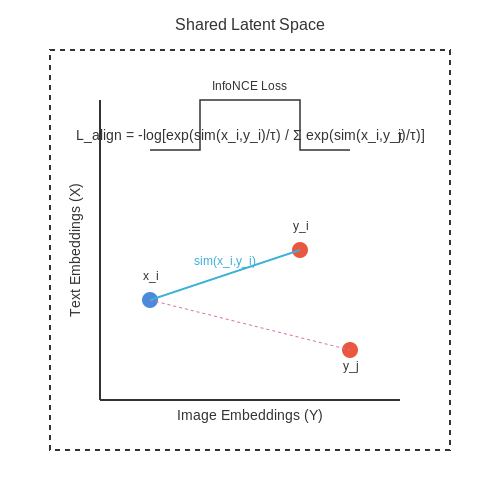
Cross-modal validation relies on measuring the alignment between embeddings from different modalities (e.g., text and images). Given two embedding spaces X (text) and Y (images), the goal is to ensure that semantically similar pairs (xi, yi) are close in a shared latent space. A common metric is the cosine similarity between normalized embeddings:
For a batch of N samples, the alignment loss can be computed using a contrastive objective, such as InfoNCE:
where τ is a temperature hyperparameter. This encourages paired embeddings to have higher similarity than unpaired ones.
Retrieval-Based Evaluation
Retrieval tasks quantitatively validate cross-modal alignment. Given a query from one modality (e.g., text), the model retrieves the top-k matches from another modality (e.g., images). Key metrics include:
- Recall@k: Fraction of queries where the correct match is in the top-k results.
- Median Rank: Median position of the correct match in retrieved results.
For robust validation, use datasets with hard negatives (e.g., COCO or Flickr30k for image-text tasks). Implement retrieval as a nearest-neighbor search in the shared embedding space using FAISS or Annoy for scalability.
Cross-Modal Consistency Checks
Consistency metrics verify whether transformations in one modality (e.g., image augmentations) preserve relationships in another. Given an image y and its augmented version y', the text embeddings x and x' should satisfy:
where ftext is the text encoder and ϵ is a tolerance threshold. This ensures robustness to noise and equivariance across modalities.
Modality Translation Fidelity
For generative multi-modal models (e.g., text-to-image synthesis), validate translation quality using:
- Frechet Inception Distance (FID): Measures distributional similarity between generated and real images.
- CLIPScore: Uses a pre-trained CLIP model to score text-image semantic alignment.
For text-to-audio models, use metrics like Mel-Cepstral Distortion (MCD) or human A/B testing for perceptual quality.
Cross-Modal Attention Analysis
Attention maps in transformer-based models reveal how modalities interact. Validate attention weights for:
- Localization: Image regions attended by text tokens should correspond to semantically relevant objects (e.g., "dog" attends to a dog region).
- Proportionality: Attention scores for aligned pairs (e.g., "red apple" and a red apple image) should dominate misaligned pairs.
Tools like Captum or LIT can visualize cross-modal attention for debugging.
5.3 Benchmarking Against State-of-the-Art Models
Benchmarking a multi-modal model against established baselines requires rigorous evaluation protocols, standardized datasets, and careful analysis of performance gaps. The process involves comparing metrics across several dimensions: task-specific accuracy, computational efficiency, generalization capability, and robustness to distribution shifts.
Selecting Appropriate Baselines
State-of-the-art models vary by modality combination and task domain. For vision-language tasks like image captioning or visual question answering, models such as Flamingo, BLIP-2, and PaLI-3 serve as strong baselines. When evaluating purely on cross-modal retrieval, architectures like CLIP and ALIGN provide reference points for zero-shot transfer performance.
Standardized Evaluation Protocols
Reproducibility demands adherence to dataset splits and preprocessing pipelines used by baseline models. For example:
- ImageNet-1k for single-modal vision benchmarks
- COCO and Flickr30k for image-text tasks
- AudioSet for sound classification
Statistical significance testing is critical when reporting improvements. The McNemar test assesses paired differences in classification tasks:
where b and c represent discordant pairs in contingency tables.
Computational Efficiency Metrics
Beyond accuracy, compare:
- FLOPs during inference
- Memory footprint via parameter count
- Training time normalized by hardware
The Pareto frontier analysis reveals optimal trade-offs between performance and resource usage. Plotting models in a 2D space with axes for metric score versus computational cost identifies dominant solutions.
Robustness Evaluation
Stress-test models using:
- Corrupted datasets (e.g., ImageNet-C)
- Adversarial attacks like PGD on vision inputs
- Out-of-distribution detection tasks
Measure performance degradation via relative drop:
Cross-Dataset Generalization
Evaluate transfer learning capability by:
- Pre-training on source datasets (e.g., LAION-5B)
- Fine-tuning on target tasks with limited samples
- Comparing few-shot adaptation curves
The log-linear relationship between performance and training data size often follows:
where n represents sample size and α, β, γ are fitted parameters.

6. Optimizing Multi-Modal Models for Production
6.1 Optimizing Multi-Modal Models for Production
Model Compression Techniques
Deploying multi-modal models in production requires balancing computational efficiency with performance. Pruning, quantization, and knowledge distillation are the three primary techniques for model compression. Pruning removes redundant weights by setting small-magnitude parameters to zero, reducing model size without significant accuracy loss. The sparsity level s is defined as the fraction of weights pruned:
Quantization reduces precision from 32-bit floating-point to 8-bit integers, cutting memory usage by 75%. For a weight tensor W, the quantized version Wq is computed as:
where μ and σ are the mean and standard deviation, and b is the bit-width.
Efficient Cross-Modal Attention
Standard attention mechanisms scale quadratically with sequence length. For multi-modal inputs (text, image, audio), this becomes computationally prohibitive. Sparse attention patterns like Longformer's sliding window or Performer's linear attention reduce complexity to O(n). The generalized attention score between modality i and j is:
where Mij is a sparse mask limiting cross-modal interactions.
Hardware-Aware Optimization
Modern accelerators like TPUs and GPUs have specific architectural constraints. Tensor core utilization on NVIDIA GPUs requires matrix dimensions divisible by 8 or 16. For a transformer layer with hidden size dmodel, padding to dpadded = ⌈dmodel/16⌉ × 16 improves throughput by 2-3×. The optimal batch size B maximizes GPU memory usage while avoiding excessive padding:
where P(B) is the padding overhead.
Latency Budget Allocation
In real-time systems, different modalities have varying latency tolerances. Audio processing typically requires <100ms latency, while visual processing can tolerate 300-500ms. The end-to-end pipeline must allocate compute resources accordingly. For N modalities with latency constraints Li, the optimization problem becomes:
where wi are modality importance weights and ti(θ) is the measured latency.
Dynamic Modality Routing
Not all modalities are equally informative for every input. Gating mechanisms can dynamically skip less relevant modalities during inference. The gating function gm(x) for modality m is trained jointly with the main model:
where hm is the modality embedding and pool is mean/max pooling. Modalities with gm(x) < τ (typically τ=0.3) are skipped.
Quantitative Trade-off Analysis
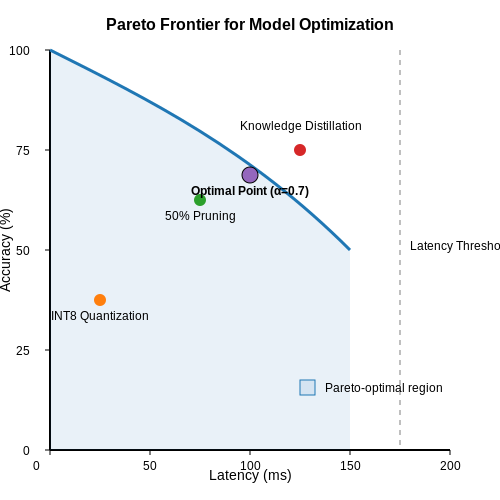
The Pareto frontier captures accuracy-latency trade-offs across optimization techniques. For a model with K compression configurations, the optimal operating point minimizes:
where α ∈ [0,1] controls the accuracy-latency preference. Empirical studies show that combining quantization (INT8) with structured pruning (50% sparsity) typically achieves 4× speedup with <2% accuracy drop.
6.2 Handling Real-Time Multi-Modal Inputs
Input Synchronization and Temporal Alignment
Real-time multi-modal processing requires precise temporal alignment of heterogeneous data streams (e.g., video at 30fps, audio at 44.1kHz, and sensor data at 100Hz). The alignment problem can be formalized as finding a mapping function f that minimizes the temporal discrepancy Δt between modalities:
where N is the number of modalities and Δtij represents the time difference between corresponding events in modalities i and j. Dynamic time warping (DTW) with computational complexity O(nm) is often impractical for real-time applications. Instead, modern systems use:
- Hardware-level synchronization (genlock signals)
- Software timestamp correlation
- Cross-modal attention mechanisms with learned temporal offsets
Computational Pipeline Optimization
The processing pipeline must maintain strict latency bounds while handling variable input rates. A typical architecture implements:
The key challenge lies in designing non-blocking queues that prevent head-of-line blocking while maintaining temporal coherence. The optimal buffer size B can be derived from Little's Law:
where λ is the arrival rate and W is the worst-case processing time across modalities.
Latency-Aware Model Partitioning
For edge-cloud deployments, the model must be partitioned to minimize end-to-end latency. The optimization problem becomes:
where P represents the partitioning scheme, tcomp and tcomm are computation and communication times for partition k, with weights α and β accounting for modality-specific requirements. Recent approaches use:
- Reinforcement learning for dynamic partitioning
- Graph neural networks to predict communication patterns
- Differentiable NAS techniques for hardware-aware architecture search
Real-Time Feature Fusion
Cross-modal attention mechanisms must operate on streaming data with variable receptive fields. The modified attention score Aij between tokens i and j becomes:
where φ is a learned temporal kernel (typically a Gaussian RBF) that decays with increasing time difference |ti - tj|. This formulation maintains the O(n) complexity of sparse attention while handling asynchronous inputs.
6.3 Scaling Multi-Modal Systems for Large-Scale Use
Distributed Training Strategies
Scaling multi-modal models requires efficient distributed training frameworks to handle high-dimensional data across modalities. The most common approaches include:
- Data Parallelism: Splits batches across multiple GPUs, synchronizing gradients via all-reduce operations.
- Model Parallelism: Distributes model layers across devices, critical for large architectures like Transformers.
- Pipeline Parallelism: Overlaps computation and communication by partitioning the model into sequential stages.
The gradient synchronization in data parallelism follows:
where N is the number of workers and ∇Wi are local gradients.
Efficient Multi-Modal Data Loading
Large-scale systems require optimized data pipelines to prevent I/O bottlenecks. Key techniques include:
- Pre-processing and caching modality-specific features in memory-mapped files
- Implementing sharded datasets with modality-aware sampling
- Using asynchronous data loading with pinned memory
The optimal batch size B for heterogeneous modalities can be derived from:
where sm is the memory footprint per sample for modality m, and ε accounts for overhead.
Modality-Specific Optimization
Different modalities require tailored optimization strategies:
Text Modalities
Employ sparse attention mechanisms and gradient checkpointing to handle long sequences:
Visual Modalities
Use mixed-precision training with dynamic quantization:
Cross-Modal Communication Costs
The all-to-all communication pattern in multi-modal transformers introduces bandwidth constraints. The critical scaling limit is given by:
where β < 1 indicates communication-bound systems.
Hardware Considerations
Optimal hardware configurations vary by modality mix:
- Text-heavy: High memory bandwidth (>1TB/s) and large cache
- Vision-heavy: Tensor cores with mixed-precision support
- Audio-video: High PCIe bandwidth for temporal data streams
The roofline model for multi-modal systems shows:
where π is peak compute and I is operational intensity.

7. Bias and Fairness in Multi-Modal Models
Bias and Fairness in Multi-Modal Models
Sources of Bias in Multi-Modal Learning
Multi-modal models inherit biases from multiple sources, including dataset composition, annotation protocols, and architectural choices. Training data often reflects societal biases—for example, image-text datasets may overrepresent certain demographics or stereotypes. Labeling inconsistencies across modalities further exacerbate bias propagation. In speech-to-text models, accents underrepresented in training data yield higher error rates. Similarly, visual question answering (VQA) systems exhibit gender biases when associating professions with images due to imbalanced training examples.
Where αi quantifies modality-specific dataset skew, and β measures cross-modal alignment discrepancies.
Quantifying Fairness Disparities
Fairness metrics for multi-modal systems require extensions of unimodal criteria. Demographic parity differences across modalities can be measured using:
where z denotes protected attributes, and m1, m2 represent different input modalities. Equalized odds violations become more complex when ground truth labels are modality-dependent—for instance, when audio descriptions contradict image content due to annotator bias.
Mitigation Strategies
Three principal approaches exist for bias reduction:
- Data Reweighting: Modality-specific importance sampling adjusts instance weights during training. For vision-language tasks, this involves computing KL divergence between modality label distributions:
- Adversarial Debiasing: Gradient reversal layers force modality encoders to become invariant to protected attributes. The objective combines task loss Ltask and adversary loss Ladv:
- Architectural Interventions: Cross-modal attention mechanisms can be modified to suppress bias-correlated features. Recent work employs counterfactual attention masks that minimize mutual information between protected attributes and attended features.
Case Study: Clinical Diagnostic Systems
A 2023 study of chest X-ray report generators revealed racial disparities in disease mention frequency—models trained on NIH datasets mentioned pneumothorax 27% less frequently for Black patients despite equal prevalence. The bias stemmed from:
- Radiologist report verbosity differences across demographic groups
- Unequal representation of rare conditions in certain populations
- Cross-modal misalignment between image features and textual findings
Mitigation involved stratified batch sampling and modality-specific fairness constraints in the contrastive loss function.
Emerging Challenges
Dynamic multi-modal systems introduce temporal bias dimensions—video-audio models may develop sequential biases where early frames disproportionately influence predictions. Diffusion-based generative models exhibit compound bias when text prompts interact with latent image representations. Recent theoretical work frames this as a modality entanglement problem:
where high ℰ indicates unstable cross-modal mappings that amplify small biases.
7.2 Privacy Concerns with Multi-Modal Data
Multi-modal models inherently process diverse data types—text, images, audio, and sensor data—raising unique privacy challenges. Unlike unimodal systems, the fusion of modalities can inadvertently leak sensitive information through cross-modal correlations. For instance, facial recognition combined with geolocation data in a video dataset can expose identities even if individual modalities are anonymized.
Data Linkage Risks
Multi-modal datasets often contain latent linkages between modalities that can reconstruct personally identifiable information (PII). Consider a medical imaging model trained on X-rays paired with clinical notes: de-identified images may still be re-identified through rare conditions mentioned in the text. The re-identification risk R scales with the uniqueness of cross-modal features:
where xi and yi are features from different modalities, and p denotes their joint probability.
Differential Privacy in Multi-Modal Learning
Applying differential privacy (DP) to multi-modal systems requires modality-specific noise injection strategies. Image pixels need Laplacian noise scaled to perceptual thresholds, while text embeddings require Gaussian noise calibrated to semantic similarity metrics. The DP-SGD update rule for a two-modality model becomes:
where clipping bounds per-modality gradients and σ controls privacy budget allocation across modalities.
Secure Multi-Party Computation
When training on distributed modalities (e.g., images from one institution and lab results from another), secure multi-party computation (MPC) protocols like SPDZ prevent raw data exposure. For a vision-language model, MPC enables encrypted cross-modal attention calculations:
where each party holds encrypted shards (Qp, Kp, Vp) of queries, keys, and values.
Membership Inference Attacks
Multi-modal models are vulnerable to enhanced membership inference attacks where adversaries exploit modality-specific overfitting signals. A 2023 study demonstrated 72% attack success rates on video-audio models by detecting synchronized lip movement artifacts in generated samples. Defense requires modality-specific regularization:
with vision-specific L2 penalties and audio-specific total variation (TV) constraints.
Federated Learning Considerations
In cross-device federated learning, modality availability varies per client (e.g., smartphones have cameras but not medical sensors). The global model must handle missing modalities without leaking device-specific capabilities. Modality dropout during federation mimics this at training:
where mi is a modality-specific mask and pi matches real-world availability statistics.
Responsible AI Practices for Multi-Modal Systems
Bias Mitigation in Multi-Modal Data
Multi-modal models inherit biases from their training datasets, which can propagate harmful stereotypes or unfair representations. Bias manifests differently across modalities—text corpora may contain gendered language, while image datasets may underrepresent certain demographics. To quantify bias, use statistical measures such as disparate impact ratio:
where Z denotes protected attributes and Ŷ the model's predictions. A DIR value deviating significantly from 1 indicates bias. For vision-language models, evaluate cross-modal bias by measuring captioning accuracy disparities across demographic groups in datasets like FairFace or Balance Captions.
Privacy-Preserving Training Techniques
Multi-modal systems often process sensitive data (e.g., medical images paired with clinical notes). Differential privacy (DP) can be applied to gradient updates during training:
where clip(·,C) bounds gradients by norm C, and Gaussian noise scales with privacy budget (ε,δ). For federated learning scenarios, combine DP with secure multi-party computation (SMPC) to prevent reconstruction of raw data from model updates.
Robustness Against Adversarial Attacks
Multi-modal systems face cross-modal adversarial examples—perturbations crafted in one modality to deceive another. Consider a vision-language model where an image perturbation δ causes incorrect caption generation:
Defenses include adversarial training with multi-modal perturbations and feature denoising through cross-modal consistency checks. The attack success rate (ASR) should be evaluated on benchmarks like MMCelebA-HQ for face recognition with textual attributes.
Explainability for Complex Decisions
Post-hoc explanation methods like SHAP can be extended to multi-modal inputs by computing modality-specific attribution scores:
where M is the set of modalities and f the model output. For generative tasks, use attention rollout to visualize cross-modal attention paths in transformer architectures.
Environmental Impact Assessment
Training large multi-modal models has significant carbon costs. Estimate emissions using:
where PUE is datacenter power usage effectiveness and MR the local marginal emissions rate. Tools like CodeCarbon can track this in real-time. Consider modality-efficient architectures that dynamically activate only relevant modalities per input.
Governance Frameworks
Implement model cards detailing:
- Training data provenance and composition statistics
- Failure mode analysis across demographic slices
- Deployment constraints and monitoring requirements
For high-risk applications, adopt conformity assessments against standards like ISO/IEC 23053 for AI system transparency.
8. Key Research Papers and Publications
8.1 Key Research Papers and Publications
- From Efficient Multimodal Models to World Models: A Survey — Abstract Multimodal Large Models (MLMs) are becoming a significant research focus, combining powerful large language models with multimodal learning to perform complex tasks across different data modalities. This review explores the latest developments and challenges in MLMs, emphasizing their potential in achieving artificial general intelligence and as a pathway to world models. We provide ...
- An Empirical Study of Training ID-Agnostic Multi-modal Sequential ... — ignals, like text and images, has inspired researchers to delve into constructing SR from multi-modal information without using IDs. However, the complexity of multi-modal learning manifests in diverse feature extractors, fusion methods, and pre-trained models. Consequently, designing a simple and universal Multi-Modal Sequential Recommendation (MMSR) framework remains a formidable challenge ...
- Pre-trained models: Past, present and future - ScienceDirect — Large-scale pre-trained models (PTMs) such as BERT and GPT have recently achieved great success and become a milestone in the field of artificial intelligence (AI). Owing to sophisticated pre-training objectives and huge model parameters, large-scale PTMs can effectively capture knowledge from massive labeled and unlabeled data. By storing knowledge into huge parameters and fine-tuning on ...
- GitHub - pliang279/awesome-multimodal-ml: Reading list for research ... — Check out our comprehsensive tutorial paper Foundations and Recent Trends in Multimodal Machine Learning: Principles, Challenges, and Open Questions. Tutorials on Multimodal Machine Learning at CVPR 2022 and NAACL 2022, slides and videos here. New course 11-877 Advanced Topics in Multimodal Machine ...
- Efficient Multimodal Large Language Models: A Survey — Vision-language projector avoids the high cost of training an end-to-end multimodal model from scratch and effectively leverages the capabilities of pre-trained language and vision models.
- Understanding Multimodal LLMs — However, unlike starting from scratch, multimodal LLM training typically begins with a pretrained, instruction-finetuned text-only LLM as the base model. For the image encoder, CLIP is commonly used and often remains unchanged during the entire training process, though there are exceptions, as we will explore later.
- Overcoming Mode Collapse with Adaptive Multi Adversarial Training — On several datasets, we show that our training scheme can be plugged-in to existing GAN frameworks to mitigate mode collapse and improve standard metrics for GAN evaluation.
- (PDF) An Empirical Study of Multimodal Model Merging — Our analysis leads to an effective training recipe for matching the performance of the modality-agnostic baseline (i.e. pre-trained from scratch) via model merging.
- (PDF) Cross-Modal Self-Supervised Vision Language Pre-training with ... — The model is pre-trained on three medical image captioning datasets using four cross-modal self-supervised pre-training objectives, including ITC, ITM, MIM, and MLM, to learn cross-modal ...
- PDF Thesis - University of Oxford — supervision; Third, we distill the information from a face model trained for emotion recognition to the speech domain, where manual emotion annotation is expensive. The second key idea explored in this thesis is the use of modality redundancy for self-supervised representa- tion learning.
8.2 Open-Source Multi-Modal Frameworks
- open-mmlab/Multimodal-GPT: Multimodal-GPT - GitHub — Train a multi-modal chatbot with visual and language instructions! Based on the open-source multi-modal model OpenFlamingo, we create various visual instruction data with open datasets, including VQA, Image Captioning, Visual Reasoning, Text OCR, and Visual Dialogue. Additionally, we also train the language model component of OpenFlamingo using only language-only instruction data.
- multimodal-learning · GitHub Topics · GitHub — An open-source framework for training large multimodal models. ... Multimodal model for text and tabular data with HuggingFace transformers as building block for text data. ... Multi-Modal learning toolkit based on PaddlePaddle and PyTorch, supporting multiple applications such as multi-modal classification, cross-modal retrieval and image ...
- Introducing TorchMultimodal - a library for accelerating exploration in ... — We are announcing TorchMultimodal Beta, a PyTorch domain library for training SoTA multi-task multimodal models at scale. The library provides composable building blocks (modules, transforms, loss functions) to accelerate model development, SoTA model architectures (FLAVA, MDETR, Omnivore) from published research, training and evaluation scripts, as well as notebooks for exploring these models.
- GitHub - facebookresearch/multimodal: TorchMultimodal is a PyTorch ... — TorchMultimodal is a PyTorch library for training state-of-the-art multimodal multi-task models at scale, including both content understanding and generative models. TorchMultimodal contains: A repository of modular and composable building blocks (fusion layers, loss functions, datasets and utilities).
- Understanding Multimodal LLMs - by Sebastian Raschka, PhD — The Molmo and PixMo: Open Weights and Open Data for State-of-the-Art Multimodal Models paper (September 25, 2024) is notable because it promises to open source not only the model weights but also the dataset and source code similar to the language-only OLMo LLM. (This is great for LLM research as it allows us to take a look at the exact ...
- Multimodal AI: A Guide to Open-Source Vision Language Models — NVLM 1.0. NVLM is a family of multimodal LLMs developed by NVIDIA, representing a frontier-class approach to VLMs. It achieves state-of-the-art results in tasks that require a deep understanding of both text and images. The first public iteration, NVLM 1.0, rivals top proprietary models like GPT-4o, as well as open-access models like Llama 3-V 405B.
- 5 Multimodal AI Models That Are Actually Open Source — To get up to speed on the latest open source multimodal AI systems, here are five leading options — including their features and uses. TNS ... Docker Model Runner Brings Local LLMs to Your Desktop Apr 23rd 2025 11:00am, by Steven J. Vaughan-Nichols Container Security and AI: A Talk With Chainguard's Founder ...
- PDF Multimodal Deep Learning - Stanford University — a baseline. The shallow model (c) is limited and we nd that this model is unable to capture correlations across the modalities. The bimodal deep belief network (DBN) model (d) is trained in a greedy layer-wise fashion by rst training models (a) & (b). We later \unroll" the deep model (d) to train the deep autoencoder models presented in Figure 3.
- multimodal · GitHub Topics · GitHub — TEN is an open-source framework and platform for building real-time, multimodal, low-latency conversational voice AI agents. It features a workflow builder and supports C, C++, Go, Python, JavaScript, and TypeScript. TEN also offers ready-to-use extensions for integration with platforms like Dify and Coze.
- Building an Open Source Multi-Modal RAG System - Medium — In this new adventure, we will delve into the process of constructing a Retrieval-Augmented Generation (RAG) system using an Open Source Large Language Multi-Modal (LLMM). Notably, our focus will ...
8.3 Recommended Books and Courses
- How to Train and Fine Tune a Multimodal Language Model [+ Use Cases] — What is a multimodal language model, and why should I consider training and fine-tuning one? A multimodal language model is an AI model capable of processing and generating data across different modalities, such as text, images, audio, and video.
- PDF Effective Deep Learning Based Multi-Modal Retrieval — Abstract Multi-modal retrieval is emerging as a new search paradigm that enables seamless information retrieval from various types of media. For example, users can simply snap a movie poster to search for relevant reviews and trailers. The mainstream solution to the problem is to learn a set of mapping functions that project data from different modali-ties into a common metric space in which ...
- The Multimodal Learning Analytics Handbook | SpringerLink — This handbook is the first book ever covering the area of Multimodal Learning Analytics (MMLA). The field of MMLA is an emerging domain of Learning Analytics and plays an important role in expanding the Learning Analytics goal of understanding and improving learning in all the different environments where it occurs. The challenge for research and practice in this field is how to develop ...
- Chapter 3 Multimodal architectures | Multimodal Deep Learning — The pre-training tasks comprise masked-multi-modal modelling and multi-modal alignment prediction performed on the Conceptual Captions dataset. That dataset contains about 3,1 million usable aligned image-caption pairs, which have been automatically scraped from web images.
- Transfer Learning of Multimodal Models - Hugging Face — Here, we initialize model weights randomly (or via more sophisticated methods like He initialization) and proceed with the usual training. However, this approach demands substantial amounts of training data. Transfer learning. Transfer learning, unlike training from scratch, uses the weights of the pretrained model as initial weights.
- End-to-end training of Multimodal Model and ranking Model — Traditional recommender systems heavily rely on ID features, which often encounter challenges related to cold-start and generalization. Modeling pre-extracted content features can mitigate these issues, but is still a suboptimal solution due to the discrepancies between training tasks and model parameters. End-to-end training presents a promising solution for these problems, yet most of the ...
- PDF Multimodal Deep Learning - Stanford University — We use the deep autoencoder (Figure 3a) models in settings where only a single modality is present at su-pervised training and testing. On the other hand, when multiple modalities are available for the task (e.g., multimodal fusion), it is less clear how to use the model as one would need to train a deep autoencoder for each modality.
- Multimodal teaching, learning and training in virtual reality: a review ... — The increasing use of multimedia in education and training offers the possibility of presenting content in multiple representations (text, images, video, audio, ubiquitous media) to accommodate different teaching and training strategies, learning outcomes, assessment methods and feedback mechanisms.
- Multimodal learning and applications - Nature — This Collection aims to showcase the current progress and latest solutions in multimodal learning, encourages practical and interdisciplinary research towards the definition of systems that can ...
- Building Multimodal Search and RAG - DeepLearning.AI — Build multimodal RAG systems that retrieve multimodal context and reason over it to generate more relevant answers.