Open-Ended Skill Discovery with Auto-Curriculum
1. Key Concepts in Open-Ended Learning
1.1 Key Concepts in Open-Ended Learning
Open-ended learning represents a paradigm shift from traditional reinforcement learning (RL) by removing predefined task boundaries and fixed reward functions. Instead, the agent autonomously discovers and refines skills through interaction with an environment that evolves in complexity. This approach is grounded in the principle of auto-curriculum, where the agent generates its own learning objectives based on intrinsic motivation, novelty, or competence progress.
Foundational Principles
The mathematical framework for open-ended learning can be derived from information-theoretic principles. Let the agent's policy be parameterized by θ, and the environment state at time t be st. The intrinsic reward rit is computed as:
where pθ is the agent's forward dynamics model and pϕ is a learned prior over state transitions. This formulation incentivizes the agent to seek states that are predictable given its actions but surprising under the environment's default dynamics.
Auto-Curriculum Mechanisms
Effective auto-curricula require mechanisms for:
- Goal Generation: Creating novel challenges through stochastic goal sampling or adversarial self-play
- Skill Composition: Hierarchically combining primitive behaviors into complex strategies
- Progress Estimation: Measuring learning progress via prediction error reduction or empowerment maximization
In practice, these mechanisms are implemented through neural architectures with modular components:
where λ balances extrinsic (re) and intrinsic rewards, and β controls the complexity penalty.
Empirical Considerations
Successful implementations must address:
- Catastrophic Forgetting: Maintain plasticity through episodic memory buffers or modular neural components
- Exploration-Exploitation Tradeoff: Dynamically adjust action noise based on estimated learning progress
- Transfer Evaluation: Quantify generalization through zero-shot performance on held-out environment configurations
Recent advances in large-scale distributed training have demonstrated that open-ended learning agents can discover complex skill hierarchies spanning millions of training steps. For instance, in robotic manipulation domains, such agents have autonomously developed tool-use strategies and multi-object coordination without explicit reward shaping.

The Role of Auto-Curriculum in Skill Acquisition
Auto-curriculum mechanisms enable agents to autonomously generate and adapt their own learning trajectories, bypassing the need for handcrafted reward functions or predefined task sequences. This self-directed learning paradigm is grounded in intrinsic motivation, where the agent actively seeks out novel or challenging scenarios to maximize its own learning progress.
Mathematical Foundations of Auto-Curriculum Learning
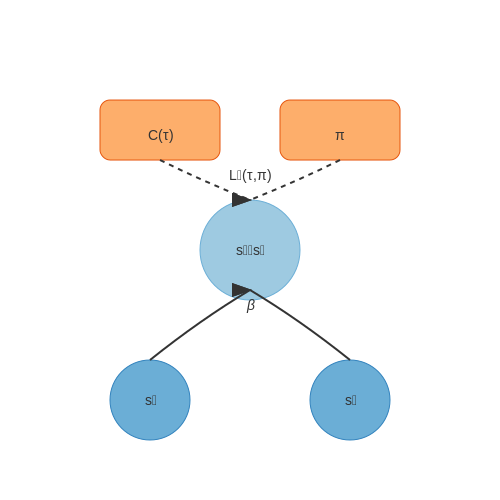
The auto-curriculum process can be formalized as a meta-optimization problem where the agent learns a policy π(a|s) while simultaneously optimizing a curriculum generator C(τ) that produces training trajectories τ. The joint optimization objective is:
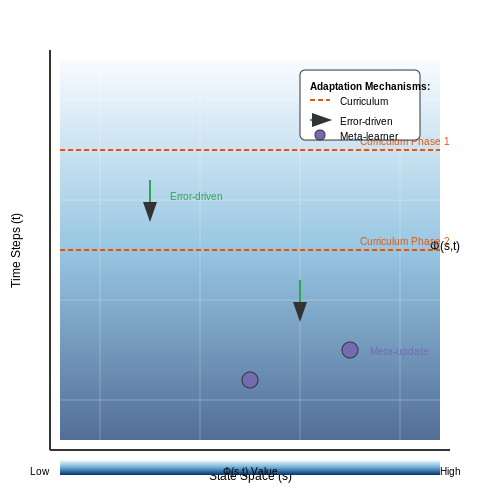
where rt represents the intrinsic reward at time step t, and γ is the discount factor. The curriculum generator C(τ) adapts based on the agent's current capabilities, typically modeled as:
where LP(τ, π) measures the learning progress on trajectory τ given policy π, and β controls the exploration-exploitation trade-off.
Dynamical Skill Composition
Advanced auto-curriculum systems employ skill chaining, where primitive skills are combined into hierarchical structures. The skill composition operator ∘ defines how skills s1 and s2 can be combined:
This compositionality enables the emergence of complex behaviors from simpler components, with the curriculum dynamically adjusting to focus on skill combinations that maximize the agent's overall competence.
Empirical Characteristics of Effective Auto-Curricula
- Non-monotonic difficulty progression: The optimal curriculum often revisits earlier tasks with new skill combinations rather than following strict difficulty ordering
- Multi-objective balancing: Maintains diversity across skill dimensions while progressively increasing challenge levels
- Transfer-aware sampling: Biases trajectory generation toward tasks that maximize positive transfer to other skills
Implementation Considerations
Practical auto-curriculum systems must address several key challenges:
where the stabilization loss ℒstabilize prevents catastrophic forgetting during curriculum transitions. Modern approaches often employ:
- Dynamically growing neural architectures to accommodate new skills
- Episodic memory buffers for curriculum replay
- Meta-learned curriculum generators that adapt to the agent's learning characteristics
Case Study: Multi-Task Reinforcement Learning
In robotic manipulation domains, auto-curriculum approaches have demonstrated the ability to discover complex tool-use strategies without explicit task definitions. The curriculum automatically progresses from basic grasping to coordinated multi-object manipulation, with the task distribution evolving according to:
where α controls the rate of curriculum progression based on the KL divergence between current success rates and a uniform distribution.
1.3 Challenges in Unsupervised Skill Discovery
Unsupervised skill discovery in reinforcement learning (RL) aims to autonomously learn diverse behaviors without extrinsic rewards. While promising, this paradigm faces several fundamental challenges that complicate its practical application.
1.3.1 Credit Assignment in Absence of Rewards
In traditional RL, the reward signal provides a clear learning signal. However, in unsupervised skill discovery, the absence of extrinsic rewards makes credit assignment ambiguous. The agent must rely on intrinsic motivation or information-theoretic objectives, which may not always correlate with meaningful behaviors. For example, maximizing empowerment (mutual information between skills and states) often leads to trivial solutions unless carefully regularized:
where S represents states and Z denotes skills. Without proper constraints, maximizing this quantity can result in degenerate skills that exploit environment dynamics rather than learning useful behaviors.
1.3.2 Skill Collapse and Redundancy
A common failure mode is skill collapse, where the agent discovers only a small subset of possible behaviors despite optimizing for diversity. This occurs when the learned skill space Z becomes low-dimensional or when multiple skills map to nearly identical behaviors. Recent approaches mitigate this via:
- Diversity regularization (e.g., Jensen-Shannon divergence between skill-conditioned policies)
- Architectural constraints like bottleneck layers
- Adversarial discriminators to enforce skill distinguishability
1.3.3 Scalability to High-Dimensional Spaces
As the state-action space dimensionality grows, the combinatorial explosion of possible skills makes discovery increasingly difficult. In continuous control tasks, for instance, the curse of dimensionality requires sophisticated exploration strategies beyond simple random noise injection. Techniques like hierarchical skill decomposition or curriculum learning help, but introduce additional hyperparameters and training instability.
1.3.4 Evaluation Metrics
Unlike supervised learning, no ground truth exists for unsupervised skills. Common proxy metrics include:
where d measures behavioral distance. However, these metrics often conflict - maximizing diversity doesn't guarantee task relevance, while transferable skills may lack diversity.
1.3.5 Catastrophic Forgetting in Non-Stationary Settings
When skills are discovered incrementally (e.g., through auto-curricula), the agent must balance acquiring new skills while retaining old ones. This resembles the continual learning problem, where neural networks tend to forget previous skills when optimizing for new objectives. Elastic weight consolidation (EWC) and memory replay buffers offer partial solutions, but remain computationally expensive for large-scale skill spaces.
2. Intrinsic Motivation and Reward Shaping
Intrinsic Motivation and Reward Shaping
Intrinsic motivation in reinforcement learning (RL) refers to mechanisms that encourage agents to explore and learn skills without relying solely on extrinsic rewards from the environment. This is particularly crucial in open-ended skill discovery, where predefined reward functions may be sparse or nonexistent. The agent must generate its own objectives through curiosity-driven exploration.
Information-Theoretic Foundations
The mathematical basis for intrinsic motivation often stems from information theory, where the agent seeks to maximize information gain or reduce uncertainty about its environment. One formalization is the predictive information of future states st+1 given current states st:
where H denotes entropy. Agents can maximize this quantity by seeking states where the conditional entropy H(st+1|st) is minimized—effectively pursuing predictable yet novel transitions.
Reward Shaping Techniques
Several concrete implementations exist for converting intrinsic motivation into reward signals:
- Prediction Error: Use the error of a learned dynamics model fθ(st+1|st, at) as a reward signal:
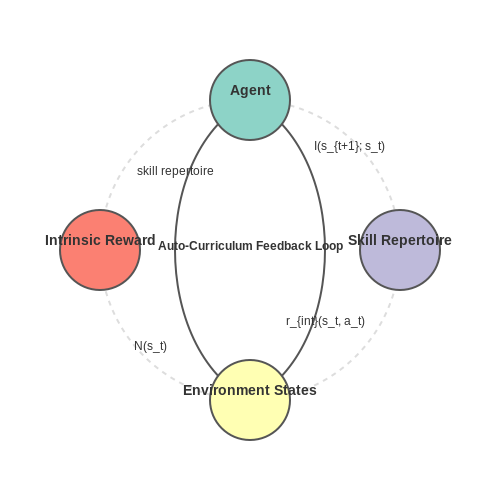
$$ r_{int}(s_t, a_t) = ||s_{t+1} - f_θ(s_t, a_t)||^2 $$
- State Visitation Counts: Reward novel state visits using density models or counting-based methods:
$$ r_{int}(s_t) = \frac{1}{\sqrt{N(s_t)}} $$where N(st) tracks state visit frequency.
- Empowerment: Maximize the mutual information between actions and future states:
$$ I(a_t; s_{t+k}) = H(a_t) - H(a_t|s_{t+k}) $$
Auto-Curriculum Dynamics
When combined with auto-curricula, these intrinsic rewards create a self-reinforcing cycle:
- The agent explores novel states due to intrinsic rewards
- New skills emerge from successful exploration trajectories
- The skill repertoire expands, enabling exploration of even more complex states
This process can be formalized as a non-stationary multi-armed bandit problem, where each "arm" represents a skill with time-varying reward distributions based on the agent's current capability.
Implementation Challenges
Practical systems must address:
- Reward Scaling: Balancing intrinsic and extrinsic rewards requires adaptive normalization
- Catastrophic Forgetting: Skills may be lost if not periodically revisited
- Coverage vs. Mastery: The exploration-exploitation tradeoff manifests temporally across skills
Modern approaches like variational intrinsic control and diversity is all you need (DIAYN) provide theoretical frameworks for these challenges by maximizing mutual information between skills and states while minimizing skill overlap.
2.2 Goal Generation Strategies
Diversity-Driven Goal Sampling
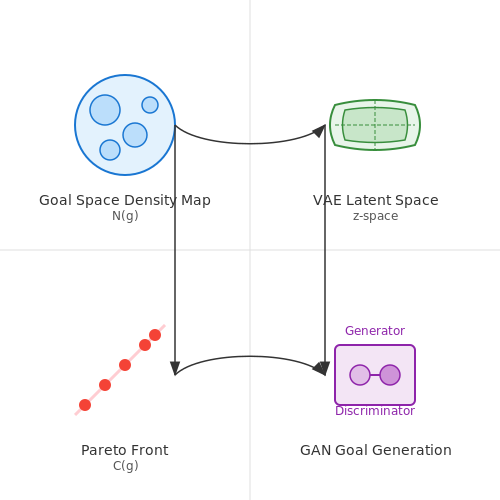
In open-ended learning, goal generation must balance exploration of novel states with exploitation of known skills. A common approach models the goal space as a density function, where new goals are sampled from low-density regions to encourage diversity. The probability of selecting goal g can be formalized as:
where N(g) counts occurrences of similar goals in a kernel density estimate, α controls exploration pressure, and ϵ prevents division by zero. This creates an automatic curriculum where the agent focuses on underrepresented regions of the goal space.
Competence-Based Prioritization
An alternative strategy prioritizes goals based on the agent's current skill level. The goal sampling probability becomes:
where C(g) ∈ [0,1] measures normalized competence at goal g, and β adjusts the focus on challenging goals. Competence can be estimated using success rates over recent attempts, with exponential moving averages providing temporal smoothing:
Goal Embedding and Relational Sampling
High-dimensional goal spaces require efficient representation learning. Variational autoencoders (VAEs) project goals into a latent space where distances correspond to skill similarity. The reconstruction loss Lrec and KL divergence LKL are combined:
where z is the latent representation. New goals can then be generated through interpolation (znew = αz1 + (1-α)z2) or by sampling from the learned prior p(z).
Multi-Objective Goal Synthesis
For complex tasks, goals can be constructed as Pareto-optimal combinations of sub-objectives. Given k objectives {fi(s)}, the goal generation becomes a multi-objective optimization:
Weight vectors w can be sampled from a Dirichlet distribution to ensure diverse coverage of the Pareto front. This approach is particularly effective in robotic manipulation tasks where goals may combine position, orientation, and force constraints.
Adversarial Goal Generation
Generative adversarial networks (GANs) can produce challenging goals by training a generator G against a discriminator D that estimates goal difficulty:
The generator's objective adapts as the agent improves, automatically maintaining an appropriate challenge level. Recent variants like Wasserstein GANs improve training stability in this setting by using the Earth-Mover distance:
2.3 Diversity-Driven Exploration Techniques
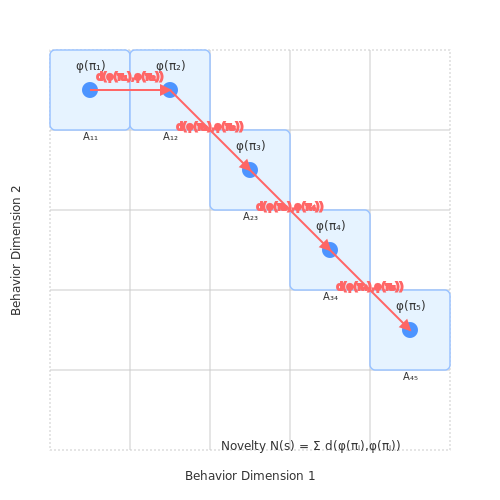
Diversity-driven exploration techniques address the fundamental challenge of open-ended learning by explicitly promoting behavioral or state-space coverage. Unlike traditional reinforcement learning approaches that optimize for a single reward signal, these methods maintain a population of policies or skills that collectively maximize a diversity metric. One widely used formulation is the diversity objective D, defined as:
where φ represents a behavior characterization function mapping policies to an embedding space, and d is a distance metric (typically L2 or cosine distance). The gradient of this objective with respect to policy parameters θi becomes:
Practical implementations often employ novelty search, where policies are rewarded for visiting states that differ significantly from previously encountered states. The novelty of a state s is computed as:
where si are the k-nearest neighbors of s in an archive of past states. This approach prevents premature convergence to local optima by continuously driving exploration toward underrepresented regions.
Quality-Diversity Algorithms
Modern quality-diversity (QD) algorithms like MAP-Elites and NSLC (Novelty Search with Local Competition) combine diversity preservation with competency. MAP-Elites maintains an archive of high-performing solutions binned by behavior characteristics, with the update rule:
where i,j index the behavior space grid. The algorithm's effectiveness depends critically on the behavior characterization φ, which must capture meaningful variations in policy execution while remaining computationally tractable.
Information-Theoretic Approaches
Maximum entropy reinforcement learning maximizes the entropy of the state visitation distribution ρπ(s):
where H is the differential entropy and α controls the exploration-exploitation trade-off. Variational inference formulations approximate this by minimizing the KL divergence between the policy's state visitation and a uniform target distribution.
Practical Implementation Considerations
Effective diversity-driven exploration requires careful attention to several implementation aspects:
- Behavior characterization: The choice of φ dramatically affects performance. Common approaches include final state positions, visited state centroids, or learned embeddings from autoencoders.
- Distance metrics: While Euclidean distance is common, task-specific metrics (e.g., dynamic time warping for temporal behaviors) often yield better results.
- Archiving strategies: Techniques like adaptive resolution grids or KD-trees help manage memory usage in high-dimensional behavior spaces.
- Parallelization: Population-based methods benefit from distributed evaluation, with synchronization strategies ranging from synchronous updates to asynchronous evolutionary approaches.
Recent advances in unsupervised skill discovery have demonstrated that diversity-driven exploration can autonomously discover complex behavior repertoires in domains ranging from robotic locomotion to game playing. The emergent behaviors often exceed human-designed solutions in both variety and capability.
3. Simulation Environments for Skill Discovery
3.1 Simulation Environments for Skill Discovery
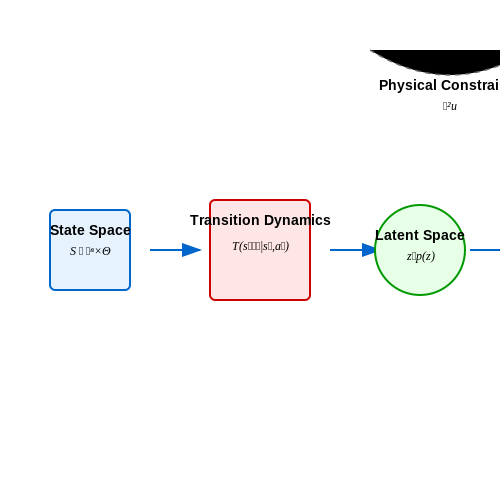
Modern reinforcement learning (RL) agents discover skills through interaction with environments that provide sufficient complexity and diversity. The choice of simulation environment critically impacts the emergent behaviors, as it defines the state-action space, reward structure, and physical constraints. High-fidelity simulations must balance computational tractability with realistic dynamics to enable meaningful skill acquisition.
Key Properties of Effective Skill Discovery Environments
An environment optimized for open-ended skill discovery exhibits several key characteristics:
- High-dimensional state space: Allows expression of diverse behaviors through rich sensory inputs
- Continuous action space: Enables fine-grained control policies rather than discrete action selection
- Physics-based dynamics: Provides realistic constraints for transfer to real-world applications
- Composable elements: Permits environment modifications to scaffold learning
- Parallelizable execution: Supports large-scale distributed training
Physics Simulation Engines
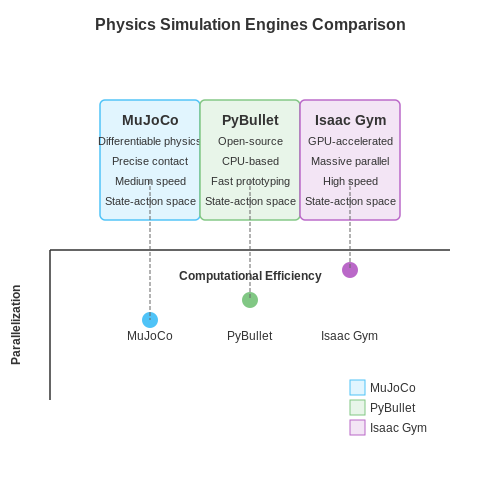
Contemporary RL systems primarily leverage three physics engines for skill discovery:
where τ represents joint torques, J the Jacobian matrix, and F the applied forces. This fundamental relationship governs how simulated agents interact with their environment.
MuJoCo
The Multi-Joint dynamics with Contact (MuJoCo) engine provides accurate rigid-body dynamics with efficient constraint solving. Its differentiable physics enables gradient-based optimization of control policies:
where fθ represents the learned transition dynamics.
PyBullet
As an open-source alternative, PyBullet offers similar capabilities with broader collision detection support. Its reduced precision trades some accuracy for faster simulation speeds:
Isaac Gym
NVIDIA's Isaac Gym enables massive parallelization through GPU-accelerated physics, allowing thousands of simultaneous environment instances for population-based training:
Environment Design Patterns
Effective skill discovery environments implement specific architectural patterns:
- Curriculum spaces: Gradually expand state-action space boundaries as skills develop
- Procedural generation: Randomize environment parameters to prevent overfitting
- Multi-agent systems: Enable social skill emergence through agent interactions
- Hierarchical reward shaping: Decompose complex tasks into learnable subskills
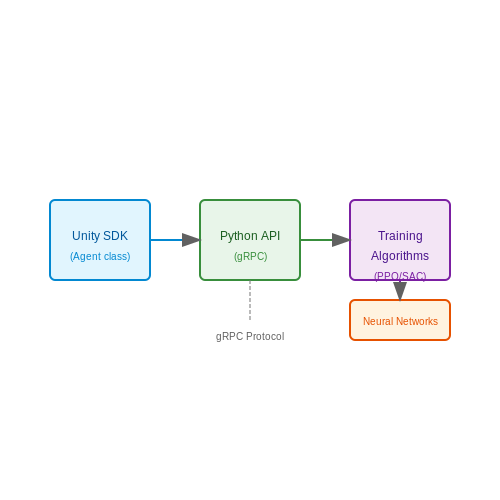
The following Python code demonstrates environment setup using the OpenAI Gym interface with MuJoCo:
import gym
import mujoco_py

env = gym.make('Humanoid-v4',
               reset_noise_scale=0.1,
               exclude_current_positions_from_observation=False)

# Domain randomization wrapper
env = gym.wrappers.DomainRandomization(
    env,
    randomize_friction=True,
    friction_range=[0.5, 1.5],
    randomize_density=True,
    density_range=[800, 1200]
)
Evaluation Metrics
Quantifying skill discovery progress requires specialized metrics beyond simple task completion:
where Dskills measures behavioral diversity across n discovered skills, with Σ representing the covariance of state visitation distributions.
Benchmarking Auto-Curriculum Approaches
Evaluating auto-curriculum methods requires carefully designed benchmarks that measure both the diversity of discovered skills and the efficiency of learning. Traditional reinforcement learning benchmarks often focus on single-task performance, which fails to capture the open-ended nature of skill discovery. Instead, specialized metrics and environments are needed to assess auto-curriculum approaches.
Key Metrics for Evaluation
Effective benchmarking of auto-curriculum methods involves tracking multiple complementary metrics:
- Skill Diversity: Measures the coverage of distinct behaviors in the learned skill space, often quantified using mutual information between states and skills or through clustering techniques.
- Transfer Performance: Evaluates how well discovered skills generalize to downstream tasks, typically measured by fine-tuning performance on target tasks.
- Sample Efficiency: Tracks the rate at which new skills are acquired relative to environmental interactions.
- Curriculum Quality: Assesses the logical progression of task difficulty, often measured by the correlation between skill mastery and curriculum stage.
where Z represents the skill space and S denotes the state space. This formulation captures the mutual information between skills and states, providing a quantitative measure of skill diversity.
Standardized Benchmark Environments
Several environments have emerged as standard testbeds for auto-curriculum research:
- Unsupervised Reinforcement Learning Benchmark (URLB): Provides a suite of continuous control tasks with carefully designed evaluation protocols for skill discovery methods.
- Procgen Benchmark: Offers procedurally generated environments that test generalization across diverse skill variations.
- XLand: A meta-learning environment specifically designed to evaluate open-ended learning through multi-task curricula.
Comparative Analysis Framework
When comparing auto-curriculum approaches, researchers should consider:
- The exploration mechanism (intrinsic rewards, diversity objectives, or goal generation)
- The curriculum structure (self-paced, population-based, or teacher-student)
- The skill representation (latent space, goal-conditioned, or option-based)
A robust benchmarking protocol should isolate these components through ablation studies while controlling for computational budget and environmental interactions.
Case Study: Population-Based Training
In population-based auto-curricula, the performance metric becomes:
where N is the population size and Ri(t) represents the reward for agent i at training step t. This formulation captures both individual learning progress and collective knowledge transfer within the population.
Practical Implementation Considerations
When implementing benchmarks for auto-curriculum approaches, several practical factors must be addressed:
- Computational Cost: Auto-curriculum methods often require significantly more resources than single-task learning due to their exploratory nature.
- Reproducibility: The stochastic nature of skill discovery necessitates multiple random seeds and rigorous statistical testing.
- Environment Design: The benchmark should provide sufficient complexity for meaningful skill discovery while remaining tractable for analysis.
3.3 Real-World Applications and Limitations
Practical Applications in Robotics and Autonomous Systems
Open-ended skill discovery with auto-curriculum has demonstrated significant success in robotics, where agents must adapt to dynamic environments without predefined tasks. For instance, in robotic manipulation, agents trained with auto-curriculum learn complex skills like object stacking or tool use by progressively increasing task difficulty. The objective function often maximizes entropy over achieved states:
where s represents the state space, and p(s) is the probability density of states visited. This approach has been applied to quadcopter control, where agents discover stable flight maneuvers without explicit reward shaping.
Game AI and Procedural Content Generation
In game AI, auto-curriculum enables non-player characters (NPCs) to develop adaptive strategies. For example, DeepMind’s AlphaStar used skill auto-curriculum to master StarCraft II by incrementally tackling scenarios of escalating complexity. The training process optimizes a meta-reward function:
where λ balances exploitation and exploration. Procedural content generation benefits from this by dynamically adjusting game difficulty based on player skill.
Industrial Automation and Optimization
Manufacturing systems leverage auto-curriculum for adaptive process control. In semiconductor fabrication, agents optimize wafer production by discovering efficient sequences of operations. The policy gradient update incorporates a curriculum coefficient α:
This minimizes divergence from prior knowledge while encouraging novel solutions.
Key Limitations and Open Challenges
- Catastrophic forgetting: Agents may lose previously acquired skills when adapting to new tasks, necessitating architectures like episodic memory or meta-learning.
- Reward sparsity: In physical systems, sparse rewards require dense reward engineering or hierarchical reinforcement learning.
- Computational cost: Auto-curriculum often demands orders of magnitude more samples than supervised learning, limiting real-time deployment.
Scalability Constraints
The sample complexity of open-ended discovery grows polynomially with state-action dimensionality. For a d-dimensional continuous space, the regret bound scales as:
where T is the horizon length. This makes high-DOF systems like humanoid robots particularly challenging.
Safety and Interpretability
Emergent behaviors in safety-critical applications (e.g., autonomous vehicles) risk being unexplainable. Current research combines auto-curriculum with symbolic constraints:
where φ(s,a) is a verifiable safety predicate.
4. Bias and Fairness in Autonomous Learning
4.1 Bias and Fairness in Autonomous Learning
Autonomous learning systems that discover skills through auto-curricula inherit biases from multiple sources: the environment design, reward shaping, and the data distribution of initial states. These biases manifest as skewed skill distributions where certain behaviors are systematically over- or under-represented. Consider a robotic arm learning manipulation tasks - if the initial state distribution favors positions near table center, edge-case manipulations may never emerge.
Mathematical Formulation of Representation Bias
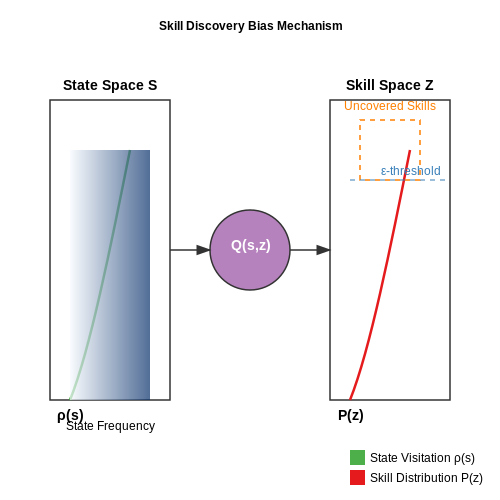
The probability of skill discovery is fundamentally tied to the state visitation distribution ρ(s). For a skill space Z, the discovered skill distribution becomes:
where Q(s,z) is the skill-conditioned value function. Representation bias occurs when ρ(s) is non-uniform, causing certain z values to have vanishingly low probability. This can be quantified through the effective skill coverage:
Sources of Algorithmic Bias
- Exploration Bias: Intrinsic motivation methods often favor novelty, creating disproportionate focus on rare states
- Curriculum Bias: Self-generated curricula may get stuck in local optima of skill difficulty
- Representational Bias: Skill embeddings may cluster similar behaviors while ignoring others
Fairness Metrics for Skill Discovery
We can adapt group fairness definitions from supervised learning:
where G partitions the state space into protected groups. For continuous skills, we measure distributional similarity using Wasserstein distance:
Debiasing Techniques
Recent approaches combine adversarial training with skill discovery:
where D is a discriminator trained to predict skill z from state s, and λ controls the fairness-utility tradeoff. The agent receives an additional reward for fooling D, encouraging state-independent skill discovery.
Implementation Considerations
In practice, debiasing requires careful handling of:
- Non-stationary skill distributions during training
- High-dimensional skill spaces where density estimation is challenging
- Conflicting objectives between skill diversity and task performance
Empirical studies show that naive fairness constraints can reduce overall skill coverage by 15-30%, while adaptive methods like progressive widening maintain coverage while improving fairness.
4.2 Scalability and Generalization Challenges
Computational Complexity in High-Dimensional Spaces
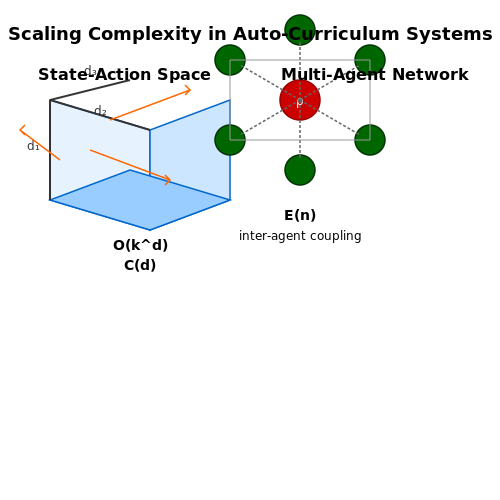
The curse of dimensionality manifests acutely in open-ended skill discovery as the state-action space grows exponentially with each additional degree of freedom. For an environment with d dimensions and k discrete actions per dimension, the policy search space scales as O(kd). Auto-curriculum methods must navigate this space while maintaining sample efficiency, requiring careful tradeoffs between exploration breadth and computational tractability.
where r represents the sparsity ratio of relevant dimensions and N bounds the maximum interaction complexity. Recent approaches like dimensionality-aware skill primitives attempt to mitigate this by factorizing the policy into hierarchical components with varying timescales.
Catastrophic Forgetting in Continual Learning
Auto-curricula generate non-stationary task distributions that challenge neural networks' ability to retain previously learned skills. The plasticity-stability dilemma becomes particularly acute when:
- Task boundaries are fuzzy or undefined
- Reward signals have overlapping feature dependencies
- Skill composition requires backward transfer
Modern solutions employ dynamic sparse reparameterization combined with meta-consolidation mechanisms. For example, the synaptic intelligence metric:
quantifies parameter importance across the curriculum trajectory, enabling selective protection of critical weights during new skill acquisition.
Transfer Learning Bottlenecks
Effective generalization requires learned skills to transfer beyond their training distribution, but auto-curricula often produce narrow skill specializations. The transfer ratio τ between source task S and target task T can be modeled as:
where RT* represents optimal performance on T. Current research addresses this through invariant skill embeddings that maximize the mutual information I(ϕ(s); z) between state features ϕ(s) and skill descriptors z while minimizing I(z; s) to reduce overfitting.
Multi-Agent Scaling Laws
In multi-agent auto-curricula, the joint policy space grows combinatorially with population size n. The effective complexity scales as:
where ρ captures inter-agent coupling strength. Recent breakthroughs in emergent curriculum theory demonstrate that carefully structured opponent sampling distributions can yield polynomial rather than exponential scaling in certain game-theoretic configurations.
Empirical Scaling Limitations
Practical implementations reveal hardware-dependent bottlenecks in auto-curriculum systems:
| Resource | Scaling Exponent | Typical Constraint |
|---|---|---|
| GPU Memory | O(b · d1.7) | Gradient checkpointing overhead |
| Inter-node Bandwidth | O(n2 log p) | Parameter server synchronization |
| Rollout Storage | O(t · s · a) | Replay buffer sampling latency |
where b is batch size, d is network depth, n is agent count, p is parallel workers, t is episode length, s is state size, and a is action dimensionality. These constraints necessitate novel distributed training paradigms like asynchronous skill distillation and selective experience replay.
4.3 Emerging Trends in Open-Ended AI Systems
Self-Supervised Skill Acquisition
Recent work in reinforcement learning (RL) has shifted toward self-supervised skill discovery, where agents learn reusable behaviors without explicit reward shaping. A key framework is diversity-driven auto-curriculum, where an intrinsic reward function encourages exploration of novel state-action spaces. The objective is often formalized as maximizing mutual information between skills and states:
Here, Z represents latent skill variables, and S denotes the state distribution. Variational methods approximate this by training a discriminator to distinguish skills based on state transitions, leading to emergent specialization.
Compositional Skill Hierarchies
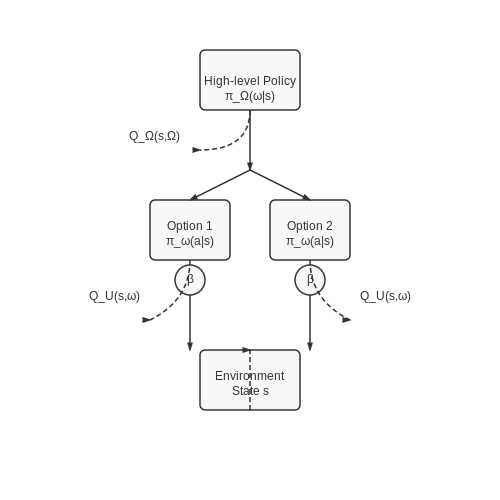
Modern approaches decompose complex tasks into hierarchical skill graphs. Techniques like Option-Critic architectures leverage temporal abstraction, where higher-level policies select among lower-level skills (options) with termination conditions. The policy gradient update for option ω is derived as:
where QU and QΩ are option-specific and meta-policy action-value functions, respectively.
Multi-Agent Emergent Complexity
In multi-agent systems, auto-curricula arise from competitive or cooperative dynamics. Population-Based Training (PBT) exemplifies this, where agents co-evolve by adapting to each other’s strategies. The Nash equilibrium concept extends to skill spaces, with agents optimizing:
Empirical results in environments like Hide-and-Seek demonstrate agents inventing tools and strategies beyond human design.
Meta-Learning for Adaptive Curricula
Meta-reinforcement learning frameworks like MAML enable agents to rapidly adapt skill repertoires to new tasks. The meta-update rule for policy parameters θ is:
where τi represents tasks sampled from a distribution. This facilitates open-ended learning by decoupling skill acquisition from specific task rewards.
Scalability via World Models
Learned dynamics models (e.g., DreamerV3) accelerate skill discovery by planning in latent spaces. The model objective combines reconstruction loss and KL regularization:
Agents trained this way exhibit zero-shot generalization to unseen environments, a hallmark of open-ended learning.
5. Key Research Papers and Surveys
5.1 Key Research Papers and Surveys
- PDF Open-Ended Learning Environments: Foundations, Assumptions, and ... — 5.2 Open-Ended vs. Traditional Views of Learning and Instruction I will not attempt to delineate all strengths and limitations of direct instruction, but consider a few key points to contrast such approaches with open-ended learning environments. The continuum shown in Figure 5.1 represents a range of dimensions on which open-ended and
- Summarizing responses to open-ended questions in educational surveys: A ... — Open-ended questions are just as important as closed-ended ones in quantitative research. They are useful for clarifying ambiguities and identifying opinions that may be hidden from researchers. 2 - 4 Analysis of closed-ended responses can be done in a short period by human experts and by semi-automatic or even fully automatic computing ...
- Open-ended versus Closed Probes: Assessing Different Formats of Web ... — On the downside, open-ended questions in web surveys, such as probes, pose additional burden on respondents in comparison to answering closed questions. ... Furthermore, previous research comparing open-ended and closed question formats has shown that the answers to the open-ended format resulted in additional categories not covered by the ...
- The Ecology of Open-Ended Skill Acquisition — HAL is a multi-disciplinary open access archive for the deposit and dissemination of sci-entific research documents, whether they are pub-lished or not. The documents may come from teaching and research institutions in France or abroad, or from public or private research centers. L'archive ouverte pluridisciplinaire HAL, est
- OMNI: Open-endedness via Models of human Notions of Interestingness - ar5iv — A key challenge in open-endedness research is the inability to quantify and thus focus on tasks that are not only learnable but also interesting. There have been many attempts to quantify interestingness, but, as we detail in Section 2 , such simple, hand-crafted formulas consistently fall short of truly capturing the essence of interestingness ...
- Assessment of cognitive, behavioral, and affective learning outcomes in ... — This systematic review on massive open online courses (MOOCs) in higher education examined the research on the assessment of learning outcomes based on 65 peer-reviewed articles published between 2017 and 2019. This study aims to investigate the learning outcomes, related instruments, and assessment characteristics of these instruments in MOOCs.
- PDF SkiLD: Unsupervised Skill Discovery Guided by Factor Interactions — tasks. This work introduces Skill Discovery from Local Dependencies (SkiLD), which leverages state factorization as a natural inductive bias to guide the skill learning process. The key intuition guiding SkiLD is that skills that induce diverse interactions between state factors are often more valuable for solving downstream tasks.
- PDF Autotelic Reinforcement Learning: Exploring Intrinsic Motivations for ... — enhance open-ended skill acquisition. Fig. 1 Dual organization of the present research. In the first part we take a bottom-up approach and study the self-organization of cultural conventions in artificial agents from social interactions. In the second part, we use a top-down approach to investigate the impact of pre-
- Automatic evaluation of open-ended questions for online learning. A ... — Students' assessment is a crucial task for teachers at all levels of education, including Higher Education (HE). According to Brown and Knight (1994), assessment is central to the student experience.Likewise, Gibbs states that assessment frames learning (Gibbs, 2006).Yet, when it comes to written assignments, it is one of the toughest, most burdensome, and most time-consuming tasks, subject ...
- A Hybrid Text Summarization Technique of Student Open-Ended ... - MDPI — This study introduces a hybrid text summarization technique designed to enhance the analysis of qualitative feedback from online educational surveys. The technique was implemented at the Hellenic Open University (HOU) to tackle the challenges of processing large volumes of student feedback. The TextRank and Walktrap algorithms along with GPT-4o mini were used to analyze student comments ...
5.2 Open-Source Tools and Frameworks
- PDF Open-Ended Learning Environments: Foundations, Assumptions, and ... — 5.2 Open-Ended vs. Traditional Views of Learning and Instruction I will not attempt to delineate all strengths and limitations of direct instruction, but consider a few key points to contrast such approaches with open-ended learning environments. The continuum shown in Figure 5.1 represents a range of dimensions on which open-ended and
- Open-World Skill Discovery from Unsegmented Demonstrations - arXiv.org — Most existing LLM-based instruction-following agents adopt a two-layer structure of planner and controller to complete tasks, which first convert the instruction into atom skills through the planner, and then use a conditioned policy to convert it into actions based on the current observation to interact with the environment (Wang et al., 2025, 2023b, 2024b; Li et al., 2024; Wang et al., 2024a ...
- GitHub - liuxin0824/ComSD — Open Source GitHub Sponsors. Fund open source developers The ReadME Project. GitHub community articles ... {Balancing State Exploration and Skill Diversity in Unsupervised Skill Discovery}, author={Liu, Xin and Chen, Yaran and Chen, Guixing and Li, Haoran and Zhao, Dongbin}, journal={IEEE Transactions on Cybernetics}, year={2025} } About.
- The Ecology of Open-Ended Skill Acquisition — The Ecology of Open-Ended Skill Acquisition Clément Moulin-Frier To cite this version: Clément Moulin-Frier. The Ecology of Open-Ended Skill Acquisition. Artificial Intelligence [cs.AI]. Université de Bordeaux (UB), 2022. �tel-03875448�
- Voyager: An Open-Ended Embodied Agent with Large Language Models — Abstract. We introduce Voyager, the first LLM-powered embodied lifelong learning agent in Minecraft that continuously explores the world, acquires diverse skills, and makes novel discoveries without human intervention. Voyager consists of three key components: 1) an automatic curriculum that maximizes exploration, 2) an ever-growing skill library of executable code for storing and retrieving ...
- Teaching and learning through open source educative processes — The actual term Open Source was originally a break-away variation of Richard Stallman's politically charged Free Software movement. Stallman (after working on seminal computer programs at M.I.T. and then being denied access to them) believed that the source code 1 of computer programs should be free. It is important to understand Stallman (2010) means when he uses the word free.
- Automatic evaluation of open-ended questions for online learning. A ... — Despite the benefit of closed-ended questions, not all the questions can be formulated in a closed-ended fashion. On the other hand, open-ended questions requiring a text answer in a natural or formal language allows a more in-depth assessment of students' capabilities and learning performances. However, their evaluation is time-consuming, it ...
- PDF Automatic Curriculum for Unsupervised Reinforcement Learning — APS [30]. Mutual Information-based Skill Learning (MISL) has been used for self-supervised skill discovery, such as VIC [20], DIAYN [14], VALOR [1]. VISR [21] also optimizes the same ojective, but its special approximation brought successor feature [2] into un-supervised skill learning paradigm and enables fast task inference.
- Curriculum Launch Materials Download - OpenSciEd — Curriculum Launch Materials Download. Professional Learning for Teachers. Professional Learning for Districts. On-Demand Teacher Support. Professional Learning Events. To support teachers with being able to use the OpenSciEd instructional materials, we have developed a set of professional learning resources that accompany each unit. All the ...
- Autotelic Reinforcement Learning: Exploring Intrinsic Motivations for ... — enhance open-ended skill acquisition. Fig. 1 Dual organization of the present research. In the first part we take a bottom-up approach and study the self-organization of cultural conventions in artificial agents from social interactions. In the second part, we use a top-down approach to investigate the impact of pre-
5.3 Recommended Courses and Tutorials
- PDF Machine beats experts: Automatic discovery of skill models for data ... — accurate set of skills and knowledge (i.e., a skill model, or the Q-Matrix). We have developed an innovative method to discover skill models from the data of online courses. Our method assumes that online courses have a pre-defined skill map for which skills are associated with formative assessment items embedded throughout the online course.
- The Ecology of Open-Ended Skill Acquisition — The Ecology of Open-Ended Skill Acquisition Clément Moulin-Frier To cite this version: Clément Moulin-Frier. The Ecology of Open-Ended Skill Acquisition. Artificial Intelligence [cs.AI]. Université de Bordeaux (UB), 2022. �tel-03875448�
- Introduction to Electronics - Coursera — Problem 5-3-3 • 30 minutes; Problem ... "I directly applied the concepts and skills I learned from my courses to an exciting new project at work." Larry W. ... Be the end of the course you would definitely get confidence with the basics of electronics and once complicated circuits would look so easy to unravel. J. JV. 4.
- Online Courses - Learn Anything, On Your Schedule | Udemy — Udemy is an online learning and teaching marketplace with over 250,000 courses and 80 million students. Learn programming, marketing, data science and more. Search bar. Site navigation ... Show all trending skills. Top companies choose Udemy Business to build in-demand career skills.
- The home of free learning from the Open University - OpenLearn — Study hundreds of free short courses, discover thousands of articles, activities, and videos, and earn digital badges and certificates. ... Improve your study skills. ... the free learning platform of The Open University, is delighted to return as a partner of Learning at Work Week (12-18 May 2025) again this year. ...
- The 15 best online courses to learn Unreal Engine — Get started on your Unreal Engine journey with 15 of our best online courses on animation, lighting, level design, and more. Totally free. ... But remember, there's over 225 hours of content in UOL, so as you progress you can always keep expanding your skill sets until you're exactly where you want to be.
- Epic Developer Community Learning | Tutorials, Courses, Demos & More ... — Epic Developer Community Learning offers tutorials, courses, demos, and more created by Epic Games and the developer community.Learn UE and start creating today.
- PDF Learning Environment Training: ECERS-3 - Center for Early Learning ... — skills • Access for 30 minutes (good quality level) • Helmets required for wheel toys (highest quality level) 26 center-elp.org Item 5: Child-related display • Display is: • Children's individualized artwork • Related to children (i.e., rules, helper jobs) • Related to current topics and interests • Staff:
- LinkedIn Learning: Online Training Courses & Skill Building — Accelerate skills & career development for yourself or your team | Business, AI, tech, & creative skills | Find your LinkedIn Learning plan today.
- Cisco Networking Academy: Learn Cybersecurity, Python & More — Cisco Networking Academy is a skills-to-jobs program shaping the future workforce. Since 1997, we have impacted over 20 million learners in 190 countries.