


cellular phone calling detector circuit schematic
#cellular phone
#sensor coil
#LED indicator
#field detection
#incoming call
#wireless communication
#RF detection
#mobile phone
#flashing LED
#proximity sensor

Description: This circuit is designed to detect incoming calls on a cellular phone, even when the phone's ringer is turned off, by utilizing a flashing LED. The device should be positioned a few centimeters away from the cellular phone, allowing its sensor coil L1 to detect the electromagnetic field emitted by the phone's receiver during an incoming call.
The circuit operates on the principle of electromagnetic induction, where the sensor coil L1 picks up the electromagnetic waves generated by the cellular phone when a call is received. The coil is tuned to the specific frequency range of the phone's signal, ensuring optimal sensitivity and responsiveness to incoming calls.
Upon detection of the electromagnetic field, the circuit activates a light-emitting diode (LED) to provide a visual indication of the incoming call. The LED flashes at a rate that can be adjusted based on the circuit design, allowing for customization of the visual alert.
Key components of the circuit include the sensor coil L1, which is typically constructed using insulated copper wire wound around a non-conductive core. The circuit may also incorporate a transistor or operational amplifier to amplify the signal from the coil, ensuring reliable detection of the phone's electromagnetic emissions. Additionally, resistors and capacitors may be used to filter noise and stabilize the circuit operation.
Power for the circuit can be supplied by a small battery or a USB power source, depending on the design requirements. The compact size of the circuit allows for easy integration into various environments, making it a versatile solution for users who may need a discreet alert system for incoming calls.
Overall, this circuit provides an effective solution for alerting users to incoming calls without relying on the traditional ringer of a cellular phone, enhancing usability in situations where sound notifications may be impractical.This circuit was designed to detect when a call is incoming in a cellular phone (even when the calling tone of the device is switched-off) by means of a flashing LED. The device must be placed a few centimeters from the cellular phone, so its sensor coil L1 can detect the field emitted by the phone receiver during an incoming call..
The circuit operates on the principle of electromagnetic induction, where the sensor coil L1 picks up the electromagnetic waves generated by the cellular phone when a call is received. The coil is tuned to the specific frequency range of the phone's signal, ensuring optimal sensitivity and responsiveness to incoming calls.
Upon detection of the electromagnetic field, the circuit activates a light-emitting diode (LED) to provide a visual indication of the incoming call. The LED flashes at a rate that can be adjusted based on the circuit design, allowing for customization of the visual alert.
Key components of the circuit include the sensor coil L1, which is typically constructed using insulated copper wire wound around a non-conductive core. The circuit may also incorporate a transistor or operational amplifier to amplify the signal from the coil, ensuring reliable detection of the phone's electromagnetic emissions. Additionally, resistors and capacitors may be used to filter noise and stabilize the circuit operation.
Power for the circuit can be supplied by a small battery or a USB power source, depending on the design requirements. The compact size of the circuit allows for easy integration into various environments, making it a versatile solution for users who may need a discreet alert system for incoming calls.
Overall, this circuit provides an effective solution for alerting users to incoming calls without relying on the traditional ringer of a cellular phone, enhancing usability in situations where sound notifications may be impractical.This circuit was designed to detect when a call is incoming in a cellular phone (even when the calling tone of the device is switched-off) by means of a flashing LED. The device must be placed a few centimeters from the cellular phone, so its sensor coil L1 can detect the field emitted by the phone receiver during an incoming call..

a friendly charger schematic for mobile phones
Most mobile chargers lack current and voltage regulation as well as short-circuit protection. These chargers supply unregulated 6-12V DC for charging battery packs. Typical mobile phone battery packs are rated at 3.6V and 650mAh. To enhance battery longevity, it is...
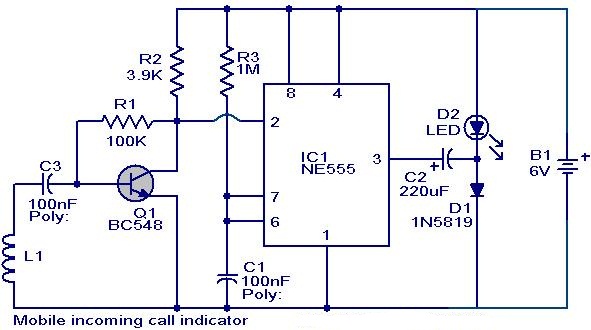
mobile incoming call indicator
This circuit can be utilized to eliminate the annoyance of mobile phone rings while at home. It provides a visual indication when placed near a mobile phone, even if the ringer is turned off. When a call is received, the...

Doorknob Proximity Alarm for wooden door
Reverse engineered circuit diagram of a popular retail doorknob alarm. It contains a small transmitter and the doorknob acts as an antenna so it will not work on a metal door. When a person comes close to the doorknob this...
Doorknob Proximity Alarm for wooden door
Reverse engineered circuit diagram of a popular retail doorknob alarm. It contains a small transmitter and the doorknob acts as an antenna so it will not work on a metal door. When a person comes close to the doorknob this...

Travelers Cellphone Battery Charger
While traveling, charging a mobile phone can be a significant challenge due to the general inaccessibility of power supply sources, leading to the risk of the battery depleting.
To address the issue of mobile phone battery depletion during travel, a portable...

connect 4000
The objective of this project was to investigate the wireless linkage of objects, locations, and individuals. Initial discussions revolved around the intended use of the project—whether for private or public purposes—and the number of participants involved. Considerations included the choice...

mobile phone battery charger circuit
Mobile phone chargers available in the market are quite expensive. The circuit presented here serves as a low-cost alternative to charge mobile telephones or battery packs with a rating of 7.2 volts.
The proposed circuit design utilizes a straightforward approach to...

Cellular Phone Calling Detector Circuit Schematic
The circuit flashes an LED when detecting an incoming call and is powered by a single 1.5V cell. It is designed to detect incoming calls in a cellular phone.
This circuit utilizes a simple yet effective approach to alert users of...
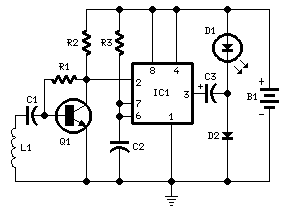
Cellular Phone calling Detector
This circuit was designed to detect when a call is incoming in a cellular phone (even when the calling tone of the device is switched-off) by means of a flashing LED. The device must be placed a few centimeters from...