


Passive Summing Schematic
#passive mixer
#summing mixer
#audio mixing
#16 channel
#audio circuit
#DIY audio
#signal summing
#audio electronics
#mixer schematic
#passive electronics
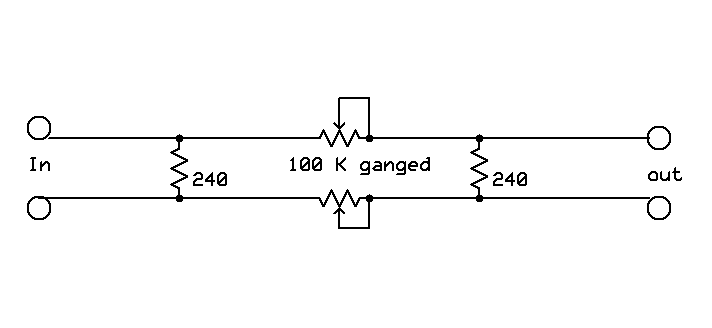
Description: A schematic for a 16-channel passive summing mixer has been developed based on information gathered from various forums and online resources.
The 16-channel passive summing mixer is designed to combine multiple audio signals into a single output while maintaining the integrity of the original audio quality. The schematic typically consists of multiple input channels, each equipped with resistors that facilitate the summing process. The resistors are strategically selected to ensure that each input signal is attenuated appropriately, preventing any single channel from dominating the mix.
In a standard configuration, each input channel will feature a resistor connected to the audio signal path, followed by a common output bus where all signals converge. The choice of resistor values is crucial; they should be selected to achieve a balanced mix without introducing significant noise or distortion. Common resistor values for such applications range from 1kΩ to 10kΩ, depending on the desired input impedance and overall mixer design.
The output of the mixer is typically connected to a buffered amplifier stage to drive the final output signal, ensuring that the combined signal maintains its strength and fidelity. This buffer stage can be implemented using an operational amplifier configured in a non-inverting mode, which provides high input impedance and low output impedance, allowing for better compatibility with subsequent audio equipment.
In addition to the basic summing function, considerations for grounding and shielding are essential to minimize hum and interference. A star grounding scheme is often recommended, where all ground connections converge at a single point to reduce ground loops.
Overall, this passive summing mixer design is ideal for applications where simplicity, low cost, and minimal signal coloration are desired, making it a popular choice among audio engineers and hobbyists alike.So I`ve searched the forums, and the internet, and I`ve put together a schematic for a 16 channel passive summing mixer I would like to build. I`m..
The 16-channel passive summing mixer is designed to combine multiple audio signals into a single output while maintaining the integrity of the original audio quality. The schematic typically consists of multiple input channels, each equipped with resistors that facilitate the summing process. The resistors are strategically selected to ensure that each input signal is attenuated appropriately, preventing any single channel from dominating the mix.
In a standard configuration, each input channel will feature a resistor connected to the audio signal path, followed by a common output bus where all signals converge. The choice of resistor values is crucial; they should be selected to achieve a balanced mix without introducing significant noise or distortion. Common resistor values for such applications range from 1kΩ to 10kΩ, depending on the desired input impedance and overall mixer design.
The output of the mixer is typically connected to a buffered amplifier stage to drive the final output signal, ensuring that the combined signal maintains its strength and fidelity. This buffer stage can be implemented using an operational amplifier configured in a non-inverting mode, which provides high input impedance and low output impedance, allowing for better compatibility with subsequent audio equipment.
In addition to the basic summing function, considerations for grounding and shielding are essential to minimize hum and interference. A star grounding scheme is often recommended, where all ground connections converge at a single point to reduce ground loops.
Overall, this passive summing mixer design is ideal for applications where simplicity, low cost, and minimal signal coloration are desired, making it a popular choice among audio engineers and hobbyists alike.So I`ve searched the forums, and the internet, and I`ve put together a schematic for a 16 channel passive summing mixer I would like to build. I`m..

Passive mixer
This simple circuit can be used to combine stereo signals to produce a monaural output. K1 and R2 isolate both circuits, while R3 controls the level of the combined output signal.
The circuit functions by taking two separate stereo input signals...

Passive Audio Mixer
I designed this circuit for one friend of mine to be used as a small portable DJ mixer. The circuit is an audio mixer circuit so simple as it can be. There are two dual logarithmic potentiometers in the circuit...

Wet/Dry Mix Knob - will this schematic work
A simple wet/dry knob is desired to be added to a GSSL (Chameleon Labs 7720) for parallel compression. A relevant schematic has been found.
To implement a wet/dry knob for parallel compression on a GSSL (Chameleon Labs 7720), the circuit can...
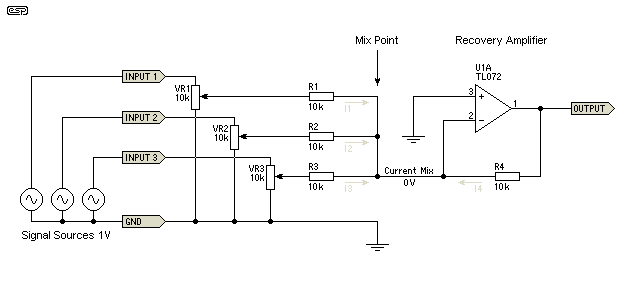
audio mixing
The fundamental principles of mixing audio signals are simple, yet they are often not clearly explained online. This article aims to address those gaps.
Mixing audio signals involves combining multiple sound sources to create a cohesive audio output. The process requires...