


1993 vw passat electrical circuit
#emergency lights
#fuse panel
#relay panel
#ignition coil
#power windows
#ABS control
#headlight switch
#engine control module
#instrument cluster
#taillight

Description: Emergency lights, fuse/relay panel, fresh air blower switch, engine control module, ignition coil, console switch, power windows, ABS control unit, ABS hydraulic unit, instrument cluster, taillight, headlight switch, automatic solenoid, ignition switch.
The described circuit encompasses multiple essential components for vehicle operation and safety. The emergency lights serve as a critical feature for alerting other drivers in situations requiring immediate attention. The fuse/relay panel is a central hub that houses various fuses and relays, protecting the electrical circuits from overloads and controlling the operation of various components through relay activation.
The fresh air blower switch is responsible for regulating airflow within the vehicle's cabin, contributing to passenger comfort. The engine control module (ECM) is a key electronic unit that manages engine performance by processing data from various sensors and adjusting parameters such as fuel injection and ignition timing. The ignition coil transforms low voltage from the battery into the high voltage necessary to ignite the air-fuel mixture in the engine's cylinders.
The console switch and power windows integrate user controls for vehicle features, enhancing convenience and functionality. The ABS (Anti-lock Braking System) control unit and hydraulic unit work in tandem to prevent wheel lock-up during braking, thereby maintaining vehicle stability and control. The instrument cluster provides the driver with vital information regarding vehicle status, including speed, fuel level, and warning indicators.
The taillight and headlight switch are crucial for vehicle visibility and safety, allowing the driver to activate the vehicle's lighting systems as needed. The automatic solenoid is typically used in various applications within the vehicle, such as controlling transmission functions or other automated systems. The ignition switch is the component that initiates the vehicle's electrical systems and starts the engine, making it fundamental to vehicle operation.
Overall, this schematic outlines a complex interconnection of components that work together to ensure vehicle safety, functionality, and user control, reflecting the intricate design of modern automotive electrical systems.Emergency lights, fuse/relay panel and fresh air blower switch, Engine control module and ignition coil, console switch, power windows, ABS control unit and ABS hydraulic unit, fuse relay panel and instrument cluster, and taillight, fuse/relay panel and headlight switch, automatic sol, fuse/relay panel and ignition switch, Engine control module.
The described circuit encompasses multiple essential components for vehicle operation and safety. The emergency lights serve as a critical feature for alerting other drivers in situations requiring immediate attention. The fuse/relay panel is a central hub that houses various fuses and relays, protecting the electrical circuits from overloads and controlling the operation of various components through relay activation.
The fresh air blower switch is responsible for regulating airflow within the vehicle's cabin, contributing to passenger comfort. The engine control module (ECM) is a key electronic unit that manages engine performance by processing data from various sensors and adjusting parameters such as fuel injection and ignition timing. The ignition coil transforms low voltage from the battery into the high voltage necessary to ignite the air-fuel mixture in the engine's cylinders.
The console switch and power windows integrate user controls for vehicle features, enhancing convenience and functionality. The ABS (Anti-lock Braking System) control unit and hydraulic unit work in tandem to prevent wheel lock-up during braking, thereby maintaining vehicle stability and control. The instrument cluster provides the driver with vital information regarding vehicle status, including speed, fuel level, and warning indicators.
The taillight and headlight switch are crucial for vehicle visibility and safety, allowing the driver to activate the vehicle's lighting systems as needed. The automatic solenoid is typically used in various applications within the vehicle, such as controlling transmission functions or other automated systems. The ignition switch is the component that initiates the vehicle's electrical systems and starts the engine, making it fundamental to vehicle operation.
Overall, this schematic outlines a complex interconnection of components that work together to ensure vehicle safety, functionality, and user control, reflecting the intricate design of modern automotive electrical systems.Emergency lights, fuse/relay panel and fresh air blower switch, Engine control module and ignition coil, console switch, power windows, ABS control unit and ABS hydraulic unit, fuse relay panel and instrument cluster, and taillight, fuse/relay panel and headlight switch, automatic sol, fuse/relay panel and ignition switch, Engine control module.
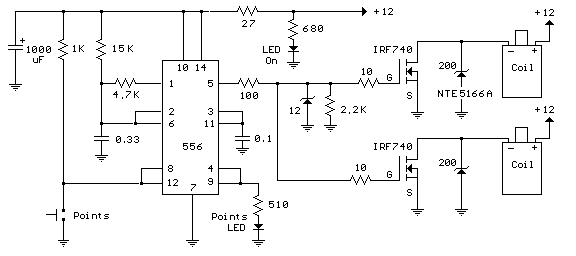
Ignition Coil Buzz Box circuit
This circuit creates a buzz coil using a standard automotive ignition coil. A 556 dual timer is employed to establish the frequency and duty cycle of the coil current. One timer functions as an oscillator to generate the 200 Hz...

1998 DeVille: front power windows work ok left front window switch
The system utilizes a single circuit breaker instead of fuses. According to the schematic, switches provide 12 volts of power and ground to the window motors in opposite polarities, allowing the windows to move up and down. Troubleshooting should begin...

Power failure emergency lights automatically converter circuit diagram
The application circuit operates the device as illustrated below, allowing for intermittent lighting in specific situations (e.g., during surgery). It utilizes an LCE module for blackout emergency lighting, which activates automatically after a power failure, ensuring uninterrupted illumination. In this...

half bridge ignition coil driver
Ignition coil drivers that utilize an oscillator chip like the NE555 and a single switching device are a common beginner high voltage project. This version highlights some of the most important issues associated with this approach. Firstly, a desire for...

Magneto Coil Points Headlamp Horn wiring diagram
Timed precisely with the pistons' pumping, this component works with the ignition coil to create the voltage jump that causes the spark in the spark plug. The engine cut-out switch serves as an emergency button; when pressed, it provides a...

Blackout emergency lights 4
The charging circuit comprises a transformer (Tl), diodes (VDI-VD4), and various additional components. It operates on 220V AC, with the transformer Tl stepping down the voltage, while diodes VDI-VD4 perform rectification. A smoothing filter (CI) converts the rectified output into...
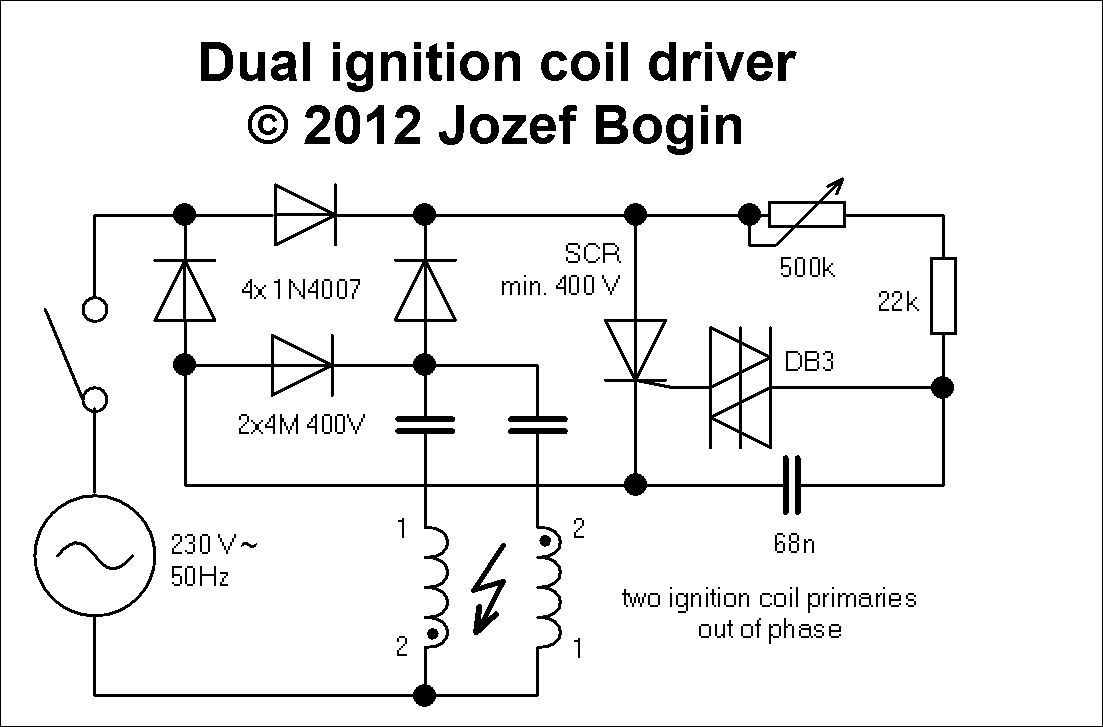
Dual ignition coil driver
In addition to flyback transformers and microwave oven transformers (MOTs), automotive ignition coils are frequently utilized as high voltage sources by various enthusiasts. This is particularly true for the classic cylindrical ignition coils used in carbureted engines prior to 1990,...

2003 gmc savana instrument cluster illumination lights
The 2003 GMC Savana has issues with the illumination lights for the instrument cluster and climate control cluster, which are not functioning. Diagnostic lights for the cluster are operational and illuminate upon ignition startup. The radio lights are functioning and...

DIY Homemade Ignition Coil Driver
One of the simplest methods to create a battery-powered high-voltage power supply is by utilizing a common car ignition coil. Ignition coils function as a type of induction transformer, inspired by the Tesla Coil invented by Nikola Tesla in 1891....