


car brake light or headlight flasher
#car lights
#flasher circuit
#12V lamps
#vehicle electronics
#brake light
#headlight
#flashing circuit
#automotive lighting
#power control
#LED driver

Description: The schematic presented here can be utilized as a circuit for a car brake light or headlight flasher, designed to flash two 10-watt, 12-volt lamps in a car or any vehicle.
This circuit employs a simple flashing mechanism suitable for automotive applications. The primary components include a timer IC (such as the 555 timer), which is configured in astable mode to generate a square wave output, effectively controlling the on-off cycling of the lamps.
The circuit is powered by the vehicle's 12-volt power supply, ensuring compatibility with standard automotive electrical systems. The two 10-watt lamps are connected in parallel to the output of the timer, allowing them to flash simultaneously.
To achieve the desired flashing effect, the frequency and duty cycle of the timer can be adjusted by changing the resistor and capacitor values connected to the timing pins of the IC. A typical configuration might use a capacitor in the range of microfarads and resistors in the kilo-ohm range to set a suitable flashing rate, which can be visually appealing and effective for signaling.
In addition to the timer, a transistor may be included in the circuit to handle the current required by the lamps, ensuring that the timer IC operates within its safe limits. A diode can also be integrated to protect against back EMF generated by the inductive load when the lamps are turned off.
Overall, this schematic provides an efficient and straightforward solution for enhancing vehicle safety through improved visibility of brake lights or headlights, making it a valuable addition to automotive lighting systems.The schematic shown here can be used as a circuit for Car brake light or headlight flasher for flashing two 10 watt 12 volt lamps in car or any vehicle. ..
This circuit employs a simple flashing mechanism suitable for automotive applications. The primary components include a timer IC (such as the 555 timer), which is configured in astable mode to generate a square wave output, effectively controlling the on-off cycling of the lamps.
The circuit is powered by the vehicle's 12-volt power supply, ensuring compatibility with standard automotive electrical systems. The two 10-watt lamps are connected in parallel to the output of the timer, allowing them to flash simultaneously.
To achieve the desired flashing effect, the frequency and duty cycle of the timer can be adjusted by changing the resistor and capacitor values connected to the timing pins of the IC. A typical configuration might use a capacitor in the range of microfarads and resistors in the kilo-ohm range to set a suitable flashing rate, which can be visually appealing and effective for signaling.
In addition to the timer, a transistor may be included in the circuit to handle the current required by the lamps, ensuring that the timer IC operates within its safe limits. A diode can also be integrated to protect against back EMF generated by the inductive load when the lamps are turned off.
Overall, this schematic provides an efficient and straightforward solution for enhancing vehicle safety through improved visibility of brake lights or headlights, making it a valuable addition to automotive lighting systems.The schematic shown here can be used as a circuit for Car brake light or headlight flasher for flashing two 10 watt 12 volt lamps in car or any vehicle. ..

Diode feedback comparator
This circuit can drive an LED display with constant current, independent of significant changes in power supply voltage. It can operate with a power supply range of at least 4V to 30V. With 10M resistances for R2 and R3 and...

In-Car lights delay circuit
This circuit gradually switches the internal lights of a car on and off. The delay time can be adjusted by changing the values of the 10k and 4.7M resistors, as well as the capacitor.
The circuit operates by utilizing a timing...

Discrete High Current Switch Mode LED Driver
This is a discrete high-current switch-mode LED driver circuit. The fundamental principle of this circuit is based on the buck-converter topology. The efficiency of this circuit is 80%.
The discrete high-current switch-mode LED driver circuit utilizes a buck converter configuration to...

Car Lights Monitor
This circuit is designed for monitoring automotive lighting. Two specialized integrated circuits (ICs) from Telefunken are used to measure the current through a light bulb. Detecting whether current flows through a bulb is an effective method to determine its operational...

Buck-Based LED Drivers
The first switching LED driver to be examined is the buck converter. The buck converter is the simplest type of switching driver and serves as a step-down converter for applications where the load voltage is typically no more than approximately...

MAX7316 white LED driver circuit diagram
The main technical characteristics of the MAX7316 include a 400 kbps, 2-wire serial interface with a voltage tolerance of 5.5V. The operating voltage ranges from 2V to 3.6V. It features 8-bit PWM control for white LED brightness, with global brightness...

Automatic Headlight Brightness Switch
This straightforward circuit can be integrated into a headlight switch to enable automatic switching between high and low beam headlights when there is oncoming traffic. It is a simple electronics project accompanied by a circuit diagram.
The circuit operates by utilizing...

Buck-Boost High Power White LED Driver
The LTC3453 is a synchronous buck-boost DC/DC converter optimized for driving up to 4 white LEDs at a combined current of up to 500mA from a single Li-Ion battery input. The regulator operates in either synchronous buck, synchronous boost, or...
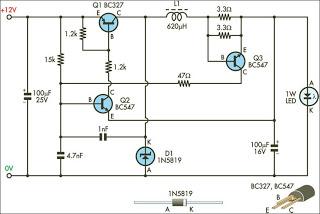
1W LED Driver
This circuit is designed to drive 1W LEDs that are commonly available. It addresses their non-linear voltage-to-current relationship and variations in forward voltage.
The circuit utilizes a constant current driver configuration to ensure that the LEDs operate efficiently while maintaining their...