


Three lighting sound and light control switch circuits
#voice control
#555 timer
#delay circuit
#bistable multivibrator
#inverting amplifier
#sound control
#light control
#SK-type IC
#switch circuit
#integrated circuit

Description: This circuit utilizes a dedicated voice integrated circuit (AI) of the SK type, which incorporates an internal bistable multivibrator and three inverting amplifiers. The 555 integrated circuit (IC) A2 is employed for delay control.
The described circuit is designed to process and reproduce voice signals using a dedicated voice IC, specifically the SK type. This integrated circuit is engineered to handle voice synthesis and playback, making it suitable for applications such as greeting cards, toys, or automated messaging systems.
The internal structure of the SK voice IC includes a bistable multivibrator, which allows the circuit to maintain one of two stable states. This feature is crucial for triggering the playback of voice messages based on external inputs, such as a push button or a motion sensor. The three inverting amplifiers serve to amplify the voice signal, ensuring that the output is loud enough for clear playback. This amplification is essential in applications where the voice needs to be heard over background noise or in larger spaces.
The 555 timer IC, designated as A2 in this circuit, is configured to provide a delay control function. This allows the circuit to introduce a time delay before the voice playback begins, which can be useful in various applications where a pause is desired before the message is triggered. The 555 timer can be configured in monostable mode, where it produces a single output pulse of a specified duration in response to an external trigger, or in astable mode for continuous operation.
In summary, this circuit combines a dedicated voice IC with a bistable multivibrator and amplifiers, along with a 555 timer for delay control, to create an effective voice playback system. The design allows for versatility in triggering and amplifying voice messages, making it suitable for a range of electronic applications.This circuit uses a dedicated voice integrated circuits Ai (SK- type), its internal features bistable multivibrator and three inverting amplifier. 555 IC A2 for the delay control.
The described circuit is designed to process and reproduce voice signals using a dedicated voice IC, specifically the SK type. This integrated circuit is engineered to handle voice synthesis and playback, making it suitable for applications such as greeting cards, toys, or automated messaging systems.
The internal structure of the SK voice IC includes a bistable multivibrator, which allows the circuit to maintain one of two stable states. This feature is crucial for triggering the playback of voice messages based on external inputs, such as a push button or a motion sensor. The three inverting amplifiers serve to amplify the voice signal, ensuring that the output is loud enough for clear playback. This amplification is essential in applications where the voice needs to be heard over background noise or in larger spaces.
The 555 timer IC, designated as A2 in this circuit, is configured to provide a delay control function. This allows the circuit to introduce a time delay before the voice playback begins, which can be useful in various applications where a pause is desired before the message is triggered. The 555 timer can be configured in monostable mode, where it produces a single output pulse of a specified duration in response to an external trigger, or in astable mode for continuous operation.
In summary, this circuit combines a dedicated voice IC with a bistable multivibrator and amplifiers, along with a 555 timer for delay control, to create an effective voice playback system. The design allows for versatility in triggering and amplifying voice messages, making it suitable for a range of electronic applications.This circuit uses a dedicated voice integrated circuits Ai (SK- type), its internal features bistable multivibrator and three inverting amplifier. 555 IC A2 for the delay control.

Mosquito-repelling circuit
In the 555 oscillator circuit, adjusting R2 will provide output frequencies ranging from below 200 Hz to above 62 kHz. It is recommended to use a good quality miniature speaker to produce frequencies around 20 kHz.
The 555 oscillator circuit operates...
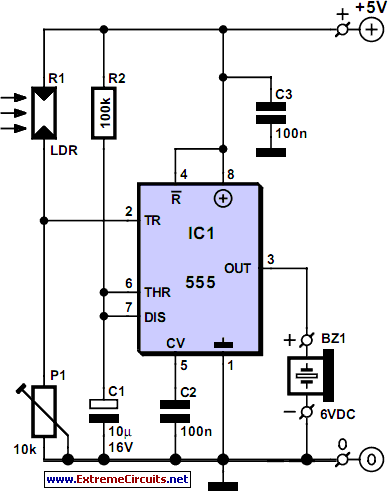
darkness activated alarm
Most darkness-activated alarms utilize operational amplifiers and various logic integrated circuits. This design presents a more cost-effective solution using the timeless 555 timer configured in monostable multivibrator mode. Components R2 and C1 form a timing network that produces a one-second...

Circuit Delay and Speakers Protektor Using TL071
The circuit-delay relay for speakers serves as a delay mechanism that prevents the immediate activation of speakers when the amplifier is powered on. This feature is designed to protect the speakers from potential damage caused by sudden power surges. The...

Monostable 555 Multivibrator Working Principle and Circuit diagram with Animation
The monostable 555 timer multivibrator circuit, also known as a one-shot monostable multivibrator, functions as a retriggerable pulse generator. The term "monostable" indicates that the circuit has only one stable state, with the unstable state referred to as the "quasi-stable...

Water Activated Alarm
The circuit utilizes a 555 timer configured as an astable oscillator, powered by the emitter current of a BC109C transistor. In dry conditions, the transistor remains off due to the absence of bias current. However, when the probes come into...

555 monostable circuit trigger solenoid
A circuit is being designed to trigger solenoid valves for airbags in a car, requiring a time range of 0 to 1 second. The selected valves operate at 12V, 0.5A, and can activate within a maximum speed of 200 milliseconds....

bistable multivibrator using ic 555
By applying a "LOW" signal to the Trigger input (pin 2) while the switch is in the Set position, the output state changes to "HIGH". Conversely, applying a "LOW" signal to the Reset input (pin 4) while the switch is...

555 tri-state acousto-optical logic circuit
The circuit utilizes a 555 timer along with resistors R4, R5, and capacitor C1 configured in a controllable multivibrator mode. This setup forces the reset terminal (pin 4) to a specific state, allowing for control of the external logic level...

555 audio oscillator
An oscilloscope is useful for analyzing the waveforms produced by this circuit, although it is not essential. An audio detector serves as a valuable piece of test equipment for this experiment, particularly if an oscilloscope is unavailable. The "555" integrated...