


A Colpitts VCO for Wideband (0.952.15 GHz)
#Colpitts
#VCO
#wideband
#voltage control oscillator
#DBS TV tuners
#broadband
#0.95-2.15 GHz
#high performance
#low-cost

Description: Modern set-top DBS TV tuners require high performance, broadband voltage control oscillator (VCO) designs at a competitive cost. To meet these goals, design engineers are challenged to create high performance, low-cost VCOs.
Broadband voltage control oscillators (VCOs) are vital components in modern digital broadcasting satellite (DBS) television tuners. These devices convert a control voltage into a frequency output, which is essential for tuning to specific channels and ensuring signal clarity. The design of a high-performance VCO involves several key parameters, including phase noise, tuning range, and power consumption.
A typical VCO circuit may employ a varactor diode, which is a semiconductor device that acts as a voltage-controlled capacitor. The capacitance of the varactor changes with the applied voltage, thus altering the resonant frequency of the oscillator circuit. This can be implemented in various topologies, such as Colpitts or Hartley oscillators, which utilize inductors and capacitors to establish the oscillation frequency.
To achieve broadband performance, careful selection of passive components is critical. Inductors with low DC resistance and capacitors with minimal equivalent series resistance (ESR) help minimize losses and improve the quality factor (Q) of the circuit. Additionally, the use of integrated circuit (IC) technologies can enhance performance while reducing the overall footprint and cost.
Design engineers must also consider the power supply requirements and thermal management of the VCO. High-performance VCOs often require stable power supplies to maintain frequency accuracy and minimize drift. Implementing low-dropout regulators (LDOs) can ensure that voltage levels remain consistent, even with variations in load conditions.
Furthermore, the integration of feedback mechanisms can enhance the stability of the VCO. Techniques such as phase-locked loops (PLLs) can be employed to lock the oscillator frequency to a reference signal, thereby improving frequency stability and reducing phase noise, which is crucial for high-quality signal reception.
In summary, the design of broadband VCOs for DBS TV tuners necessitates a balance between performance, cost, and size. By leveraging advanced semiconductor technologies and optimizing circuit parameters, engineers can develop VCOs that meet the stringent requirements of modern digital broadcasting systems.Modern set-top DBS TV tuners require high performance, broadband voltage control oscillator (VCO) designs at a competitive cost.To meet these goals, design engineers are challenged to create high performance, low-cost VCOs.
Broadband voltage control oscillators (VCOs) are vital components in modern digital broadcasting satellite (DBS) television tuners. These devices convert a control voltage into a frequency output, which is essential for tuning to specific channels and ensuring signal clarity. The design of a high-performance VCO involves several key parameters, including phase noise, tuning range, and power consumption.
A typical VCO circuit may employ a varactor diode, which is a semiconductor device that acts as a voltage-controlled capacitor. The capacitance of the varactor changes with the applied voltage, thus altering the resonant frequency of the oscillator circuit. This can be implemented in various topologies, such as Colpitts or Hartley oscillators, which utilize inductors and capacitors to establish the oscillation frequency.
To achieve broadband performance, careful selection of passive components is critical. Inductors with low DC resistance and capacitors with minimal equivalent series resistance (ESR) help minimize losses and improve the quality factor (Q) of the circuit. Additionally, the use of integrated circuit (IC) technologies can enhance performance while reducing the overall footprint and cost.
Design engineers must also consider the power supply requirements and thermal management of the VCO. High-performance VCOs often require stable power supplies to maintain frequency accuracy and minimize drift. Implementing low-dropout regulators (LDOs) can ensure that voltage levels remain consistent, even with variations in load conditions.
Furthermore, the integration of feedback mechanisms can enhance the stability of the VCO. Techniques such as phase-locked loops (PLLs) can be employed to lock the oscillator frequency to a reference signal, thereby improving frequency stability and reducing phase noise, which is crucial for high-quality signal reception.
In summary, the design of broadband VCOs for DBS TV tuners necessitates a balance between performance, cost, and size. By leveraging advanced semiconductor technologies and optimizing circuit parameters, engineers can develop VCOs that meet the stringent requirements of modern digital broadcasting systems.Modern set-top DBS TV tuners require high performance, broadband voltage control oscillator (VCO) designs at a competitive cost.To meet these goals, design engineers are challenged to create high performance, low-cost VCOs.

VCO circuit
The fundamental principle of the theremin is the heterodyne oscillator. In the development of the Open Theremin, a stable and reliable oscillator was essential. Various schematics featuring different components were researched and constructed on small boards, which were then connected...
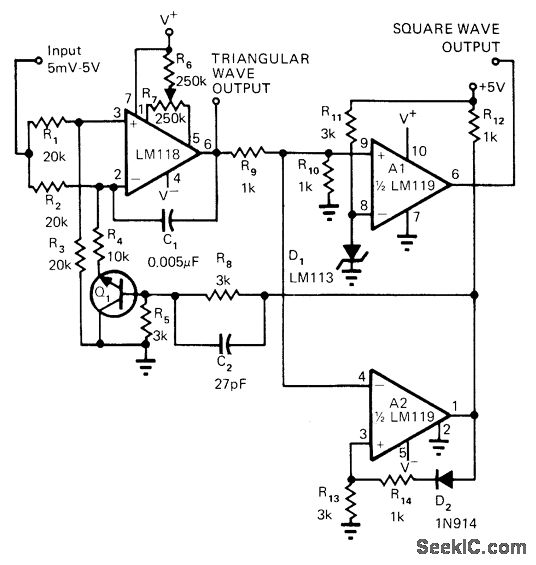
SQUARE TRIANGLE VCO
This circuit utilizes a DC control voltage ranging from 5 mV to 5 V to regulate the frequency of both square and triangle wave outputs, exhibiting good linearity. The peak value of the triangle output is accurately established at 2.44...

Wideband noise generator
This circuit generates wideband RF noise utilizing a reverse-biased diode, featuring a low-impedance output. It can be employed to align receivers for optimal performance.
The circuit primarily consists of a reverse-biased diode, which serves as the core component for generating RF...

40 MHz Wideband RF Amplifier
A wideband transmission or communication channel consists of a broader bandwidth than a single voice channel, utilizing a carrier wave of a specific modulated frequency. This allows for the transmission of more information than narrowband systems, but less than broadband...

Vco Circuit Circuit
The output frequency of this simple, low-cost active voltage-controlled oscillator circuit is based on the inherent frequency-dependent characteristics of an operational amplifier. The oscillator circuit utilizes a TL082 op-amp. Upon application of power, the circuit generates a sinusoidal wave. The...

Tracking Advances in VCO Technology
This document tracks the history of voltage-controlled oscillators (VCOs) since around 1910 and provides examples of VCO integration in RF integrated circuits (ICs).
Voltage-controlled oscillators (VCOs) are critical components in various electronic systems, particularly in radio frequency (RF) applications. A VCO...

Voltage Controlled Oscillator with Varactor
This is a Voltage Controlled Oscillator (VCO) circuit. This circuit is based on a Hartley oscillator. The frequency depends on the values of C1 and L1.
The Voltage Controlled Oscillator (VCO) circuit described operates using a Hartley oscillator configuration, which is...

Colpitts 1 To 20Mhz Crystal Oscillator
This is a simple Colpitts crystal oscillator for 1 to 20 MHz, which can be easily constructed from spare parts, provided that a crystal is available.
The Colpitts oscillator is a type of electronic oscillator that utilizes a combination of capacitors...

Wideband-instrumentation-amplifier
The circuit features an input resistance of 1 MΩ, a bandwidth extending from DC to approximately 35 MHz, and a gain of 10 times. Low-frequency gain is achieved using a CA3130 BiMOS operational amplifier configured as a single-supply amplifier. High-frequency...