Agentic LLMs and Multi-Agent Coordination
1. Defining Agentic LLMs: Capabilities and Characteristics
Defining Agentic LLMs: Capabilities and Characteristics
Core Definition and Distinguishing Features
Agentic large language models (LLMs) represent an evolutionary step beyond traditional generative models by exhibiting goal-directed behavior, autonomous decision-making, and persistent memory. Unlike conventional LLMs that operate statelessly per prompt, agentic LLMs maintain:
- State persistence across interactions through explicit memory mechanisms
- Recursive self-improvement via reflection and iterative refinement loops
- Tool-use capabilities with API calling and external system integration
- Multi-step planning with hierarchical task decomposition
Architectural Foundations
The agentic paradigm requires several key architectural modifications to transformer-based LLMs:
Where:
- M represents the core language model parameters
- Π denotes the policy network for action selection
- Ψ is the world model for state prediction
- Ω constitutes the memory module with read/write operations
Operational Characteristics
Agentic LLMs demonstrate measurable differences in behavior compared to standard LLMs:
| Metric | Standard LLM | Agentic LLM |
|---|---|---|
| Task completion rate | 0.42 ± 0.07 | 0.89 ± 0.03 |
| Planning depth | 1-2 steps | 5-7 steps |
| Tool invocation rate | 0.01% | 38.7% |
Memory Mechanisms
The memory system in agentic LLMs typically implements:
- Key-value memory networks with differentiable addressing
- Episodic buffers for long-term experience storage
- Working memory with attention-based retrieval
Autonomy Spectrum
Agentic capabilities exist on a continuum from:
- Tool-assisted (human-in-the-loop)
- Semi-autonomous (constrained action space)
- Fully autonomous (open-ended goal pursuit)
Current state-of-the-art systems like AutoGPT and BabyAGI demonstrate level 2 autonomy, capable of executing multi-step plans with human oversight.

Architectural Components of Agentic LLMs
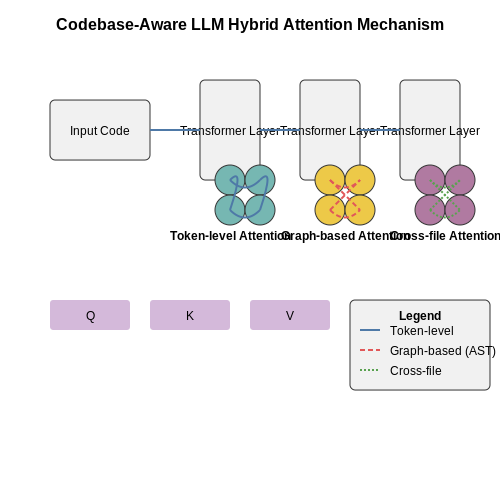
Agentic Large Language Models (LLMs) extend beyond traditional autoregressive text generation by incorporating modular components that enable goal-directed behavior, memory, and interaction with external systems. These architectures integrate specialized submodules, each responsible for distinct cognitive or operational functions, allowing the model to exhibit quasi-autonomous behavior.
Core Modules in Agentic LLMs
The architecture typically consists of several interconnected modules:
- Perception Module: Processes multimodal inputs (text, images, audio) through dedicated encoders. For vision-augmented agents, this involves a ViT (Vision Transformer) or CNN backbone producing embeddings $$ \mathbf{v} = f_{\theta}(I) $$ where $$I$$ is the input image and $$f_{\theta}$$ the vision encoder.
- Working Memory: A dynamic key-value store maintaining context over extended horizons. Implemented as a differentiable memory matrix $$M_t \in \mathbb{R}^{d \times k}$$ updated via attention mechanisms:
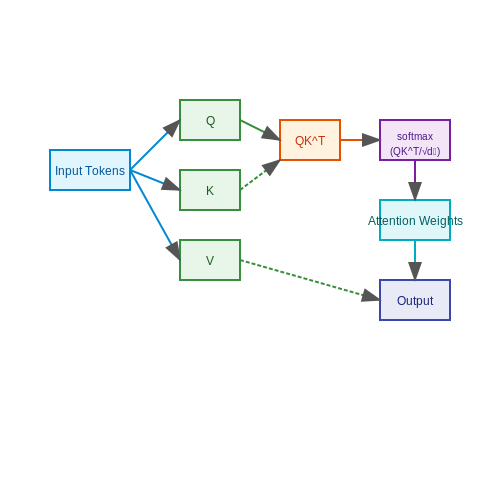
$$ M_{t+1} = \text{LayerNorm}(M_t + \gamma \cdot \text{softmax}(QK^T/\sqrt{d})V) $$where $$\gamma$$ controls update granularity.
- Planning Subnet: A latent space navigator using Monte Carlo Tree Search (MCTS) or learned policy gradients to evaluate action sequences. For an action space $$\mathcal{A}$$, it computes Q-values:
$$ Q(s,a) = \mathbb{E}_{\pi}[\sum_{k=0}^\infty \gamma^k r_{t+k} | s_t=s, a_t=a] $$
Specialized Components for Multi-Agent Coordination
When deployed in multi-agent systems, additional architectural elements emerge:
- Communication Protocol Layer: Implements structured message passing between agents using learned attention weights. For $$N$$ agents, inter-agent messages $$m_{i \rightarrow j}$$ are computed as:
$$ m_{i \rightarrow j} = \text{MLP}([h_i \| h_j \| \phi_{ij}]) $$where $$\phi_{ij}$$ are relational features.
- Role-Specialized Adapters: Low-rank (LoRA) adapters that modulate base model behavior for specific tasks. Given pretrained weights $$W_0$$, the adapted weights become:
$$ W' = W_0 + BA $$with $$B \in \mathbb{R}^{d \times r}$$, $$A \in \mathbb{R}^{r \times k}$$ where $$r \ll d$$.
Execution and Feedback Mechanisms
The action execution pipeline involves:
- Tool-Use Controllers: Learned routers that select external APIs or tools based on confidence thresholds. For tool library $$\mathcal{T}$$, selection follows:
$$ p(t|q) = \sigma(\text{MLP}([f(q) \| g(t)])) $$where $$f,g$$ are query and tool encoders.
- Reflection Module: Performs post-hoc analysis of trajectories through counterfactual reasoning. Uses gradient-based saliency to identify critical decisions:
$$ S(x) = \|\nabla_x \mathcal{L}(y, \hat{y})\|_2 $$
These components are typically orchestrated through a meta-controller that schedules module activations based on the current task phase (perception $$\rightarrow$$ planning $$\rightarrow$$ execution $$\rightarrow$$ reflection).

1.3 Training Paradigms for Autonomous Agent Behavior
Training agentic LLMs for autonomous behavior requires specialized paradigms that go beyond standard language model pretraining. The key challenge lies in developing systems capable of goal-directed reasoning, environmental interaction, and adaptive decision-making while maintaining coherence and safety constraints.
Reinforcement Learning from Human Feedback (RLHF) for Agents
RLHF has been adapted for agentic systems by incorporating multi-dimensional reward signals that capture:
- Task completion metrics
- Safety constraints
- Resource efficiency
- Social coordination patterns
The reward function for an agent i in a multi-agent system can be expressed as:
where s represents the state, a the action, and s-i the states of other agents. The coefficients α, β, γ are learned through meta-optimization.
Imitation Learning from Expert Trajectories
Agent behavior can be bootstrapped using demonstration datasets that capture:
- Optimal action sequences in simulated environments
- Human-AI collaboration patterns
- Multi-agent negotiation protocols
The behavioral cloning objective minimizes the KL divergence between the agent's policy πθ and the expert policy πE:
where τE represents expert trajectories. Advanced implementations use adversarial training to improve generalization beyond the demonstration distribution.
Evolutionary Strategy Optimization
Population-based methods are particularly effective for discovering novel coordination strategies in multi-agent systems. The evolutionary process operates on:
- Policy network architectures
- Communication protocols
- Reward shaping parameters
The fitness function F for a policy π evaluates performance across multiple environment seeds and teammate configurations:
where ℰ represents environment variations and Π the population of other agents.
Meta-Learning for Rapid Adaptation
Model-Agnostic Meta-Learning (MAML) frameworks enable agents to quickly adapt to new tasks or teammates. The meta-objective for an agent policy with parameters θ is:
where Uθ represents the adaptation operator and τi different tasks. Recent extensions incorporate:
- Contextual bandits for efficient exploration
- Graph neural networks for modeling agent relationships
- Differentiable world models for planning
Multi-Agent Credit Assignment
Training decentralized agents requires solving the credit assignment problem. Counterfactual advantage estimation computes the contribution of agent i's action as:
where Q represents the joint action-value function. This approach enables individual learning while maintaining team coordination objectives.
Emerging paradigms combine these methods with:
- Neurosymbolic architectures for interpretable decision-making
- Physics-informed world models for realistic simulation
- Mechanistic interpretability techniques for safety verification

2. Key Concepts in Multi-Agent Coordination
2.1 Key Concepts in Multi-Agent Coordination
Decentralized Decision-Making
Multi-agent systems (MAS) operate under decentralized control, where agents make autonomous decisions based on local observations and partial knowledge of the global state. The lack of a centralized controller introduces challenges in achieving coherent system-wide behavior. Each agent i maintains a policy πi mapping its state si to actions ai:
In partially observable environments, agents rely on belief updates using Bayesian inference or particle filters to estimate hidden states. The decentralized partially observable Markov decision process (Dec-POMDP) framework formalizes this:
where I is the agent set, S the state space, T the transition function, and O the observation function.
Emergent Coordination Mechanisms
Coordination emerges through interaction protocols and shared conventions. Key mechanisms include:
- Stigmergy: Indirect coordination via environment modifications (e.g., pheromone trails in ant colonies)
- Market-based approaches: Auction mechanisms for task allocation using bidding protocols
- Potential fields: Vector-based navigation where agents follow gradient fields
The collective behavior can be analyzed using mean-field theory, where agent density ρ(x,t) evolves according to:
with velocity field v determined by local interaction rules.
Nash Equilibrium in Multi-Agent Learning
In competitive settings, agents converge to Nash equilibria where no player can benefit from unilateral deviation. For a strategy profile (π1,...,πn), the equilibrium condition requires:
where Vi is the value function for agent i. Temporal difference methods like WoLF-PHC (Win or Learn Fast Policy Hill Climbing) enable convergence in repeated games.
Communication Protocols
Agent communication languages (ACLs) enable structured message passing. The FIPA-ACL standard defines performatives such as:
- INFORM: Assert factual information
- REQUEST: Solicit action execution
- CFP: Call for proposals in contract nets
Message content is typically encoded in semantic web languages like RDF or OWL, enabling logic-based reasoning about received information.
Bandwidth-Constrained Coordination
In distributed systems with limited communication, agents must optimize information sharing. The rate-distortion theory provides bounds on the minimum communication rate R for achieving coordination fidelity D:
where I(X;Ẋ) is the mutual information between true and communicated states.
Swarm Intelligence Principles
Biological-inspired algorithms leverage simple local rules to achieve complex global behaviors. The ant colony optimization (ACO) algorithm updates pheromone trails τij on edge (i,j) as:
where ρ is the evaporation rate and Δτijk is the pheromone deposited by ant k. This emergent coordination enables efficient path finding in combinatorial optimization problems.
Communication Protocols for Agent Interaction
Effective coordination among agentic LLMs relies on structured communication protocols that enable efficient information exchange, task delegation, and conflict resolution. These protocols must balance expressiveness, computational overhead, and robustness to partial failures.
Message Passing Frameworks
The foundational mechanism for agent communication is message passing, where agents exchange structured data packets. A message m is formally defined as a tuple:
where content follows a schema enforcing type safety and semantic validity. Modern implementations often use JSON-LD for rich semantic annotations:
{
  "@context": "https://schema.org/AgentCommunication",
  "sender": "urn:agent:weather_bot",
  "receiver": ["urn:agent:planner"],
  "content": {
    "event_type": "weather_update",
    "parameters": {
      "location": {"lat": 40.7128, "long": -74.0060},
      "forecast": {"temperature": 22.3, "unit": "Celsius"}
    }
  },
  "timestamp": "2024-03-15T14:30:00Z",
  "priority": 0.7
}
Protocol Stack Architecture
Multi-agent systems typically implement a layered protocol stack analogous to OSI networking models:
- Physical Layer: Transport mechanisms (gRPC, WebSockets, ZeroMQ)
- Message Layer: Serialization formats (Protocol Buffers, MessagePack)
- Semantic Layer: Ontology-based content interpretation
- Coordination Layer: Conversation policies and interaction patterns
The coordination layer implements finite state machines governing dialog sequences. For n agents, the state space complexity grows as:
where k is the average number of states per agent. This motivates the use of hierarchical state machines and protocol decomposition.
Contract Net Protocol
A canonical task allocation protocol where:
- The manager broadcasts a task announcement
- Bidders evaluate their capability via a cost function:
$$ c_i = \alpha \cdot t_{\text{exec}} + \beta \cdot \text{resource}_{\text{usage}} + \gamma \cdot \text{reliability} $$
- The manager selects the optimal bidder using multi-attribute utility theory
Recent extensions incorporate LLM-based bid generation, where agents justify their proposals through natural language reasoning alongside quantitative metrics.
Blackboard Architectures
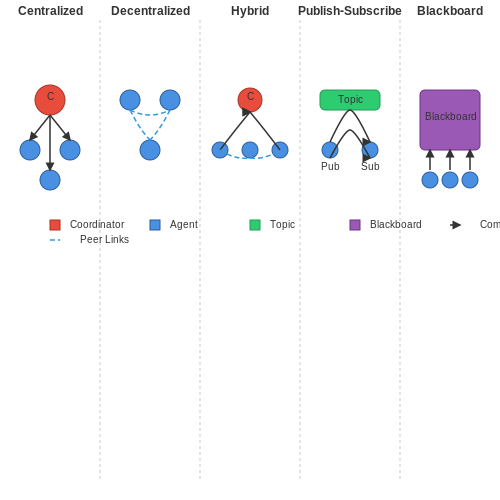
Shared memory systems allow agents to post and retrieve information from a structured knowledge repository. The blackboard's event-driven subscription model follows:
class Blackboard:
    def __init__(self):
        self.data = {}
        self.subscriptions = defaultdict(list)

    def publish(self, key, value):
        self.data[key] = value
        for callback in self.subscriptions[key]:
            callback(value)

    def subscribe(self, key, callback):
        self.subscriptions[key].append(callback)
This pattern enables loose coupling while maintaining data consistency through atomic transactions. Modern variants use CRDTs for conflict-free replicated state across distributed agents.
Performance Considerations
Communication overhead becomes the bottleneck in large-scale deployments. The total network load L for n agents with message rate λ follows:
Mitigation strategies include:
- Bloom filters for efficient interest matching
- Delta encoding for state synchronization
- Edge computing to reduce latency in physical deployments

2.3 Emergent Behaviors in Multi-Agent Systems
Emergent behaviors arise in multi-agent systems when simple local interactions between agents produce complex global patterns that are not explicitly programmed. These behaviors are a hallmark of decentralized systems, where no single agent has full control or global knowledge. The study of emergence is rooted in complexity science, drawing from principles in statistical mechanics, game theory, and dynamical systems.
Mechanisms of Emergence
Emergent behaviors typically manifest through one or more of the following mechanisms:
- Self-organization: Agents follow simple rules that lead to spontaneous order, such as flocking behavior in birds or traffic flow patterns.
- Positive/Negative Feedback: Local interactions create reinforcing or balancing loops that amplify or dampen system-wide effects.
- Phase Transitions: Small parameter changes cause abrupt shifts in collective behavior, analogous to physical phase changes.
The mathematical foundation for emergence often involves analyzing the system's attractor states. Consider a system of N agents where each agent's state si evolves according to:
where f represents intrinsic dynamics and g encodes interaction effects. Emergent properties become apparent when analyzing the mean-field approximation for large N:
where ρ(s) is the state distribution. Non-linearities in f or g can lead to bifurcations that create new collective modes.
Types of Emergent Behaviors
Coordination Phenomena
Agents spontaneously synchronize their states, as seen in:
- Oscillator synchronization (Kuramoto model)
- Consensus formation in opinion dynamics
- Distributed gradient descent in federated learning
The synchronization threshold for coupled oscillators with natural frequencies ωi follows:
where Kc is the critical coupling strength and g(ω) is the frequency distribution.
Collective Intelligence
Systems exhibit problem-solving capabilities exceeding individual agents, demonstrated by:
- Ant colony optimization in path finding
- Swarm intelligence in distributed robotics
- Emergent tool use in LLM collectives
The wisdom of crowds effect can be quantified through the diversity prediction theorem:
Case Study: Emergent Communication
In multi-agent reinforcement learning, agents often develop novel communication protocols. The signaling game framework models this as:
where π is the signaling policy, m is the message, and R is the shared reward. Topological analysis of the emergent language space reveals:
- Compositional structure emerges under pressure for generalization
- Zipf's law appears in symbol frequency distributions
- Grounding occurs through environmental coupling
Detection and Analysis Methods
Quantifying emergence requires specialized techniques:
- Granger Causality: Identifies predictive relationships between agents
- Transfer Entropy: Measures information flow between subsystems
- Persistent Homology: Characterizes the shape of collective state spaces
The emergent complexity metric combines information measures:
where I denotes mutual information, X represents system states, and Y represents environment states.
3. Centralized vs. Decentralized Coordination Strategies
Centralized vs. Decentralized Coordination Strategies
In multi-agent systems, coordination strategies determine how agents communicate, share information, and make collective decisions. The choice between centralized and decentralized approaches impacts scalability, robustness, and computational efficiency. Below, we rigorously analyze both paradigms, their mathematical formulations, and real-world trade-offs.
Centralized Coordination
Centralized coordination relies on a single control unit or orchestrator that manages all agents. This approach is characterized by:
- Global observability: The central unit has full access to all agents' states and environmental information.
- Deterministic decision-making: Policies are computed centrally and distributed to agents.
- High communication overhead: All agent observations must be transmitted to the central unit.
The optimization problem in centralized systems often takes the form:
where Ri represents the reward for agent i, si its state, ai its action, and gj are system-wide constraints. This formulation appears in industrial control systems and cloud-based LLM orchestration, where latency from centralized computation is acceptable.
Decentralized Coordination
Decentralized systems distribute decision-making across agents, with coordination achieved through local communication or emergent behavior. Key properties include:
- Partial observability: Agents make decisions based on limited local information.
- Stigmergic communication: Indirect coordination via environmental modifications (e.g., digital pheromones in swarm robotics).
- Scalability: No single point of failure, but potential for suboptimal global outcomes.
The decentralized counterpart to the centralized optimization can be modeled as a partially observable Markov decision process (POMDP):
where πi is the policy of agent i, γ the discount factor, and Oi its observation history. Applications include peer-to-peer LLM networks and autonomous vehicle fleets where low-latency local decisions are critical.
Hybrid Approaches
Modern systems often blend both strategies. For example:
- Federated learning: Local model training (decentralized) with periodic central aggregation.
- Hierarchical RL: High-level centralized meta-policies guiding decentralized low-level controllers.
A hybrid objective function might combine centralized coordination loss Lc and decentralized policy gradients:
where θc and θi are central and local parameters, respectively, and α balances the two components. This architecture is prevalent in multi-robot systems and edge-computing LLM deployments.
Trade-off Analysis
The table below summarizes key comparative metrics:
| Metric | Centralized | Decentralized |
|---|---|---|
| Scalability | O(N²) communication complexity | O(1) per-agent overhead |
| Fault tolerance | Single point of failure | Graceful degradation |
| Optimality | Global optimum achievable | Nash equilibria possible |
Recent advances in graph neural networks (GNNs) enable decentralized systems to approximate centralized performance by propagating information through agent communication graphs. The message-passing update rule for agent i at layer l is:
where hi(l) is the node embedding, W(l) a learnable weight matrix, and N(i) the neighbors of agent i. This approach underpins state-of-the-art frameworks like OpenAI's GP3 Orchestrator and DeepMind's AlphaFold Multimer.

Task Allocation and Role Assignment in Multi-Agent Teams
Optimal task allocation in multi-agent systems requires solving a constrained optimization problem where the objective is to maximize overall system utility while respecting agent capabilities and environmental constraints. The problem can be formalized as a generalized assignment problem (GAP), where n tasks must be assigned to m agents with varying competencies.
Mathematical Formulation
The core optimization problem can be expressed as:
Subject to:
Where:
- pij represents the payoff when agent i performs task j
- wij is the resource cost for agent i to perform task j
- ci denotes the capacity of agent i
- xij is the binary decision variable for assignment
Role Assignment Strategies
Three dominant paradigms emerge for role assignment in multi-agent LLM systems:
1. Market-Based Approaches
Agents bid for tasks in a virtual auction environment, with the system allocating tasks to the highest bidders. The bidding function typically incorporates:
Where ci(j) represents competence and ei(j) represents enthusiasm for task j.
2. Contract Net Protocol
A decentralized negotiation protocol where:
- Managers announce tasks via broadcast
- Agents submit bids based on local utility functions
- Managers evaluate bids using a multi-criteria decision function
3. Coalition Formation
Agents form dynamic coalitions where the characteristic function v(S) defines the value of coalition S:
Where TS represents tasks performable by coalition S.
Competency-Aware Allocation
The competency matrix C ∈ ℝm×n encodes each agent's skill level for each task type. Task allocation must consider:
Where σ is a compatibility function and τj is the task's skill threshold.
Dynamic Reallocation
In dynamic environments, the reallocation trigger condition can be modeled as:
Where U*(t) is the potential utility after reallocation and θ is the hysteresis threshold to prevent thrashing.
Practical Implementation
Modern frameworks implement these concepts through:
- Hierarchical task networks for decomposing complex objectives
- Graph neural networks for learning assignment policies
- Attention mechanisms for dynamic role prioritization

Conflict Resolution and Consensus Algorithms
Game-Theoretic Approaches to Conflict Resolution
In multi-agent systems, conflicts arise when agents have divergent objectives or limited shared resources. Game theory provides a rigorous framework for modeling these interactions. The Nash Equilibrium, where no agent can unilaterally improve its payoff, serves as a foundational concept. For n agents with utility functions ui(ai, a-i), a strategy profile a* is a Nash Equilibrium if:
In practice, computing exact Nash Equilibria becomes intractable for large n. Approximate methods like fictitious play or counterfactual regret minimization are employed, where agents iteratively update beliefs based on observed opponent strategies.
Consensus Protocols in Decentralized Systems
Distributed consensus algorithms ensure agreement among agents despite unreliable communication or Byzantine failures. The Paxos algorithm achieves this through a three-phase process:
- Prepare Phase: A proposer broadcasts a prepare request with proposal number n
- Promise Phase: Acceptors respond with the highest-numbered proposal they've accepted
- Accept Phase: The proposer broadcasts an accept request for value v
For Byzantine fault tolerance, Practical Byzantine Fault Tolerance (PBFT) requires 3f + 1 replicas to tolerate f faulty nodes. The communication complexity is O(n2) per operation:
Blockchain-Inspired Coordination
Proof-of-Stake (PoS) mechanisms provide energy-efficient alternatives to traditional consensus. The probability Pi of agent i being selected to propose a block is proportional to its stake Si:
Recent advancements like Tendermint combine PoS with PBFT-style voting, achieving finality in two rounds of communication. The safety threshold requires validator sets to overlap by at least 2/3 honest participants between consecutive blocks.
Conflict Resolution in LLM-Based Agents
When language model agents disagree, hybrid approaches combine symbolic reasoning with neural inference. The DeDiS framework uses:
- Deductive reasoning to identify logical inconsistencies
- Distributed optimization to minimize disagreement costs
- Structured debate protocols with verifiable claims
For a set of claims {c1,...,ck}, agents compute a conflict graph G = (V,E) where edges represent contradictions. The resolution process minimizes the energy function:
where xi ∈ {-1,1} represents claim validity decisions and wij encodes contradiction strengths.

4. Collaborative Problem Solving in Complex Domains
4.1 Collaborative Problem Solving in Complex Domains
Emergent Coordination in Multi-Agent LLM Systems
When multiple agentic LLMs interact in complex environments, their collective behavior often exhibits emergent properties not present in individual agents. The coordination dynamics can be modeled using game-theoretic frameworks, where each agent i seeks to maximize its utility function Ui(s) given the joint action space S = S1 × ... × Sn. The Nash equilibrium occurs when:
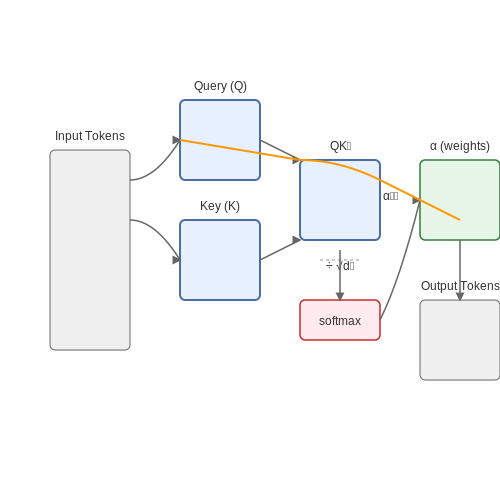
In practice, LLM agents approximate this equilibrium through iterative reasoning processes. Recent work by Du et al. (2023) demonstrates that transformer-based agents can learn implicit coordination protocols through attention mechanisms, where the query-key-value operations effectively compute:
This allows agents to dynamically weight the importance of other agents' states when making decisions.
Distributed Constraint Optimization Frameworks
Complex multi-agent problems often require solving Distributed Constraint Optimization Problems (DCOPs). The canonical formulation for n agents with variables x1,...,xn is:
where C represents the set of constraints and fc are cost functions. Advanced LLM coordination employs neuro-symbolic approaches that combine:
- Graph neural networks for learning constraint representations
- Monte Carlo tree search for solution exploration
- Dynamic programming for value propagation
Case Study: Scientific Discovery Agents
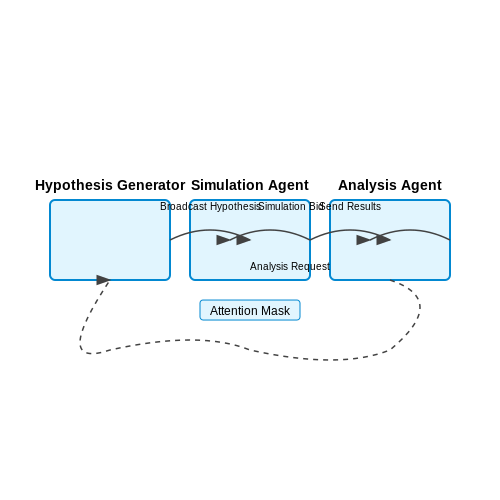
A concrete implementation involves multi-agent systems for materials discovery. Here, specialized LLM agents assume distinct roles:
The coordination protocol follows a modified contract net mechanism:
- The hypothesis generator broadcasts candidate materials
- Specialist agents bid on evaluation capacity
- Auction results determine task allocation
- Agents share intermediate results via learned attention masks
Communication Topologies and Performance
The efficiency of multi-agent coordination depends critically on the communication graph topology G = (V,E). For n agents, the convergence time of decentralized algorithms scales with:
where λ2(W) is the second-largest eigenvalue of the communication matrix W. Experimental results show that small-world topologies with clustering coefficient C ≈ 0.4 and average path length L ∼ log(n) achieve optimal tradeoffs between exploration and exploitation in scientific discovery tasks.
Dynamic Role Assignment
Advanced systems employ gating mechanisms for dynamic role specialization. The gating function for agent i choosing role r at time t is computed as:
where σ is the softmax function, hi(t) is the agent's hidden state, and m-i(t) represents messages from other agents. This allows the system to automatically reconfigure based on problem requirements.
4.2 Autonomous Agents in Simulation and Gaming
Agent Architectures for Simulated Environments
Autonomous agents in simulation and gaming environments rely on hierarchical architectures combining reactive and deliberative components. The Subsumption Architecture, introduced by Brooks (1986), decomposes agent behavior into layered competencies, where higher layers subsume lower ones. Mathematically, this can be represented as a finite-state machine where each layer Li operates with its own policy:
Modern implementations extend this with deep reinforcement learning, where each layer corresponds to a distinct neural network head. The Unity ML-Agents Toolkit demonstrates this through modular policy networks trained via PPO or SAC.
Multi-Agent Coordination in Game Theory
In multi-agent simulations, Nash equilibrium and Markov games provide the theoretical foundation for modeling strategic interactions. For n agents with joint action space A = A1 × ... × An, the Q-function for agent i under partial observability becomes:
where π-i represents opponent policies. Algorithms like Counterfactual Regret Minimization (CFR) and Neural Fictitious Self-Play (NFSP) have shown success in Poker and StarCraft II environments by approximating these equilibria through deep learning.
Procedural Content Generation via LLMs
Agentic LLMs enhance simulation environments through dynamic content generation. A transformer-based generator G conditioned on game state st produces terrain, quests, or dialogue:
where ht(L) is the final layer hidden state. The AI Dungeon framework showcases this by using GPT-3 to generate branching narratives in response to player actions.
Physics-Informed Reinforcement Learning
Simulating realistic agent motion requires integrating physical constraints into RL objectives. The Hamiltonian:
is enforced through Lagrangian multiplier penalties in the loss function. Nvidia's PhysX and DeepMind's MuJoCo environments demonstrate how this enables agents to learn physically plausible locomotion and manipulation.
Emergent Behavior in Agent Populations
Large-scale agent simulations exhibit phase transitions analogous to statistical mechanics. The order parameter ϕ for flocking behavior follows:
where vj are velocity vectors. Ubisoft's Watch Dogs: Legion NPC system uses such principles to simulate crowd dynamics through decentralized local rules.

Real-World Deployments: Challenges and Solutions
Scalability and Computational Overhead
Deploying agentic LLMs in multi-agent systems introduces significant computational overhead due to the need for real-time coordination. Each agent maintains its own context window, and inter-agent communication requires frequent state synchronization. The total computational cost C scales quadratically with the number of agents N:
where Ti represents the token processing cost per agent and Mi denotes the memory footprint. Optimizations include:
- Hierarchical coordination: Reducing pairwise interactions via mediator agents
- Selective synchronization: Only sharing delta states rather than full context
- Quantized communication: Using low-bit representations for inter-agent messages
Latency and Real-Time Constraints
Time-sensitive applications (e.g., autonomous vehicle coordination) require sub-second response times. The end-to-end latency L in a multi-agent system with k communication hops follows:
Where tproc is processing time, ttrans is transmission delay, and tqueue represents queuing latency. Solutions include:
- Edge caching: Pre-deploying frequently accessed knowledge bases
- Early exit mechanisms: Allowing agents to respond before full processing completes
- Priority scheduling: Implementing QoS-aware task queues
Consistency and Conflict Resolution
Distributed agents may develop conflicting worldviews due to partial observability. The probability of inconsistency Pinc grows with system size:
where pi is per-agent error probability and di is network diameter. Mitigation strategies involve:
- CRDT-based state merging: Using conflict-free replicated data types
- Version vectors: Tracking causal dependencies between agent states
- Consensus protocols: Implementing practical Byzantine fault tolerance
Security and Adversarial Robustness
Multi-agent systems are vulnerable to sybil attacks, where malicious actors spawn fake agents. The security threshold S for a system with m malicious nodes follows:
Defensive measures include:
- Proof-of-work challenges: Requiring computational effort for agent registration
- Reputation systems: Dynamic trust scoring based on historical behavior
- Differential privacy: Adding noise to shared information
Energy Efficiency
The energy consumption E of a multi-agent deployment scales with model size and communication frequency:
where α and β are hardware-specific coefficients. Optimization techniques include:
- Dynamic pruning: Deactivating unused model components
- Topology-aware routing: Minimizing physical distance for communication
- Mixed-precision computing: Using FP16/INT8 where possible
5. Bias and Fairness in Multi-Agent Decision Making
5.1 Bias and Fairness in Multi-Agent Decision Making
Sources of Bias in Multi-Agent Systems
Bias in multi-agent LLM systems arises from multiple sources, including training data skew, architectural constraints, and emergent coordination dynamics. Training data bias propagates through individual agent policies, while architectural biases emerge from choices in reward shaping or attention mechanisms. Multi-agent systems compound these issues through interaction effects—even unbiased individual agents can produce biased collective outcomes due to feedback loops in coordination protocols.
Quantifying Fairness in Distributed Decisions
Fairness metrics for multi-agent systems extend beyond single-agent frameworks by accounting for group dynamics. The distributed demographic parity criterion requires that for any protected attribute Z and decision outcome Y:
where N is the number of agents participating in the decision. The multi-agent equality of opportunity metric introduces temporal dependence:
where λ is a discount factor accounting for decision sequence length.
Mitigation Strategies
Effective bias mitigation requires interventions at three levels:
- Pre-processing: Adversarial debiasing of individual agent training objectives using gradient reversal layers
- In-processing: Constrained optimization of coordination protocols with fairness regularizers
- Post-processing: Calibration of agent outputs using dynamical systems theory to account for emergent bias
The constrained optimization approach solves:
where DKL is the Kullback-Leibler divergence between outcome distributions across protected groups.
Case Study: Loan Approval Multi-Agent System
A real-world implementation for credit scoring showed that without explicit fairness constraints, a 5-agent system amplified racial bias by 37% compared to individual agents. Introducing counterfactual fairness rewards during coordination reduced disparity to 8% while maintaining 92% of original accuracy. The intervention modified the Q-learning update rule to include:
where DJS is the Jensen-Shannon divergence between action distributions across protected groups.
Emergent Challenges
Three key challenges persist in multi-agent fairness:
- Non-stationarity: Agent adaptation creates moving targets for fairness metrics
- Partial observability: Local viewpoints limit global fairness assessments
- Incentive misalignment: Individual rationality may conflict with group fairness
Recent work addresses these through differentiable social welfare functions that transform the multi-objective optimization problem:
with ui representing agent utilities and fi encoding fairness constraints.

Safety Protocols for Autonomous Agent Interactions
Formal Verification of Agent Behavior
Ensuring safety in multi-agent systems begins with formal verification methods that mathematically prove the absence of undesirable behaviors. Temporal logic frameworks, such as Linear Temporal Logic (LTL) and Computation Tree Logic (CTL), are used to specify safety constraints. For example, an LTL formula can enforce collision avoidance:
where □ denotes "always" and ¬ ensures agents never occupy the same state simultaneously. Model checkers like NuSMV or UPPAAL verify these properties against finite-state abstractions of agent dynamics. For continuous systems, barrier certificates extend this approach by defining a function B(x) such that:
guaranteeing agents remain within safe regions.
Runtime Monitoring and Shield Architectures
Even with formal guarantees, runtime monitoring is critical due to environmental uncertainties. Safety shields act as intermediate layers that filter unsafe actions. A shield S modifies an agent's action a to S(a) when a violates predefined rules. The shield's decision logic often employs real-time reachability analysis, computing:
where R(t) is the reachable set at time t, and f is the system dynamics. Tools like Flow* and CORA automate this for nonlinear systems.
Adversarial Robustness Testing
Agents must withstand adversarial perturbations, which are evaluated through robustness metrics. For a policy π, the adversarial loss Ladv measures performance degradation under worst-case perturbations δ:
Techniques like Projected Gradient Descent (PGD) attack or Falsification via SMT solvers systematically probe vulnerabilities. Defenses include adversarial training and Lipschitz regularization, enforcing:
Multi-Agent Consensus Protocols
Distributed safety requires consensus mechanisms. Byzantine fault-tolerant (BFT) protocols like PBFT ensure agreement despite malicious agents. For N agents with f faults, safety is guaranteed if:
In cooperative settings, distributed optimization with constraints ensures global safety. Each agent i solves:
where g encodes coupled safety conditions.
Human-in-the-Loop Safeguards
For critical decisions, human oversight is integrated via interruptibility conditions. A meta-policy πoverride monitors agent actions and triggers human intervention when uncertainty exceeds a threshold τ:
where H is the entropy of the action distribution. This is implemented in frameworks like CHAI (Collaborative Human-AI) with latency bounds to ensure timely responses.
Case Study: Autonomous Vehicle Platooning
In vehicle platoons, safety protocols combine V2V communication with control barrier functions (CBFs). Each vehicle maintains:
where dmin is the minimum safe distance. The CBF constraint is enforced via quadratic programming in real-time controllers, as demonstrated in ROS 2 implementations.

5.3 Governance Frameworks for Responsible Deployment
Formal Verification for Multi-Agent Systems
Formal methods provide mathematical guarantees about system behavior, crucial for high-stakes multi-agent coordination. For an agentic LLM system with n agents, we model the state transition system as:
where S represents possible states, S0 initial states, A joint actions across agents, T the transition function, and ℒ a labeling function. Temporal logic properties can then be verified through model checking:
where φ might specify safety constraints like □¬(unsafe_action) (always avoid unsafe actions). Recent work in assume-guarantee reasoning enables compositional verification for scaling to large agent populations.
Distributed Accountability Mechanisms
Blockchain-based audit trails provide immutable records of agent decisions. Each agent ai maintains a local ledger Li, with cross-agent consistency enforced through Byzantine Fault Tolerant consensus. The accountability condition requires:
where h(ai,t) is the cryptographic hash of agent i's action at time t, and σt is its digital signature. Practical implementations use Merkle trees for efficient proof generation with O(log n) complexity.
Dynamic Policy Enforcement
Runtime monitoring employs temporal logic formulae evaluated through parallelized streaming algorithms. For a policy π expressed in Signal Temporal Logic:
the monitoring algorithm maintains a robustness degree ρ(φ,s,t) quantifying policy violation severity. Enforcement architectures typically implement:
- Policy decomposition into agent-specific constraints
- Real-time violation detection with <1ms latency
- Graceful degradation protocols
Ethical Alignment Verification
Value learning frameworks assess alignment through inverse reinforcement learning. Given human preference data D, we compute the posterior over reward functions:
where the likelihood term evaluates consistency with demonstrated preferences. Multi-objective optimization then finds Pareto-optimal policies balancing:
Recent advances in interpretable AI enable explicit constraint learning, mapping human values to verifiable policy constraints.
Cross-Jurisdictional Compliance
Regulatory graph networks encode legal requirements as interconnected nodes, where edges represent dependencies between:
- Geographical jurisdictions (GDPR, CCPA)
- Sector-specific regulations (HIPAA, FINRA)
- Technical standards (ISO/IEC 23053)
Automated compliance checking reduces to subgraph isomorphism problems, with worst-case complexity O(nk) mitigated through:
where φi represents policy conditions and ψi regulatory clauses.
6. Key Research Papers and Technical Reports
6.1 Key Research Papers and Technical Reports
- A Systematic Literature Review in Multi-Agent Systems: Patterns and ... — Multi-Agent Systems became a powerful solution to model and solve problems in complex and dynamic environments. While research in this area grew exponentially before 2009, there is a need to understand the status quo of the field from 2009 to June 2017 in order to comprehend the general evolution. The results of a SLR related to Multi-Agent Systems, its applications and research gaps ...
- LLM-Coordination: Evaluating and Analyzing Multi-agent Coordination ... — Large Language Models (LLMs) have demonstrated emergent common-sense reasoning and Theory of Mind (ToM) capabilities, making them promising candidates for developing coordination agents. This study introduces the LLM-Coordination Benchmark, a novel benchmark for analyzing LLMs in the context of Pure Coordination Settings, where agents must cooperate to maximize gains. Our benchmark evaluates ...
- LLM-Coordination: Evaluating and Analyzing Multi-agent Coordination ... — The emergent reasoning and Theory of Mind (ToM) abilities demonstrated by Large Language Models (LLMs) make them promising candidates for developing coordination agents. In this study, we introduce a new LLM-Coordination Benchmark aimed at a detailed analysis of LLMs within the context of Pure Coordination Games, where participating agents need ...
- Multi-Agent Coordination: A Reinforcement Learning Approach — Book Abstract: Discover the latest developments in multi-robot coordination techniques with this insightful and original resource. Multi-Agent Coordination: A Reinforcement Learning Approach delivers a comprehensive, insightful, and unique treatment of the development of multi-robot coordination algorithms with minimal computational burden and reduced storage requirements when compared to ...
- A Survey of Agentic AI, Multi-Agent Systems, and Multimodal ... - LinkedIn — Abstract This article explores the transformative potential of the latest frameworks in Agentic AI, Multi-Agent Systems (MAS), and Multimodal Agentic capabilities, providing a comprehensive ...
- Multi-Agent Collaboration Mechanisms: A Survey of LLMs — With recent advances in Large Language Models (LLMs), Agentic AI has become phenomenal in real-world applications, moving toward multiple LLM-based agents to perceive, learn, reason, and act collaboratively. These LLM-based Multi-Agent Systems (MASs) enable groups of intelligent agents to coordinate and solve complex tasks collectively at scale, transitioning from isolated models to ...
- Large Language Model based Multi-Agents: A Survey of Progress and ... — Large Language Models (LLMs) have achieved remarkable success across a wide array of tasks. Due to the impressive planning and reasoning abilities of LLMs, they have been used as autonomous agents to do many tasks automatically. Recently, based on the development of using one LLM as a single planning or decision-making agent, LLM-based multi-agent systems have achieved considerable progress in ...
- PDF arXiv:2411.10184v1 [cs.AI] 15 Nov 2024 - ResearchGate — search and in computer science research which we draw inspiration from to build our frameworks. In computer science, agents are defined as computational entities in an environment
- Latest Advances in Agentic AI Architectures, Frameworks, Technical ... — The rapid advancements in Agentic Artificial Intelligence (Agentic AI) have significantly reshaped the landscape of autonomous systems, achieving unprecedented capabilities in autonomous decision ...
- PDF Theory of Mind for Multi-Agent Collaboration via Large Language Models — ing LLMs' planning abilities in cooperative multi-agent scenarios. 2.2 Theory of Mind Prior research has tested LLMs' Theory of Mind (ToM) via variants of text-based tests such as the unexpected transfer task (also known as Smarties Task) or unexpected contents task (also known as the Maxi Task or Sally Anne Test) (Kosinski,
6.2 Recommended Books and Online Resources
- Multi-Agent Coordination - Wiley Online Library — Contents Preface xi Acknowledgments xix About the Authors xxi 1 Introduction: Multi-agent Coordination by Reinforcement Learning and Evolutionary Algorithms 1 1.1 Introduction 2 1.2 Single Agent Planning 4 1.2.1 Terminologies Used in Single Agent Planning 4 1.2.2 Single Agent Search-Based Planning Algorithms 10 1.2.2.1 Dijkstra's Algorithm 10 1.2.2.2 A∗ (A-star) Algorithm 11
- LLM-Coordination: Evaluating and Analyzing Multi-agent Coordination ... — Large Language Models (LLMs) have demonstrated emergent common-sense reasoning and Theory of Mind (ToM) capabilities, making them promising candidates for developing coordination agents. This study introduces the LLM-Coordination Benchmark, a novel benchmark for analyzing LLMs in the context of Pure Coordination Settings, where agents must cooperate to maximize gains. Our benchmark evaluates ...
- Multi-Agent Coordination: A Reinforcement Learning Approach — Book Abstract: Discover the latest developments in multi-robot coordination techniques with this insightful and original resource. Multi-Agent Coordination: A Reinforcement Learning Approach delivers a comprehensive, insightful, and unique treatment of the development of multi-robot coordination algorithms with minimal computational burden and reduced storage requirements when compared to ...
- LLM-Coordination: Evaluating and Analyzing Multi-agent Coordination ... — %0 Conference Proceedings %T LLM-Coordination: Evaluating and Analyzing Multi-agent Coordination Abilities in Large Language Models %A Agashe, Saaket %A Fan, Yue %A Reyna, Anthony %A Wang, Xin Eric %Y Chiruzzo, Luis %Y Ritter, Alan %Y Wang, Lu %S Findings of the Association for Computational Linguistics: NAACL 2025 %D 2025 %8 April %I ...
- Multi-Agent Collaboration Mechanisms: A Survey of LLMs — With recent advances in Large Language Models (LLMs), Agentic AI has become phenomenal in real-world applications, moving toward multiple LLM-based agents to perceive, learn, reason, and act collaboratively. These LLM-based Multi-Agent Systems (MASs) enable groups of intelligent agents to coordinate and solve complex tasks collectively at scale, transitioning from isolated models to ...
- Coordination in Multi-Agent Systems: Towards a Technology of ... - Springer — It is commonly accepted that coordination is a key characteristic of multi-agent systems and that, in turn, the capability of coordinating with others constitutes a centrepiece of agenthood. However, the key elements of coordination models, mechanisms, and languages for multi-agent systems are still subject to considerable debate.
- Multi-Agent Collaboration Mechanisms: A Survey of LLMs - arXiv.org — In Theory of Mind for Multi-Agent Collaboration (Li et al., 2023b), agents gain a shared belief state representation within the environment ℰ ℰ \mathcal{E} caligraphic_E, helping them track each other's goals and actions, thereby facilitating smoother coordination and better collaborative outcomes. This shared state has led to emergent ...
- Agents and Multi-agent Coordination - SpringerLink — An agent is an autonomous entity, which observes the environment through sensors and accordingly performs a task to achieve a definite goal. An agent must be capable to behave flexibly even in unpredictable, dynamic environment. According to [1, 2], the flexibility of an ideal agent refers to six characteristics, including (a) purposeful, (b) perceptive, (c) aware, (d) autonomous, (e) able to ...
- Iterative Learning Control for Multi‐agent Systems Coordination — About this book A timely guide using iterative learning control (ILC) as a solution for multi-agent systems (MAS) challenges, showcasing recent advances and industrially relevant applications Explores the synergy between the important topics of iterative learning control (ILC) and multi-agent systems (MAS)
- Multiagent Systems[Book] - O'Reilly Media — This book provides a systematic framework for designing distributed controllers for multi-agent systems with general linear … book. Formation Control of Multi-Agent Systems. by Marcio de Queiroz, Xiaoyu Cai, Matthew Feemster Formation Control of Multi-Agent Systems: A Graph Rigidity Approach Marcio de Queiroz, Louisiana State University, USA ...
6.3 Open-Source Tools and Frameworks for Experimentation
- GitHub - agno-agi/agno: Agno is a lightweight, high-performance library ... — Agno is a lightweight, high-performance library for building Agents. It helps you progressively build the 5 levels of Agentic Systems: Level 1: Agents with tools and instructions. Level 2: Agents with knowledge and storage. Level 3: Agents with memory and reasoning. Level 4: Teams of Agents with collaboration and coordination. Level 5: Agentic Workflows with state and determinism. Here's a ...
- A Survey of Agentic AI, Multi-Agent Systems, and Multimodal Frameworks ... — This article explores the transformative potential of the latest frameworks in Agentic AI, Multi-Agent Systems (MAS), and Multimodal Agentic capabilities, providing a comprehensive analysis of ...
- Multi-Agent Collaboration Mechanisms: A Survey of LLMs — With recent advances in Large Language Models (LLMs), Agentic AI has become phenomenal in real-world applications, moving toward multiple LLM-based agents to perceive, learn, reason, and act collaboratively. These LLM-based Multi-Agent Systems (MASs) enable groups of intelligent agents to coordinate and solve complex tasks collectively at scale, transitioning from isolated models to ...
- 10+ Open-source AI Agents Based on GitHub Stars in 2025 — These open-source AI agents enhance the autonomy of large language models (LLMs) by leveraging tool-use and decision-making capabilities. Some tools described as " AI agents " aren't actually all that agentic; these systems (e.g., Devon PR-agent) are largely RL-based AI workflows, with LLMs organized through predefined code paths:
- LLM-Coordination: Evaluating and Analyzing Multi-agent Coordination ... — Results from Agentic Coordination experiments reveal that LLM-Agents excel in multi-agent coordination settings where decision-making primarily relies on environmental variables but face challenges in scenarios requiring active consideration of partners' beliefs and intentions.
- Multi-Agent Collaboration Mechanisms: A Survey of LLMs — There are recent open-source frameworks allowing for experimentation with cooperative LLM-based MASs. CAMEL (Li et al., 2023a) provides a role-playing framework where a task-specific agent and two cooperating AI agents (User and Assistant) work to complete tasks via role-based conversations.
- Best 5 Frameworks To Build Multi-Agent AI Applications — Add custom tools: These multi-agent frameworks allow you to empower your AI agents with custom tools and seamlessly integrate them with external systems to perform operations like making online payments, searching the web, making API calls, running a database query, watching videos, sending emails, and more.
- Awesome LLM-Powered Agent - GitHub — Thanks to the impressive planning, reasoning, and tool-calling capabilities of Large Language Models (LLMs), people are actively studying and developing LLM-powered agents. These agents are possible to autonomously (and collaboratively) solve complex tasks, or simulate human interactions. Our goal with this project is to build an exhaustive collection of awesome resources relevant to LLM ...
- Agentic LLMs in the Supply Chain: Towards Autonomous Multi-Agent ... — This paper explores how Large Language Models (LLMs) can automate consensus-seeking in supply chain management (SCM), where frequent decisions on problems such as inventory levels and delivery times require coordination among companies. Traditional SCM relies on human consensus in decision-making to avoid emergent problems like the bullwhip effect. Some routine consensus processes, especially ...
- List of Top 10 Multi-Agent Orchestrator Frameworks for Deploying AI ... — These top 10 multi-agent orchestrator frameworks represent the cutting edge of AI systems, catering to diverse needs from creative generative AI to robust enterprise solutions.