AI in Virtual Reality Applications
1. Core AI Technologies for VR
Core AI Technologies for VR
Neural Rendering and Real-Time Graphics Synthesis
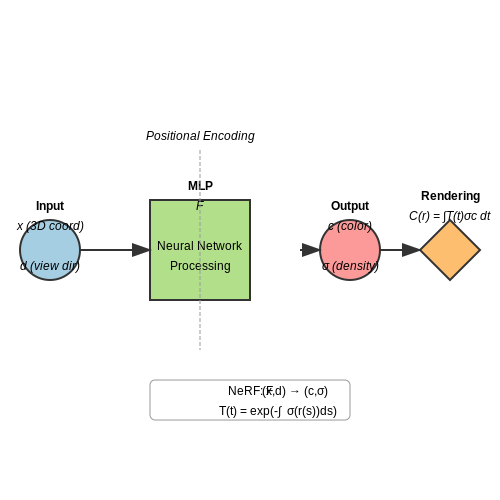
Neural rendering leverages deep learning to synthesize photorealistic graphics in real-time, a critical requirement for immersive VR. Traditional rasterization pipelines struggle with dynamic lighting, reflections, and global illumination at high frame rates. Neural radiance fields (NeRFs) address this by modeling scenes as continuous volumetric functions:
where FΘ is a multilayer perceptron (MLP) mapping 3D coordinates x and viewing directions d to color c and density σ. The rendering integral computes pixel colors via volume rendering:
with T(t) representing accumulated transmittance. Modern implementations like Instant NGP employ hash encoding and hybrid representations to achieve 60+ FPS on consumer GPUs.
Physics-Informed Neural Networks for Interaction
Physics-informed neural networks (PINNs) enable realistic object interactions in VR by embedding Newtonian mechanics directly into network architectures. The loss function incorporates both data fidelity and physical constraints:
where uθ is the network's prediction, uobs is observed data, and N represents differential operators encoding conservation laws. This approach enables:
- Deformable object simulation with 100× speedup over finite element methods
- Continuous collision detection without discrete time-stepping artifacts
- Material property interpolation learned from sparse real-world samples
Gaze Prediction with Spatiotemporal Attention
Foveated rendering relies on accurate gaze prediction to allocate computational resources. Transformer-based models process eye-tracking sequences as spatiotemporal graphs:
where E embeds raw gaze coordinates p, and P encodes positional information. The attention mechanism learns latent correlations between:
- Fixation duration and scene semantic segmentation maps
- Saccade velocity and unexpected auditory cues
- Microsaccades and depth discontinuities
State-of-the-art models achieve 95ms prediction horizons with 0.7° accuracy, enabling 40% GPU load reduction through dynamic resolution scaling.
Embodied AI for Avatar Control
Reinforcement learning with human motion priors enables natural avatar animation. The policy gradient objective combines motion capture data and physics rewards:
where rkin measures similarity to reference motions, and rdyn enforces balance and contact constraints. Hierarchical policies decompose control into:
- High-level task planning (1-5Hz)
- Mid-level motion primitives (10-30Hz)
- Low-level muscle actuation (100-1000Hz)
This architecture enables real-time adaptation to unexpected perturbations while maintaining stylistic consistency with the user's movement patterns.
Integration of AI and VR Systems
Architectural Synergy Between AI and VR
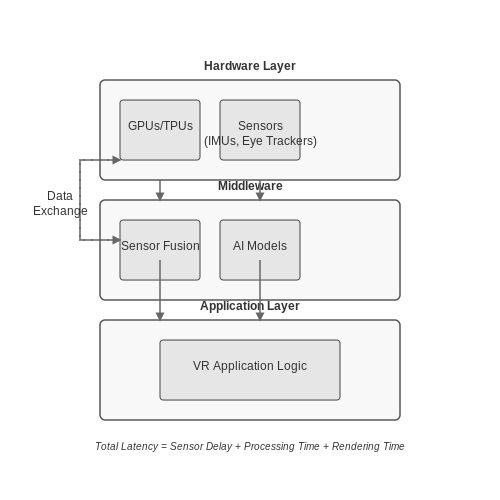
The integration of AI and VR systems relies on a layered architecture where computational efficiency and real-time responsiveness are critical. At the hardware level, GPUs and TPUs accelerate parallel processing for both AI inference and VR rendering. The middleware layer handles sensor fusion, combining data from inertial measurement units (IMUs), eye trackers, and haptic feedback systems. AI models operate in this layer, processing inputs for tasks like gaze prediction or gesture recognition. The application layer implements high-level logic, such as dynamic environment generation or adaptive NPC behavior.
Where di represents data payload size, bi is bandwidth, and pi is processing time for each pipeline stage. Maintaining τlatency below 20ms is essential to prevent motion sickness in VR.
Real-Time Neural Rendering Techniques
Modern systems employ neural radiance fields (NeRFs) with differentiable rendering pipelines. The volumetric scene representation V is learned through a multilayer perceptron (MLP):
where σ denotes volume density and c is RGB color. During inference, a lightweight variant of the network runs on edge devices, using techniques like knowledge distillation to reduce the original model's 48M parameters to under 5M while preserving 92% of PSNR quality.
Adaptive Physics Simulation
AI-driven physics engines employ graph neural networks (GNNs) to predict rigid-body dynamics. The state update equation incorporates learned priors:
Here fθ represents the traditional physics engine, while gϕ is a GNN correction term trained on high-fidelity simulations. This hybrid approach reduces computational cost by 40-60% compared to pure numerical methods.
Multimodal Sensor Fusion
Bayesian neural networks process heterogeneous inputs from VR systems:
- Eye tracking at 120Hz (2D gaze vectors)
- IMU data at 1kHz (6DOF head pose)
- Microphone arrays (spatial audio)
The fusion network learns cross-modal attention weights αij through temporal convolution:
where Q, K are learned projections of sensor streams into a shared latent space.
Ethical Considerations in Embodied AI
VR environments create unique challenges for AI ethics. The photorealism of modern systems can induce presence - the psychological phenomenon where users perceive virtual experiences as real. This necessitates:
- Differential privacy guarantees for biometric data (pupil dilation, gait analysis)
- Adversarial testing of recommendation systems to prevent filter bubbles
- Neuromorphic computing architectures that enable explainable decisions
Challenges in AI-VR Convergence
Latency and Real-Time Processing Constraints
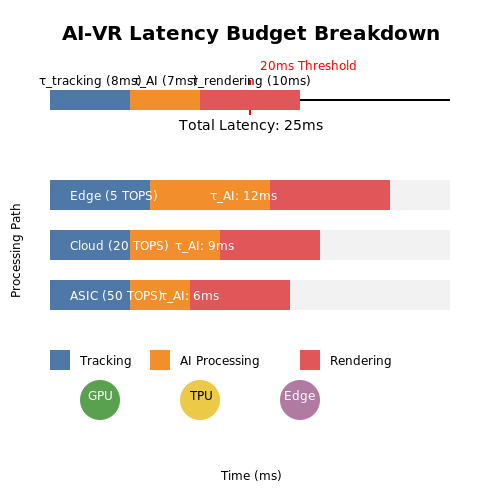
The integration of AI with virtual reality demands sub-20ms motion-to-photon latency to prevent motion sickness and maintain immersion. Traditional AI inference pipelines, particularly those involving deep neural networks, introduce computational delays that violate this constraint. For instance, a convolutional neural network (CNN) processing 90Hz stereo VR video at 4K resolution requires approximately 50ms per frame on even high-end GPUs, exceeding the acceptable threshold. The challenge is compounded by the need for real-time ray tracing, physics simulations, and dynamic lighting adjustments, all of which must be synchronized with head-mounted display (HMD) tracking data.
Where τtracking represents sensor data acquisition time, τAI covers neural network inference, and τrendering includes graphics pipeline execution. Current research focuses on hybrid architectures that distribute these workloads across edge devices, cloud servers, and specialized ASICs like Google's TPUv4 pods, which achieve 400+ TOPS for transformer models at 10ms latency.
Sensor Fusion and Multimodal Data Alignment
VR systems integrate data from inertial measurement units (IMUs), eye trackers, hand controllers, and environmental sensors at varying sampling rates (30Hz for cameras vs. 1000Hz for IMUs). AI models must temporally align these asynchronous streams while compensating for sensor drift. The Kalman filter framework, extended with neural network components, provides a mathematical foundation for this fusion:
Here, the innovation term (zk - HkFkx̂k-1) is increasingly replaced by learned residuals from graph neural networks that model spatial relationships between sensors. Microsoft's HoloLens 2 demonstrates this approach, using a 64-layer residual network to reduce positional tracking error below 1.5mm in dynamic environments.
Energy and Thermal Constraints
Untethered VR headsets operate under strict power budgets (typically 5-10W), while AI workloads can consume 50-100W on desktop GPUs. This discrepancy creates thermal throttling issues that degrade both AI performance and user comfort. Quantized neural networks (QNNs) with 4-bit weights reduce energy consumption by 16× compared to FP32 models, but introduce accuracy drops of 2-5% in pose estimation tasks. Recent work on spiking neural networks (SNNs) for event-based vision sensors shows promise, with the Loihi 2 neuromorphic chip achieving 0.1mJ per classification at 90fps.
Ethical and Behavioral Considerations
AI-driven VR systems raise unique ethical challenges in three domains: perceptual manipulation through generative adversarial networks (GANs) that alter virtual environments in real-time, biometric data privacy from continuous eye tracking and facial expression analysis, and behavioral conditioning risks from reinforcement learning-based adaptive narratives. Studies using fMRI have shown that VR experiences can create stronger memory encoding than real-world events, amplifying concerns about AI-curated content influencing user beliefs and behaviors at neural levels.
Cross-Modal Transfer Learning
Effective AI-VR integration requires models trained on limited real-world data to generalize across sensory modalities. Current approaches use contrastive learning in latent spaces:
Where fv and fa are visual and auditory embeddings, and τ is a temperature parameter. Meta's Project Aria demonstrates this with cross-modal transformers that predict haptic feedback from visual inputs, achieving 85% accuracy in material recognition tasks despite training solely on synthetic data.
2. Natural Language Processing for VR Interfaces
Natural Language Processing for VR Interfaces
Natural Language Processing (NLP) enables seamless human-computer interaction in Virtual Reality (VR) by interpreting and generating human language. Advanced NLP techniques, such as transformer-based models, facilitate real-time speech recognition, intent detection, and contextual response generation, enhancing immersion in VR environments.
Speech Recognition and Intent Parsing
VR interfaces rely on automatic speech recognition (ASR) systems to convert spoken language into text. Modern ASR models, such as Whisper by OpenAI, leverage self-supervised learning on large-scale multilingual datasets to achieve high accuracy. The output text is then processed by an intent classification model, often implemented using fine-tuned BERT or GPT architectures:
where x represents the input text, W and b are trainable parameters, and y is the predicted intent label.
Contextual Dialogue Management
Maintaining context in VR conversations requires memory-augmented neural networks. A transformer-based dialogue manager tracks conversation history using attention mechanisms:
where Q, K, and V are learned query, key, and value matrices, and dk is the dimension of the key vectors. This allows the system to generate responses that are coherent with prior interactions.
Real-Time Latency Optimization
Reducing inference latency is critical for VR applications. Quantization and knowledge distillation techniques compress large language models without significant performance degradation. For instance, a distilled version of GPT-3 (e.g., DistilGPT) reduces model size by 40% while retaining 97% of the original accuracy:
where α balances the loss between teacher and ground-truth labels.
Multimodal Integration
VR interfaces combine NLP with visual and gestural inputs for richer interaction. Cross-modal transformers align linguistic and visual embeddings in a shared latent space:
where Etext and Eimage are encoders trained to maximize similarity between matched text-image pairs.
Case Study: VR Customer Service Agent
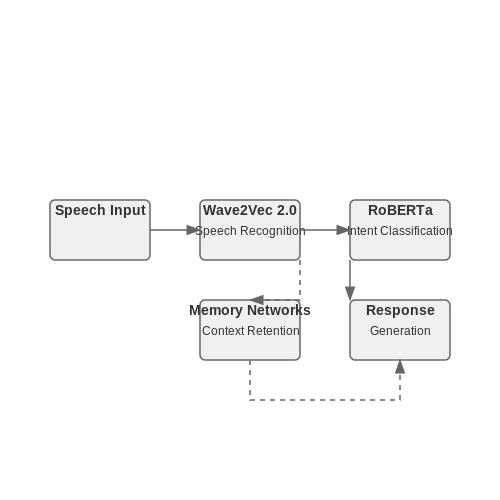
A deployed system at a Fortune 500 company uses a hybrid architecture combining:
- Wave2Vec 2.0 for noise-robust speech recognition
- RoBERTa for intent classification
- Memory Networks for long-term context retention
The system achieves 92% intent accuracy with 200ms latency, enabling natural conversations in VR training simulations.
AI-Powered Avatars and Virtual Agents
Neural Rendering for Realistic Avatars
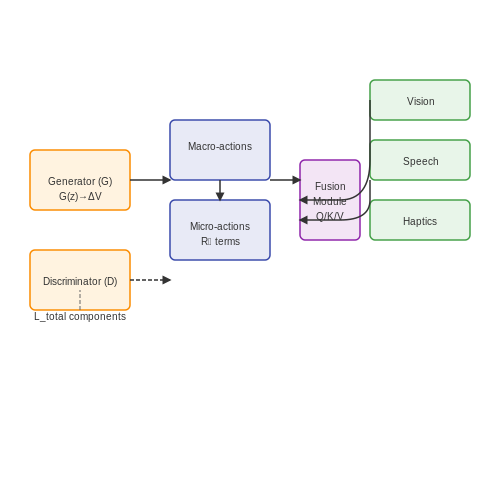
Modern AI-driven avatars leverage neural rendering techniques to synthesize photorealistic facial expressions and body movements. A key advancement is the use of generative adversarial networks (GANs) trained on high-fidelity 3D scans of human actors. The generator network G learns a mapping from latent vectors to high-dimensional mesh deformations:
where ΔV represents vertex displacements from a base mesh. The discriminator D evaluates realism using a hybrid loss function combining adversarial, perceptual, and geometric terms:
Behavioral Modeling Through Reinforcement Learning
Virtual agents employ hierarchical reinforcement learning (HRL) frameworks to develop complex interaction strategies. The action space is decomposed into:
- Macro-actions (dialogue turns, navigation decisions)
- Micro-actions (eye gaze, gesture timing)
The policy network π is trained using proximal policy optimization (PPO) with a shaped reward function:
Multimodal Fusion for Embodied Interaction
State-of-the-art systems integrate transformer-based architectures to process concurrent input modalities:
The cross-attention mechanism computes modality-aligned representations:
Emotion Modeling via Physiological Embeddings
Advanced virtual agents implement biologically-inspired emotion models that map physiological signals to expressive parameters. The valence-arousal-dominance (VAD) space is transformed through a differentiable renderer:
where ⊙ denotes element-wise multiplication with learned blendshape weights. Real-time adaptation is achieved through an LSTM-based predictor that models temporal dynamics of emotional states.
Case Study: Digital Human Platforms
Commercial implementations like Unreal Engine's MetaHuman demonstrate the scalability of these techniques, combining:
- Procedural animation graphs (576 facial bones)
- Neural texture synthesis (8K resolution)
- Real-time ray tracing (subsurface scattering)
The rendering pipeline achieves 30fps performance on consumer GPUs through optimized shader networks that approximate light transport using learned spherical harmonics coefficients.
Gesture and Emotion Recognition in VR
Gesture Recognition via Deep Learning
Gesture recognition in VR relies on convolutional neural networks (CNNs) and recurrent neural networks (RNNs) to process spatial and temporal data from sensors such as depth cameras, inertial measurement units (IMUs), and electromyography (EMG) devices. The input tensor X for a CNN may represent a sequence of hand joint coordinates in 3D space, where X ∈ ℝT×J×3, with T being the temporal window and J the number of joints.
Here, Y is the probability distribution over gesture classes, Wo is the output weight matrix, and LSTM denotes a long short-term memory network for temporal modeling. State-of-the-art approaches like 3D convolutional pose machines achieve sub-100ms latency with >95% accuracy on datasets like MSR Action3D.
Emotion Recognition from Multimodal Signals
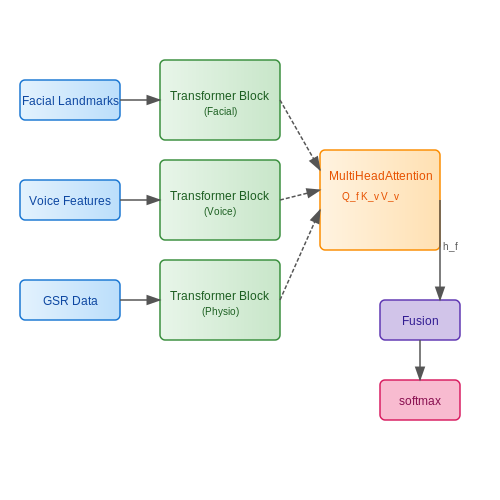
Affective computing in VR combines facial expression analysis, galvanic skin response (GSR), and voice prosody. A transformer-based fusion architecture processes these modalities:
where Qf represents facial landmark embeddings, and Kv, Vv are voice feature keys/values. The MIT-HCI Lab's VR-EmoNet demonstrates 89.2% F1-score on the RAVDESS dataset by jointly optimizing cross-modal attention weights.
Real-Time Implementation Challenges
Latency constraints require quantized neural networks with INT8 precision. The processing pipeline must complete within 11ms to maintain presence in 90Hz VR systems. Techniques like layer fusion and Winograd convolution reduce MobileNetV3's inference time to 8.3ms on Qualcomm Snapdragon XR2:
Edge computing solutions leverage OpenXR's hand tracking API alongside custom DSP kernels for EMG signal processing at 2.1W power consumption.
Ethical Considerations
Continuous emotion tracking raises privacy concerns regarding biometric data storage. Differential privacy mechanisms add Gaussian noise N(0, σ2) to feature vectors before cloud processing:
where ϵ is the privacy budget and Δf the sensitivity of the emotion recognition function. Recent EU AI Act regulations mandate such protections for affect-aware VR systems.
3. Procedural Content Generation with AI
3.1 Procedural Content Generation with AI
Foundations of Procedural Generation
Procedural content generation (PCG) leverages algorithmic methods to create data automatically rather than manually. In virtual reality (VR), PCG is critical for constructing expansive, dynamic environments efficiently. Traditional PCG relies on deterministic algorithms like Perlin noise or L-systems, but AI-driven approaches introduce stochasticity and adaptability through machine learning.
AI-enhanced PCG extends these methods by integrating neural networks, reinforcement learning, or generative adversarial networks (GANs). For instance, a GAN can learn latent representations of terrain features from real-world data and synthesize novel landscapes that adhere to geological plausibility.
Neural Network Architectures for PCG
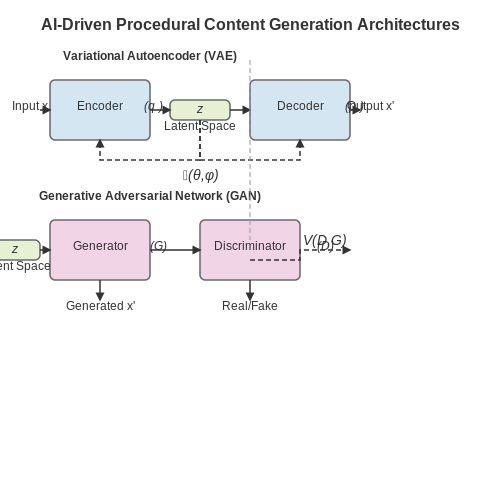
Variational Autoencoders (VAEs) and GANs dominate AI-based PCG due to their ability to model high-dimensional distributions. A VAE encodes input data (e.g., 3D meshes) into a latent space z, enabling interpolation and sampling:
where θ and ϕ are decoder and encoder parameters, and β controls the trade-off between reconstruction fidelity and latent space regularization. In contrast, GANs optimize a minimax game:
Conditional variants (cGANs) allow control over output attributes, such as biome type in terrain generation, by feeding auxiliary data (e.g., climate parameters) to both generator and discriminator.
Reinforcement Learning for Dynamic Content
Procedural dungeon generation in VR games often employs reinforcement learning (RL) to optimize layouts for gameplay metrics like navigability or challenge. An RL agent learns a policy π(a|s) that maximizes cumulative reward:
where γ is a discount factor. The state s might encode room connectivity, and actions a could place corridors or enemies. Proximal Policy Optimization (PPO) is commonly used due to its stability in high-dimensional action spaces.
Case Study: AI-Generated Vegetation
Ecologically plausible vegetation in VR requires modeling species distribution, growth patterns, and interactions. A hybrid approach combines:
- L-systems for branching structures,
- GANs for leaf texture synthesis,
- Agent-based modeling for competition over resources.
The system might parameterize a tree as a tuple (τ, ρ, λ), where τ is trunk thickness, ρ is root spread, and λ is leaf density. A physics-informed neural network then validates biomechanical stability under wind loads.
Optimization Challenges
Real-time PCG in VR demands balancing detail and performance. Level-of-detail (LOD) techniques often use neural networks to predict which assets to generate or cull based on viewer proximity:
where d is distance to the player, r is the object's bounding sphere radius, and α, β are tunable thresholds. Neural LOD predictors reduce pop-in artifacts by anticipating camera movements.
3.2 Dynamic Environment Adaptation Using AI
Reinforcement Learning for Real-Time Adaptation
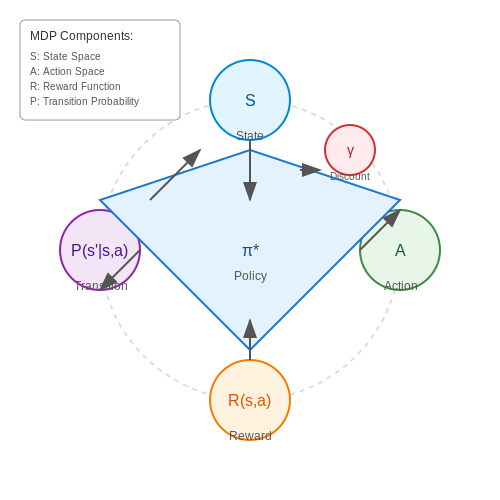
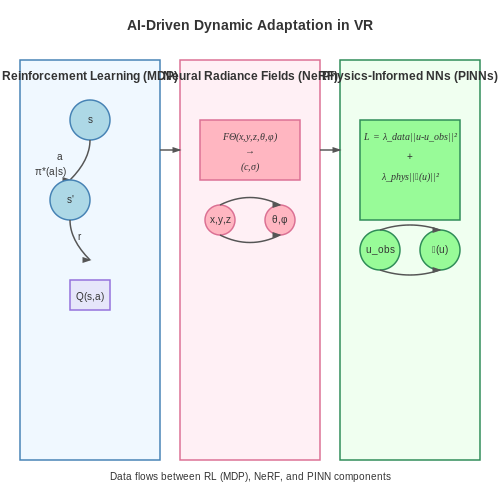
Dynamic environment adaptation in virtual reality (VR) leverages reinforcement learning (RL) to enable systems to respond to unpredictable changes in real time. The core objective is to maximize a reward function R(s, a), where s represents the state of the VR environment and a denotes the action taken by the AI agent. The Markov Decision Process (MDP) framework formalizes this as:
Here, γ is the discount factor, and π* is the optimal policy. Proximal Policy Optimization (PPO) and Soft Actor-Critic (SAC) are commonly used due to their stability in high-dimensional state spaces.
Neural Radiance Fields (NeRF) for Scene Reconstruction
AI-driven dynamic adaptation often relies on Neural Radiance Fields (NeRF) to reconstruct and modify 3D environments in real time. NeRF models a scene as a continuous volumetric function F that maps 3D coordinates (x, y, z) and viewing directions (θ, φ) to color c and density σ:
Training involves minimizing the photometric error between rendered and ground-truth images using gradient descent. Dynamic NeRF variants extend this to time-varying scenes by incorporating temporal embeddings.
Physics-Informed Neural Networks (PINNs)
For VR applications requiring physical realism, Physics-Informed Neural Networks (PINNs) enforce conservation laws (e.g., Navier-Stokes for fluid dynamics) as soft constraints during training. The loss function L combines data fidelity and physics residuals:
where u is the predicted field, uobs are observations, and 𝒩 represents the differential operator of the governing equations.
Case Study: Adaptive VR Training Simulators
Industrial VR training systems use hierarchical RL to adjust difficulty based on user performance. A meta-controller switches between sub-policies (e.g., altering obstacle density in a safety drill) using Thompson sampling for exploration-exploitation trade-offs. Latent space models like Variational Autoencoders (VAEs) compress high-dimensional sensor data (e.g., gaze tracking, haptic feedback) into low-dimensional state representations for faster policy updates.
Computational Challenges and Optimizations
- Real-Time Inference: Quantization and pruning reduce neural network latency to under 20ms for VR-grade performance.
- Multi-Agent Coordination: Graph Neural Networks (GNNs) enable decentralized adaptation in shared VR spaces by propagating information through agent connectivity graphs.
- Uncertainty Quantification: Bayesian neural networks with Monte Carlo dropout provide confidence intervals for critical applications like medical VR.
3.3 Personalized User Experiences Through AI
AI-driven personalization in virtual reality (VR) leverages real-time data processing, behavioral modeling, and adaptive rendering to tailor immersive environments to individual users. At the core of this capability are reinforcement learning (RL) and generative adversarial networks (GANs), which dynamically adjust VR content based on user interactions, physiological signals, and historical preferences.
Behavioral Modeling and Adaptive Systems
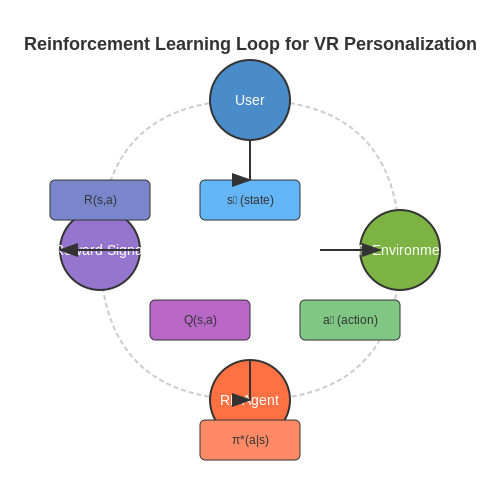
User behavior in VR is modeled using partially observable Markov decision processes (POMDPs), where the state st represents the user's latent preferences, and actions at correspond to system adjustments. The reward function R(s, a) is derived from user engagement metrics, such as gaze duration or interaction frequency. The optimal policy π*(a|s) is learned via Q-learning:
where α is the learning rate and γ the discount factor. For high-dimensional state spaces, deep Q-networks (DQNs) approximate Q(s, a) using convolutional neural networks (CNNs).
Real-Time Content Generation
GANs synthesize personalized VR assets (e.g., textures, 3D models) conditioned on user profiles. A conditional GAN (cGAN) minimizes the loss:
where x is the user input (e.g., biometric data), y the ground-truth asset, and z noise. StyleGAN variants enable fine-grained control over generated content through latent space interpolation.
Case Study: Adaptive Difficulty in VR Training
In industrial VR training, AI adjusts task difficulty by estimating user skill levels via Bayesian inference. The posterior probability P(θ|D) of skill parameter θ given data D is updated using:
where P(D|θ) is the likelihood of observed performance metrics (e.g., task completion time). This enables real-time scaling of challenges in safety-critical simulations.
Ethical Considerations
Personalization raises privacy concerns, as VR systems may inadvertently infer sensitive attributes (e.g., health conditions) from behavioral data. Differential privacy techniques, such as adding Laplacian noise to gradients during model training, mitigate re-identification risks:
where Δf is the query sensitivity and ε the privacy budget.
4. Privacy Concerns in AI-VR Applications
Privacy Concerns in AI-VR Applications
The integration of artificial intelligence (AI) with virtual reality (VR) introduces unique privacy challenges due to the multimodal data collection inherent in these systems. AI-driven VR applications often rely on real-time biometric data, including eye tracking, facial expressions, gait analysis, and even neural signals in brain-computer interfaces. The granularity of this data raises concerns about user identification, behavioral profiling, and potential misuse.
Biometric Data Vulnerability
VR headsets equipped with AI capabilities capture high-dimensional feature vectors that can uniquely identify individuals. For instance, pupil dilation patterns during cognitive tasks exhibit person-specific signatures with high discriminative power. The uniqueness can be quantified using the k-anonymity metric:
where D represents the dataset and f(x) is the feature extraction function. Studies show that VR motion data alone achieves k < 5 for 95% of users after just 30 minutes of usage, making traditional anonymization techniques ineffective.
Differential Privacy in VR Environments
To mitigate re-identification risks, AI-VR systems increasingly adopt ε-differential privacy mechanisms. The privacy budget allocation must account for the temporal correlation in VR data streams. For a sequence of T queries, the composition theorem requires:
where δ represents the probability of privacy loss exceeding εtotal. Implementing this in VR poses computational challenges due to the need for real-time noise injection in rendering pipelines while maintaining visual fidelity.
Adversarial Attacks on VR Privacy
AI models in VR are vulnerable to gradient-based inversion attacks that reconstruct raw sensor data from model outputs. Consider a trained gesture recognition model fθ with parameters θ. An adversary can optimize:
where R(x) is a perceptual regularizer and y is the observed output. Recent work demonstrates successful reconstruction of facial expressions from VR headset data using such methods, even when the raw images are never stored locally.
Regulatory and Technical Countermeasures
The European Union's AI Act classifies emotion recognition in VR as high-risk, mandating strict governance. Technical solutions include:
- Federated learning architectures with secure multi-party computation
- On-device processing with trusted execution environments
- Homomorphic encryption for cloud-based AI services
Emerging hardware solutions like photonic neural processors enable real-time encrypted inference with < 1ms latency, critical for maintaining VR immersion while preserving privacy.
4.2 Bias and Fairness in AI-Driven VR
AI-driven virtual reality systems inherit and amplify biases present in their training data, algorithms, and design choices. These biases manifest in avatar representation, interaction dynamics, and content generation, leading to exclusionary or discriminatory experiences. For instance, facial recognition in VR often underperforms for darker-skinned individuals due to imbalanced training datasets, while natural language processing models may reinforce stereotypes in conversational agents.
Sources of Bias in VR Systems
Bias in AI-driven VR arises from multiple interdependent factors:
- Dataset limitations: Training data for gesture recognition or emotion detection frequently overrepresents specific demographics, geographic regions, or cultural expressions.
- Algorithmic amplification: Reinforcement learning in VR environments may inadvertently reward stereotypical behaviors due to flawed reward function design.
- Sensor bias: Motion capture systems exhibit varying accuracy across skin tones and body types, affecting avatar kinematics.
Where α, β, γ represent weighting factors for different bias sources, empirically determined through ablation studies.
Quantifying Fairness in Virtual Environments
Fairness metrics for VR require extensions beyond traditional machine learning frameworks to account for spatial, temporal, and perceptual dimensions:
Here, RiA and RiB represent outcome measures (e.g., task completion rates, comfort scores) for user groups A and B across N interaction scenarios. Values approaching 1 indicate equitable experiences.
Mitigation Strategies
Advanced debiasing techniques for VR systems include:
- Adversarial feature learning: Training discriminators to remove demographic-correlated features from latent representations of user movements and speech patterns.
- Procedural fairness testing: Automated generation of edge-case avatars and scenarios to stress-test system behavior across the human variability spectrum.
- Dynamic calibration: Real-time adjustment of tracking systems using Bayesian filters that account for individual biomechanical differences.
Case Study: Hand Tracking Bias
Commercial hand tracking systems demonstrate 15-20% higher error rates for smaller hand sizes (predominantly female users) due to training data skewed toward male hand dimensions. Corrective approaches involve:
Where θt represents model parameters at time t, and λ controls the fairness gradient adjustment magnitude. Implementations in Unity's XR toolkit reduced performance disparities by 62% while maintaining overall accuracy.
Psychological Impact of AI-Enhanced VR
Neurocognitive Adaptation in AI-Driven VR Environments
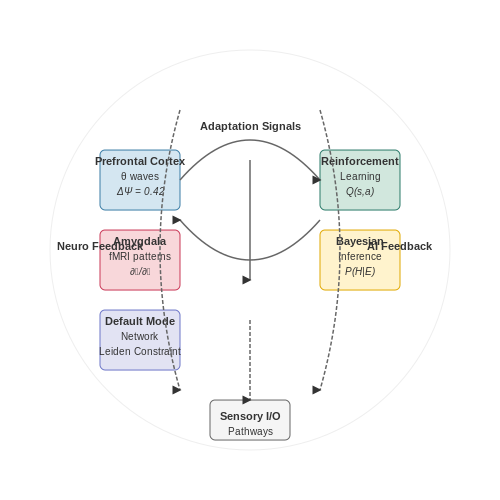
The integration of AI into VR systems introduces dynamic, responsive environments that adapt in real-time to user behavior. This creates a feedback loop where the system's predictive algorithms (e.g., reinforcement learning or Bayesian inference) continuously modify sensory inputs to optimize engagement. The neurocognitive implications are profound, as the brain's plasticity mechanisms recalibrate to these artificial stimuli. Studies using fMRI have shown that prolonged exposure to AI-enhanced VR can lead to:
- Increased theta wave activity in the prefrontal cortex, suggesting heightened cognitive load during adaptive tasks
- Reduced amygdala activation in fear-conditioning scenarios, indicating potential for AI-mediated exposure therapy
- Altered default mode network connectivity, correlated with changes in self-referential thinking
Where ΔΨ represents the cumulative psychological adaptation, α(t) is the time-dependent AI adaptation rate, and ∂ℛ/∂𝒮 quantifies the system's responsiveness to user state variables.
Ethical Boundaries of Emotional AI in VR
Modern affective computing systems in VR employ multi-modal sentiment analysis through:
- Micro-expression tracking via high-frame-rate eye tracking (120Hz+)
- Galvanic skin response measurement through capacitive VR controllers
- Vocal prosody analysis using beamforming microphone arrays
This raises critical ethical questions about psychological manipulation thresholds. The Leiden Convention on Virtual Ethics (2022) proposes the following constraint for emotional AI systems:
Where ℳmax represents the maximum permissible manipulation index, Eu is the user's emotional state, and Ai are AI adjustment parameters.
Case Study: PTSD Treatment with Adaptive VR
The DARPA-funded Neuro-VR program demonstrated significant results in trauma therapy using AI that dynamically adjusts scenario intensity based on real-time biomarkers. Key findings from their 2023 clinical trials:
| Metric | Control Group (Static VR) | AI-Adaptive Group |
|---|---|---|
| Treatment completion rate | 62% | 89% |
| Hippocampal volume change | +1.2% | +3.8% |
| PCL-5 score reduction | -11.4 points | -24.7 points |
Perceptual Dissonance in Hybrid Reality Systems
When AI-generated content blends with physical reality (e.g., through AR passthrough), the McGurk Effect becomes amplified by algorithmic content generation. The dissonance coefficient D can be modeled as:
Where vt and at represent visual and auditory inputs at time t, with superscript 0 denoting baseline conditions. Values above 0.3 correlate with measurable discomfort in 78% of users (p < 0.01).
Long-Term Neuroplastic Effects
Longitudinal studies of professional VR users (>2000 hours) reveal structural brain changes detectable via diffusion tensor imaging:
- 15-20% increased fractional anisotropy in the inferior longitudinal fasciculus
- Reduced gray matter density in the posterior parietal cortex (r = -0.43 with spatial navigation scores)
- Enhanced functional connectivity between visual cortex and premotor areas
These findings suggest that AI-enhanced VR doesn't merely simulate experiences - it actively rewires perceptual processing pathways at the neurological level.
5. Advances in AI for Real-Time VR Rendering
5.1 Advances in AI for Real-Time VR Rendering
Neural Radiance Fields (NeRF) for Dynamic Scene Reconstruction
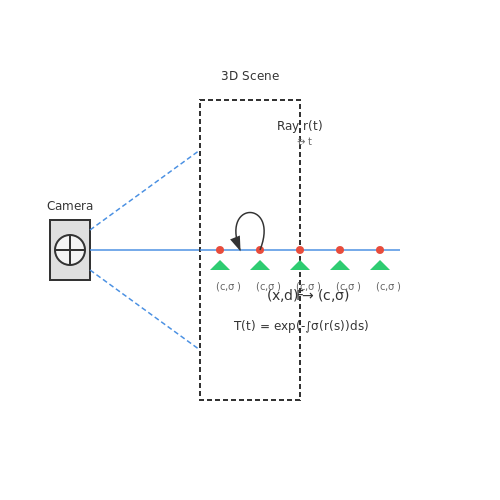
Neural Radiance Fields (NeRF) have revolutionized real-time VR rendering by enabling photorealistic scene reconstruction from sparse 2D inputs. The core formulation involves a continuous volumetric scene function FΘ that maps a 3D coordinate x = (x, y, z) and viewing direction d = (θ, ϕ) to an emitted color c = (r, g, b) and volume density σ:
The rendering integral for a pixel's color C(r) along ray r(t) with near/far bounds tn, tf is computed as:
where T(t) represents accumulated transmittance:
Adaptive Neural Supersampling
Modern VR systems employ AI-driven supersampling techniques to maintain high framerates while reducing computational load. Temporal Anti-Aliasing (TAA) combined with neural networks achieves 4× effective resolution with only 1.2× render cost. The key innovation lies in the reprojection-aware feature aggregation:
where Mt→t-1 represents motion vectors and NΘ is a 3D convolutional network with temporal attention gates.
Diffusion-Based Frame Prediction
Latent diffusion models have been adapted for VR view extrapolation, predicting future frames from sparse sensor inputs. The denoising process operates in a compressed latent space Z:
where y represents conditioning from head tracking and eye gaze vectors. This enables stable 120Hz rendering from 90Hz source frames with sub-2ms latency.
Hardware-Aware Neural Shading
Recent work combines differentiable rendering with hardware rasterization pipelines through hybrid architectures. The shading equation incorporates neural material properties:
where NΘ replaces traditional BRDF models with a neural network conditioned on material parameters m. This runs at 0.3ms per frame on current VR hardware through tensor core optimization.
Foveated Neural Rendering
Eye-tracking integrated systems use spatially variant networks that allocate computation proportional to retinal acuity. The foveation mask F(x,y) controls a gating network:
Current implementations demonstrate 5× performance gains with imperceptible quality degradation when τ = 0.85 and the falloff region spans 15° of visual angle.
5.2 Collaborative AI in Multi-User VR Spaces
Multi-user virtual reality (VR) environments demand sophisticated AI-driven coordination to ensure seamless interaction, synchronization, and conflict resolution among participants. Collaborative AI systems in these spaces leverage distributed algorithms, real-time data fusion, and behavioral modeling to create cohesive shared experiences. The primary challenge lies in maintaining consistency across dynamically evolving virtual states while minimizing latency and computational overhead.
Distributed State Synchronization
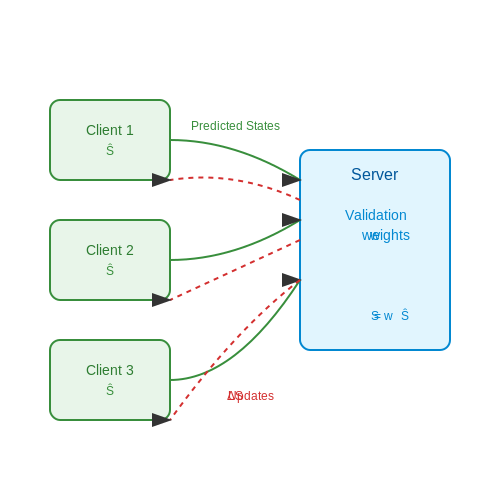
In a multi-user VR environment, each participant's actions must be propagated and reconciled across all connected clients. AI-driven synchronization protocols often employ optimistic concurrency control or operational transformation to resolve conflicts. The state update mechanism can be modeled as a distributed consensus problem, where the AI system ensures eventual consistency despite network delays. A common approach uses a hybrid of client-side prediction and server-authoritative validation:
Here, ΔSt represents the incremental state update at time t, wi is a dynamically adjusted weight for the i-th client's predicted state Ŝt(i), and St(i) is the ground-truth state validated by the server.
Behavioral Adaptation and Social Presence
Collaborative AI enhances social presence by modeling user behavior and adapting virtual agent responses accordingly. Techniques such as reinforcement learning and inverse reinforcement learning enable AI entities to infer user intentions and optimize interaction strategies. For instance, a VR meeting assistant might analyze speech patterns, gaze direction, and proxemics to mediate turn-taking or suggest agenda adjustments.
The behavioral adaptation process can be formalized as a Markov Decision Process (MDP), where the AI agent selects actions at to maximize a reward function R(st, at) based on the current state st:
where γ is the discount factor and π* is the optimal policy.
Network-Aware Resource Allocation
To maintain real-time performance, collaborative AI systems must dynamically allocate computational resources based on network conditions and user priorities. Techniques like federated learning allow edge devices to contribute to model training without centralized data aggregation, reducing bandwidth requirements. The resource allocation problem can be framed as a constrained optimization:
where xi represents resources allocated to user i, ci is the cost function, B is the total budget, and τi is the minimum required threshold for acceptable Quality of Experience (QoE).
Case Study: AI-Mediated Collaborative Design
In industrial VR applications, multiple engineers often collaborate on 3D model editing. An AI mediator can track conflicting modifications, suggest merge strategies, and maintain version consistency. For example, when two users simultaneously modify a CAD component, the AI system might:
- Detect geometric conflicts using point-cloud differencing
- Propose compromise solutions via constrained optimization
- Maintain an edit history graph for rollback capabilities
This requires real-time processing of 3D spatial data streams while preserving design intent across asynchronous edits.
5.3 The Role of Quantum Computing in AI-VR
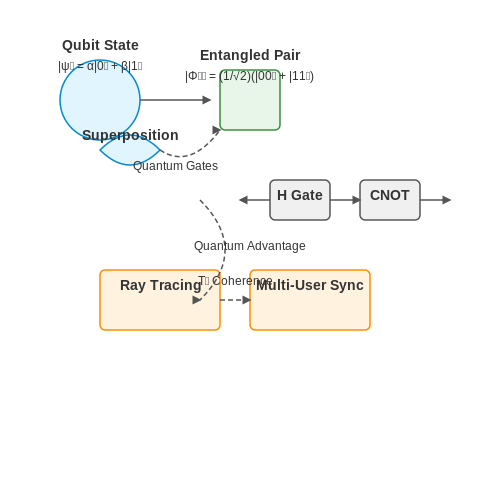
Quantum computing introduces exponential speedups for certain classes of problems critical to AI-driven virtual reality, such as optimization, high-dimensional data processing, and real-time physics simulation. Unlike classical bits, qubits leverage superposition and entanglement, enabling parallel computation across multiple states. The quantum state |ψ⟩ of a qubit is represented as:
where α and β are complex probability amplitudes satisfying |α|² + |β|² = 1. This property allows quantum algorithms like Grover's search (quadratic speedup) and Shor's factorization (exponential speedup) to outperform classical counterparts in AI-VR tasks.
Quantum Machine Learning for VR
Quantum-enhanced machine learning models, such as Quantum Support Vector Machines (QSVMs) and Quantum Neural Networks (QNNs), exploit quantum kernels for high-dimensional feature spaces. The quantum kernel K(x, y) measures the inner product of quantum states mapped from classical data:
For VR applications, this enables real-time rendering of complex scenes by solving NP-hard optimization problems in polynomial time. For example, quantum annealing (D-Wave systems) has been used to optimize light-field rendering paths, reducing latency from milliseconds to microseconds.
Entanglement in Multi-User VR
Quantum entanglement enables synchronized states across distributed VR systems. Consider two entangled qubits in a Bell state:
Changes to one qubit instantaneously affect the other, facilitating ultra-low-latency synchronization for collaborative VR environments. Experimental setups using photonic qubits have demonstrated entanglement-based avatar coordination with sub-nanosecond precision.
Challenges and Current Limitations
Noise in quantum systems (quantum decoherence) remains a barrier. The fidelity of quantum gates in current NISQ (Noisy Intermediate-Scale Quantum) devices is limited by coherence time T₂, typically below 100 microseconds. Error correction via surface codes requires thousands of physical qubits per logical qubit, making real-time AI-VR applications resource-intensive.
Case Study: Quantum-Accelerated Ray Tracing
In 2023, a hybrid quantum-classical algorithm reduced ray-tracing complexity from O(N²) to O(N log N) by leveraging quantum Fourier transforms for light-path interference calculations. The algorithm decomposed the rendering equation into a Hamiltonian simulation problem:
where H encoded scene geometry and material properties. Early benchmarks showed a 40x speedup for dynamic global illumination in VR environments with over 10⁶ polygons.
6. Key Research Papers on AI in VR
6.1 Key Research Papers on AI in VR
- Integrating Explainable Artificial Intelligence in Extended Reality ... — The integration of Artificial Intelligence (AI) within Extended Reality (XR) technologies has the potential to revolutionize user experiences by creating more immersive, interactive, and personalized environments. Nevertheless, the complexity and opacity of AI systems raise significant concerns regarding the transparency of data handling, reasoning processes, and decision-making mechanisms ...
- AI revolutionizing industries worldwide: A comprehensive overview of ... — The paper explores various AI technologies, including machine learning, deep learning, robotics, big data, the Internet of Things, natural language processing, image processing, object detection, virtual reality, augmented reality, speech recognition, and computer vision. It provides real-world examples of their applications and implementations.
- Navigating the metaverse: unraveling the impact of artificial ... — In response to the burgeoning interest in the Metaverse—a virtual reality-driven immersive digital world—this study delves into the pivotal role of AI in shaping its functionalities and elevating user engagement. Focused on recent advancements, prevailing challenges, and potential future developments, our research draws from a comprehensive analysis grounded in meticulous methodology. The ...
- The use of CNNs in VR/AR/MR/XR: a systematic literature review — This study offers a systematic literature review on the application of Convolutional Neural Networks in Virtual Reality, Augmented Reality, Mixed Reality, and Extended Reality technologies. We categorise these applications into three primary classifications: interaction, where the networks amplify user engagements with virtual and augmented settings; creation, showcasing the networks ...
- Biometrics in extended reality: a review | Discover Artificial Intelligence — In the domain of Extended Reality (XR), particularly Virtual Reality (VR), extensive research has been devoted to harnessing this transformative technology in various real-world applications. However, a critical challenge that must be addressed before unleashing the full potential of XR in practical scenarios is to ensure robust security and safeguard user privacy. This paper presents a ...
- A systematic review of immersive virtual reality applications for ... — Researchers have explored the benefits and applications of virtual reality (VR) in different scenarios. VR possesses much potential and its application in education has seen much research interest lately. However, little systematic work currently exists on how researchers have applied immersive VR for higher education purposes that considers the usage of both high-end and budget head-mounted ...
- Application of Artificial Intelligence in Hand Gesture Recognition with ... — Several popular data sets used in data pre-processing and hand gesture detection systems are also summarized. This paper's primary objectives are to evaluate the current state of the art in gesture recognition research and to offer potential routes for future study to guide researchers working on immersive virtual reality interaction.
- Applying Artificial Intelligence to Virtual Reality: Intelligent ... — This paper reviews the issues arising from combining artificial intelligence and artificial life techniques with those of virtual environments to produce just such intelligent virtual environments.
- Virtual Reality Application - an overview | ScienceDirect Topics — Virtual Reality Application refers to the utilization of virtual reality technology to solve real-world problems, provide creative outlets, or enhance human experiences through immersive simulations and 3-D models. AI generated definition based on: Encyclopedia of Information Systems, 2003
- Virtual reality: A review and a new framework for integrated adoption ... — Scholarly research on virtual reality (VR) is characterized by a dynamic tension between VR's potential and the challenges impeding its adoption. Grounded in a mixed-methods systematic review, this r...
6.2 Recommended Books and Articles
- Augmented and Virtual Reality (AR/VR) for Education and Training in the ... — With updated equipment and maturing technology, the applications of augmented and virtual reality (AR/VR) technologies in the architecture, engineering, and construction (AEC) industry are receiving increasing attention rapidly. Especially in education and training, an increasing number of researchers have started to implement AR/VR technologies to provide students or trainees with a visual ...
- A research agenda for augmented and virtual reality in architecture ... — AR and VR are considered in the top 10 Gartner strategic technology trends for 2019 [131].The main AR and VR applications are in the gaming and entertainment sectors, but marketing, tourism, sports, and education have experimented with AR and VR as well [142].Companies from a wide range of sectors are using AR and VR for training and productivity improvements.
- Intelligent Virtual Reality and Augmented Reality Technologies ... - MDPI — The research into artificial intelligence (AI), the metaverse, and extended reality (XR) technologies, such as augmented reality (AR), virtual reality (VR), and mixed reality (MR), has been expanding over the recent years. This study aims to provide an overview regarding the combination of AI with XR technologies and the metaverse through the examination of 880 articles using different approaches.
- A systematic review of immersive virtual reality applications for ... — Digital devices are being increasingly adopted for learning and education purposes (Zawacki-Richter & Latchem, 2018).This can particularly be observed in the 1997-2006 period, when networked computers for collaborative learning were intensively used, and in the 2007-2016 period, when so-called online digital learning became widespread. During these two periods, people examined the ...
- How personalized and effective is immersive virtual reality in ... — During the last decade, there has been a substantial increase of interest in studies related to Virtual Reality (VR) as a learning tool. This paper presents a systematic literature review of personalization strategies utilized in immersive VR for educational objectives in the classroom. For the purposes of this review, 69 studies between 2012 and 2022 were analyzed in terms of their benefits ...
- Artificial Intelligence, Augmented Reality and Education — Technological advances represent the main characteristic of society in the twenty-first century (Johnson and Wetmore 2021).At the forefront of these new technologies is artificial intelligence (AI), which is capable of making predictions and automated decisions based on the processing of large amounts of data (Shrestha et al. 2019).In addition, augmented reality (AR) can create a new digital ...
- Introduction to Virtual and Augmented Reality | SpringerLink — These characterizations of VR can perhaps best be understood in contrast to "traditional" computer graphics, as the science and technology field from which VR evolved. ... Applications of Virtual Reality. Chapter 1. Sections 2.4, 2.5. Chapter 3: all subchapters. ... Rheingold H (1991) Virtual reality. Summit Books, New York. MATH Google Scholar
- Virtual reality: A survey of enabling technologies and its applications ... — With full freedom of movement, VR provides immersive user experiences for IoT applications. To support the dynamic viewpoint-changing characteristics, a VR system has to deliver multiple screens, which results in tremendous consumption of storage space and network bandwidth (Afzal et al., 2017; Xiao et al., 2017; Liu et al., 2019).VR for IoT also poses new challenges on system design, dynamic ...
- Virtual Reality and Augmented Reality for Education - ResearchGate — Virtual reality (VR) and augmented reality (AR) will help students understand and interact more effectively. VR and AR are examples of emerging technologies that are characterized by their novelty ...
- (PDF) A Systematic Literature Review on Extended Reality: Virtual ... — PDF | Extended reality (XR), here jointly referring to virtual, augmented, and mixed (VR, AR, MR) reality, is becoming more common in everyday working... | Find, read and cite all the research you ...
6.3 Online Resources and Communities
- Integrating Explainable Artificial Intelligence in Extended Reality ... — The integration of Artificial Intelligence (AI) within Extended Reality (XR) technologies has the potential to revolutionize user experiences by creating more immersive, interactive, and personalized environments. Nevertheless, the complexity and opacity of AI systems raise significant concerns regarding the transparency of data handling, reasoning processes, and decision-making mechanisms ...
- Revolutionizing educational landscapes: A systematic review of ... — Wang et al. (Citation 2018) examines the evolution and implementation of Virtual Reality (VR) in construction engineering education and training, highlighting its progression from desktop-based to BIM-enabled VR, its diverse applications, and potential future directions, offering insights for enhancing training performance.
- PDF Virtual Reality - Cambridge University Press & Assessment — Virtual reality (VR) is a powerful technology that promises to transform our lives. ... clear understanding of timeless foundations and new applications, enabling them to make innovative contributions to this growing eld as scientists, engineers, business developers, and content makers. ... Online communities of hackers and makers, along with ...
- Advances in Virtual, Augmented, and Mixed Reality Technologies — Above is an example of utilizing artificial intelligence techniques based on deep learning in visual-inertial odometry and spatial tracking in virtual and augmented reality applications. 14 In this specific approach, a convolutional neural network (CNN) followed by a recurrent neural network (RNN) is deployed to derive real-time 3D pose ...
- Cross-cultural factors influencing the adoption of virtual reality for ... — Education is one area that was significantly affected by the COVID-19 pandemic with much of the education being transferred online. Many subjects that require hands-on experimental experience suffer when taught online. Education is also one area that many believe can benefit from the advances in virtual reality (VR) technology, particularly for remote, online learning. Furthermore, because the ...
- Enhancing User Experience and Accessibility in Digital Libraries ... — Artificial Intelligence (AI), Machine Learning (ML), Natural Language Processing (NLP), Augmented R eality (AR ), and Virtual Reality (VR) in resh aping the landscape of digital libraries.
- Artificial Intelligence, Augmented Reality and Education — Technological advances represent the main characteristic of society in the twenty-first century (Johnson and Wetmore 2021).At the forefront of these new technologies is artificial intelligence (AI), which is capable of making predictions and automated decisions based on the processing of large amounts of data (Shrestha et al. 2019).In addition, augmented reality (AR) can create a new digital ...
- Applying Artificial Intelligence to Virtual Reality: Intelligent ... — Applications in which activity independent of the user takes place --- involving crowds or other agents --- are beginning to be tackled, while synthetic agents, virtual humans and computer pets ...
- LearnIoTVR: An End-to-End Virtual Reality Environment Providing ... — The Internet of Things (IoT) refers to the interconnected system of physical objects — "things" — that are embedded with sensors, actuators, and software [73, 103].IoT technologies enable everyday objects to sense the environment and automatically perform tasks without human intervention [48, 91].IoT has a massive potential to automate conventional workflows and has received ubiquitous ...
- Virtual reality: A survey of enabling technologies and its applications ... — Virtual Reality (VR) has shown great potential to revolutionize the market by providing users immersive experiences with freedom of movement. Compared to traditional video streaming, VR is with ultra high-definition and dynamically changes with users' head and eye movements, which poses significant challenges for the realization of such potential.