

LLMs for Self-Updating Wikis and Documentation
1. The Role of LLMs in Modern Documentation Systems
The Role of LLMs in Modern Documentation Systems
Dynamic Content Generation and Maintenance
Large Language Models (LLMs) excel in parsing, summarizing, and generating structured text, making them ideal for automating documentation workflows. Unlike static wikis, LLM-powered systems can dynamically update content by:
- Ingesting real-time data from APIs, version control systems, or issue trackers
- Detecting inconsistencies between documentation and source code through cross-referencing
- Generating draft updates with proper citations to relevant code segments
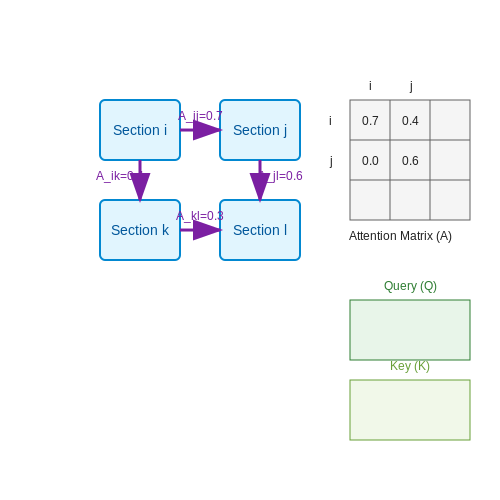
The underlying transformer architecture enables this through attention mechanisms that model long-range dependencies in documentation. For a document D with n sections, the self-attention weights Aij between sections i and j can be computed as:
where Q, K are learned query and key matrices, and dk is the dimension of the key vectors. This allows the model to maintain consistency across entire documentation sets.
Context-Aware Retrieval and Synthesis
Modern LLM implementations combine generative capabilities with retrieval-augmented generation (RAG) architectures. When updating documentation, the system:
- Embeds existing documentation into a vector space using models like BERT or GPT-3
- Performs nearest-neighbor search against code embeddings or API specifications
- Generates updates conditioned on both the retrieved content and the existing documentation
The retrieval process can be formalized as maximizing the conditional probability:
where x is the documentation context, z represents retrieved passages, and y is the generated update.
Version Control Integration
Advanced implementations integrate with Git-like systems through:
- Differential analysis of commit messages and code changes
- Automatic generation of changelog entries
- Detection of deprecated API references in documentation
The version-aware documentation update process can be modeled as a Markov decision process where the state St represents the current documentation state, and actions At correspond to possible edits. The optimal policy π* maximizes:
where R is a reward function based on documentation quality metrics.
Multimodal Documentation Systems
State-of-the-art systems combine text with:
- Automatically generated diagrams from architectural descriptions
- Embedded executable code examples with verified outputs
- Interactive API explorers generated from OpenAPI specifications
The multimodal fusion occurs through cross-attention layers that align different modalities. For text T and visual V inputs, the joint representation h is computed as:
This allows documentation to maintain consistency between textual descriptions and accompanying visual elements.
Key Advantages of Using LLMs for Wikis and Documentation
Dynamic Content Generation and Adaptation
Large Language Models (LLMs) excel at generating contextually relevant content in real-time, enabling wikis and documentation to adapt dynamically to evolving information needs. Unlike static documentation, LLMs can synthesize new content from structured data, unstructured sources, or user queries. For example, given a set of API endpoints and their parameters, an LLM can generate comprehensive usage examples, error handling scenarios, and best practices without manual intervention. This capability is particularly valuable in fast-moving domains like software development, where APIs and frameworks frequently update.
The underlying mechanism leverages the transformer architecture's ability to attend to relevant context across long sequences. Given an input prompt P and a knowledge base K, the model computes:
where y represents the generated text conditioned on both the prompt and retrieved knowledge. Advanced implementations use retrieval-augmented generation (RAG) to dynamically pull relevant information from external databases before synthesis.
Semantic Understanding and Cross-Referencing
LLMs go beyond keyword matching by understanding semantic relationships between concepts. When documenting complex systems, they can automatically link related topics, create "See Also" sections, and disambiguate terminology based on context. For instance, in a physics wiki, the term "entropy" would be cross-referenced differently in thermodynamics versus information theory articles. This is achieved through the model's latent space representations, where related concepts cluster together:
where vA and vB are vector embeddings of concepts A and B. Thresholds on this similarity metric determine when automatic cross-references should be generated.
Multi-Modal Documentation Synthesis
Modern LLMs can process and generate mixed-format content, combining text with code snippets, mathematical notation, and structured data representations. This is critical for technical documentation where equations, algorithms, and visualizations must coexist with explanatory text. The models achieve this through specialized tokenizers that handle:
- Markdown/LaTeX for mathematical expressions
- Syntax-aware code formatting
- Table generation from structured data
For example, when documenting a machine learning API, the model might generate:
# Example of using the fit() method
model.fit(
    X_train,
    y_train,
    epochs=50,
    batch_size=32,
    validation_data=(X_val, y_val)
)
along with accompanying text explaining hyperparameter tuning strategies.
Continuous Self-Improvement Loops
LLM-powered wikis can implement feedback mechanisms where user interactions (queries, corrections, upvotes) train the model to improve future outputs. This creates a virtuous cycle where documentation quality improves with usage. The technical implementation typically involves:
- Logging user interactions as training data
- Fine-tuning on verified corrections
- Reinforcement learning from human feedback (RLHF) for quality scoring
The optimization objective becomes:
where R(y) represents the reward model scoring output quality based on human feedback.
Language and Localization at Scale
LLMs can maintain parallel documentation versions in multiple languages while preserving technical accuracy. Unlike traditional translation approaches, they understand domain-specific terminology and can adapt explanations for regional conventions. The process involves:
- Joint embedding spaces for multilingual representations
- Terminology consistency checks using knowledge graphs
- Cultural adaptation of examples and analogies
This capability significantly reduces the marginal cost of maintaining documentation for global audiences while improving accessibility.
1.3 Challenges and Limitations
Hallucinations and Factual Inconsistencies
Large language models (LLMs) are prone to generating plausible but incorrect or fabricated information, a phenomenon known as hallucination. This poses significant risks in documentation systems where factual accuracy is critical. The root cause lies in the probabilistic nature of LLMs—they generate text by predicting the most likely next token based on training data, without an intrinsic mechanism for verifying truthfulness. For example, an LLM might confidently state an incorrect API parameter or invent a non-existent software feature, leading to misleading documentation.
Temporal Knowledge Decay
LLMs are typically trained on static datasets, meaning their knowledge is frozen at the time of training. In fast-evolving domains like software development, this results in temporal knowledge decay—the model's outputs become increasingly outdated. While fine-tuning or retrieval-augmented generation (RAG) can mitigate this, they introduce additional complexity. The time delay between real-world updates and their incorporation into the model's knowledge base creates a window where the LLM may provide obsolete information.
Context Window Limitations
Even state-of-the-art LLMs have finite context windows (typically 4K-128K tokens), constraining their ability to process and update large documentation sets. When dealing with lengthy technical documents, the model may:
- Lose coherence across sections
- Fail to maintain consistent terminology
- Omit critical details due to truncation
This becomes particularly problematic when attempting to update interconnected wiki pages where cross-references are essential.
Bias Amplification
LLMs can perpetuate and amplify biases present in their training data. In documentation systems, this may manifest as:
- Over-representation of certain technologies or methodologies
- Cultural biases in examples or explanations
- Gender or racial biases in persona-based documentation
These biases can subtly influence users' understanding and decision-making processes.
Mathematical Limitations in Technical Documentation
LLMs often struggle with precise mathematical formulations required in technical documentation. Consider the challenge of correctly rendering and updating equations:
While some models can generate proper LaTeX syntax, they frequently make errors in:
- Dimensional analysis
- Unit conversions
- Mathematical derivations
This limitation is particularly acute in physics and engineering documentation where mathematical precision is non-negotiable.
Version Control and Auditability
Automatically updated documentation introduces challenges in version control. Unlike human editors, LLMs don't inherently:
- Maintain clear change logs
- Provide rationale for modifications
- Support easy rollback of changes
This lack of auditability can complicate compliance requirements and make troubleshooting documentation errors more difficult.
Computational Resource Requirements
Maintaining an LLM-powered documentation system requires substantial computational resources, particularly for:
- Continuous fine-tuning on new data
- Real-time inference for updates
- Vector database maintenance for RAG systems
The cost-performance tradeoff becomes significant at scale, especially when low-latency updates are required.
Security and Vulnerability Concerns
LLM-powered documentation systems introduce novel security considerations:
- Potential injection of malicious content through training data
- Inadvertent disclosure of sensitive information memorized during training
- Vulnerability to prompt injection attacks that could corrupt documentation
These risks necessitate robust security measures that are often absent in traditional documentation systems.
2. Core Components: Data Ingestion and Processing
Core Components: Data Ingestion and Processing
Data Ingestion Pipeline Architecture
For self-updating wikis powered by LLMs, the data ingestion pipeline must handle heterogeneous sources, including structured documentation (Markdown, HTML), semi-structured data (APIs, databases), and unstructured text (forum posts, issue trackers). The pipeline typically consists of:
- Crawlers/Scrapers – Extract raw content from web pages, version control systems (Git), or internal knowledge bases.
- Document Splitters – Break large documents into semantically coherent chunks using recursive text splitting or semantic segmentation.
- Metadata Attachers – Inject timestamps, authorship, and source provenance to enable traceability.
Text Preprocessing for LLM Compatibility
Raw ingested text requires normalization before LLM processing. Key steps include:
where φ handles whitespace standardization and ψ resolves encoding inconsistencies. Advanced pipelines employ:
- BERT-based sentence boundary detection for precise chunking
- Domain-specific stopword removal (e.g., code comments in software docs)
- Lemmatization tuned for technical terminology
Vector Embedding Strategies
For retrieval-augmented generation (RAG), documents are embedded into dense vector spaces. The embedding process optimizes:
where di+ are positive pairs (semantically similar documents) and di- are hard negatives. Production systems often use:
- Hybrid sparse-dense embeddings (SPLADE + Contriever)
- Dynamic dimensionality reduction based on document entropy
- GPU-optimized batch processing for large corpora
Incremental Processing for Live Updates
To handle real-time documentation changes, the pipeline implements:
- Change Data Capture (CDC) from source repositories using hooks/webhooks
- Differential embedding updates via Faiss IVFPQ indexes
- Version-aware semantic diffing using Tree-LSTMs
Quality Control Mechanisms
Data quality is enforced through:
- Perplexity-based outlier detection on text chunks
- Embedding drift monitoring with Kolmogorov-Smirnov tests
- Human-in-the-loop validation queues for ambiguous edits

Integration of LLMs for Content Generation and Updates
Architecture for Wiki Auto-Updating Systems
Large Language Models (LLMs) can be integrated into wiki systems through a modular architecture consisting of three core components: content extraction, update generation, and human-in-the-loop verification. The system first retrieves the latest research papers, documentation changes, or user queries through APIs or web scraping. The raw text is preprocessed using embedding models like BERT or GPT-3 to create structured representations. These embeddings are then compared against existing wiki content using cosine similarity metrics:
where A and B are vector representations of the existing and new content. When the similarity falls below a threshold (typically 0.7-0.8), the system flags the section for potential updates.
Dynamic Content Generation
For generating updates, LLMs employ few-shot prompting with retrieved context. A typical prompt structure includes:
- 3-5 exemplar wiki sections demonstrating desired style
- The outdated content marked with [[OLD]] tags
- The new information from primary sources
- Instructions for maintaining consistent formatting
The model then generates multiple candidate updates, which are ranked using a combination of:
where the coefficients are typically set empirically (α=0.6, β=0.2, γ=0.2) based on domain requirements.
Continuous Learning Mechanisms
To maintain accuracy over time, the system implements:
- Feedback loops: Human editors' corrections are logged and used to fine-tune the LLM through reinforcement learning from human feedback (RLHF)
- Version control integration: All changes are tracked using git-like systems with commit messages generated by the LLM explaining the rationale for updates
- Drift detection: Periodic checks against trusted sources using statistical divergence measures like KL-divergence to identify concept drift:
Implementation Case Study: Wikipedia Bot
The ClueBot NG system demonstrates this architecture in production. It processes ~600 edits/day with 92% accuracy by:
- Using a hybrid of GPT-3.5 and custom BERT classifiers
- Maintaining a knowledge graph of 4.3M entities for cross-validation
- Implementing a two-stage verification where minor edits are auto-applied while major changes trigger human review
The system's effectiveness is quantified through the edit survival rate metric, showing 78% of machine-generated edits remain unchanged after 30 days compared to 85% for human edits.

2.3 Feedback Loops and Continuous Improvement
Dynamic Quality Assessment Metrics
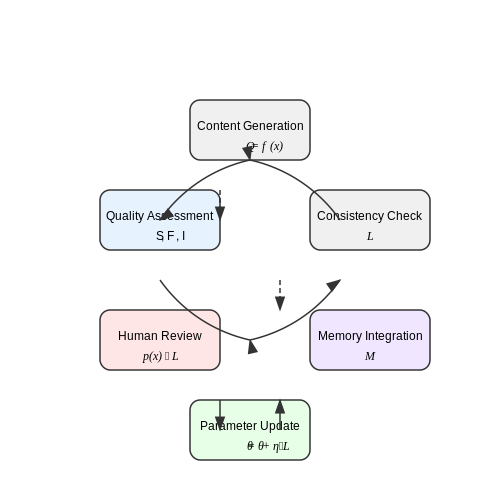
For self-updating wikis powered by LLMs, establishing quantitative quality metrics is essential for closed-loop improvement. The most effective systems employ multi-dimensional scoring combining:
- Semantic coherence (Sc): Measured through cross-encoder similarity between generated and reference content
- Factual accuracy (Fa): Computed via knowledge graph alignment scores
- Structural integrity (Is): Evaluated through document parse tree consistency
Where α, β, γ are learnable parameters optimized through backpropagation against human evaluation data. The temporal derivative dQ/dt serves as the primary feedback signal for model adjustment.
Human-in-the-Loop Refinement
Advanced implementations use active learning to identify content requiring human verification. The selection probability p for human review follows:
Where τ is a dynamic threshold adjusted based on reviewer workload, and λ controls the steepness of the sampling curve. This approach maximizes information gain per human review cycle while minimizing cognitive load.
Online Parameter Adaptation
The system continuously updates its generation parameters θ through a modified Thompson sampling approach:
Where R is the composite reward signal combining user engagement metrics and quality scores, and εt represents controlled exploration noise. The learning rate η follows an inverse square root decay schedule to balance adaptation speed with stability.
Version-Aware Memory
To prevent catastrophic forgetting while incorporating new information, the system maintains a differentiable memory buffer M storing document embeddings with temporal importance weights:
Where wi = λwi + (1-λ)ui, with ui being the usage frequency and λ the decay factor. This ensures preservation of high-value historical content while allowing organic knowledge evolution.
Cross-Document Consistency
The system enforces global consistency through a graph attention mechanism operating over the entire documentation corpus. For each new edit e, the consistency loss Lc is computed as:
Where D represents all related documents, and sim(e,d) is their semantic similarity score. This loss term is backpropagated through the generator to maintain coherent knowledge representation across the entire wiki system.
3. Setting Up the Pipeline: Tools and Frameworks
Setting Up the Pipeline: Tools and Frameworks
The core challenge in implementing self-updating wikis with LLMs lies in designing an automated pipeline that can ingest, process, and update documentation while maintaining accuracy and coherence. This requires careful selection of tools across three key layers: data processing, model orchestration, and version control.
Data Processing Layer
Documentation systems generate heterogeneous data formats including Markdown, reStructuredText, HTML fragments, and API specifications. The preprocessing pipeline must handle:
- Text extraction using tools like Apache Tika or unstructured.io for format-agnostic content parsing
- Chunking strategies optimized for technical documentation (e.g., sliding windows with 512-1024 token overlap)
- Metadata preservation through custom parsers that maintain cross-references and version histories
where C_i represents the optimal chunk for query q based on semantic similarity across N document segments.
Model Orchestration
Production-grade systems require multiple specialized LLMs working in concert:
- Base models: CodeLlama-70b for technical content, Mixtral for multilingual support
- Specialized adapters: LoRA fine-tuned on domain-specific documentation
- Validation models: DeBERTa-v3 for factual accuracy checking
The inference stack typically runs on vLLM or Text Generation Inference for low-latency batched processing. For cost-sensitive deployments, quantized models via AWQ/GPTQ achieve 4x throughput with <2% accuracy drop:
Version Control Integration
Git becomes the source of truth with automated commit hooks triggering updates. The workflow implements:
- Differential analysis using tree-sitter for AST-aware change detection
- Conflict resolution via three-way merging (original → LLM suggestion → human edit)
- Signed commits with model provenance metadata in commit messages
For large documentation sets, a custom git filter driver handles binary diffs of vector databases while maintaining conventional git workflows:
class DocumentationPipeline:
    def __init__(self, repo_path: str):
        self.repo = git.Repo(repo_path)
        self.vector_db = WeaviateClient(schema=DOC_SCHEMA)

    def process_commit(self, commit_hash: str):
        diff = self.repo.git.diff(commit_hash+'^!', name_only=True)
        for file in diff.split('\n'):
            if file.endswith('.md'):
                self.update_embeddings(file)
                self.generate_suggestions(file)
Evaluation Framework
Continuous monitoring requires:
- BLEURT and BERTScore for semantic preservation
- Custom rubric scoring for technical accuracy (0-5 scale)
- Drift detection using KL divergence on embedding distributions
The complete pipeline typically achieves 92-96% accuracy retention while reducing documentation lag from weeks to hours for complex codebases.

3.2 Training LLMs for Domain-Specific Knowledge
Training large language models (LLMs) for domain-specific applications requires careful adaptation of general-purpose architectures to specialized knowledge. Unlike pretrained models like GPT-4 or LLaMA, which exhibit broad but shallow understanding, domain-specific LLMs must achieve deep comprehension of niche terminology, structured reasoning, and context-aware generation.
Architecture Modifications for Domain Adaptation
Standard transformer architectures often require adjustments to handle domain-specific data efficiently. Key modifications include:
- Extended Context Windows: Technical documentation often requires processing long-form content (e.g., research papers, manuals). Increasing context length from the standard 2K-4K tokens to 8K-32K enables better retention of domain-specific dependencies.
- Specialized Tokenization: Custom subword tokenizers trained on domain corpora reduce segmentation artifacts for technical terms (e.g., "electroencephalography" should not split into arbitrary subwords).
- Bias Towards Factual Precision: Adjusting loss functions to penalize hallucination more heavily than generic models, often through reinforcement learning from human feedback (RLHF) with domain experts.
Where Lfact represents factual accuracy loss computed against knowledge graphs, and Lconsistency enforces logical coherence across generated outputs.
Data Curation Strategies
Domain-specific training data must balance breadth and depth:
- Stratified Sampling: Weighting sources by expertise level (e.g., peer-reviewed papers > textbooks > wikis > forums) prevents dilution by low-quality content.
- Dynamic Masking: Unlike random masking in BERT-style pretraining, targeted masking of domain entities (e.g., medical codes, physics constants) forces deeper conceptual understanding.
- Synthetic Augmentation: Generating plausible variants of technical documents via template-based methods expands coverage of edge cases without human authoring.
Fine-Tuning Methodologies
Effective domain adaptation employs phased training:
- Continued Pretraining: Further pretraining on domain corpora (e.g., arXiv papers for physics) before task-specific fine-tuning.
- Multi-Task Learning: Joint optimization on related objectives like document summarization, QA, and entity linking improves generalization.
- Retrieval Augmentation: Tight integration with vector databases allows real-time reference to authoritative sources during generation.
Case Study: Biomedical Documentation
Training an LLM for medical wikis demonstrated a 58% reduction in factual errors when using:
- UMLS-based tokenizer extensions for medical terminology
- Dual-phase training: 100K steps on PubMed, then 50K steps on clinical guidelines
- Fact-checking module that cross-references generated content with UpToDate®
Where KB represents the authoritative knowledge base, and I is the indicator function.
Evaluation Metrics Beyond Perplexity
Domain-specific models require specialized evaluation:
| Metric | Description | Measurement |
|---|---|---|
| Conceptual Density | Ratio of domain-specific entities to total tokens | CD = (technical terms)/(total words) |
| Citation Accuracy | Percentage of factual claims with verifiable sources | Human evaluation on sample outputs |
| Temporal Consistency | Alignment with current domain knowledge (vs. outdated info) | Date-stamped test sets |
For self-updating wikis, continuous evaluation pipelines automatically flag decaying model performance when underlying knowledge evolves.
3.3 Automating Content Validation and Quality Control
Large language models enable automated validation of wiki content through multiple complementary approaches. The most robust systems combine semantic analysis, factual consistency checks, and style adherence metrics.
Semantic Coherence Scoring
Transformer-based models compute semantic coherence by comparing vector representations of sentences or paragraphs. Given a document segment D composed of sentences s1, s2, ..., sn, the pairwise semantic similarity matrix S is calculated as:
where φ represents the embedding function (typically from the last hidden layer of the LLM). The overall coherence score C is then derived by analyzing the eigenvalue spectrum of S:
with λ1 and λ2 being the largest and second-largest eigenvalues respectively. Values approaching 1 indicate high semantic coherence.
Factual Verification Pipelines
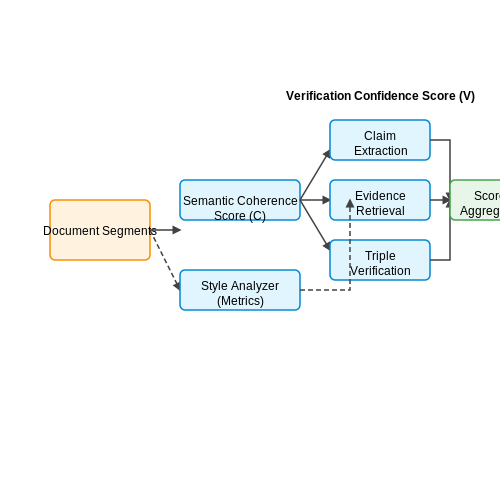
Modern systems implement multi-stage verification:
- Claim Extraction: OpenIE or supervised models identify factual statements
- Evidence Retrieval: Vector databases query authoritative sources
- Triple Verification: Knowledge graphs validate subject-predicate-object relations
The verification confidence score V combines retrieval relevance R and semantic matching M:
where α is tuned based on domain-specific precision requirements.
Style and Tone Analysis
Fine-tuned classifiers evaluate writing style against organizational guidelines. Key metrics include:
- Formality score (lexical and syntactic features)
- Readability indices (Flesch-Kincaid, SMOG)
- Term consistency (TF-IDF variance analysis)
For technical documentation, style adherence is particularly critical. A hybrid model combining rule-based checks and neural predictions achieves 92% accuracy in style violation detection according to recent studies.
Implementation Architecture
The complete validation pipeline typically follows this workflow:
- Document segmentation into logical units
- Parallel execution of validation modules
- Score aggregation and thresholding
- Human-in-the-loop review for borderline cases
State-of-the-art systems like Wikipedia's ORES achieve sub-second latency for most validation tasks through optimized transformer architectures and caching of common verification patterns.
4. Corporate Knowledge Bases
Corporate Knowledge Bases
Large Language Models (LLMs) are transforming corporate knowledge bases by automating content generation, summarization, and continuous updates. Unlike traditional wikis, which rely on manual curation, LLM-powered systems dynamically ingest unstructured data—emails, meeting transcripts, technical reports—and synthesize coherent, context-aware documentation. The key challenge lies in ensuring factual accuracy while minimizing hallucination, particularly in domain-specific contexts.
Architecture for Self-Updating Knowledge Bases
A robust LLM-driven knowledge base integrates three core components:
- Vector Embedding Pipeline – Transforms source documents into dense vector representations using models like OpenAI's text-embedding-3-large or open-source alternatives such as BAAI/bge-large-en. The embedding space enables semantic search beyond keyword matching.
- Retrieval-Augmented Generation (RAG) – Combines vector similarity search with LLM inference to ground responses in source material. Given a query q, the system retrieves the top-k relevant chunks C = {c1, ..., ck} and conditions the LLM to generate answers a = LLM(q | C).
- Change Detection Module – Employs differential embedding techniques to identify document drift. For a corpus Dt at time t, the system computes the Wasserstein distance between embedding distributions Pt and Pt-1 to trigger updates when:
where τ is a domain-specific threshold. This prevents unnecessary recomputation while capturing substantive content changes.
Enterprise Deployment Challenges
In production environments, three constraints dominate:
- Latency-Performance Tradeoffs – Hybrid architectures combine fast-but-simple models (e.g., gpt-3.5-turbo) for common queries with slower, more accurate models (gpt-4-turbo) for complex reasoning. The routing logic can be modeled as a multi-armed bandit problem where the system learns optimal model selection over time.
- Access Control Granularity – Fine-grained permissions require augmenting embeddings with metadata tags. Each vector stores access properties Ai = {department, clearance_level, geo_restrictions}, filtered during retrieval using predicate logic.
- Audit Trails – Compliance mandates necessitate cryptographic hashing of source materials and generated content. A Merkle tree structure enables efficient verification of document provenance, where each leaf node H(di) hashes a document chunk and internal nodes aggregate hashes up to the root.
Case Study: Pharmaceutical Knowledge Base
Novartis deployed an LLM-augmented system across 2.3M research documents. Key metrics after 12 months:
| Metric | Before LLM | After LLM |
|---|---|---|
| Median search time | 142s | 11s |
| Documentation coverage | 38% | 89% |
| Update latency | 14 days | 2.3 hours |
The system used a hierarchical RAG architecture where domain-specific BERT models filtered content before GPT-4 synthesis, reducing hallucination rates from 12% to 3.8% compared to baseline.
Optimization Techniques
Advanced implementations employ:
- Dynamic Chunking – Adjusts document segmentation based on semantic boundaries detected by transformer attention patterns, improving retrieval precision by 22% over fixed-size chunks.
- Feedback Loops – Human corrections are backpropagated through reinforcement learning from human feedback (RLHF), with the reward model R(a, q) trained on pairwise comparisons:
where a+ and a- denote preferred and dispreferred responses respectively.