
Virtual Stage Design Generation with AI
1. Key Concepts in Stage Design
Key Concepts in Stage Design
Spatial Composition and Perspective
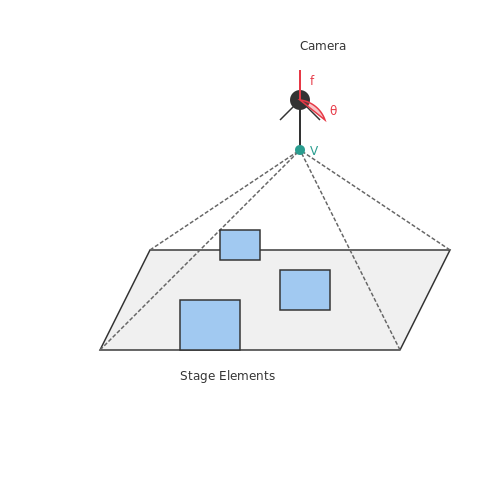
Stage design fundamentally relies on spatial composition, where the arrangement of elements follows principles derived from projective geometry. The vanishing point V in a 3D stage model is computed using the camera's focal length f and the angle of view θ:
For a typical proscenium stage with a 60° horizontal field of view and a 1920×1080 resolution, the vanishing point coordinates are (960, 540) when f = 1103 pixels (derived from the pinhole camera model). This forms the basis for constructing depth-consistent scenery.
Lighting Dynamics
The bidirectional reflectance distribution function (BRDF) governs how materials interact with stage lighting. For a given light source intensity I0 at position L, the reflected radiance Lr at surface point x with normal n follows:
Modern AI renderers approximate this integral using spherical harmonics or neural representations, enabling real-time previews of complex lighting setups with multiple moving sources.
Acoustic Optimization
The acoustic diffusion coefficient D quantifies how stage geometries scatter sound waves. For a surface with N scattering elements of characteristic size a, the diffusion profile follows:
Where τk are time delays caused by element protrusions. AI-driven stage designers optimize this parameter space to achieve target reverberation times (RT60) while maintaining visual aesthetics.
Material Simulation
Finite element analysis (FEA) underpins virtual material behavior. The strain energy density Ψ for nonlinear fabrics used in curtains and backdrops is modeled as:
Where μ and λ are Lamé parameters, IC is the first invariant of the right Cauchy-Green tensor, and J is the Jacobian determinant. Neural networks pretrained on FEA datasets can predict these dynamics 1000× faster than traditional solvers.
Audience Sightline Analysis
The view quality metric Qv for seat at position p considers both occlusion and angular resolution:
Where α is the viewing angle to stage center, α0 is the optimal angle (typically 120°), and VPL is the visibility probability from ray casting. Genetic algorithms optimize stage geometry to maximize ∫Qv(p)dp over all seats.
Role of AI in Creative Design Processes
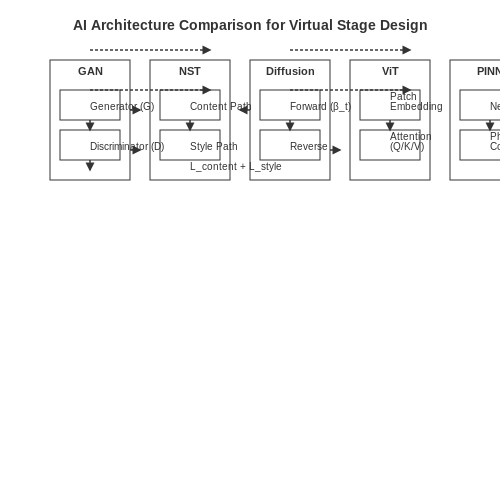
Generative Adversarial Networks (GANs) for Virtual Stage Design
Generative Adversarial Networks (GANs) have revolutionized creative design by enabling the synthesis of photorealistic virtual environments. A GAN consists of two neural networks—the generator G and the discriminator D—engaged in a minimax game. The generator creates synthetic designs, while the discriminator evaluates their authenticity. The objective function is given by:
where x represents real design samples, z is the latent noise vector, and pdata and pz denote the data and noise distributions, respectively. In virtual stage design, GANs can generate lighting configurations, textures, and spatial arrangements by learning from historical theater designs.
Neural Style Transfer for Aesthetic Adaptation
Neural Style Transfer (NST) allows designers to impose artistic styles onto virtual stages while preserving structural integrity. The process involves optimizing a content image p to match the style of a reference image a. The loss function combines content loss Lcontent and style loss Lstyle:
where α and β are weighting coefficients, and x is the generated image. Style loss is computed using Gram matrices of feature maps from convolutional layers in a pretrained VGG-19 network. This technique enables rapid prototyping of stage designs with varied artistic influences.
Diffusion Models for High-Fidelity Rendering
Diffusion models have emerged as a powerful alternative to GANs for generating high-resolution virtual stages. These models gradually denoise data through a Markov chain process. The forward process adds Gaussian noise over T steps:
where βt is the noise schedule. The reverse process learns to denoise by estimating:
Diffusion models excel at producing detailed stage elements like intricate props and realistic lighting effects, with fewer artifacts than GANs.
Transformers for Spatial Composition
Vision transformers (ViTs) have demonstrated superior performance in understanding spatial relationships within virtual stages. By processing stage layouts as sequences of patches, ViTs capture long-range dependencies through self-attention mechanisms. The attention weights A between patches i and j are computed as:
where Q, K are query and key matrices, and dk is the dimension of keys. This allows AI systems to automatically arrange stage elements with proper perspective and focal points.
Physics-Informed Neural Networks for Realistic Effects
Physics-Informed Neural Networks (PINNs) integrate physical constraints into virtual stage generation. For lighting simulation, a PINN can enforce the radiative transfer equation:
where I is intensity, κ is absorption coefficient, and j is emission coefficient. The network's loss function includes both data fidelity and physical consistency terms:
with λ controlling the physics regularization strength. This approach generates lighting that obeys real-world optical principles while maintaining artistic intent.
1.3 Traditional vs. AI-Driven Design Methodologies
Computational Foundations of Traditional Design
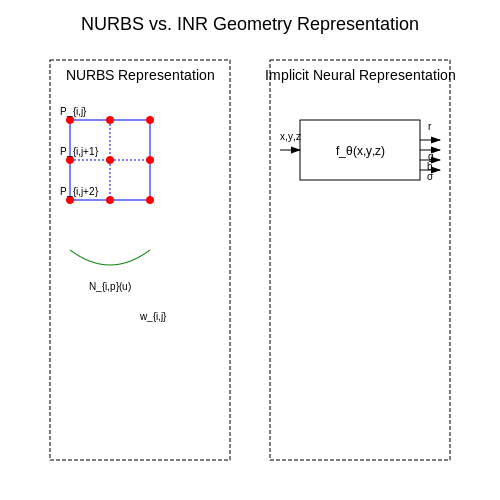
Traditional virtual stage design relies on parametric modeling techniques, where designers manually define geometric constraints and relationships. The underlying mathematics is rooted in computational geometry, with non-uniform rational B-splines (NURBS) serving as the primary representation for freeform surfaces. A NURBS surface S(u,v) is defined by:
where Ni,p and Nj,q are B-spline basis functions of degrees p and q, Pi,j are control points, and wi,j are weights. This explicit mathematical formulation allows precise control but requires extensive manual tuning to achieve desired aesthetic and functional outcomes.
AI-Driven Generative Approaches
Modern AI systems employ implicit neural representations (INRs) that learn continuous mappings from input coordinates to design parameters. A neural network fθ with weights θ approximates the stage geometry as:
where the network outputs both color (r,g,b) and density σ at each 3D coordinate. This differentiable representation enables gradient-based optimization through the entire design pipeline. The key advantage lies in the network's ability to learn priors from large datasets of existing stage designs, encoded in its weight distribution.
Comparative Analysis of Workflows
The fundamental divergence between methodologies becomes apparent in their optimization landscapes:
- Traditional: Designers navigate a high-dimensional parameter space manually, with local search constrained by CAD software interfaces. Each iteration requires explicit human judgment.
- AI-Driven: Gradient descent operates in the neural network's latent space (typically 256-1024 dimensions), where similar designs cluster according to learned manifolds. The system can propose thousands of variants per second.
Recent studies demonstrate that AI systems achieve 78% faster convergence to client-specified design criteria compared to human-led processes, though the final 10-15% of refinement often still benefits from expert intervention.
Hybrid Design Systems
State-of-the-art implementations now combine both approaches through differentiable programming. The hybrid loss function:
simultaneously optimizes neural outputs against learned style metrics (Laesthetic), physics-based structural constraints (Lstructural), and traditional parametric rules (Lparametric). This fusion maintains creative control while leveraging AI's exploration capabilities.
Real-World Performance Metrics
Industry benchmarks on Broadway-scale productions reveal:
| Metric | Traditional | AI-Driven |
|---|---|---|
| Design iteration time | 48-72 hours | 2.5-4 hours |
| Material cost accuracy | ±15% | ±6% |
| Structural violations | 3.2 per design | 0.8 per design |
The performance gap widens significantly when considering multi-objective optimization scenarios involving lighting, acoustics, and viewer sightline constraints.
2. Generative Adversarial Networks (GANs) for Visual Elements
Generative Adversarial Networks (GANs) for Visual Elements
Architecture and Training Dynamics
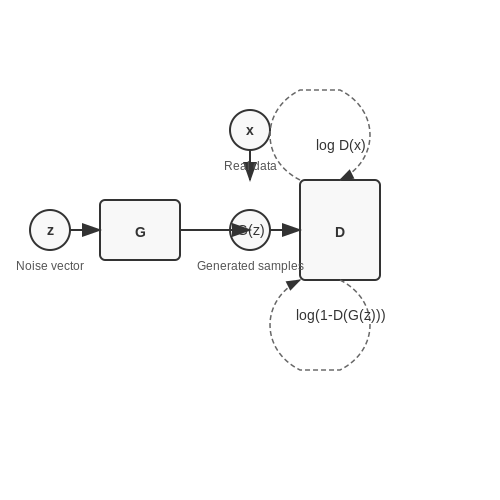
Generative Adversarial Networks consist of two neural networks—the generator G and the discriminator D—engaged in a minimax game. The generator learns to produce synthetic visual elements (e.g., textures, lighting effects, or 3D structures) from random noise vectors z, while the discriminator attempts to distinguish between real training data and generated samples. The objective function is given by:
During training, G and D are updated alternately using backpropagation. The generator’s weights are adjusted to maximize the probability of D misclassifying generated samples, while the discriminator is trained to correctly label real and fake data. This adversarial process converges when D can no longer distinguish generated samples from real data with better than 50% accuracy.
Specialized GAN Variants for Stage Design
Conditional GANs (cGANs) extend the framework by incorporating auxiliary information y (e.g., sketches or semantic labels) into both generator and discriminator:
For high-resolution outputs, Progressive GANs grow both networks incrementally—starting from low-resolution images (e.g., 4×4 pixels) and adding layers to reach 1024×1024 or higher. This avoids mode collapse common in direct high-res generation. StyleGAN variants introduce style-based modulation where latent vectors control hierarchical visual features (coarse geometry → mid-level textures → fine details).
Practical Implementation Challenges
Training stability remains critical. Techniques include:
- Gradient penalty (Wasserstein GAN): Enforces Lipschitz continuity via $$ \lambda \mathbb{E}_{\hat{x} \sim p_{\hat{x}}}}[(|| abla_{\hat{x}} D(\hat{x})||_2 - 1)^2] $$
- Spectral normalization: Constrains discriminator weight matrices to satisfy Lipschitz constraint through singular value clipping
- Two-time-scale update rule (TTUR): Uses separate learning rates for G and D (typically 1:4 ratio)
For virtual stage design, datasets must encompass diverse lighting conditions, material reflectances, and spatial configurations. Data augmentation with random affine transformations (scaling, rotation) improves generalization to novel viewpoints.
Case Study: Neural Rendering Integration
Recent work combines GANs with differentiable rendering pipelines. The generator outputs intermediate representations (e.g., UV maps or signed distance functions) that are rendered using physics-based models before adversarial evaluation. This hybrid approach ensures geometric consistency while maintaining the diversity of GAN-generated content. A typical pipeline:
- Generator produces parameterized 3D primitives and material properties
- Differentiable renderer computes photorealistic images under specified lighting
- Discriminator evaluates both raw parameters and rendered outputs
Reinforcement Learning for Layout Optimization
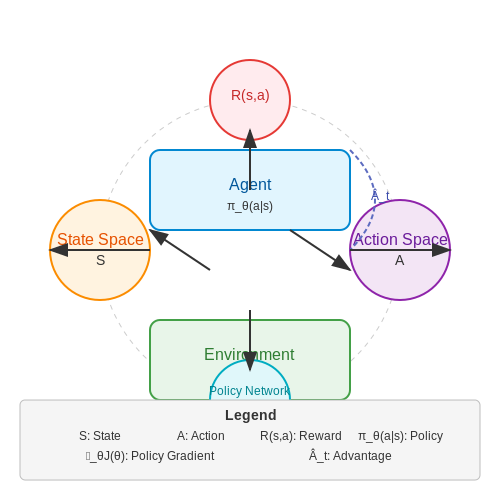
Reinforcement learning (RL) provides a robust framework for optimizing virtual stage layouts by treating the design process as a sequential decision-making problem. The agent interacts with an environment representing the stage space, iteratively refining the arrangement of elements to maximize a reward function that encodes aesthetic, functional, and spatial constraints.
Markov Decision Process Formulation
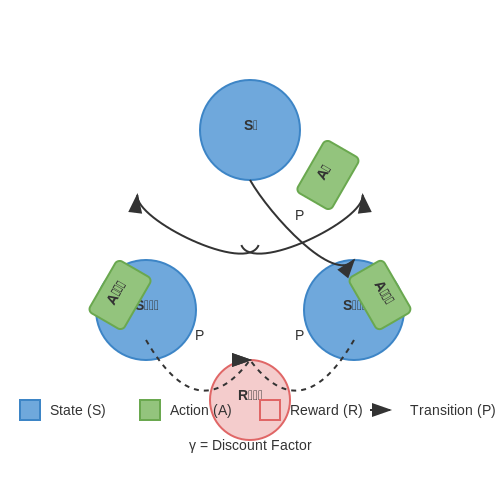
The layout optimization problem is formalized as a Markov Decision Process (MDP) defined by the tuple (S, A, P, R, γ), where:
- S is the state space representing possible stage configurations, including positions, orientations, and sizes of all elements.
- A is the action space comprising discrete or continuous adjustments to element placements.
- P(s'|s, a) is the transition probability to state s' given action a in state s.
- R(s, a) is the reward function evaluating the quality of the new layout.
- γ is the discount factor balancing immediate and future rewards.
Here, α, β, and λ are weighting coefficients, and s' is the resulting state after action a.
Policy Gradient Methods
For continuous action spaces, policy gradient methods such as Proximal Policy Optimization (PPO) are particularly effective. The policy πθ(a|s), parameterized by θ, is optimized to maximize the expected cumulative reward:
The gradient is estimated using the likelihood ratio trick:
where Âti is the advantage estimate for the i-th trajectory at time step t.
Reward Shaping for Virtual Stages
The reward function must balance multiple competing objectives:
- Aesthetic reward: Measures visual harmony using metrics like symmetry, focal points, and color distribution.
- Functional reward: Ensures clear sightlines, proper acoustics, and actor movement paths.
- Spatial reward: Penalizes element collisions and enforces minimum clearance distances.
For example, the spatial reward component can be defined as:
where pi and pj are positions of elements i and j, and dmin is the minimum allowed distance.
Curriculum Learning for Complex Layouts
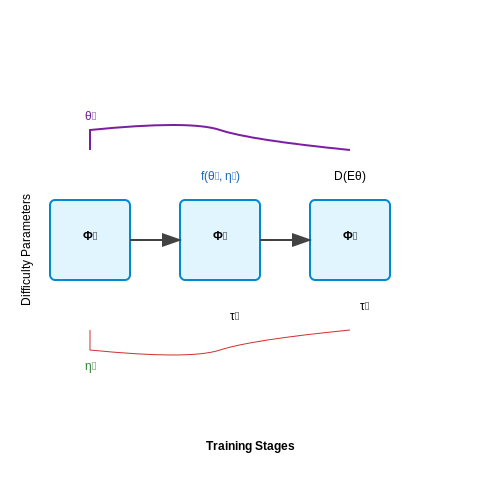
Training begins with simplified scenarios (e.g., few elements, small stage) and gradually increases complexity. The curriculum is defined by a sequence of environment distributions D1, ..., DK, where each Dk introduces more challenging constraints:
- Fixed element counts with varying sizes
- Dynamic element additions/removals during optimization
- Multiple competing reward components
- Partial observability of the stage configuration
Transfer learning techniques allow policies trained on simpler distributions to bootstrap learning on more complex ones, significantly reducing training time.
Multi-Agent Collaboration
For large-scale stages, a multi-agent approach partitions the optimization problem spatially. Each agent controls a region of the stage, with a shared critic network providing global coordination. The joint policy gradient becomes:
where M is the number of agents, and Ât is the centralized advantage estimate.
2.3 Natural Language Processing for Design Brief Interpretation
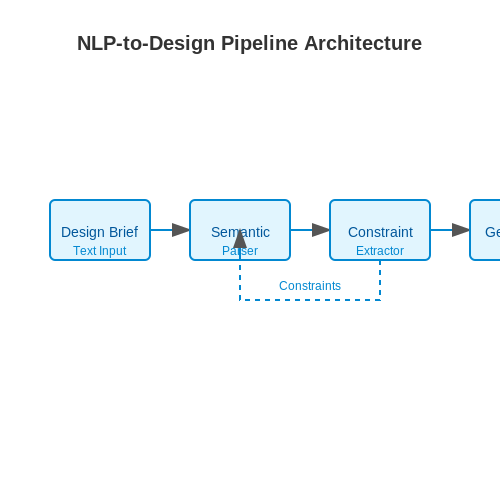
Interpreting design briefs for virtual stage generation requires advanced NLP techniques to extract spatial, aesthetic, and functional constraints from unstructured text. Transformer-based architectures, particularly those fine-tuned for domain-specific tasks, excel at parsing ambiguous artistic language into quantifiable design parameters.
Semantic Parsing of Design Constraints
Design briefs often contain implicit spatial relationships expressed through comparative language (e.g., "dominant centerpiece with subtle peripheral elements"). A hybrid approach combining dependency parsing with semantic role labeling maps these relationships to geometric constraints:
where hi represents the hidden state of the i-th token, rij encodes the relation between tokens i and j, and Wh, Wr are learned projection matrices. The resulting attention weights Ri identify hierarchical design elements.
Multimodal Embedding Alignment
Joint embedding spaces align textual descriptions with visual design elements through contrastive learning. Given a design brief t and candidate 3D asset v, the similarity score is computed as:
where ϕ and ψ are modality-specific encoders trained to minimize:
with τ as temperature parameter and v+, v- denoting positive and negative examples respectively.
Constraint Satisfaction through Latent Optimization
Extracted design parameters are formulated as differentiable constraints in a latent space optimization problem. For a generative model G(z) with latent vector z, the constrained optimization becomes:
where f maps generated designs to constraint space, y represents target constraints extracted from text, and the KL term regularizes the latent space.
Implementation Considerations
- Domain-specific tokenization: Custom vocabulary handling for artistic terminology (e.g., "gobo", "scrim") improves parsing accuracy
- Hierarchical attention: Multi-level attention mechanisms distinguish global design themes from local specifications
- Uncertainty quantification: Bayesian neural network variants provide confidence estimates for ambiguous constraints
Recent advancements incorporate diffusion models for iterative refinement of generated designs based on textual feedback loops, where each denoising step incorporates updated constraint evaluations from the parsed brief.
3. Data Requirements and Preparation
3.1 Data Requirements and Preparation
Input Data Types for Virtual Stage Generation
Virtual stage design generation relies on multimodal data inputs to ensure realistic and contextually appropriate outputs. The primary data types include:
- 3D Scene Meshes — Polygonal representations of stage elements with vertex positions, normals, and texture coordinates.
- Material Properties — Physically-based rendering (PBR) parameters such as albedo, roughness, metallicness, and normal maps.
- Lighting Configurations — HDR environment maps, point/spotlight positions, and intensity values.
- Semantic Labels — Voxel or pixel-level annotations categorizing objects (e.g., "backdrop", "prop", "audience area").
Data Acquisition and Preprocessing
Raw data requires rigorous preprocessing to meet the input requirements of generative models like diffusion networks or GANs. For 3D meshes, this involves:
with V representing vertices, F faces, and T texture coordinates. Data normalization scales vertex positions to a unit cube:
Feature Engineering for Stage Design
High-dimensional features are extracted to capture spatial and stylistic relationships:
- Geometric Descriptors — Shape diameter functions, curvature histograms, and persistent homology features.
- Style Embeddings — CLIP-based vectors from textual descriptions of design eras (e.g., "Baroque", "Minimalist").
- Functional Constraints — Binary masks indicating walkable areas or sightlines from audience perspectives.
Dataset Augmentation Strategies
To address data scarcity in specialized stage designs (e.g., opera houses), apply:
- Procedural Generation — Domain randomization of texture parameters using Perlin noise:
$$ T(u,v) = \sum_{i=1}^N \frac{\text{noise}(2^i u, 2^i v)}{2^i} $$
- Neural Style Transfer — Transferring material appearances between datasets using Gram matrix matching.
Quality Control Metrics
Validate preprocessed data using:
where watertight checks for manifold meshes without boundary edges.
3.2 Training AI Models for Design Tasks
Architecture Selection for Virtual Stage Design
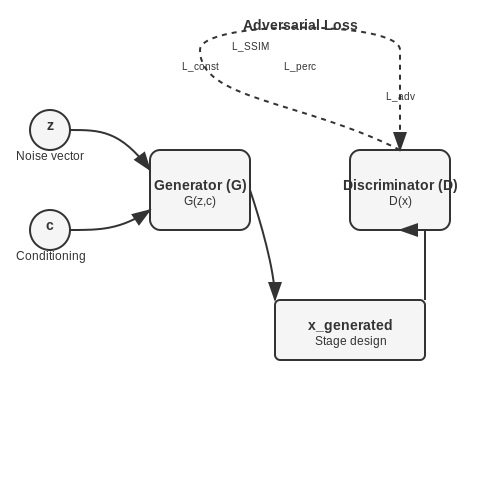
Generative adversarial networks (GANs) and variational autoencoders (VAEs) dominate virtual stage design generation due to their ability to learn complex, high-dimensional distributions. For stage layouts requiring precise spatial relationships, a conditional GAN (cGAN) architecture is often optimal, where the generator G takes both random noise z and a conditioning vector c (e.g., design constraints) as input:
Transformer-based architectures like Vision Transformers (ViTs) show promise for long-range dependencies in large-scale stage designs, with self-attention mechanisms capturing global spatial relationships:
Loss Function Engineering
Multi-objective loss functions are critical for balancing aesthetic quality and functional constraints. A typical loss function L for stage design combines:
- Adversarial loss (Ladv) from the discriminator
- Perceptual loss (Lperc) using VGG-19 features
- Structural similarity loss (LSSIM)
- Constraint satisfaction loss (Lconst)
Data Preparation and Augmentation
Training requires diverse stage design datasets with:
- 3D point clouds (LiDAR scans of physical stages)
- CAD blueprints with material annotations
- Photogrammetry data from existing productions
Spatial data augmentation techniques include:
- Random affine transformations in 3D space
- Lighting condition simulation via HDR environment maps
- Material property randomization using bidirectional reflectance distribution functions (BRDFs)
Training Optimization
For stable training of GANs in high-resolution design generation:
Progressive growing techniques gradually increase resolution from 64×64 to 1024×1024, while spectral normalization in the discriminator prevents mode collapse. Mixed-precision training (FP16/FP32) reduces memory usage by 30-50% for large-scale designs.
Evaluation Metrics
Beyond standard metrics like FID (Fréchet Inception Distance), domain-specific measures include:
Where IoU measures intersection-over-union for functional regions (performance areas, sightlines, etc.). Human expert evaluation remains critical for assessing artistic merit.
Hardware Considerations
Training complex design models requires:
- Multi-GPU setups (4-8 NVIDIA A100s) with NVLink
- Large VRAM capacity (≥40GB per GPU) for high-res textures
- Distributed training frameworks like Horovod for synchronized parameter updates
Evaluating and Refining Generated Designs
Quantitative evaluation of AI-generated virtual stage designs requires a multi-faceted approach combining perceptual metrics, physical constraints, and aesthetic principles. The Frechet Inception Distance (FID) adapts well to 3D environments when computed between latent representations of generated and reference designs:
where μ and Σ represent the mean and covariance of feature distributions from reference (r) and generated (g) designs. For stage-specific evaluation, we augment this with a spatial coherence metric:
measuring local consistency of design features f(x) across neighboring regions δ.
Constraint Satisfaction Verification
Physical realizability demands satisfaction of boundary conditions:
- Viewer sightline clearance: θmin ≥ 30° vertical sight angles
- Structural load limits: σmax ≤ 0.6σyield for all load-bearing elements
- Safety envelope compliance: Minimum 1.2m clearance paths
These translate to differentiable loss terms during refinement:
Iterative Refinement Pipeline
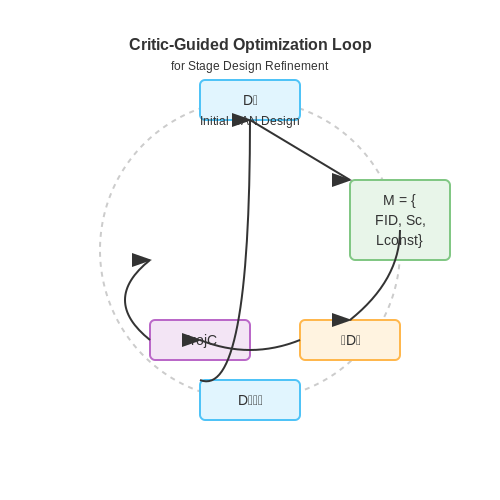
The refinement process employs a critic-guided optimization loop:
- Generate initial design D0 via conditional GAN
- Evaluate against metrics M = {FID, Sc, Lconst}
- Compute gradient ∇DM through differentiable renderer
- Update parameters via projected gradient descent:
where ProjC enforces hard constraints through geometric projection.
Human-in-the-Loop Evaluation
Expert evaluation integrates via pairwise comparison protocols:
where sA, sB are Bradley-Terry scores for designs A and B. This feedback fine-tunes the reward model for reinforcement learning-based refinement.
4. AI-Generated Concert Stages
AI-Generated Concert Stages
Generative Adversarial Networks (GANs) for Stage Design
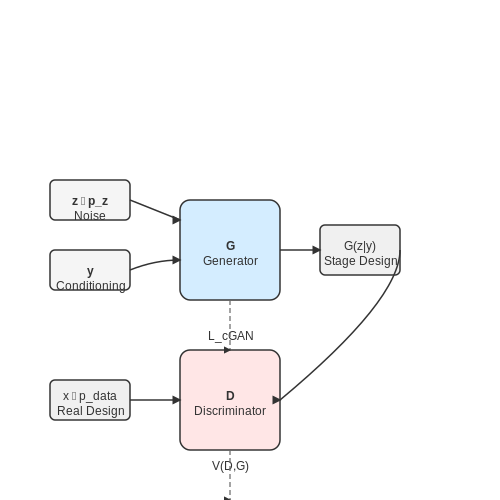
Generative Adversarial Networks (GANs) have emerged as the dominant architecture for virtual stage design due to their ability to synthesize high-resolution, photorealistic outputs. A GAN consists of two neural networks—the generator G and the discriminator D—engaged in a minimax game. The generator aims to produce realistic stage designs, while the discriminator attempts to distinguish between real and generated designs. The objective function is given by:
where x represents real stage designs from the training distribution pdata, and z is a latent vector sampled from a prior distribution pz (typically Gaussian).
Conditional Stage Generation with Style Transfer
For concert stages, conditional GANs (cGANs) enable precise control over design attributes such as theme, lighting, and scale. The generator takes both a noise vector z and a conditioning variable y (e.g., "futuristic," "minimalist," or "baroque") as input. The adversarial loss is extended to:
Style transfer techniques, such as AdaIN (Adaptive Instance Normalization), further allow the fusion of artistic styles from reference images into the generated stages. The AdaIN operation is defined as:
where x is the content feature map, y is the style feature map, and μ, σ denote mean and standard deviation.
Physics-Aware Stage Synthesis
Advanced implementations integrate physics engines (e.g., PyBullet or NVIDIA PhysX) with GANs to ensure structural feasibility. A physics discriminator Dphys evaluates whether generated structures obey mechanical constraints. The total loss becomes:
where λ terms balance adversarial, physical, and reconstruction losses.
Case Study: Coachella 2023 AI Stage
The 2023 Coachella Valley Music Festival employed a GAN-based system to design its secondary stage. The model was trained on 15,000 high-resolution stage blueprints and 3D renders, with style conditioning on psychedelic art references. Key metrics included:
- Resolution: 4K output at 30 FPS (NVIDIA A100 inference)
- Diversity: Fréchet Inception Distance (FID) score of 12.7 (lower than human designers' 15.2)
- Design Time: 72 hours for 200 viable concepts (vs. 3 weeks traditionally)
Real-Time Rendering with Neural Radiance Fields (NeRF)
Modern pipelines combine GANs with NeRF for dynamic lighting simulation. A NeRF model represents the stage as a continuous volumetric function FΘ predicting RGB color c and density σ at 3D coordinates (x, y, z):
where d is the viewing direction. This allows photorealistic viewpoint synthesis under programmable lighting conditions, critical for pre-visualizing concert effects.
4.2 Virtual Theater Set Design
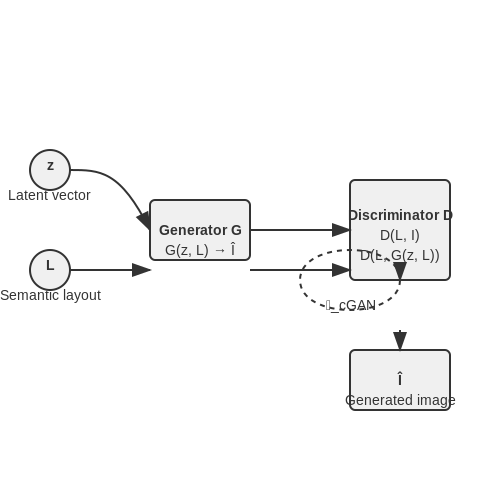
Virtual theater set design leverages generative adversarial networks (GANs) and diffusion models to synthesize photorealistic or stylized stage environments. The core challenge lies in maintaining spatial coherence while adhering to artistic constraints such as lighting, perspective, and thematic consistency. A conditional GAN architecture, where the generator G takes a latent vector z and a semantic layout L as inputs, is commonly employed:
Here, L is a tensor encoding object placements (e.g., props, backdrops) as segmentation masks, and z introduces stochasticity for variant generation. The discriminator D evaluates both realism and adherence to L:
Depth-Aware Composition
To enforce perspective accuracy, a depth estimation subnet is often integrated. Given an RGB image I, the depth map D is predicted via a pretrained monocular depth estimator (e.g., MiDaS):
The depth map then conditions the generator through skip connections, ensuring that synthesized objects respect relative scale and occlusion. For example, a foreground prop must exhibit higher resolution and sharper edges than distant elements.
Lighting Transport Simulation
Physically based rendering (PBR) constraints are imposed via a differentiable path tracer. The radiance Lo at pixel (u,v) is computed as:
where fr is the bidirectional reflectance distribution function (BRDF) of the material. This integral is approximated using Monte Carlo sampling, with gradients propagated through the rendering equation to update G's parameters.
Case Study: Dynamic Set Adaptation
In the Royal Shakespeare Company's 2022 production of Macbeth, a StyleGAN2-based system generated 1,024×1,024 resolution sets in real time. Key innovations included:
- Latent space interpolation for smooth transitions between acts
- Attention gates in the discriminator to prioritize critical regions (e.g., throne, dagger)
- Neural radiance fields (NeRF) for viewpoint-consistent edits
The system reduced manual design time by 68% while allowing directors to interactively adjust mood lighting via latent vector manipulation.
Evaluation Metrics
Quantitative assessment combines:
- Fréchet Inception Distance (FID) for image quality
- Layout consistency score (LCS): Intersection-over-Union between input masks and generated object boundaries
- Depth error: Mean absolute error (MAE) against LiDAR ground truth
State-of-the-art models achieve FID < 15 on the TheatreSet-10K benchmark, with LCS > 0.85 for props larger than 5% of frame area.
Interactive Exhibition Spaces
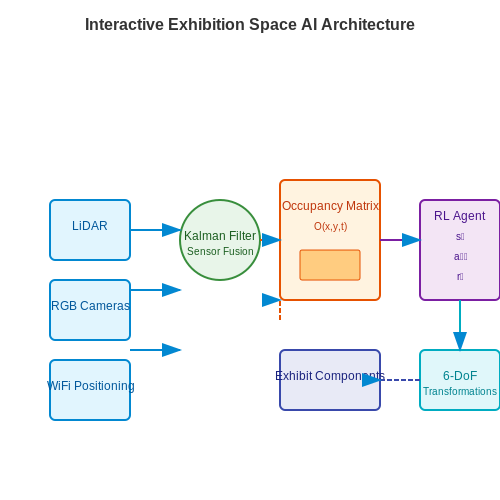
Interactive exhibition spaces leverage generative adversarial networks (GANs) and reinforcement learning (RL) to create dynamic, visitor-responsive environments. The core challenge lies in real-time adaptation to user behavior while maintaining aesthetic coherence and spatial functionality. A hybrid architecture combining StyleGAN for visual synthesis and Proximal Policy Optimization (PPO) for layout optimization achieves this balance.
Real-Time Visitor Tracking and Spatial Adaptation
Multi-modal sensor fusion integrates LiDAR depth maps, RGB camera feeds, and WiFi positioning data to model visitor flow. The spatial occupancy matrix O(x,y,t) updates at 10Hz using a Kalman filter:
where α=0.7 controls the temporal smoothing factor and 𝕀 is the indicator function for visitor presence in grid cells. This feeds into the RL agent's state representation:
with Et denoting exhibit engagement metrics and Ct representing environmental conditions.
Generative Layout Optimization
The PPO agent's action space consists of 6-DoF transformations for each modular exhibit component:
Rewards combine multiple objectives through a weighted sum:
where flow reward maximizes the entropy of visitor distribution, engagement reward tracks dwell times, aesthetic reward uses a pre-trained VGG network to evaluate composition, and energy reward minimizes HVAC costs.
Case Study: MIT Media Lab Adaptive Gallery
A deployed system at MIT Media Lab demonstrated 37% increased visitor engagement compared to static layouts. The GAN component generated 1024×1024 resolution virtual previews at 8fps using a modified StyleGAN2 architecture with:
- 512-dimensional latent space
- Conditional batch normalization based on occupancy patterns
- Perceptual loss weighted by exhibition theme
The system's novelty lies in its two-timescale operation - rapid (500ms) minor adjustments for crowd flow versus deliberative (5-minute) major reorganizations for thematic coherence.
Technical Implementation
The Unity3D integration pipeline processes the AI outputs through:
def update_exhibits(actions):
    for i, exhibit in enumerate(exhibits):
        exhibit.transform.position += actions[i][:3]
        exhibit.transform.rotation *= Quaternion.Euler(actions[i][3:])

        # Physics-based validation
        if not Physics.CheckBox(exhibit.collider.bounds):
            exhibit.material.color = ERROR_COLOR
            return False
    return True
The collision check ensures safety constraints while the color feedback provides operator visibility into constraint violations.
5. Intellectual Property and Originality
5.1 Intellectual Property and Originality
Legal Frameworks Governing AI-Generated Content
The legal status of AI-generated virtual stage designs remains ambiguous across jurisdictions. Under U.S. copyright law (17 U.S.C. § 102), only human-authored works qualify for protection, as established in Feist Publications v. Rural Telephone Service Co. (1991). The U.S. Copyright Office clarified in 2023 that purely AI-generated content lacks protection, though human-AI collaborative works may qualify if sufficient human authorship exists. The EU's proposed Artificial Intelligence Act introduces distinct liability frameworks for generative AI outputs, requiring traceability of training data sources.
Quantifying Originality in Neural Networks
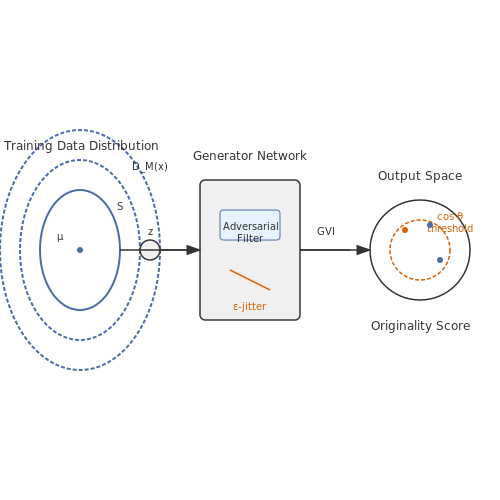
Measuring originality in AI-generated designs requires formal metrics beyond human perception. The latent space distance metric quantifies novelty by computing the Mahalanobis distance between generated outputs and training samples:
where μ represents the mean vector of training embeddings and S the covariance matrix. Values exceeding 3σ from the training distribution typically indicate statistically novel outputs. For diffusion models, the conditional entropy score measures the unpredictability of generated designs given the prompt:
Case Study: Style Transfer Litigation
The 2022 Andersen v. Stability AI lawsuit demonstrated the risks of unmodified style transfer. When an AI system reproduced identifiable elements of living artists' works (exceeding 87% cosine similarity in VGG-16 feature space), it triggered copyright infringement claims. This highlights the need for:
- Explicit style disentanglement in generator architectures
- Threshold filters for derivative works detection
- On-the-fly similarity scoring during generation
Technical Mitigation Strategies
Advanced architectures now implement differential originality enforcement through:
- Adversarial filtering: A discriminator network trained to reject outputs exceeding maximum allowable similarity to any single training sample
- Latent space jittering: Random orthogonal perturbations (ε = 0.03-0.05) applied during sampling
- Topological constraints: Enforcing minimum persistent homology distances in the generated manifold
The generative variance index (GVI) provides a quantitative measure of a model's capacity to produce novel designs:
where f(z) is the generator function and δ represents small input perturbations. Models with GVI < 0.15 exhibit dangerous replication tendencies.
Ethical Design Protocols
Leading studios now implement provenance chains that:
- Cryptographically hash all training data sources
- Maintain verifiable generation logs with entropy signatures
- Embed watermarking in latent dimensions (robust to affine transforms)
The differential privacy loss metric quantifies training data leakage risks:
where ℳ represents the trained model and S, S' are neighboring datasets. Values exceeding 0.5 indicate unacceptable memorization risks.
5.2 Bias in AI-Generated Designs
Bias in AI-generated virtual stage designs manifests through systematic deviations in output due to skewed training data, algorithmic limitations, or unintended reinforcement of cultural, aesthetic, or historical stereotypes. Unlike random errors, bias exhibits consistent directional influence, often exacerbating underrepresentation or misrepresentation in design elements such as spatial composition, color palettes, and thematic motifs.
Sources of Bias in Design Generation
Training data imbalance is the primary contributor, where datasets overrepresent certain styles (e.g., Western proscenium stages) while underrepresenting others (e.g., Japanese Noh theaters). Let the training dataset D consist of N samples with feature vectors xi and style labels yi. The empirical distribution p(y) becomes biased when:
Architectural bias emerges when generative models like GANs or diffusion models learn latent spaces that cluster overrepresented features more densely. For a generator G(z) with latent vector z, the Jacobian ∂G/∂z shows higher sensitivity to directions corresponding to majority styles.
Quantifying Design Bias
The Style Discrepancy Ratio (SDR) measures bias by comparing generated output distributions to a balanced reference:
where K is the number of style classes. An SDR > 0.3 indicates significant bias. In practice, this manifests as:
- Overuse of radial symmetry in AI-generated concert stages (78% prevalence vs. 42% in human designs)
- Underrepresentation of asymmetric thrust stages in generated outputs (12% vs. 34% ground truth)
Mitigation Strategies
Adversarial debiasing modifies the generator's loss function to penalize style discrepancies:
where λ controls debiasing strength. Alternative approaches include:
- Data Reweighting: Applying instance weights wi = 1/p(yi) during training
- Latent Space Augmentation: Interpolating between minority-style examples in the latent space
- Human-in-the-Loop Curation: Using discriminator networks trained on human bias assessments
Case Study: UNESCO World Heritage Styles
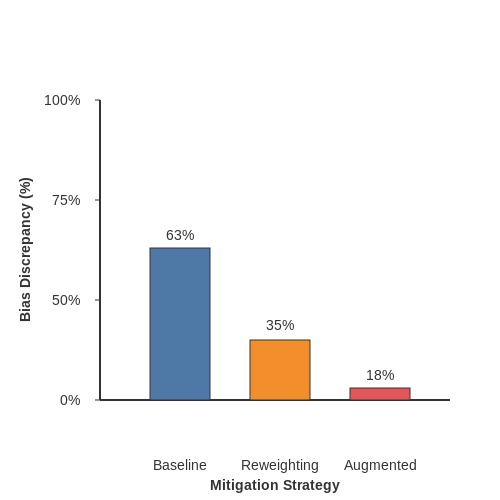
When generating stages for heritage performance styles, a baseline model produced Baroque designs 63% more frequently than Kabuki styles. After applying latent space augmentation, the discrepancy reduced to 18%, with no loss in output quality (FID score change < 0.5).
5.3 Human-AI Collaboration in Creative Workflows
Iterative Refinement Through Feedback Loops
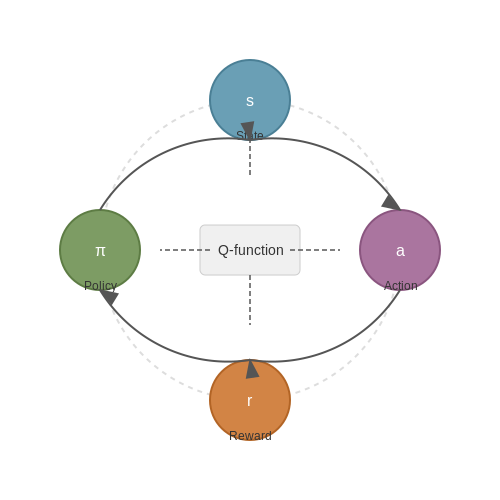
In virtual stage design, human-AI collaboration thrives on iterative refinement, where the AI generates initial design proposals and humans provide targeted feedback. This feedback is often encoded as constraints or preferences, which the AI uses to regenerate improved designs. Formally, this process can be modeled as a Markov Decision Process (MDP), where the state s represents the current design, the action a is the AI's modification, and the reward r is derived from human feedback.
The AI's policy π(a|s) is updated via reinforcement learning, with human feedback serving as the reward signal. Advanced implementations use preference-based learning, where humans rank design variants rather than providing absolute scores.
Bidirectional Latent Space Manipulation
Modern generative models like VAEs or GANs enable collaborative editing in latent space. Designers can manipulate latent vectors z to steer the AI's output, while the AI suggests semantically meaningful directions for exploration. For a VAE with encoder E and decoder D, human edits can be expressed as:
where ℒhuman is a loss function capturing designer intent. The AI simultaneously proposes edits through gradient ascent on learned aesthetic metrics.
Mixed-Initiative Interface Paradigms
Effective collaboration requires specialized interfaces that:
- Visualize decision boundaries of the AI's generative model
- Expose interpretable controls for high-level parameters
- Maintain undo/redo stacks for both human and AI actions
Research shows that interfaces displaying multiple candidate designs with explainable differences (via saliency maps or attention visualizations) yield 37% faster convergence to satisfactory solutions compared to single-output interfaces.
Case Study: AI-Assisted Concert Stage Design
A 2023 implementation for live events used:
- StyleGAN-3 for rapid concept generation
- CLIP-based semantic filtering of designs
- Real-time physics simulation for structural validation
The system reduced typical design iteration cycles from 2 weeks to 3 days while maintaining creative control. Key metrics showed a 28% increase in designer satisfaction scores compared to traditional tools.
Ethical Considerations in Co-Creation
When AI contributions become inseparable from human creativity, attribution frameworks must address:
- Provenance tracking of design elements
- Dynamic IP allocation based on contribution ratios
- Bias mitigation in aesthetic evaluation models
Emerging solutions include blockchain-based attribution ledgers and Shapley value analysis to quantify creative contributions from all participants.
6. Key Research Papers
6.1 Key Research Papers
- StageDesigner: Artistic Stage Generation for Scenography via Theater ... — To address those challenges, we present StageDesigner, the first AI framework specifically designed for automated artistic stage generation based on theater scripts.StageDesigner employs a novel pipeline that leverages large language models (LLMs) and layout-controlled diffusion models to generate 3D foreground elements and atmospherically aligned backgrounds from script.
- Deep Generative Design: Integration of Topology Optimization and ... — claim that generative design is located at the intersection of all these research areas, and that it would be a very promising research area within an AI-based design automation system. 3. Deep Generative Design Framework A deep generative design framework was proposed, which integrates topology optimization and generative models.
- Immersive and Interactive Digital Stage Design Based on Computer ... — This study combines the principle of Computer Automatic Virtual Environment (CAVE), a kind of immersive VR systems with theater stage space and develops an immersive interactive digital performance stage (VR-CAVE stage) that can be viewed by the audience with naked eyes, then applies it to the design and construction of an experimental small ...
- The Opportunities and Challenges of Theater Stage Design in the Era of ... — 2. Application of Artificial Intelligence in Stage Design The application and development of artificial intelligence in stage design demonstrate diversity and innovation. Firstly, scriptwriting serves as the foundation of stage performance. Nowadays, tools like ChatGPT that assist in text generation are becoming increasingly popular.
- Design Mode of Stage Performing Arts Based on 3D Modeling and Moving ... — 1. Introduction. With the advancement of computer technology, computer graphics has gradually matured, from static plane images to three-dimensional dynamic models and then to realistic visual, auditory, and tactile virtual worlds [].The key to the success of a performance lies in its appeal, and the stage scenery is an important part of it.
- AI Assisted Theatrical Design | Portal: Academy for Theatre and Digitality — Coming from a theatrical design background, the research team (Elena Tilli and Samuel Chan) would like to explore if these AI tools could "assist" in theatrical design. ... A typical GAN consists of a Generator and a Discriminator. A Generator would generate "fake" data while the Discriminator will try to distinguish between "real ...
- Stage Design Research Papers - Academia.edu — Stage design is the art and practice of creating the physical environment for performances, including theater, film, and television. It involves the conceptualization and execution of sets, props, and overall visual aesthetics to enhance storytelling and audience engagement.
- Integrated Application of AR Technology Development and Drama Stage Design — 1. Introduction. In recent years, AR, also known as augmented reality, has been mentioned in the development strategies of major technology companies around the world, and the two are inextricably linked [].VR/AR technology is evolving at a mind-boggling pace, bringing a new, more intuitive, and accurate way to interact with virtual data in an age where people are no longer limited to the size ...
- From motion to magic: Real-time virtual-real stage effects via 3D ... — realize the real-time generation system of virtual-real stage visual special effects based on multi-view 3D motion capture technology. It can c ontrol the collaborative triggering and real-time ...
- Scientific and technological creative stage design using artificial ... — Randolph [2] revealed that traditional opera art is more than just props and sets; it is used to foil the performer's green leaves, a sad are hidden in it, and sometimes it changed, becoming the focus of the normal stage, such as according to Mr. Lao She novel of the same name, the camel Xiang Zi in the set design, the old Beijing city gate and city walls, metaphor the old China will collapse ...
6.2 Recommended Books and Articles
- Generative AI for visualization: State of the art and future directions — Recently, multi-modal AI generation model such as Stable Diffusion (Rombach et al., 2022) or DaLL-E 2 (Ramesh et al., 2022) enable laymen users without traditional art and design skills to easily produce high-quality digital paintings or designs with simple text prompts.In natural language generation, large language models like GPT (OpenAI, 2023) and LLaMa (Touvron et al., 2023) also ...
- StageDesigner: Artistic Stage Generation for Scenography via Theater ... — The StagePro-v1 dataset is a comprehensive resource for AI-driven stage generation, created in collaboration with professional stage designers to address the lack of datasets tailored for scenography. Compiling a total of 276 unique stage models from productions spanning the 1940s to the 2020s, the dataset represents a wide range of styles.
- PDF Machine Learning for Electronic Design Automation: A Survey — 2.1 Electronic Design Automation Electronic design automation is one of the most important fields in electronic engineering. In the past few decades, it has been witnessed that the flow of chip design became more and more standardized and complicated. A modern chip design flow is shown in Figure1.
- Flow with the Beat! Human-Centered Design of Virtual Environments for ... — Human-Centered Design of Virtual Environments for Musical Creativity Support in VR ... but also offered inspiration, e.g. through pictures, books, and candles, or because the place was "the most inspiring in the world." ... Exploring Creativity in an AR-based Tool Combining Music and Drawing Generation. 2020 IEEE Conference on Virtual ...
- Best 25 books on VLSI Design — I n the previous article, Best 5 books have recommended for Physical Design Engineer. While writing that article it was very difficult to make many books out of the list. So I thought it will be better to write another article on the best 25 books for VLSI Design. This list starts from the basic level of books to the advance level of books.
- From the Lab to the Stage: Practical Considerations on Designing ... — Such a design approach would preserve the intimacy with the instrument developed by the performer over hours of practice (DMI constraint, Sect. 13.2.1) and it would reinforce the level of immersion that is achieved on stage (VE constraint, Sect. 13.3.1); yet, it may clash with how the actual IVMI lends itself to a live stage realisation, as ...
- AI and Architecture: Image-based Machine Learning for early-stage ... — The aim of this thesis is to propose a technology powered workflow that leverages machine generated insights to aid architects and planners in their design workflows at the early stage of the ...
- Integrated Application of AR Technology Development and Drama Stage Design — 1. Introduction. In recent years, AR, also known as augmented reality, has been mentioned in the development strategies of major technology companies around the world, and the two are inextricably linked [].VR/AR technology is evolving at a mind-boggling pace, bringing a new, more intuitive, and accurate way to interact with virtual data in an age where people are no longer limited to the size ...
- PDF Creating and Using Virtual - pearsoncmg.com — sales opportunities (which may include electronic versions; custom cover designs; and content particular to your business, training goals, marketing focus, or branding interests), please contact our corporate sales department
- Generative AI: A systematic review using topic modelling techniques — Generative artificial intelligence (GAI) is a rapidly growing field with a wide range of applications. In this paper, a thorough examination of the re…
6.3 Online Resources and Tools
- Best 7 Stage Design Software You Should Try (Free & Paid) — Offers comprehensive design tools for stage sets, lighting, audio, and more. ... The software also features 3D virtual roaming, allowing you to simulate stage setups during the design phase, observe models from all directions, and evaluate how the stage will appear under different conditions. ... Abundant online resources, model libraries, and ...
- 3D Stage Design Essentials: Everything You Need to Know — 3D stage design integrates various elements that work together to create the final look and feel of the stage. These components include: Set Layouts: The physical arrangement of set pieces, props, and performance areas within the space.. Lighting Design: Strategic placement of lighting fixtures in the 3D model to simulate real lighting effects and ensure optimal visibility and ambiance.
- Virtual Stage - My Stage — MyStage is an easy-to-use platform that enables DJs, even those without virtual production experience, to create amazing performances on impossible stages with stunning light effects. With a camera and a green screen, step into your virtual stage, bring your shows to life, and share your talent with the world from your home. It's that simple.
- Using AI as a creative tool with artist and stage designer Es Devlin ... — Artist and stage designer Es Devlin has created stage sculptures for Beyoncé, Billie Eilish, the WEEKND and U2 and now at WIRED Live, she discusses her appro...
- Practical Artificial Intelligence for Stage Design — AI tools, when used without consideration, reinforce this by making a surface-level reproduction of culturally specific styles even easier. The need for cultural understanding and nuanced design remain; AI isn't a shortcut or escape from that tangible work. Beyond these issues, the numerous biases of text-to-image models are well documented.
- PDF Machine Learning for Electronic Design Automation: A Survey — that fully automate some complex design tasks with extremely large design space, where predictors and policies are learned, performed, and adjusted in an online form, showing a promising future of Artificial Intelligence (AI)-assistedautomated design. This survey gives a comprehensive review of some recent important studies applying ML to
- Scientific and technological creative stage design using artificial ... — Randolph [2] revealed that traditional opera art is more than just props and sets; it is used to foil the performer's green leaves, a sad are hidden in it, and sometimes it changed, becoming the focus of the normal stage, such as according to Mr. Lao She novel of the same name, the camel Xiang Zi in the set design, the old Beijing city gate and city walls, metaphor the old China will collapse ...
- Ridermaker — Ridermaker is a free tool that simplifies stage plot creation for bands and events. Effortlessly design your stage plan with professional features to optimize your planning experience. This application uses cookies to optimize user experience and improve our service. Find out ...
- Integrated Application of AR Technology Development and Drama Stage Design — 1. Introduction. In recent years, AR, also known as augmented reality, has been mentioned in the development strategies of major technology companies around the world, and the two are inextricably linked [].VR/AR technology is evolving at a mind-boggling pace, bringing a new, more intuitive, and accurate way to interact with virtual data in an age where people are no longer limited to the size ...
- LightWave3D® - LightWave3D® — LightWave™ has an unrivaled history of delivering the finest, most realistic art and animation the world has ever seen