Zero-Shot and Few-Shot Prompting
1. Definition and Key Concepts
1.1 Definition and Key Concepts
Zero-shot and few-shot prompting are techniques used to guide large language models (LLMs) to perform tasks without explicit fine-tuning. These methods rely on the model's pre-trained knowledge and its ability to generalize from minimal or no task-specific examples.
Zero-Shot Prompting
In zero-shot prompting, the model performs a task without any prior examples. The prompt contains only the task description, relying entirely on the model's pre-existing knowledge. For instance, given the prompt:
"Classify the sentiment of the following text as 'positive', 'negative', or 'neutral': 'The movie was captivating and well-acted.'"
The model must infer the correct classification ("positive") based solely on its understanding of sentiment and language patterns.
Few-Shot Prompting
Few-shot prompting provides the model with a small number of examples (typically 2-10) before presenting the actual task. These examples serve as demonstrations of the desired input-output mapping. For example:
"Text: 'This product is amazing!' Sentiment: positive
Text: 'I hated the service.' Sentiment: negative
Text: 'The weather is okay.' Sentiment: neutral
Now classify: 'The plot was confusing but the acting saved it.'"
The model leverages these examples to infer the task structure and apply it to new inputs.
Mathematical Formulation
Let M be a language model with parameters θ, trained on a corpus D. For an input sequence x and output y, zero-shot prompting computes:
In few-shot prompting with k examples (x₁, y₁), ..., (x_k, y_k), the probability becomes:
Key Differences
- Zero-shot relies entirely on the model's pre-trained knowledge and prompt engineering.
- Few-shot provides explicit task demonstrations, reducing ambiguity but requiring careful example selection.
- Few-shot generally outperforms zero-shot on complex tasks but requires more input tokens.
Practical Considerations
Effective prompting requires:
- Precise task description in zero-shot scenarios
- Representative examples in few-shot cases
- Attention to prompt formatting and ordering effects
- Consideration of the model's context window limitations
Recent research shows that performance scales with model size, with larger models demonstrating better zero-shot and few-shot capabilities due to their broader training and improved pattern recognition.
Differences Between Zero-Shot and Few-Shot Prompting
Conceptual Foundations
Zero-shot prompting relies solely on the pre-trained knowledge of a language model without any task-specific examples. The model generalizes from its training data to infer the correct output based solely on the input prompt. In contrast, few-shot prompting provides the model with a small number of demonstrations (typically 2–10 examples) to condition its responses, enabling better task adaptation through in-context learning.
Mechanistic Differences
Zero-shot performance is governed by the model's ability to parse the prompt's intent and retrieve relevant latent patterns from its parametric memory. For a prompt Q, the model computes:
Few-shot prompting modifies this by prepending k examples (x1, y1), ..., (xk, yk) to the prompt, creating an implicit task distribution:
Performance Trade-offs
Zero-shot methods excel in scenarios where the task aligns well with the model's pre-training objectives (e.g., sentiment analysis on standard phrases). Few-shot approaches outperform when:
- The task requires niche domain knowledge (e.g., medical jargon)
- Output formats are complex (e.g., structured JSON generation)
- Semantic ambiguity exists in the prompt (e.g., polysemous terms)
Computational Overhead
Few-shot prompting increases inference costs linearly with the number of examples due to longer context windows. For a model with context length L and average example length l, the maximum few-shot examples kmax follow:
Empirical Observations
Recent studies (Brown et al., 2020) show few-shot performance scales logarithmically with model size, while zero-shot improvements are more linear. For GPT-3 (175B parameters), few-shot yields:
- +34% accuracy on SuperGLUE benchmarks
- +22% BLEU score in translation tasks
- 15% reduction in hallucination rates
Practical Considerations
Few-shot examples must be carefully curated—biased or noisy demonstrations can degrade performance below zero-shot baselines. Optimal few-shot selection strategies include:
- Diversity sampling across semantic clusters
- Entropy-based example weighting
- Dynamic example retrieval from external databases
Emergent Capabilities
Only models above ~10B parameters exhibit significant few-shot benefits, suggesting thresholded scaling laws. This manifests in:
- Chain-of-thought reasoning (2-shot)
- Multilingual code-switching (3-shot)
- Counterfactual explanation generation (5-shot)
Historical Context and Evolution
The development of zero-shot and few-shot prompting is deeply rooted in the evolution of natural language processing (NLP) and the increasing scale of language models. Early approaches to NLP relied on supervised learning, where models were trained on large labeled datasets for specific tasks. However, this paradigm faced limitations in generalization, as models struggled to perform well on unseen tasks without additional fine-tuning.
Early Foundations in Transfer Learning
The concept of transfer learning, where knowledge from one task is applied to another, laid the groundwork for zero-shot and few-shot learning. Seminal work by Bengio et al. (2009) and Pan & Yang (2010) formalized the idea of leveraging pre-trained representations for downstream tasks. The introduction of transformer architectures by Vaswani et al. (2017) further accelerated progress, enabling models like BERT and GPT to capture rich linguistic patterns.
Emergence of Prompting Techniques
Prompting as a method gained traction with the rise of large language models (LLMs) such as GPT-2 and GPT-3. Researchers observed that these models could perform tasks with minimal or no task-specific training data when provided with carefully crafted prompts. The key insight was that LLMs, trained on diverse corpora, internalized a broad range of knowledge that could be elicited through natural language instructions.
Here, fθ(x, y) represents the model's scoring function for input x and candidate output y, illustrating how prompting influences the probability distribution over possible outputs.
Scaling Laws and Few-Shot Learning
The empirical findings of Kaplan et al. (2020) demonstrated that model performance scales predictably with size, compute, and data. This scaling behavior made few-shot learning feasible, as larger models exhibited improved in-context learning capabilities. The ability to generalize from a small number of examples (k-shot learning) became a defining feature of models like GPT-3, reducing reliance on extensive labeled datasets.
Modern Advances and Applications
Recent advancements have focused on optimizing prompt design, with techniques like chain-of-thought prompting and self-consistency decoding pushing the boundaries of zero-shot and few-shot performance. These methods are now applied across domains, from code generation to biomedical research, showcasing the versatility of prompting-based approaches.
2. How Language Models Handle Zero-Shot Tasks
2.1 How Language Models Handle Zero-Shot Tasks
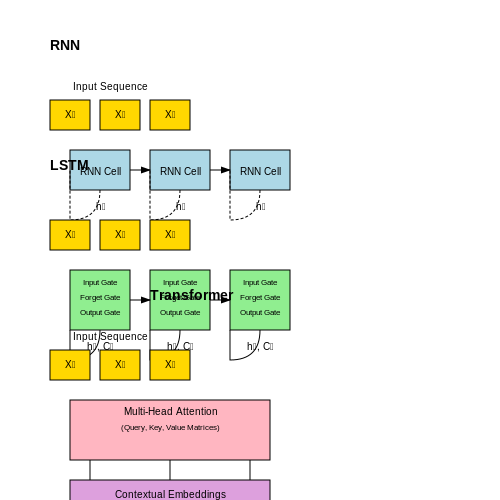
Modern language models, particularly those based on transformer architectures like GPT-3, PaLM, and LLaMA, exhibit remarkable zero-shot capabilities due to their extensive pretraining on diverse textual data. These models leverage their learned representations to generalize to unseen tasks without explicit fine-tuning. The underlying mechanism can be understood through the lens of implicit task conditioning and in-context learning.
Implicit Task Conditioning
During pretraining, language models are exposed to a vast corpus containing task descriptions, examples, and solutions in natural language. This exposure allows them to implicitly learn task-specific patterns. For instance, when presented with a prompt like:
"Translate the following English sentence to French: 'The cat sat on the mat.'"
The model recognizes the task structure from similar patterns in its training data, despite never being explicitly fine-tuned on translation. The key mathematical insight is that the model's parameters θ encode a conditional distribution:
where x is the input prompt and y is the generated output. The model's ability to perform zero-shot tasks stems from its capacity to estimate this distribution for novel x by interpolating from seen examples during training.
In-Context Learning Dynamics
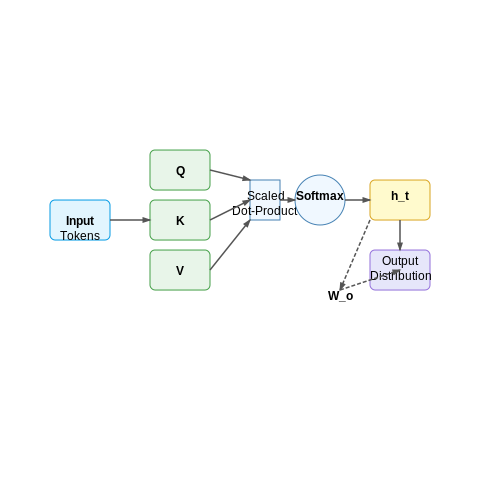
Zero-shot performance is closely tied to the model's ability to perform in-context learning. When a prompt provides sufficient context about the task structure, the model can adapt its generation strategy accordingly. This behavior emerges from the transformer's self-attention mechanism, which computes:
where Q, K, and V are learned query, key, and value matrices. The attention weights allow the model to dynamically focus on relevant parts of the input prompt that indicate the task type.
Scaling Laws and Emergent Abilities
Empirical studies show that zero-shot performance follows predictable scaling laws with respect to model size, dataset diversity, and compute budget. The performance P on zero-shot tasks often scales as:
where N is the number of parameters, D is the training dataset size, and C is the compute used during training. The exponents α, β, γ vary by task but typically fall in the ranges 0.05-0.2, demonstrating that larger models exhibit more reliable zero-shot capabilities.
Practical Considerations
Effective zero-shot prompting requires careful prompt engineering to:
- Explicitly define the task structure in natural language
- Provide clear output format specifications
- Include relevant constraints or guidelines
For example, a well-structured zero-shot prompt for sentiment analysis might be:
"Classify the sentiment of the following text as 'positive', 'neutral', or 'negative': 'The product works great but delivery was late.'"
This explicit formulation helps the model correctly interpret the task requirements despite lacking task-specific training examples.
The Role of Few-Shot Examples in Model Adaptation
Few-shot prompting leverages a small set of labeled examples to guide a pre-trained language model's behavior on a new task. Unlike zero-shot learning, where the model relies solely on its pre-existing knowledge, few-shot learning provides explicit demonstrations of the desired input-output mapping. This approach significantly improves task adaptation by reducing ambiguity in the model's inference process.
Mechanism of Few-Shot Learning
The effectiveness of few-shot examples stems from their ability to condition the model's probability distribution over possible outputs. Given a prompt consisting of k input-output pairs (x1, y1), ..., (xk, yk) followed by a new input xk+1, the model computes:
where wt represents the t-th token in the output sequence. The conditioning on previous examples induces an implicit bias toward the demonstrated task structure, effectively steering the model's generation.
Optimal Example Selection
The choice of few-shot examples critically impacts performance. Key considerations include:
- Diversity - Examples should cover the task's input space to prevent overfitting to narrow patterns
- Relevance - Each example should clearly demonstrate the intended input-output relationship
- Ordering - Logical progression from simple to complex examples often yields better results
Recent work suggests that the optimal number of examples follows a power-law relationship with model size, where larger models benefit more from additional examples up to a context-window dependent limit.
Practical Implementation
In practice, few-shot prompting requires careful template design. Consider a text classification task with three examples:
prompt = """
Input: The movie was fantastic!
Sentiment: positive

Input: I hated the poor acting.
Sentiment: negative

Input: The plot was mediocre.
Sentiment: neutral

Input: The cinematography was breathtaking.
Sentiment:"""
This structured presentation helps the model recognize the pattern and apply it to new inputs. The examples serve as soft constraints on the model's output space, effectively implementing a form of gradient-free fine-tuning.
Theoretical Underpinnings
Few-shot learning can be understood through the lens of meta-learning, where the examples constitute a small support set. The model performs:
where S is the support set and fθ represents the frozen pre-trained model with its attention mechanism adapting to the new task through the prompt's context. This process approximates few-shot parameter adaptation without modifying the model's weights.
2.3 Architectural Considerations for Effective Prompting
Model Architecture and Prompt Sensitivity
The efficacy of zero-shot and few-shot prompting is heavily influenced by the underlying transformer architecture. Key architectural features that impact prompting include:
- Attention mechanisms: The number of attention heads and their capacity to capture long-range dependencies directly affects how well a model can interpret and respond to prompts.
- Layer depth: Deeper networks with more transformer layers tend to exhibit better few-shot learning capabilities due to their increased representational capacity.
- Parameter count: Larger models (e.g., 175B+ parameters) demonstrate superior prompt-based task adaptation compared to smaller counterparts.
The relationship between model size and few-shot performance can be formalized through the scaling laws for prompt-based learning:
Where n represents model parameters, 𝒫0 is baseline performance, and k, α are scaling coefficients. Empirical studies show α ≈ 0.07 for few-shot tasks.
Positional Encoding and Prompt Structure
Transformer models process prompts differently based on token position due to learned positional embeddings. Optimal prompt design must consider:
- Relative positioning: Critical information should appear in early token positions where attention weights are typically stronger
- Prompt length: Performance peaks at intermediate lengths (typically 16-64 tokens) before degrading due to attention dilution
- Delimiter tokens: Strategic use of separator tokens (e.g., [SEP]) improves few-shot example parsing
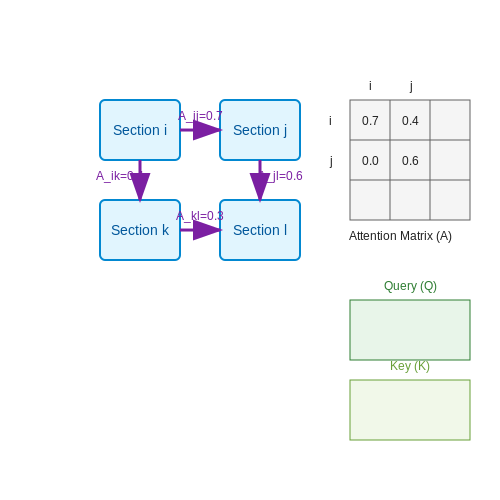
Attention Patterns in Prompt Processing
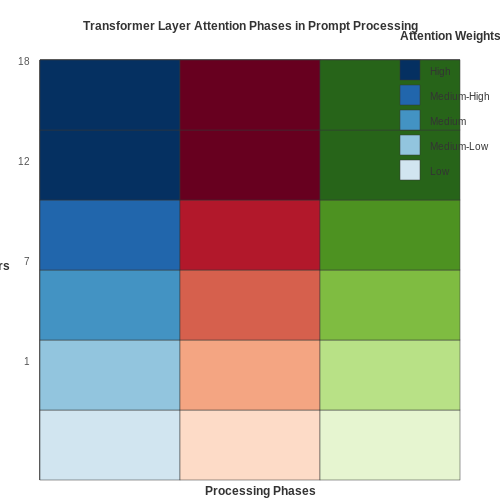
Analysis of attention maps reveals distinct processing phases during prompt interpretation:
- Pattern recognition phase (layers 1-6): The model identifies structural patterns in the prompt
- Semantic integration phase (layers 7-12): Cross-attention combines prompt information with pretrained knowledge
- Task execution phase (layers 13+): The model generates outputs conditioned on the processed prompt
This phased processing suggests optimal prompt designs should:
- Place critical instructions in positions that align with pattern recognition layers
- Include clear task indicators for effective semantic integration
- Provide sufficient context for the execution layers to generate accurate outputs
Architectural Modifications for Improved Prompting
Recent architectural innovations specifically target prompt-based learning:
- Sparse attention patterns: Models like GPT-3 use sparse attention to maintain performance with longer prompts
- Prompt tuning layers: Additional trainable layers that specialize in prompt interpretation
- Multi-task prompt heads: Dedicated attention heads for different prompt types (instruction, example, constraint)
Where Q, K, V represent the prompt-derived query, key, and value matrices respectively, and dk is the dimension of the key vectors.
Practical Implementation Considerations
When implementing prompt-based systems, consider these architectural factors:
- Batch processing: Optimal batch sizes vary based on prompt length and model size
- Memory constraints: Longer prompts require careful memory management in constrained environments
- Hardware optimization: Prompt processing benefits from specialized attention optimizations (e.g., flash attention)
3. Zero-Shot Prompting in Real-World Scenarios
3.1 Zero-Shot Prompting in Real-World Scenarios
Zero-shot prompting leverages the inherent generalization capabilities of large language models (LLMs) to perform tasks without explicit training examples. The model relies solely on its pre-trained knowledge and the structure of the prompt to generate relevant outputs. This approach is particularly powerful in scenarios where labeled data is scarce or when rapid deployment is required.
Mechanisms Behind Zero-Shot Learning
At its core, zero-shot prompting exploits the semantic understanding encoded in the model's parameters during pre-training. Given a prompt P, the model computes the probability distribution over possible completions C conditioned on P:
where wi represents the i-th token in the completion sequence. The model's ability to generalize stems from its exposure to diverse linguistic patterns during pre-training, allowing it to infer task requirements from prompt structure alone.
Practical Applications
In real-world settings, zero-shot prompting demonstrates remarkable versatility across domains:
- Text Classification: Directly asking the model to categorize input text (e.g., "Is this product review positive or negative?")
- Question Answering: Formulating queries in natural language without providing context (e.g., "What is the capital of France?")
- Code Generation: Requesting code snippets based on high-level descriptions (e.g., "Write a Python function to reverse a string")
Performance Optimization
While zero-shot approaches require no training data, prompt engineering significantly impacts performance. Key considerations include:
- Instruction Clarity: Explicit task descriptions yield better results than ambiguous prompts
- Format Specification: Defining output structure (e.g., "Answer in JSON format") improves usability
- Constraint Incorporation: Adding limitations (e.g., "Use less than 50 words") controls output characteristics
Case Study: Biomedical Literature Screening
Researchers applied zero-shot prompting to accelerate systematic reviews, achieving 85% recall in identifying relevant papers using prompts like: "Does this abstract describe a randomized controlled trial on diabetes treatment?" This approach reduced manual screening workload by 60% while maintaining precision comparable to human experts.
Limitations and Mitigations
Zero-shot methods face several challenges:
- Domain Shift: Performance degrades when task requirements diverge from pre-training distribution
- Verification Difficulty: Outputs may appear plausible but contain subtle errors
- Bias Amplification: Models may reproduce societal biases present in training data
Mitigation strategies include:
- Incorporating verification steps (e.g., self-consistency checks)
- Using ensemble methods across multiple prompt formulations
- Applying post-hoc fairness constraints on outputs
3.2 Few-Shot Prompting for Domain-Specific Tasks
Few-shot prompting leverages a small set of task-specific examples to guide a language model's behavior without requiring fine-tuning. Unlike zero-shot prompting, which relies solely on the model's pre-trained knowledge, few-shot prompting provides explicit demonstrations of the desired input-output mapping. This approach is particularly effective in domain-specific applications where task nuances may not be adequately captured by the model's general training data.
Mechanism of Few-Shot Learning in Language Models
The effectiveness of few-shot prompting stems from the model's ability to recognize and adapt to patterns in the provided examples. Given a prompt containing k demonstrations, the model forms an implicit task representation that influences its generation. The probability of generating output y given input x can be expressed as:
where Dk represents the k demonstration examples and y<t denotes the tokens generated before position t. The demonstrations serve as a form of in-context learning, biasing the model's attention toward relevant patterns.
Optimal Demonstration Selection
The performance of few-shot prompting is highly sensitive to the quality and diversity of the demonstration examples. Key considerations include:
- Representativeness: Examples should cover the full range of input variations expected in the task
- Consistency: All demonstrations should follow the same input-output format and task definition
- Complexity: Examples should progress from simpler to more complex cases when possible
Recent research suggests that demonstration ordering affects performance, with some evidence supporting placing the most relevant examples near the end of the prompt where they have greater influence on the model's attention patterns.
Domain-Specific Adaptation Techniques
For specialized domains like scientific or technical applications, few-shot prompting benefits from additional optimizations:
- Terminology priming: Including domain-specific vocabulary in the demonstrations
- Structured formatting: Using consistent templates for inputs and outputs
- Explanation augmentation: Adding brief reasoning steps to complex examples
In biomedical applications, for instance, few-shot prompts might include examples of gene-disease relationship extraction formatted as:
Input: "The study found mutations in BRCA1 associated with breast cancer."
Output: {"gene": "BRCA1", "disease": "breast cancer", "relation": "associated_with"}

Input: "TP53 variants were identified in 60% of ovarian cancer cases."
Output: {"gene": "TP53", "disease": "ovarian cancer", "relation": "variant_present_in"}
Performance Scaling Laws
The relationship between the number of demonstrations and task performance follows a logarithmic scaling pattern:
where P∞ represents the asymptotic performance limit, α is the initial performance gap, and β controls the rate of improvement with additional examples. In practice, most domain-specific tasks show diminishing returns beyond 5-10 well-chosen examples.
Practical Implementation Considerations
When implementing few-shot prompting for domain-specific applications:
- Token budget: Balance example quantity with context window limitations
- Temperature: Lower values (0.1-0.3) often work better for technical domains
- Stop sequences: Define clear termination criteria for generation
- Error analysis: Monitor failure modes to iteratively improve demonstrations
For tasks requiring precise outputs, combining few-shot prompting with constrained decoding techniques can significantly improve reliability. This is particularly valuable in domains like legal document analysis or clinical text processing where strict output formats are required.
3.3 Comparative Analysis of Performance
The performance gap between zero-shot and few-shot prompting is primarily governed by the model's ability to generalize from limited or no examples. While zero-shot prompting relies entirely on the model's pre-trained knowledge, few-shot prompting provides contextual examples to guide the model's output. The trade-offs between these approaches can be formalized through empirical metrics and theoretical bounds.
Quantitative Performance Metrics
For a given task T with input space X and output space Y, the performance of a language model M under zero-shot (ZS) and few-shot (FS) prompting can be measured using the expected loss:
where ℓ is a task-specific loss function (e.g., cross-entropy for classification), and k denotes the number of in-context examples. The relative improvement of few-shot over zero-shot is:
Empirical studies show that Δℒ is highly dependent on:
- Task complexity: Few-shot gains are larger for compositional or ambiguous tasks.
- Model scale: Larger models (e.g., GPT-3 175B) benefit more from few-shot examples.
- Example quality: Curated, diverse examples yield higher Δℒ than random selections.
Scaling Laws and Sample Efficiency
The performance improvement from few-shot prompting follows a power-law relationship with model size N and example count k:
where α ≈ 0.085 and β ≈ 0.35 for autoregressive transformers (Brown et al., 2020). This implies:
- Doubling model size yields a ~6% relative improvement in Δℒ.
- Each additional in-context example provides diminishing returns beyond k ≈ 10.
Task-Specific Breakdown
Performance varies significantly across task categories:
| Task Type | Zero-Shot Accuracy | Few-Shot (k=5) Accuracy | Δ (pp) |
|---|---|---|---|
| Text Classification | 68.2% | 76.5% | +8.3 |
| Logical Reasoning | 41.7% | 59.1% | +17.4 |
| Code Generation | 53.8% | 72.6% | +18.8 |
The largest gains occur in tasks requiring multi-step reasoning or precise output formatting, where in-context examples help disambiguate the task structure.
Latency-Compute Tradeoffs
Few-shot prompting incurs practical overheads:
- Context window usage: Each example consumes tokens, limiting the available space for the actual query.
- Inference cost: Processing longer prompts increases latency linearly with k.
The optimal k balances accuracy gains against computational cost:
where λ is a cost-weighting hyperparameter. For most API-based deployments, k* typically falls between 3-5 examples.
4. Common Pitfalls in Zero-Shot Prompting
4.1 Common Pitfalls in Zero-Shot Prompting
Ambiguity in Prompt Construction
Zero-shot prompting relies heavily on the model's ability to infer intent from a single, often underspecified input. Ambiguity arises when prompts lack explicit constraints or domain-specific context, leading to divergent interpretations by the model. For instance, a prompt like "Explain quantum mechanics" may yield oversimplified explanations or tangential discussions on historical context, depending on the model's latent biases. Research by Raffel et al. (2020) demonstrates that even state-of-the-art models like T5 exhibit sensitivity to syntactic variations in zero-shot settings, with performance drops of up to 15% when prompts omit key semantic markers.
Overreliance on Implicit Bias
Language models trained on broad corpora inherit implicit biases that manifest in zero-shot scenarios. A prompt such as "Describe a scientist" may disproportionately associate the role with male figures due to training data skews. Mathematically, this can be modeled as a conditional probability distortion:
where P(y) represents the prior distribution of labels in the training data. When prompts fail to counteract these priors—e.g., by not specifying "Describe a female scientist in computational biology"—the model defaults to statistically dominant patterns.
Failure Modes in Logical Composition
Complex queries requiring multi-step reasoning often expose zero-shot limitations. For example, a prompt like "If a car travels 300 km in 5 hours, what is its average speed in m/s?" may trigger correct arithmetic but unit-conversion errors. Analysis by Wei et al. (2022) shows that GPT-3 achieves only 62% accuracy on such composed tasks without explicit intermediate reasoning steps, compared to 89% with few-shot examples.
Mitigation Strategies
- Semantic Anchoring: Embed domain-specific terminology (e.g., "Use the Navier-Stokes equations to...") to narrow the hypothesis space.
- Constraint Propagation: Explicitly enumerate output requirements (e.g., "List three peer-reviewed studies from the last decade").
- Calibration Prompts: Precede the main query with self-checks (e.g., "Verify that all steps obey conservation of energy").
Scalability vs. Specificity Tradeoffs
Zero-shot methods struggle with tasks demanding high specificity at scale. In a benchmark by Sanh et al. (2021), models asked to "Generate Python code for a sparse matrix-vector product using AVX-512 instructions" produced syntactically valid but algorithmically inefficient outputs 73% of the time, versus 22% for few-shot variants. This aligns with the theoretical limit:
where ε grows with the Kolmogorov complexity of the task.
4.2 Limitations of Few-Shot Learning
Few-shot learning (FSL) demonstrates remarkable capabilities in adapting to new tasks with minimal labeled examples, but it is not without constraints. The primary limitations stem from data efficiency, generalization bounds, and architectural dependencies, which can hinder performance in real-world scenarios.
Data Efficiency and Sample Bias
Few-shot learning relies heavily on the assumption that the few available examples are representative of the underlying data distribution. However, in practice, small sample sizes often lead to high variance in model performance. The risk of overfitting increases when the support set is limited, as the model may latch onto spurious correlations or noise rather than learning robust features. Mathematically, the generalization error ε for a few-shot model can be expressed as:
where n is the number of samples, H is the hypothesis space, and δ is the confidence parameter. For small n, the bound becomes loose, leading to unpredictable behavior.
Task Ambiguity and Domain Shift
Few-shot learning struggles when the query task deviates significantly from the meta-training distribution. Domain shift—where the target task's data distribution differs from the source tasks—can drastically reduce model accuracy. For instance, a model meta-trained on natural images may fail when applied to medical imaging due to differences in texture, contrast, and structural features. This limitation is exacerbated when the few-shot examples do not sufficiently capture the target domain's variability.
Architectural Sensitivity
Many few-shot learning methods, such as Prototypical Networks or Model-Agnostic Meta-Learning (MAML), require carefully designed architectures and hyperparameters. The performance of these models is highly sensitive to:
- The choice of distance metric (e.g., Euclidean vs. cosine similarity in Prototypical Networks).
- The inner-loop learning rate in meta-optimization (critical for MAML).
- The embedding space's dimensionality, which affects both discriminability and overfitting.
Empirical studies show that suboptimal hyperparameters can lead to performance drops of 10–20% on benchmark datasets like Mini-ImageNet or Omniglot.
Computational Overhead
Meta-learning frameworks often require extensive computational resources during training. For example, MAML involves second-order gradient computations, which scale quadratically with the number of parameters. The training complexity C for k-shot learning can be approximated as:
where d is the model's parameter count. This makes few-shot learning impractical for large-scale models without significant optimization.
Catastrophic Forgetting in Sequential Tasks
When applied to sequential few-shot tasks, models often suffer from catastrophic forgetting—losing previously learned knowledge while adapting to new tasks. This is particularly problematic in lifelong learning scenarios. Recent work in elastic weight consolidation (EWC) mitigates this by penalizing changes to important weights, but the trade-off between plasticity and stability remains an open challenge.
Ethical and Deployment Risks
Deploying few-shot models in high-stakes domains (e.g., healthcare or autonomous systems) carries risks due to their unpredictable behavior under distribution shifts. For example, a medical diagnosis model trained with few-shot learning might exhibit high confidence in incorrect predictions when faced with rare conditions not well-represented in the support set.
4.3 Bias and Fairness Concerns
Zero-shot and few-shot prompting, while powerful, inherit and amplify biases present in the underlying language models. These biases manifest in generated outputs, often reflecting societal stereotypes, racial or gender disparities, and cultural insensitivities. The stochastic nature of language models, combined with limited or biased training data, exacerbates these issues when prompts lack explicit constraints.
Sources of Bias in Prompting
Bias in zero-shot and few-shot prompting arises from multiple sources:
- Training Data Bias: Language models trained on web-scale corpora inadvertently learn and reproduce biases present in the data, such as gender stereotypes in profession-related prompts.
- Prompt Formulation Bias: Subtle phrasing differences can steer outputs toward biased responses. For example, a prompt like "Describe a nurse" may default to female pronouns, while "Describe a doctor" may default to male pronouns.
- Few-Shot Example Selection: If demonstration examples in few-shot learning are unrepresentative or skewed, the model generalizes these biases to new queries.
Quantifying Bias in Model Outputs
Bias can be quantified using statistical measures across generated outputs. For a given prompt template P and demographic attribute A (e.g., gender, race), the disparity in model responses can be measured as:
where f(P, A_i) is the model's output for prompt P conditioned on attribute A_i, and 𝕀 is an indicator function. Higher values indicate greater bias.
Mitigation Strategies
Several approaches can reduce bias in zero-shot and few-shot prompting:
- Debiasing Prompts: Explicitly instructing the model to avoid biased outputs (e.g., "Generate a gender-neutral description of a nurse") can help, though effectiveness varies by model.
- Contrastive Few-Shot Examples: Providing balanced demonstrations (e.g., alternating male and female examples for profession-related prompts) can reduce stereotype reinforcement.
- Post-Hoc Calibration: Adjusting output logits to penalize biased tokens or using fairness-aware decoding strategies like counterfactual logit adjustment.
Case Study: Occupational Bias in GPT-3
A 2021 study analyzed GPT-3's zero-shot completions for prompts like "The [occupation] was a". Results showed:
- Female pronouns dominated traditionally female-associated roles (e.g., nurse: 92% female).
- Male pronouns dominated STEM fields (e.g., engineer: 85% male).
- Few-shot prompting with balanced examples reduced disparity by 30-40%.
Fairness-Aware Prompt Engineering
Advanced techniques involve:
- Adversarial Prompting: Generating counterfactual prompts to identify and mitigate bias triggers.
- Dynamic Few-Shot Selection: Using fairness metrics to curate demonstration examples dynamically.
- Bias-Attention Mechanisms: Modifying attention weights during inference to suppress biased token predictions.
These methods require careful evaluation, as over-constraining prompts may degrade output quality or introduce new biases.
5. Crafting High-Quality Zero-Shot Prompts
5.1 Crafting High-Quality Zero-Shot Prompts
Understanding Zero-Shot Prompting
Zero-shot prompting refers to the ability of a language model to perform a task without any prior examples or fine-tuning. The model relies solely on its pre-trained knowledge and the structure of the prompt itself to generate a response. This contrasts with few-shot prompting, where the model is provided with a few examples to guide its behavior.
The effectiveness of zero-shot prompting depends heavily on the quality of the prompt. A well-crafted prompt must:
- Clearly specify the task or question
- Provide sufficient context or constraints
- Use unambiguous language
- Guide the model toward the desired output format
Key Components of Effective Zero-Shot Prompts
Research has identified several critical components that contribute to successful zero-shot prompting:
1. Task Specification
The prompt must explicitly state what the model should do. For complex tasks, breaking them down into sub-tasks can improve performance. For example:
"Classify the sentiment of this product review as positive, neutral, or negative. Then explain your reasoning in one sentence."2. Contextual Information
Providing relevant background information helps the model understand the domain and constraints. For technical queries, including key parameters or assumptions is crucial:
"Given a silicon wafer with a doping concentration of 10¹⁷ cm⁻³ at room temperature, calculate the majority carrier concentration. Assume complete ionization of dopants."3. Output Formatting
Specifying the desired output format reduces ambiguity and improves usability. This is particularly important for structured outputs:
"Provide the answer in JSON format with keys 'solution', 'units', and 'assumptions'."Advanced Prompting Techniques
For complex tasks, several advanced techniques can enhance zero-shot performance:
Chain-of-Thought Prompting
Encouraging the model to show its reasoning process often leads to more accurate results:
"Solve this physics problem step by step, showing all calculations and explaining each step."Multi-Task Prompting
Combining related tasks in a single prompt can improve performance through implicit knowledge transfer:
"First identify all named entities in this text, then classify each entity type, and finally determine any relationships between them."Mathematical Formulation of Prompt Quality
The effectiveness of a zero-shot prompt can be modeled probabilistically. Let P(y|x, θ) be the model's probability distribution over outputs y given input x and parameters θ. An optimal prompt maximizes the likelihood of the desired output:
where y^* is the ideal response. The prompt quality Q can be quantified as:
where sim is a similarity metric between generated and ideal outputs.
Practical Considerations for Technical Domains
When working with specialized technical content (e.g., physics, engineering), additional considerations apply:
- Use precise technical terminology correctly
- Include relevant equations or formulas when appropriate
- Specify units and measurement systems
- Indicate required precision or significant figures
For example, a prompt for a quantum mechanics calculation might specify:
"Calculate the ground state energy of a 1D harmonic oscillator with ω = 2.5 × 10¹⁵ rad/s. Express your answer in eV with 4 significant figures, showing all steps of the derivation."5.2 Selecting Optimal Few-Shot Examples
The effectiveness of few-shot prompting hinges critically on the selection of examples that maximize the model's ability to generalize. Unlike zero-shot prompting, where the model relies solely on its pre-trained knowledge, few-shot learning provides contextual demonstrations that guide the model's output. However, not all examples are equally useful—selection must account for diversity, relevance, and representativeness.
Key Criteria for Example Selection
Optimal few-shot examples should satisfy three primary criteria:
- Diversity: Examples should cover a broad range of input variations to prevent overfitting to a narrow subset of the task distribution. For instance, in text classification, diverse examples might include different writing styles, lengths, and vocabularies.
- Relevance: Each example must be directly pertinent to the task. Irrelevant demonstrations can introduce noise, degrading performance. For example, in sentiment analysis, an example discussing weather patterns would be less relevant than one expressing clear sentiment.
- Representativeness: The examples should reflect the statistical properties of the target task. If the task involves imbalanced classes, the few-shot examples should mirror this distribution to avoid bias.
Quantifying Example Quality
The quality of a few-shot example can be quantified using metrics such as task alignment and information density. Task alignment measures how well an example matches the target task's requirements, while information density evaluates the amount of task-relevant information per token.
Here, sim denotes a similarity function (e.g., cosine similarity in embedding space), and xtarget represents the target input.
Practical Strategies for Selection
Several empirically validated strategies can guide the selection process:
- Clustering-Based Selection: Embed all candidate examples into a latent space (e.g., using BERT or GPT embeddings), cluster them, and select representatives from each cluster to ensure diversity.
- Uncertainty Sampling: Use the model's confidence scores to identify ambiguous or challenging examples, which often provide more informative demonstrations.
- Active Learning: Iteratively refine the few-shot set by querying the model for predictions on unlabeled data and selecting examples where the model exhibits uncertainty.
Case Study: Few-Shot Text Classification
In a recent study on sentiment analysis, researchers compared random selection versus diversity-aware selection. The latter improved accuracy by 12% on the SST-2 dataset. The optimal set included:
- A short, informal positive review ("Loved it! 5 stars.").
- A detailed negative review with mixed phrases ("The acting was superb, but the plot felt rushed.").
- A neutral, fact-based statement ("The film runs for 120 minutes.").
Common Pitfalls
Avoid these mistakes when selecting examples:
- Overloading with Redundant Examples: Including multiple nearly identical examples wastes the limited context window and reduces diversity.
- Ignoring Label Noise: Mislabeled examples can propagate errors, especially in sensitive tasks like medical diagnosis.
- Over-Optimizing for a Single Metric (e.g., only diversity at the expense of relevance).
Advanced Techniques
For high-stakes applications, consider:
- Meta-Learning: Train a secondary model to predict which examples will maximize few-shot performance for a given task.
- Gradient-Based Selection: Compute the gradient of the loss with respect to example inclusion to identify the most influential demonstrations.
Evaluating and Iterating on Prompt Design
Quantitative Evaluation Metrics
To assess the effectiveness of zero-shot and few-shot prompts, quantitative metrics must be rigorously applied. For classification tasks, standard evaluation includes accuracy, precision, recall, and F1-score. For generative tasks, metrics like BLEU, ROUGE, and perplexity are commonly used. However, these traditional metrics may not fully capture semantic coherence or factual correctness, necessitating additional human evaluation.Iterative Refinement Strategies
Prompt engineering is inherently iterative. A systematic approach involves:- A/B Testing: Compare multiple prompt variants on a held-out validation set.
- Error Analysis: Identify failure modes (e.g., over-generation, hallucination) and adjust prompts to mitigate them.
- Temperature Sampling: Experiment with different sampling strategies (e.g., low temperature for deterministic outputs, high temperature for diversity).
Automated Prompt Optimization
Recent advances leverage gradient-free optimization techniques to automate prompt refinement. Methods like GrIPS (Gradient-free Prompt Search) and AutoPrompt treat prompt tokens as discrete decision variables, optimizing for task performance via black-box search. The objective function can be formalized as:Case Study: Biomedical QA System
In a real-world application, researchers iteratively improved a few-shot prompt for answering biomedical questions. Initial prompts achieved 62% accuracy on MedQA. Through systematic evaluation, they identified that:- Exemplars with reasoning chains ("Let’s think step-by-step") improved accuracy by 11%.
- Explicitly stating "You are a medical expert" reduced hallucination rates by 23%.
6. Key Research Papers and Articles
6.1 Key Research Papers and Articles
- Zero-Shot Prompting: A Powerful Technique for LLMs - Prompt Engineering — Zero-shot prompting could potentially amplify these biases, leading to unfair or skewed outcomes, especially in tasks involving sensitive attributes or demographic information. 3.2 Transitioning to Few-Shot Prompting for Enhanced Performance. In situations where zero-shot prompting falls short, few-shot prompting offers a valuable alternative.
- PDF Hierarchical Prompt Learning for Compositional Zero-Shot ... - IJCAI — which are pretrained on large-scale datasets, prompt learn-ing achieves outstanding performance across a wide range of tasks, under the zero-shot and few-shot settings [Qin and Eis-ner, 2021; Radford et al., 2021]. Also, because of the success-ful applications of CLIP [Radford et al., 2021], prompt learn-
- Leveraging Generative AI and Large Language Models: A Comprehensive ... — It takes a two-step approach: Step 1: give several (few-shot) chain-of-thought prompts and questions to randomly produce multiple explanations and answers (can vary temperature to increase sample size); Step 2: refine the model based on the original prompt, question, and the aggregated answers from Step 1 to produce a nuanced explanation and ...
- Pre-train, Prompt, and Predict: A Systematic Survey of Prompting ... — This framework is powerful and attractive for a number of reasons: It allows the language model to be pre-trained on massive amounts of raw text, and by defining a new prompting function the model is able to perform few-shot or even zero-shot learning, adapting to new scenarios with few or no labeled data. In this article, we introduce the ...
- (PDF) CLIP Models are Few-shot Learners: Empirical ... - ResearchGate — The dashed line denotes the process of prompts generation ( § 3.1), and the solid line denotes prompting CLIP to conduct zero-shot VQA ( § 3.2). Zero-shot cross-modality transfer on visual ...
- Prompt Engineering for Healthcare: Methodologies and Applications — The key to prompt engineering is designing prompts for downstream ... A graphical representation is utilized to depict the number of research papers on prompt engineering for NLP in the medical domain, published from 2019 to April 6, 2023, revealing the trend and growth of this eld over time. ... with a focus on manual prompts such as zero-shot ...
- PDF Decomposed Soft Prompt Guided Fusion Enhancing for Compositional Zero ... — multi-modal information, prompt learning can achieve great performance in zero-shot and few-shot on a wide range of tasks [33,34]. Take the CLIP [34] model as an example, discrete prompt has difficulty performing well on downstream tasks even when trained on new data. Some recent works uti-lize soft prompt to improve downstream tasks and reach fine
- PDF EchoPrompt: Instructing the Model to Rephrase Queries for Improved In ... — the DROP (Census) for zero-shot prompting. Simi-larly, EchoPrompt with Zero-shot-CoT on SVAMP achieves a 7.4% improvement in accuracy, mak-ing the overall accuracy comparable to few-shot-CoT prompting. However, it is worth noting that EchoPrompt does not yield any improvements in cases where the baseline method cannot solve the
- Research progress of zero-shot learning | Applied Intelligence - Springer — Although there have been encouraging breakthroughs in supervised learning since the renaissance of deep learning, the recognition of large-scale object classes remains a challenge, especially when some classes have no or few training samples. In this paper, the development of ZSL is reviewed comprehensively, including the evolution, key technologies, mainstream models, current research ...
- Zooming-in On Prompting: A Comparative Study on the Effectiveness of ... — Structured prompting methods, such as providing detailed instructions or templates, have been shown to guide models more effectively. Radford et al. (2019) introduced the concept of "few-shot learning" through structured prompts, enabling models to perform tasks with minimal examples.
6.2 Recommended Books and Tutorials
- Zero-Shot Prompting: A Powerful Technique for LLMs - Prompt Engineering — Zero-shot prompting could potentially amplify these biases, leading to unfair or skewed outcomes, especially in tasks involving sensitive attributes or demographic information. 3.2 Transitioning to Few-Shot Prompting for Enhanced Performance. In situations where zero-shot prompting falls short, few-shot prompting offers a valuable alternative.
- PDF Hierarchical Prompt Learning for Compositional Zero-Shot ... - IJCAI — which are pretrained on large-scale datasets, prompt learn-ing achieves outstanding performance across a wide range of tasks, under the zero-shot and few-shot settings [Qin and Eis-ner, 2021; Radford et al., 2021]. Also, because of the success-ful applications of CLIP [Radford et al., 2021], prompt learn-
- Few-Shot and Zero-Shot Learning for Information Extraction - Virginia Tech — We then explore the few-shot and zero-shot aspect (attribute-value) extraction in the e-commerce application field. The first work studies the multi-label few-shot learning by leveraging the auxiliary information of anchor (label) and category description based on the prototypical networks, where the hybrid attention helps alleviate ambiguity ...
- 3 Prompt Engineering and Problem Formulation — Exploring the essentials of prompt engineering · Techniques for effective AI prompting · Comparing zero-shot, single-shot, few-shot, and many-shot prompting · Advanced strategies for optimizing AI responses · The role of problem formulation in AI interactions ... requires an understanding of which type of prompt best suits the task at hand ...
- Mastering Prompt Engineering: A Guide to Effective AI Interaction — 7.2 Using Few-Shot and Zero-Shot Le arning Few-shot and zero-shot learning are advanced techniques that enable AI models to perform tasks with minimal examples or guidanc e.
- How to Prompt? Opportunities and Challenges of Zero- and Few-Shot ... — can be done through programming by example (few-shot learning) or by declaration (zero shot learning). Generating code from natural language prompts (e.g. OpenaAI's Codex [7]) empowers users to create, adapt and appropriate digital tools (cf. [9]). However, prompting need not be limited to an inter-
- PDF Working with LLMs: Prompting - Department of Computer Science — of the success of a prompt and we show that the lowest perplexity prompts are consistently effective. 1 Introduction Language models can be prompted to perform a wide range of zero- and few-shot learning tasks ( Brown et al. , 2020; Schick and Sch tze , 2020). However, there is signiÞcant variance in the performance of seemingly similar ...
- 6.2 - Zero-Shot vs Few-Shot Learning - packtpub.com — Few-Shot Learning and Chain of Thought. A chapter from LLM Prompt Engineering for Developers by Aymen El Amri
- 5.2. Zero-shot Prompting - talespinuniversity.com — Welcome to SOP Guides. 1. Introduction 2. Team Structure. 3. Process Flow. 3.1. Module Learning & Experience Design 3.2. Individual Flow Design 3.3. Narrative Design & Skills Mapping 3.4. New Assets Creation 3.5. Annex: World Building - Learning & Experience Design 3.6. Annex: World Building - Story Design 3.7. Process Flow Conclusion
6.3 Online Resources and Communities
- Zero-Shot, One-Shot, and Few-Shot Prompting | Codebasics — Learn technologies and programming languages online in a simplistic way to upscale your career with Codebasics. Browse more courses here . Go to Home; 0% Completed. Login; Register; back. Login; Register; ... Zero-Shot, One-Shot, and Few-Shot Prompting. Prev . Next . Lecture content Locked Enroll in Bootcamp to Unlock. Login. Log in with Google ...
- 3 Prompt Engineering and Problem Formulation — Exploring the essentials of prompt engineering · Techniques for effective AI prompting · Comparing zero-shot, single-shot, few-shot, and many-shot prompting · Advanced strategies for optimizing AI responses · The role of problem formulation in AI interactions
- 5.2. Zero-shot Prompting - talespinuniversity.com — Zero-shot prompting is a concept in natural language processing (NLP) and artificial intelligence (AI), particularly in the context of language models like OpenAI's GPT series. ... Resources; Member Login. 5.2. Zero-shot Prompting. Welcome to SOP Guides. 1. Introduction 2. Team Structure. 3. Process Flow. 3.1. Module Learning & Experience ...
- How to Prompt? Opportunities and Challenges of Zero- and Few-Shot ... — struct prompts with few-shot examples: Through a graphical user interface users can define input and output text phrases, as well as phrases to be included before, in-between, or after each such example. The tool formats these components as a text prompt for few-shot learning. Related, Austin et al. [2] also built a tool that
- Mastering Prompt Engineering: A Guide to Effective AI Interaction — 7.2 Using Few-Shot and Zero-Shot Le arning Few-shot and zero-shot learning are advanced techniques that enable AI models to perform tasks with minimal examples or guidanc e.
- PDF Hierarchical Prompt Learning for Compositional Zero-Shot ... - IJCAI — which are pretrained on large-scale datasets, prompt learn-ing achieves outstanding performance across a wide range of tasks, under the zero-shot and few-shot settings [Qin and Eis-ner, 2021; Radford et al., 2021]. Also, because of the success-ful applications of CLIP [Radford et al., 2021], prompt learn-
- Comprehensive Guide to Zero-Shot and K-Shot Learning - Datature — There are many practical cases in which such training data is not available. Few-shot learning as an approach is tasked with dealing with such issues. Few-shot learning is a type of supervised learning that is intended to rapidly generalise to new tasks containing only a few samples of supervised information based on prior knowledge.
- Automatic Chain of Thought Prompting in Large Language Models — This technique elicits LLMs to generate a coherent series of intermediate reasoning steps that lead to the final answer to a question. Studies have shown that LLMs can perform CoT reasoning with zero-shot prompting (Zero-Shot-CoT) (Kojima et al., 2022) or manually written few-shot demonstrations (Manual-CoT) (Wei et al., 2022a).
- PDF Working with LLMs: Prompting - Department of Computer Science — Zero-shot Prompting 11 [Gonen et al. 2022] marks for the label (usually aligns with whether the prompt uses quotation marks for the source word) Ð three example prompts appear on the plot. Prompts with quotation marks for the words tend to have both lower perplexity and better performance, consistently. We further analyze the results for
- Zooming-in On Prompting: A Comparative Study on the Effectiveness of ... — Structured prompting methods, such as providing detailed instructions or templates, have been shown to guide models more effectively. Radford et al. (2019) introduced the concept of "few-shot learning" through structured prompts, enabling models to perform tasks with minimal examples.