Binary Numbers
1. Definition of Binary Numbers
1.1 Definition of Binary Numbers
In the realm of digital systems and electronics, the concept of binary numbers holds a foundational role. At its essence, a binary number system, or base-2 numeral system, employs two distinct digits: 0 and 1. Unlike the decimal system, which utilizes ten symbols (0 through 9), binary numbers express all possible values through various combinations of just these two digits. This simplicity is not merely an arbitrary choice; it is intrinsically tied to the physical nature of electronic circuitry, where two states—typically representing off (0) and on (1)—negate ambiguity and facilitate reliable data representation.
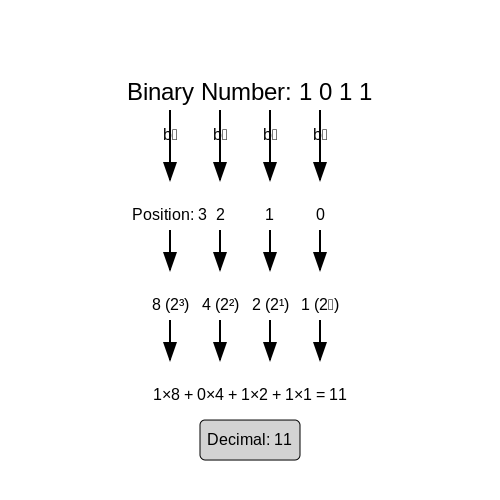
Each digit in a binary number is referred to as a bit, a term derived from the contraction of “binary digit.” The rightmost bit represents the lowest value (20), while each subsequent bit to the left contributes increasingly higher powers of 2. Consequently, the binary number 1011 can be expressed mathematically as:
This transformation illustrates the conversion between binary and decimal systems, which is of paramount significance in digital electronics. Being able to interpret binary numbers in terms of decimal values allows engineers and programmers to interface more effectively with digital systems, ensuring accurate data processing and representation.
Furthermore, binary numbers serve not only in computation but also in data storage, transmission, and error detection mechanisms. For instance, in computer memory, each bit represents a single binary state, and the configuration of thousands or millions of bits forms the core of any data structure—from simple integers to complex multimedia files. Understanding the properties of binary numbers thus proves critical in disciplines like computer science, electrical engineering, and information theory.
In summary, the binary numeral system is not merely a theoretical construct but a practical necessity in modern technology. Its inherent duality allows for straightforward representation and manipulation of data, tailoring it perfectly to the needs of electronic systems and paving the way for countless innovations. The familiar binary representation is the bedrock upon which entire fields of technology stand, including modern computing and communications.
1.2 Importance of Binary in Computing
The binary numeral system serves as the foundation of modern computing. It operates on a simplistic premise: using just two digits, 0 and 1, to represent all forms of data and instructions within digital devices. This subsection delves into the various reasons why binary is paramount in computing, highlighting its practical relevance, theoretical underpinnings, and implications for engineers and researchers alike.
Binary Fundamentals: A Brief Recap
Before exploring the importance of binary in computing, it's essential to revisit its fundamentals. The binary system is a base-2 numeral system, where each digit represents a power of 2, in contrast to the decimal system, which is base-10. For example, the binary number 1011 can be expressed in decimal as:
This straightforward representation allows systems to leverage the binary state of an electronic switch, where a '0' can represent an "off" state and a '1' an "on" state, facilitating the design of digital circuits with high reliability and efficiency.
Clarity and Complexity in Design
The use of binary not only simplifies the design of hardware but also enhances its reliability. Consider the implementation of logic gates—fundamental building blocks in digital circuits. A logic gate operates with binary inputs and outputs, allowing the construction of complex circuits using simple combinations of AND, OR, NOT, and other logic functions. For instance:
- An AND gate will yield a true output (1) only if all inputs are true (1).
- An OR gate outputs a true value if at least one input is true.
This binary operation leads to deterministic behaviors in circuits, which is critical for operations in computers, where predictable outcomes are paramount.
Efficiency in Data Representation
An undeniable advantage of the binary system is its efficiency in data representation and manipulation. Data types—ranging from integers to complex structures—are often encoded in binary, allowing for compact and efficient storage. For example, a standard 8-bit byte can represent 256 different values, calculated as:
This compactness is particularly significant in areas like data transmission, where bandwidth is often limited. By using binary encoding schemes like UTF-8, computers can translate characters into binary sequences, reducing communication costs while ensuring that information is preserved accurately across different systems and platforms.
Underlying Computational Logic
At a deeper level, binary forms the basis for computational logic via Boolean algebra. This algebra underpins the operations within CPUs, influencing how operations are performed at the machine code level. The systematic manipulation of binary digits allows computers to execute complex mathematical tasks, control systems, and manage data efficiently. For instance, executing arithmetic operations like addition, subtraction, or multiplication in binary follows systematic rules:
- 1 + 1 = 10 (binary for 2)
- 1 + 0 = 1
- 0 + 0 = 0
The transition from binary to other numerical systems is also facilitated through compilers and interpreters, presenting engineers with versatile tools for system development.
Applications Beyond Computing
While binary is synonymous with computing, its applications extend to various fields, including telecommunications, digital signal processing, and even quantum computing. For example, in quantum computing, the binary concept is enhanced through qubits, which can exist in multiple states simultaneously, a characteristic harnessed in quantum algorithms. This illustrates the evolution of binary thinking, where traditional 0s and 1s are transformed into dynamic states of information, further amplifying the importance of binary systems in leading-edge technology innovations.
In summary, binary numbers are essential not only for their simplicity and clarity in digital design but also for their efficiency in data representation and their role in underpinning the logical operations that drive computations. The versatility of binary continues to influence advancements in computing and beyond.
2. Structure of Binary Numbers
2.1 Structure of Binary Numbers
The binary number system is the foundation of modern computing and digital electronics, operating on the simple principle of two distinct states, typically represented as 0 and 1. This section delves into the structural intricacies of binary numbers, illuminating how they form the backbone of data representation in computers and other digital systems.
Understanding the Basics
Binary numbers, or base-2 numbers, utilize a positional notation much like the decimal system, which is a base-10 numeral system. However, instead of powers of ten, binary showcases powers of two. Each digit, called a bit, serves as a placeholder that can either be a 0 or 1, with the value of each bit determined by its position within the number.
To illustrate, consider the binary number 1011. To ascertain its decimal equivalent, we perform the following calculation:
This operation highlights how binary values correlate to decimal ones, showcasing the structural underpinnings of each binary digit contributing to the overall value based on its position.
Structure of Binary Numbers
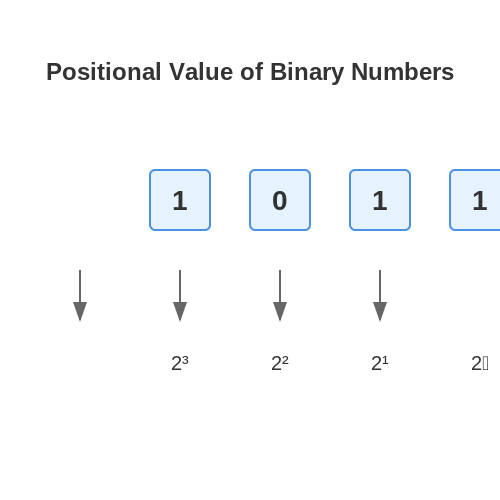
The structure of binary numbers is primarily based on the place value system, which assigns increasing powers of 2 to each successive bit from right to left. This formation can be summarized as follows:
- The rightmost bit represents \(2^0\) (1's place).
- The next bit to the left represents \(2^1\) (2's place).
- The subsequent bit represents \(2^2\) (4's place).
- This pattern continues: \(2^3\) (8's place), \(2^4\) (16's place), and so forth.
As binary numbers grow in length, they can effectively represent increasingly larger values. This property is crucial in computer architecture, where memory addresses, numeric values, and operation codes are represented in binary.
Practical Relevance in Computing
The relevance of binary number structure extends beyond theoretical understanding—it is integral to various applications in computing, ranging from data encoding to error detection. For example, ASCII (American Standard Code for Information Interchange) employs binary representation to encode text characters, assigning each character a unique binary number. With variations of lengths from 7 to 16 bits, the binary structured system allows diverse character representation essential for computer communication.
Additionally, foundational concepts in networking, such as IP addressing, utilize binary structure to define unique device identifiers within digital networks. Understanding how binary works enables engineers and computer scientists to develop systems for efficient data processing and transmission.
Conclusion
In summary, the structure of binary numbers, grounded firmly in positional notation, plays an essential role in computational systems. Each bit contributes to the overall value determined by its position, facilitating a system where complex data can be represented and manipulated through simple binary states. As engineering and physics continue to evolve with technology, a robust understanding of binary structures remains pivotal.
With the foundation laid in this section, we will next explore the various types of binary representations—including signed and unsigned integers—further broadening our understanding of binary's capabilities and applications.
2.2 Base and Notation
In the study of binary numbers, understanding the concept of base and notation is fundamental. The binary number system, which utilizes only two symbols, 0 and 1, is known as base-2. This contrasts sharply with the more commonly used decimal system, known as base-10, which employs ten symbols (0 through 9). Each base represents a different way of grouping numerical values, fundamentally impacting arithmetic, data storage, and how computers interpret and process information.Understanding Numerical Base
The *base* of a number system indicates the number of different digits that can be used to represent numbers in that system. In any base \( b \) system, a number can be expressed as: $$ N = d_n \cdot b^n + d_{n-1} \cdot b^{n-1} + ... + d_1 \cdot b^1 + d_0 \cdot b^0 $$ where \( d_i \) are the digits (or coefficients) and \( n \) is the highest position of the significant digit. For example, the decimal number 245 can be expressed as follows: $$ 245 = 2 \cdot 10^2 + 4 \cdot 10^1 + 5 \cdot 10^0 $$ In binary, the equivalent number is represented as \( 11110101_2 \): $$ 245_{10} = 1 \cdot 2^7 + 1 \cdot 2^6 + 1 \cdot 2^5 + 1 \cdot 2^4 + 0 \cdot 2^3 + 1 \cdot 2^2 + 0 \cdot 2^1 + 1 \cdot 2^0 $$ The notation \( b_d \) indicates that a number is expressed in base \( b \). Thus, \( 11110101_2 \) comfortably conveys the base, making it easier for engineers and computer scientists to comprehend the representations clearly.Notation Systems
In addition to binary and decimal systems, many other numeral systems exist, such as octal (base-8) and hexadecimal (base-16). Each system has its own practical applications:- Octal: Frequently employed in computing as a shorthand representation of binary. Each octal digit corresponds to three binary digits, thus simplifying the visibility and readability of long binary strings.
- Hexadecimal: Commonly used in digital electronics and computer programming. Each hex digit corresponds to four binary digits, allowing for a compact representation making large binary values easier to handle.
Real-World Applications
Binary representations are not purely theoretical. In digital circuits and computer architectures, these systems' use is ubiquitous. For instance: - Data Representation: Binary codings such as ASCII use binary numbers to represent textual data, ensuring efficient computer memory utilization and speed. - Network Protocols: Binary numbers serve as a fundamental basis for Internet Protocol (IP) addressing and packet structuring, reflecting how data traverses networks globally. - Binary Logic: Understanding binary systems is crucial in digital electronics where logic gates operate on binary inputs. They are the building blocks for comprehensive systems ranging from simple logic applications to sophisticated microprocessors. For engineers and physicists, mastering the binary number system's foundational aspects lays the groundwork for more advanced concepts, such as data encryption, error correction algorithms, and even quantum computing. Thus, a thorough understanding of numerical bases and their notation is of immense practical relevance in an increasingly digital world.3. Decimal to Binary Conversion
3.1 Decimal to Binary Conversion
Converting a decimal number to binary is a foundational concept in computer science and digital electronics. Binary is the language of computers, representing values using only two symbols: 0 and 1. In this section, we will delve into the methods for converting decimal numbers to their binary counterparts, exploring both theoretical and practical aspects.
Understanding Decimal and Binary Systems
The decimal system, also known as base-10, employs ten digits (0 through 9). In contrast, the binary system is base-2, using only two digits (0 and 1). Each digit in a binary number represents a power of two, which can be expressed as:
Where n is the decimal value to convert, \( b_k \) is the value of each binary digit (0 or 1), and k is its position. This relationship underlies why we can convert from decimal to binary through systematic methods.
Conversion Techniques
There are primarily two widely known methods for converting decimal numbers to binary: the successive division method and the subtraction method. Below, we explore each method in detail.
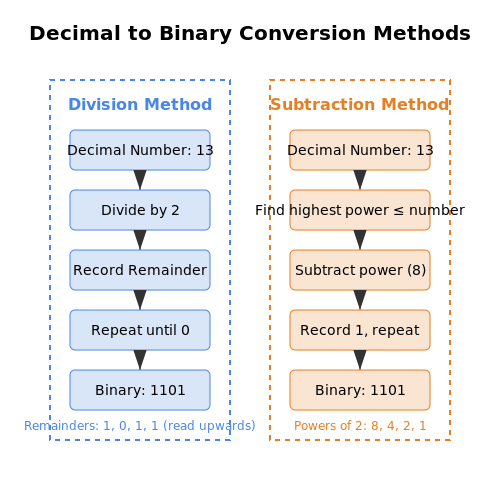
1. Successive Division Method
The successive division method involves dividing the decimal number by 2 repeatedly and recording the remainders. This can easily be contrasted with other base conversions, given its systematic approach.
- Divide the decimal number by 2.
- Write down the remainder (0 or 1).
- Update the quotient as the new number to divide.
- Repeat until the quotient is 0.
- The binary equivalent is obtained by reading the remainders in reverse order.
For example, converting the decimal number 13 involves the following steps:
- 13 ÷ 2 = 6 with a remainder of 1
- 6 ÷ 2 = 3 with a remainder of 0
- 3 ÷ 2 = 1 with a remainder of 1
- 1 ÷ 2 = 0 with a remainder of 1
Reading the remainders from bottom to top yields the binary representation: 1101.
2. Subtraction Method
Alternatively, the subtraction method involves using powers of two to reduce the decimal number to zero. This method is less common but valuable for understanding the underlying logic of binary representation.
The process includes:
- List the powers of 2 (1, 2, 4, 8, 16,...).
- Starting from the highest power, subtract it from the decimal number if it does not exceed it.
- Record a 1 for each power used, and a 0 for powers not used.
- Continue this until the number is reduced to 0.
Using 13 as our example again:
- 16 (2^4) is too high, so the first digit is 0.
- 8 (2^3) fits, so the second digit is 1.
- 4 (2^2) is not used, so the third digit is 0.
- 2 (2^1) fits, so the fourth digit is 1.
- 1 (2^0) fits, so the fifth digit is 1.
The resulting binary number is again 1101.
Practical Relevance and Applications
Understanding how to convert from decimal to binary is critical in programming and digital circuit design. Computers use binary operations to process data, and various algorithms depend on these conversions for representations of integers and floating-point numbers in memory.
In addition to computational applications, there are scenarios in data encoding, communication protocols, and network addressing where binary representation is essential. As engineers and researchers progress in fields like computer science and embedded systems, the ability to efficiently convert between these number systems remains invaluable.
In conclusion, converting decimal numbers to binary numbers is not only a fundamental skill but also a bridge to understanding more complex computing principles.
3.2 Binary to Decimal Conversion
Understanding how to convert binary numbers to decimal is fundamental for advanced work in electronics and computing. Binary, a base-2 numeral system, operates using only two symbols: 0 and 1. This contrasts with our familiar decimal system, which uses ten digits. The interplay between these number systems is crucial, particularly in architecture design for microcontrollers and processors.
Understanding Binary Representation
In binary encoding, each digit represents a power of 2, starting from the rightmost digit, which corresponds to 20 (1), the next one to the left corresponds to 21 (2), and so forth. To convert a binary number to decimal, you sum the values represented by each '1' in the binary number based on its position.
Step-by-Step Conversion Process
To illustrate binary to decimal conversion, consider the binary number 1011. We can break it down as follows:
- The rightmost digit (1) represents 20 = 1
- The second digit (1) represents 21 = 2
- The third digit (0) represents 22 = 0 (since it’s 0, it does not contribute to the sum)
- The leftmost digit (1) represents 23 = 8
Thus, the total is:
This gives us the decimal equivalent of the binary number 1011, which is 11.
Practical Applications of Binary to Decimal Conversion
This conversion is not merely academic; it has practical applications across various fields:
- Computer Science: Binary representation is fundamental in computer systems architecture. Data stored in binary reflects on the processing performance and overhead computations.
- Digital Electronics: Circuits often rely on binary signals. Understanding conversions aids in analyzing circuit design and function.
- Networking: IP addresses and subnetting rely on binary numbers, showcasing the necessity for precise conversions to understand network classes and addressing.
Historical Context
The binary system dates back to ancient civilizations but was modernized by mathematicians like Gottfried Wilhelm Leibniz in the 17th century. His insights laid the groundwork for contemporary computing, forming the basis for binary logic in computer algorithms.
As we delve deeper into the implications of binary representation, bridging both theory and application through practical experience becomes indispensable. The transformation from binary to decimal forms the bedrock for understanding higher-level concepts in digital electronics and computation.
3.3 Binary to Other Bases and Vice Versa
The binary number system, with its foundation in the powers of two, serves as the basis for digital computing and electronic systems. However, practitioners in the fields of engineering and physics often require conversions between binary and other numeral systems such as decimal, hexadecimal, and octal. This section delves into methods for efficiently converting binary numbers to these bases and vice versa, emphasizing practical applications and theoretical underpinnings.Conversions Between Binary and Decimal
To convert a binary number to decimal, the process involves multiplying each bit by two raised to the power of its position, counting from right to left starting at zero. Consider the binary number 1011:Binary to Hexadecimal and Vice Versa
Hexadecimal, based on powers of 16, is a compact representation preferred in programming and memory addressing. The conversion from binary to hexadecimal is straightforward because one hexadecimal digit corresponds to four binary digits (bits). Using the same example, 1011 converts as follows: - Group the binary number into sets of four from the right: 1011. - Each four-bit group equates to a single hexadecimal digit. - 1011 in binary corresponds to B in hexadecimal. Thus, the binary 1011 equals B in hexadecimal. For conversions in the opposite direction, we reverse the process: 1. Convert each hexadecimal digit to its binary equivalent: - B = 1011. 2. Combine the binary values: - The hexadecimal number B converts back to binary as 1011.Octal Representation
The octal numeral system, utilizing base 8, involves slightly larger digit groupings compared to hexadecimal. Here, three binary digits represent one octal digit. For a binary number like 1011, we first pad it on the left with zeros to obtain a group of three bits: 001 011. Now, converting this into octal gives: - 001 corresponds to 1 - 011 corresponds to 3 Therefore, the binary number 1011 becomes 13 in octal. When converting from octal to binary, we apply the inverse approach by transmuting each octal digit back to its binary representation: - 1 = 001 - 3 = 011 Combining gives 001011, corresponding to the original binary number.Practical Applications
Understanding these conversions is crucial in various electronic and computing applications. For instance, binary and hexadecimal conversions are frequently utilized in programming languages and digital circuit design. Octal is still found in legacy computing situations, such as UNIX file permissions, which are often represented in octal form. Moreover, these numeral system transformations aid in memory management, where binary data needs to be mapped efficiently to display readable formats for systems programmers and hardware engineers. By mastering binary conversions and their relationships to decimal, hexadecimal, and octal systems, professionals equipped with these skills can more effectively navigate the complexities of modern computational systems, enhancing both their problem-solving and project implementation capabilities.4. Addition of Binary Numbers
4.1 Addition of Binary Numbers
The addition of binary numbers is a fundamental operation in digital electronics and computer science, forming the basis for arithmetic operations in binary-coded systems. Understanding this operation is crucial for engineers and physicists, as it has practical implications in computing and digital circuit design.
Binary addition operates similarly to decimal addition, yet it only involves two digits—0 and 1. Beginning with the basics, we perform binary addition by applying a set of rules aligned with the decimal system, but with notable differences due to the binary numeral system's base-2 structure.
Basic Binary Addition Rules
When adding binary digits (bits), the rules are straightforward:
- 0 + 0 = 0
- 0 + 1 = 1
- 1 + 0 = 1
- 1 + 1 = 10 (This results in a carry of 1)
- 1 + 1 + 1 = 11 (This results in a carry of 1 and a sum of 1)
These rules are pivotal in digital circuits, where binary addition is often implemented using logic gates.
Performing Binary Addition
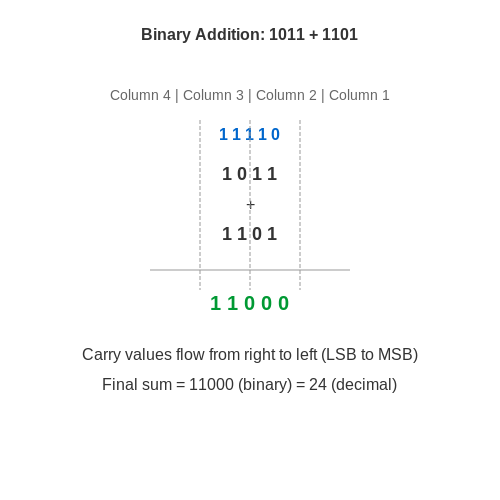
To illustrate binary addition, consider adding two binary numbers: 1011 (which is 11 in decimal) and 1101 (which is 13 in decimal).
The addition process moves from right to left:
- Column 1: 1 + 1 = 10, write down 0 and carry 1.
- Column 2: 1 (carry) + 1 + 0 = 10, write down 0 and carry 1.
- Column 3: 1 (carry) + 0 + 1 = 10, write down 0 and carry 1.
- Column 4: 1 (carry) + 1 + 1 = 11, write down 1 and carry 1.
Thus, 1011 + 1101 = 11000, which is 24 in decimal.
Importance in Digital Electronics
Binary addition is integral to the functioning of various electronic systems. In CPUs, arithmetic logic units (ALUs) leverage binary addition to perform mathematical computations. Furthermore, understanding binary addition lays the groundwork for more complex operations, such as subtraction, multiplication, and division in binary.
In practical applications, one can find binary addition being utilized in:
- Computer programming languages that handle low-level arithmetic
- Digital signal processing for error detection and correction algorithms
- Hardware design, particularly in the development of adders and multipliers
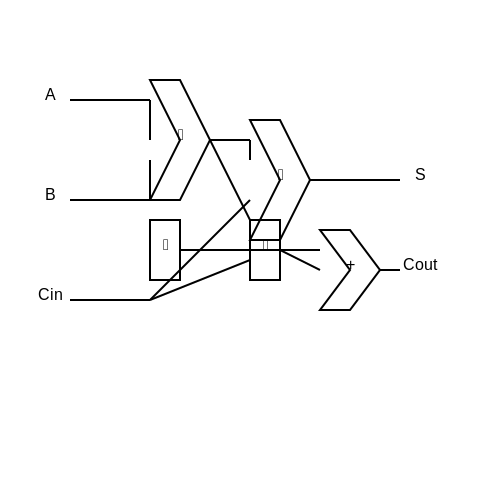
The implementation of binary addition also sets the stage for understanding larger digital designs, such as the construction of full adders and ripple carry adders, which are critical building blocks in more complex computational circuits.
As we proceed, we will explore further binary operations and how they connect to broader computational processes, highlighting their significance in both theoretical and applied contexts.
4.2 Subtraction of Binary Numbers
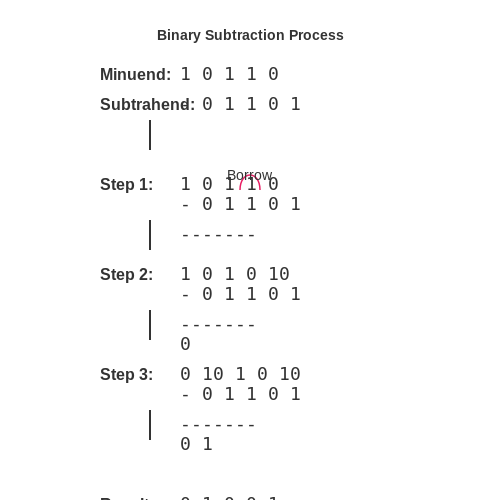
Subtraction in binary, much like its decimal counterpart, requires careful attention to the borrowing process when the minuend (the number from which another number is to be subtracted) is smaller than the subtrahend (the number to be subtracted). The process of binary subtraction is foundational in various fields including computer science, digital electronics, and data processing. Here, we will explore binary subtraction using both the direct method and the method of complements, particularly the two’s complement.
Understanding the Binary System
Before diving into subtraction, it's pivotal to reconsolidate our understanding of binary numbers. A binary number system is base-2, using only two digits: 0 and 1. Each binary digit, or bit, represents an increasing power of two, with the rightmost bit representing \(2^0\), the next \(2^1\), and so on. This base-2 system is the foundation of all modern digital electronics, crucial for information representation.
Direct Subtraction Method
To begin with, let’s look at a direct method for binary subtraction. Similar to decimal subtraction, we proceed from the least significant bit to the most significant bit, applying the borrowing technique when necessary. Let's illustrate this with an example:
Consider the subtraction of the binary numbers \(1101_2\) (13 in decimal) and \(101_2\) (5 in decimal).
   1101
-  0101
-------
Starting from the right, we perform the following steps:
- Subtract 1 from 1 (no borrowing needed): 0
- Subtract 0 from 0 (no borrowing needed): 0
- Subtract 1 from 1 (no borrowing needed): 0
- Subtract 0 from 1: 1
Thus, \(1101_2 - 0101_2 = 1000_2\) (which is 8 in decimal).
Borrowing in Binary
In some cases, borrowing is necessary. For instance, consider the subtraction of \(1010_2\) (10 in decimal) from \(1100_2\) (12 in decimal):
   1100
-  1010
-------
Following these steps:
- 0 cannot subtract 0 (borrow from the next bit). The current bit becomes 10 (2 in binary): 10 - 0 = 0 (after borrowing).
- 0 becomes 1 after borrowing. Now subtracting 1 from 1 results in 0.
- 1 becomes 0 after borrowing (since we borrowed for the previous bit). Now subtracting 0 from 1 results in 1.
- The last bit subtracts, 1 - 1 results in 0.
The result is \(0010_2\) (which is 2 in decimal).
Two’s Complement Method
An efficient method to perform subtraction in binary involves utilizing two's complement. Two’s complement is a way to encode negative numbers in binary, allowing simpler hardware implementations for subtraction. The steps include:
- Inverting the bits of the subtrahend (changing 0s to 1s and vice versa).
- Adding 1 to the inverted bits to get the two’s complement.
- Adding this result to the minuend.
For the example of \(1100_2 - 1010_2\):
- Invert \(1010_2\) to get \(0101_2\).
- Add 1: \(0101_2 + 0001_2 = 0110_2\) (6 in decimal).
- Add this to \(1100_2\):
1100 + 0110 ------- - The result is \(10010_2\). Because we're only dealing with 4 bits, we discard the leftmost bit. Thus, you get \(0010_2\).
Practical Applications
Binary subtraction and its methodologies are foundational in digital circuit design, particularly in Arithmetic Logic Units (ALUs), which are integral parts of CPUs in computing systems. Understanding these operations enables engineers to implement efficient algorithms for data processing, error detection, and correction, as well as in various applications such as digital filters and signal processing systems.
In conclusion, while the binary subtraction process may initially seem daunting due to the borrowing system, mastery over the direct method and the two's complement technique simplifies the arithmetic operations essential in electronics and computing.
4.3 Multiplication of Binary Numbers
Understanding the multiplication of binary numbers is crucial for anyone working with digital systems, as binary is the foundational language of computers. Unlike decimal multiplication that most are accustomed to, binary multiplication utilizes a specific method that mirrors the familiar arithmetic operations but retains simplicity due to the limited digits involved (0 and 1).
Binary Multiplication Basics
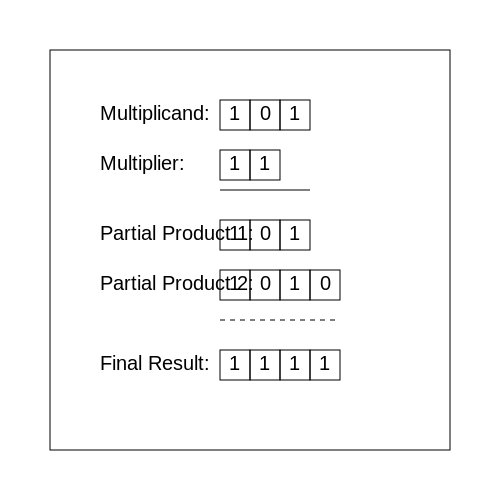
Binary multiplication operates similarly to long decimal multiplication, where each digit of one operand is multiplied with each digit of another operand, followed by appropriate shifts based on the place value of the digits. This results in a series of partial products, which are then summed to yield the final result. Consider the binary multiplication of two numbers, 101 (5 in decimal) and 11 (3 in decimal).
Step-by-Step Multiplication Process
This operation can be broken down into the following steps:
- Start with the least significant bit (LSB) of the multiplier; in our case, 1.
- Multiply the entire multiplicand (101) by the digit (1), resulting in 101.
- Move to the next LSB of the multiplier; here this is 1, but now we shift one position to the left, yielding 1010.
- Add the two partial results together:
This yields \( 1111 \), which is equivalent to 15 in decimal form. Thus, the binary multiplication of 101 and 11 results in 1111.
The Algorithmic Approach
In computational applications, binary multiplication is often implemented using algorithms that optimize the number of operations. Two common methods are:
- Shift and Add: This technique relies solely on shifts and additions, avoiding immediate multiplication operations.
- Booth's Algorithm: This method handles both positive and negative numbers and reduces the number of necessary additions by taking into account the patterns in the binary digits.
Both methods are integral in designing efficient arithmetic logic units (ALUs) in microprocessors, and they underscore the significance of mastering binary multiplication.
Practical Relevance
The ability to perform efficient binary multiplication has wide-reaching implications in modern technology. It plays a critical role in:
- Computer Architecture: Integral for rapid computations and data processing in ALUs.
- Signal Processing: Essential in digitally processing audio and video signals where binary operations are continuous.
- Cryptography: Used extensively in algorithms that rely on large binary number computations for secure data transmission.
As technology continues to advance with a strong reliance on digital computation, the expertise in binary operations, particularly multiplication, cannot be underestimated.
Conclusion
In essence, the multiplication of binary numbers is foundational not just from a mathematical perspective but from an applied engineering viewpoint. By understanding this process, you are well-equipped to delve deeper into more complex operations and concepts in binary math.
4.4 Division of Binary Numbers
In the realm of binary arithmetic, division is an operation that can present unique challenges compared to its decimal counterpart. While the fundamental principles remain the same—dividing a numerator by a denominator—the methods and nuances differ significantly when handling binary numbers. Understanding these processes is crucial for engineers and computer scientists alike, particularly as they relate to computer architecture and algorithm design.
Division of binary numbers typically employs a method known as binary long division, which is analogous to the long division method taught in elementary mathematics. This method systematically breaks down the division process, allowing us to manage the binary digits step by step.
Understanding Binary Division
When dividing in binary, we start from the leftmost bit of the dividend. The goal is to find out how many times the divisor can fit into the current segment of the dividend. If the divisor can fit, we denotate this by placing a '1' in the quotient; otherwise, we place a '0'. Once we establish this fitting, we subtract the product of the divisor and the quotient bit from the current segment of the dividend, bringing down the next bit in the operation. This process continues until all bits have been processed.
As with decimal division, each quotient bit represents a power of two, and the entire quotient can be represented as a binary number. The remnant after the division provides further insight into the operation, with implications in error checking, numeric stability, and computational efficiency.
Binary Long Division Process
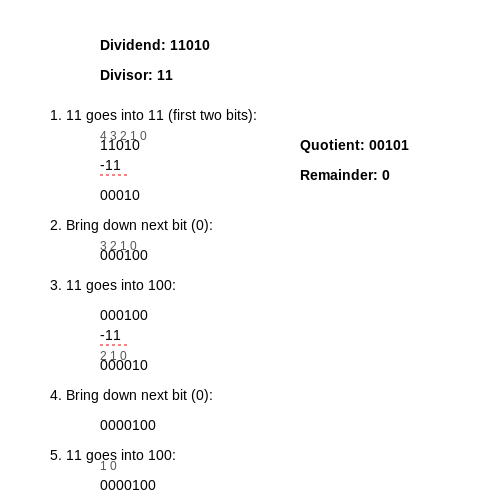
To illustrate binary division, let’s divide the binary number 11010 (which is 26 in decimal) by 11 (which is 3 in decimal). We will follow the binary long division steps outlined below:
- Identify the divisor (11) and the dividend (11010).
- Begin by aligning the divisor with the leftmost bits of the dividend.
- Determine how many times the divisor can fit into the current segment of the dividend.
- Subtract and bring down the next bit.
- Repeat until there are no more bits to bring down.
This results in the following sequence:
Where the remainder, in this case, is 0, indicating that the division is exact.
Binary Division Implementation and Applications
In practical digital circuit design, binary division is facilitated through various architectures, including shift registers and dividers that are implemented in both hardware and software environments. Consider the following:
- In computer algorithms, binary division forms the basis for integer division and can impact performance in algorithms that require quick multiplicative inversions.
- Hardware implementations of binary division can be found in components like digital signal processors (DSPs), where division operations are frequent and need to be executed efficiently.
Understanding binary division equips professionals with the knowledge to design effective systems that utilize these operations for performance-critical applications, such as in network communications and real-time signal processing.
With this foundation, we can explore related advanced topics, such as binary multiplication and its role in dividing complex numbers represented in binary form in upcoming sections.
5. Binary in Computer Systems
5.1 Binary in Computer Systems
The binary numeral system, utilizing only the digits 0 and 1, serves as the foundation of modern computer systems. This digital language is deeply ingrained in the architecture of computers, enabling the representation and manipulation of data in a structured manner. Understanding binary numbers is essential for engineers and researchers as it directly influences both hardware design and software development.
At the heart of computer systems, binary numbers represent electrical states—where 0 typically indicates a low voltage (off) and 1 indicates a high voltage (on). These states translate into complex operations, ensuring the processing and storage of data is efficient. The utilization of binary in computing can be observed across various levels, from microprocessor operations to higher-level software abstraction.
Binary Logic and Gates
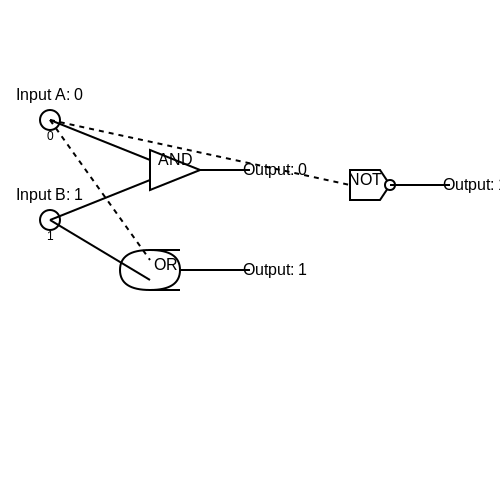
To fully appreciate the practicality of binary numbers in computer systems, one must explore the role of logic gates. Logic gates, which perform basic logical functions, are the building blocks of digital circuits. The most commonly used gates are:
- AND Gate: Outputs true (1) only if both inputs are true (1).
- OR Gate: Outputs true (1) if at least one input is true (1).
- NOT Gate: Inverts the input; outputs true (1) if the input is false (0).
These gates are combined to create more complex circuits, leading to functionality essential for computing tasks, such as arithmetic operations, data storage, and signal processing.
Data Representation and Storage
In computer systems, binary numbers are used to represent different types of data. For example, in a modern computer:
- Integers: Represented in binary format, such as 5 being stored as 101.
- Characters: Utilized through encoding schemes like ASCII or UTF-8, where each character is assigned a unique binary sequence.
- Floating-point numbers: Represented using IEEE 754 standard, which encodes numbers in a binary format to enable precise representation of real numbers.
The ability to convert and manipulate these different forms of data underscores the versatility of binary systems in computing.
Binary Arithmetic
The proficiency in binary arithmetic is pivotal for engineers and computer scientists. Much like decimal arithmetic, binary arithmetic follows its own rules, including:
- Binary addition (e.g., 1 + 1 = 10 in binary).
- Binary subtraction through the method of borrow.
- Multiplication and division, which are often performed using shifts and adds.
This arithmetic allows for efficient computation and is implemented directly in the instruction sets of microprocessors.
Application in Computing Systems
The implications of binary numbers extend far beyond simple representation and arithmetic. They are utilized in various practical scenarios:
- Programming: High-level programming languages abstract the binary operations, but ultimately translate to binary instructions understood by processors.
- Networking: Data packets transmitted across networks are encoded in binary, enabling efficient communication protocols.
- Machine Learning: Algorithms implemented in binary often result in optimized processing and quicker computations, essential for handling vast datasets.
Thus, comprehending the significance of binary numbers in computer systems is crucial for advancing technology and creating innovative solutions in the field.
5.2 Digital Electronics and Logic Gates
Digital electronics encompasses systems that utilize binary numbers, which are central to modern computing and digital circuit design. This subsection will explore the essential components of digital electronics, primarily focusing on logic gates and their applications.
Understanding Logic Gates
At the heart of digital circuits lie logic gates, which are devices that perform basic logical functions that are fundamental to digital circuits. These gates act on binary inputs and produce a binary output, allowing complex binary operations to take place within electronic systems.
Each logic gate corresponds to a specific logical operation. The most common types include:
- AND Gate: Outputs true only if all inputs are true.
- OR Gate: Outputs true if at least one input is true.
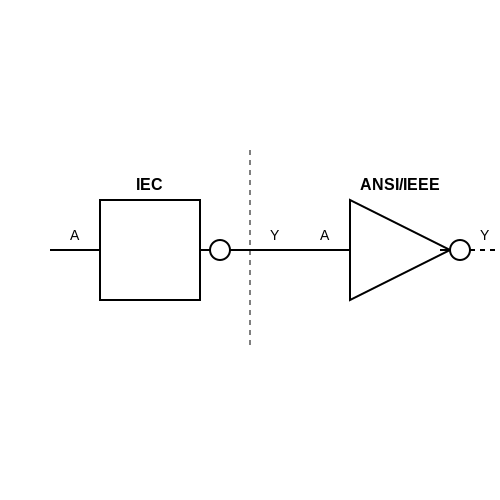
- NOT Gate (Inverter): Outputs the inverse of the input.
- NAND Gate: Outputs false only when all inputs are true; it is the negation of the AND gate.
- NOR Gate: Outputs true only when all inputs are false; it is the negation of the OR gate.
- XOR Gate (Exclusive OR): Outputs true if an odd number of inputs are true.
- XNOR Gate: Outputs true if an even number of inputs are true; it is the negation of the XOR gate.
A logical operation can be mathematically represented. For example, the output of an AND gate can be represented as:
Where \(Y\) is the output and \(A\) and \(B\) are the binary inputs. By employing Boolean algebra, one can derive more complex circuits by combining these gates into bigger networks.
Designing Digital Circuits
The design of digital circuits begins with specifying the behavior required from the circuit, often done using a truth table. A truth table lists all possible combinations of inputs for a logic function and the corresponding outputs. For example, consider a simple two-input AND gate:
| Input A | Input B | Output Y |
|---|---|---|
| 0 | 0 | 0 |
| 0 | 1 | 0 |
| 1 | 0 | 0 |
| 1 | 1 | 1 |
Truth tables are invaluable, as they allow the designer to visualize the behavior of digital circuits before implementing them physically. Once the truth table is established, one can simplify the logic using Boolean expressions, often leveraging methods such as Karnaugh maps or Quine-McCluskey algorithm to minimize the number of gates required.
Applications of Logic Gates
Logic gates are not only foundational in creating combinational circuits (such as adders, multiplexers, and decoders) but also in building sequential logic circuits, which incorporate memory elements. Applications range from simple arithmetic operations in calculators to complex microprocessors where millions of gates function together to perform computations.
Furthermore, understanding logic gates is critical for realizing embedded systems and digital architecture design, where they are instrumental in executing tasks ranging from signal processing to control systems for robotics and automation.
Thus, knowledge of logic gates and their operation is essential for those engaged in electrical engineering, computer science, and information technology, providing the basis for understanding how digital systems operate and interact.
5.3 Data Encoding and Compression
With the rapid growth of digital information, the need for efficient data management becomes crucial. Data encoding and compression play vital roles in the realms of computer science, telecommunications, and multimedia applications, directly impacting storage requirements and transmission efficiency. This subsection explores the mechanisms behind data encoding and compression, emphasizing their practical applications and underlying principles.
Understanding Data Encoding
Data encoding is the process of transforming information into a specific format for efficient storage or transmission. This process involves converting data into binary representations, making it interpretable by digital systems. There are various encoding schemes such as ASCII, UTF-8, and more specialized formats like Base64, each suited for different applications.
ASCII (American Standard Code for Information Interchange) represents characters using 7 bits, allowing for 128 unique symbols. For example, the letter 'A' is represented by the binary number 01000001. In contrast, UTF-8 extends encoding to accommodate a wider range of characters, which is essential for internationalization. UTF-8 encodes characters in one to four bytes, providing flexibility while maintaining backward compatibility with ASCII.
Data Compression Techniques
After encoding, data may benefit from compression, which reduces the storage space required or enhances transmission speeds. There are two main types of compression:
- Lossless Compression: In this method, the original data can be perfectly reconstructed from the compressed data. Techniques such as Run-Length Encoding (RLE) and Huffman Coding are common examples. For instance, RLE works by replacing repeated elements with a single element followed by a count. This is particularly useful in bitmap images with large areas of a single color.
- Lossy Compression: This approach permanently removes certain data, which can lead to a loss of quality. It is often employed in multimedia formats like JPEG and MP3. The key is to remove information that is less perceptible to human senses, thereby achieving significant reductions in file size while maintaining adequate quality for typical use cases.
Run-Length Encoding Example
Consider the string of data AABBBCCDAA. Using RLE, this can be encoded as 2A3B2C1D2A. The compressed data takes up significantly less space, demonstrating how encoding and compression can significantly reduce the amount of data needed to represent information.
Mathematical Foundations
To illustrate the efficiency of compression, we can look at the lossless compression ratio. The compression ratio CR is defined mathematically as:
Where S_{original} is the size of the original data and S_{compressed} is the size after compression. For instance, if a file initially measures 10 MB and compresses to 2 MB, the compression ratio is:
This indicates a five-fold reduction in size, underlining the practical relevance of effective data encoding and compression techniques.
Application in Real-World Systems
Data encoding and compression are essential in various applications, including:
- Streaming Services: Applications like Netflix and Spotify utilize data compression to deliver high-quality audio and video with minimal bandwidth utilization.
- File Storage Systems: Formats like ZIP and GZIP are vital for packaging multiple files into directories with reduced sizes for easy sharing and storage.
- Networking Protocols: Efficient data transmission protocols employ compression algorithms to enhance throughput, especially over limited bandwidth channels.
In conclusion, data encoding and compression are pivotal in our digital ecosystem, influencing everything from storage solutions to content delivery. Understanding these concepts not only provides insights into the workings of modern technology but also prepares engineers and researchers to develop better systems for the future.
6. Recommended Texts
6.1 Recommended Texts
- Digital Design and Computer Architecture — This book integrates a comprehensive introduction to digital design and computer architecture. It is beneficial for understanding binary numbers in the context of system and circuit design.
- The Art of Electronics — A classic reference that blends electronics theory with practical experimentation, providing insights into binary numerals used within digital systems and a deeper understanding of their technical applications.
- An Introduction to Information Theory — This resource delves into the mathematics of binary systems in the context of information theory, offering a robust mathematical background for binary representation in data transmission and storage.
- Computer Architecture: A Quantitative Approach — This text provides in-depth coverage of computer design concepts, enhancing understanding of binary numbers within hardware systems and microarchitecture, ideal for advanced learners.
- Applied Cryptography — Offers insights into how binary numbers play a critical role in cryptography, helping readers comprehend the application of binary operations in security protocols.
- Computer Networking: A Top-Down Approach — This approach provides practical examples of binary numbers used in networking protocols and data transmission, coupled with explanations from a top-down perspective of data communication.
- Digital Logic Design: A Rigorous Approach — A textbook that rigorously covers the principles of digital electronics, with an emphasis on logical reasoning and binary number systems applied in digital logic design.
6.2 Online Resources
- Khan Academy - Computer Science — A section dedicated to computer science that includes a comprehensive discussion on binary numbers, bit operations, and their applications in computing and digital systems.
- YouTube - Binary Numbers and Base Systems as Fast As Possible — A concise and engaging video that explains binary numbers, providing essential insights into how binary is used in computer systems.
- TutorialsPoint - Binary Numbers — Offers a detailed guide on binary numbers including mathematical operations and conversions, suitable for learning practical applications in digital electronics.
- Computer Science Tutorials - Binary Numbers — Extensive tutorial on binary numbers with a focus on mathematical conversions and logic gates, providing practice exercises for thorough understanding.
- GeeksforGeeks - Binary Numbers: Theory of Sets and Logical Family — Explores binary numbers within the domain of set theory and discusses their significance in logical circuits and computational logic.
- edX - CS50's Introduction to Computer Science — An introductory course from Harvard University that delves into the fundamental concepts of computer science, including binary systems.
- The University at Buffalo - Binary Numbers in Data Structures — Explains the use of binary numbers in data structures and algorithms, emphasizing practical implementation in software systems.
- IBM Documentation - Binary Numbers and Arithmetic — Provides technical documentation on binary arithmetic, including binary addition, subtraction, and implications for computational efficiency.
- Coursera - Digital Systems: From Logic Gates to Processors — A course offering a comprehensive understanding of digital systems, emphasizing the role of binary numbers in logic circuits and processors.
- MIT OpenCourseWare - Computation Structures — Access to lecture notes on computation structures with a focus on binary mathematics and electronic design principles.
6.3 Research Articles
- IEEE Xplore: Binary Numbers in Error Detection — A comprehensive study focusing on the role of binary numbers in error detection and correction codes. Discusses the practical applications in digital systems.
- ScienceDirect: Binary Arithmetic Operations — Explores the mathematical formulation and computational efficiency of binary arithmetic operations, showing advanced techniques used in computer algorithms.
- JSTOR: Historical Development of Binary Systems — Provides a historical analysis of how the binary number system evolved and its implications on modern computer science and electronic design.
- Springer: Binary Numbers in Quantum Computing — Examines the integration of binary systems within quantum computing frameworks, offering insight into the challenges and innovations of binary processing at quantum levels.
- Oxford Academic: Binary Representation in Data Science — Discusses the significance of binary representation in data science and machine learning, showcasing algorithms that utilize binary trees for decision making.
- arXiv: Neural Networks and Binary Number Systems — A theoretical paper explaining how binary number systems contribute to the efficiency of artificial neural networks, particularly in resource-constrained environments.
- ACM: Binary Numbers in Algorithm Design — Focuses on the critical role of binary numbers in algorithmic design. Offers case studies on compression algorithms and binary search optimizations.