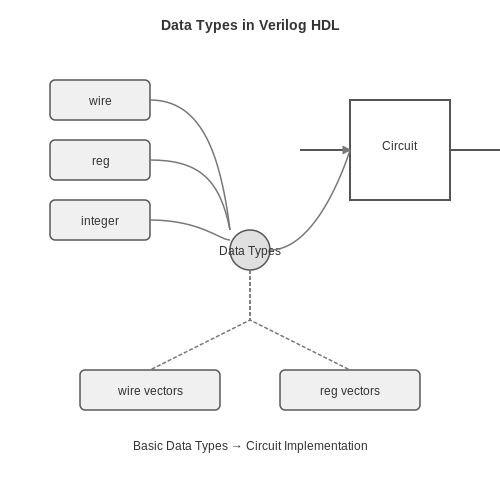
Binary to Decimal Conversion
1. Definition of Binary Numbers
1.1 Definition of Binary Numbers
Binary numbers are the foundational language of computers and digital systems. They operate on a base-2 numerical system, which fundamentally differs from the decimal system (base-10) that we commonly use in everyday life. In binary, each digit, referred to as a "bit," can hold one of two possible values: 0 or 1. This duality allows binary systems to represent all forms of data, from numbers and letters to complex multimedia files.
Understanding the Binary System
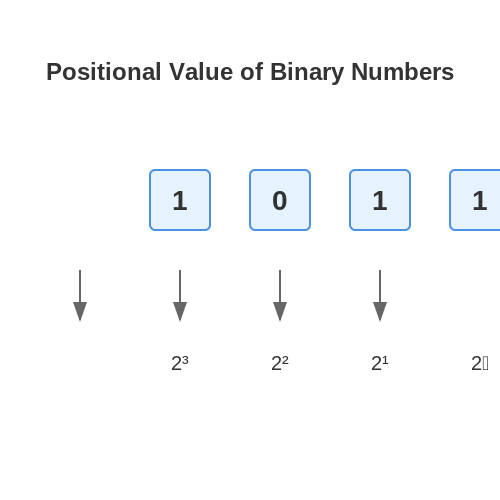
The binary system employs positional notation similar to the decimal system, where the position of a digit signifies its weight or value in the overall number. For instance, in the binary number 1011, the rightmost digit represents 20, the next one 21, followed by 22, and so forth. This means:
Calculating each term, we find:
This demonstrates how binary numbers can be converted into their decimal counterparts, highlighting their utility in computer logic and arithmetic.
Historical Context
The binary system, although now integral to contemporary computing, has roots that trace back to ancient civilizations. The concept was notably proposed by Gottfried Wilhelm Leibniz in the 17th century, who recognized its potential to symbolize logic and thought processes. His work laid the groundwork for subsequent advancements in computing. Decades later, the invention of electronic components that utilized binary states enabled the design of computationally efficient logic circuits, ultimately leading to the development of modern computers.
Practical Applications
In contemporary digital systems, every operation we perform—including mathematical calculations, image processing, and even web browsing—relies on binary encoding. This dependency underlines the significance of understanding binary numbers, especially for engineers and physicists who design and innovate within digital realms. Whether programming in low-level languages, designing circuits, or understanding computational theory, binary numbers serve as the essential building blocks of digital technology.
In this formula, \( D \) represents the resulting decimal value, \( b_i \) denotes the individual binary digits, and \( n \) is the total number of bits. The systemic conversion is not merely academic; it forms the backbone of efficient data representation in software algorithms and hardware designs.
As you delve further into the complexities of binary numbers, keep in mind their critical role in creating and understanding the technology that shapes our world.
1.2 Base-2 Number System
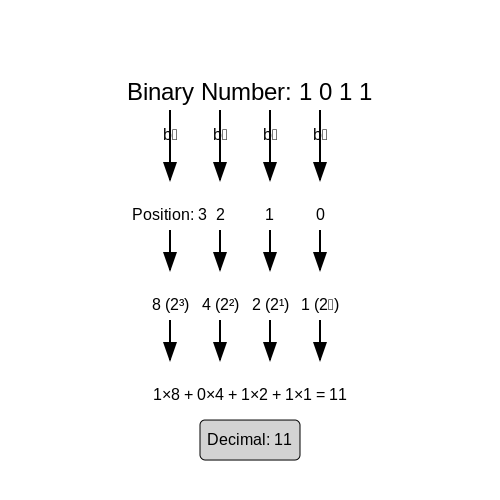
In the realm of digital electronics, the base-2 number system, or binary system, serves as the foundational underpinning for how information is represented and processed in computational devices. In contrast to the decimal system, which is base 10 and universally utilized in everyday human interactions, the binary system employs only two digits: 0 and 1. This simplicity facilitates efficient data processing and logical operations, crucial for modern computing.Understanding Binary Representation
To grasp the binary system, it's essential to comprehend how numbers are constructed using digits and their respective positions. Each position represents a power of 2, analogous to how each decimal place represents a power of 10. For instance, consider the binary number 1011. Here’s the breakdown of its value based on positional notation: - The rightmost digit (1) is \(1 \times 2^0\) - The next digit (1) is \(1 \times 2^1\) - The subsequent digit (0) is \(0 \times 2^2\) - The leftmost digit (1) is \(1 \times 2^3\) Calculating the total gives: $$ 1 \times 2^0 + 1 \times 2^1 + 0 \times 2^2 + 1 \times 2^3 = 1 + 2 + 0 + 8 = 11 $$ This conversion is pivotal, as it highlights the relationship between binary and decimal forms, establishing the framework necessary for binary to decimal conversion.The Practical Relevance of Binary
The binary system is not merely theoretical; it encapsulates the fundamental principles guiding digital computing. Computer circuits operate on binary logic, interpreting binary digits (bits) through the manipulation of electrical states — either ON (1) or OFF (0). This binary representation allows for the encoding of complex data types such as images, text, and sounds simply and efficiently. For example, an 8-bit binary number can convey values between 0 and 255, thus fitting conveniently within an 8-bit byte, a standard unit of digital data. Moreover, contemporary advancements in technology, such as quantum computing and AI data processing, continue to utilize variations of the binary system or its extensions, making it an indispensable concept across a multitude of disciplines including computer science, data engineering, and electronics.Visualizing Binary Data
To further elucidate the impact of binary representation, it can be helpful to visualize it. Imagine a light switch, where the OFF position corresponds to 0 and the ON position corresponds to 1. A sequence of these lights can represent more complex information as configurations of ONs and OFFs, visually rendering various binary combinations. Here’s a view of simple binary representations and their decimal equivalents:| Binary | Decimal |
|---|---|
| 0000 | 0 |
| 0001 | 1 |
| 0010 | 2 |
| 0011 | 3 |
| 0100 | 4 |
| 1111 | 15 |
| 1000 | 8 |
1.3 Comparison with Decimal System
To grasp the intricacies of binary to decimal conversion, it is imperative to understand the inherent differences between the binary and decimal systems. The decimal system—also known as the base-10 system—has been the primary numeral system for humans, owing to our ten fingers. It comprises ten symbols: 0 through 9. In contrast, the binary system, used predominantly in computing, operates on base-2, utilizing only two symbols: 0 and 1. This fundamental difference leads to varying methods of representation, calculation, and real-world applications.
Understanding Base Representation
At its core, a numeral system is defined by its base, which indicates the number of unique digits it uses. The value of a numeral, regardless of the system, is determined by its position. For instance, in the decimal system, the number 253 can be expressed as:
This positional notation shows that each digit's value is dependent on its exponent associated with the base of the system.
Likewise, in binary, the number 1011 can be represented as:
Here, the significance of each bit is mirrored, but it reflects the powers of 2 instead. The result of this computation is 11 in the decimal system.
Comparative Conversion Mechanics
The conversion of binary numbers to decimal is achieved through the sum of products of each bit position multiplied by the corresponding power of 2. It necessitates an understanding of how to perform arithmetic operations within different bases—a skill vital for engineers and computer scientists alike.
To enhance comprehension, consider the binary number 11010. The decimal equivalent can be calculated as follows:
Thus, 11010 in binary correlates to 26 in decimal.
Real-World Applications and Implications
The significance of this juxtaposition extends beyond theoretical understanding. In the realm of computer science, understanding binary is critical for logic design, circuit implementation, and programming languages built on binary logic (such as assembly language). Additionally, engineers use these conversions when designing microcontrollers, digital circuits, or any system relying on binary data representation.
Furthermore, gaining proficiency in binary notation allows professionals to optimize data storage and processing efficiencies, particularly with emerging technologies like quantum computing and advanced algorithms.
As we continue to explore the nuances between binary and decimal systems, keep in mind how these concepts interlink with broader themes in technology and engineering.
2. Conversion Method Overview
2.1 Conversion Method Overview
The conversion of binary numbers to decimal format is a fundamental process in digital electronics and computer science, as it bridges the gap between human-readable numbers and machine-readable data. This section outlines the key methodologies used for binary-to-decimal conversion, emphasizing both theoretical and practical aspects.
Understanding the Binary System
Binary, a base-2 numeral system, uses only two symbols: 0 and 1. Each digit in a binary number is referred to as a bit. The position of each bit represents a power of two, and the value of the binary number is the sum of each bit multiplied by its corresponding power of two. For instance, in the binary number 1101:
- The rightmost bit represents \( 2^0 \), the next \( 2^1 \), then \( 2^2 \), and \( 2^3 \).
- This translates to \( 1 \times 2^3 + 1 \times 2^2 + 0 \times 2^1 + 1 \times 2^0 = 8 + 4 + 0 + 1 = 13 \) in decimal.
This positional system allows one to derive the decimal value straightforwardly, given the binary digits.
Conversion Methods
There are several established methods for converting binary numbers to decimal, each suitable for different scenarios:
- Direct Conversion Method: This straightforward approach involves calculating the decimal value using binary digit positions as previously described. It is efficient but can become tedious with large binary numbers.
- Cumulative Method: In this technique, the conversion takes place in stages. Starting from the leftmost bit, each bit is added to a running total, which is multiplied by 2 with each progression. This method can be visualized as expanding the binary number dynamically.
- Double Dabble Method: Primarily used in hardware implementations, this method allows binary-coded decimal conversion through a series of shifts and additions, accommodating the binary representations of decimal numbers while maintaining their integrity.
Practical Relevance
The practical applications of binary to decimal conversions extend into countless domains. In computer engineering, this conversion facilitates the debugging process during software development, where programmers need to understand the underlying binary representations of their outputs. In digital signal processing, binary configurations are translated to decimal for easier interpretation and manipulation of sensor data.
Moreover, understanding binary to decimal conversion is essential for engineers designing digital systems, as it lays the foundation for more complex arithmetic operations, such as binary addition, subtraction, and even floating-point arithmetic.
Summative Insights
Ultimately, mastering binary to decimal conversion enhances one’s ability to navigate the digital landscape effectively. It serves as a cornerstone for both theoretical studies and practical implementations in fields such as computer science, electrical engineering, and data processing.
2.2 Step-by-Step Conversion Process
Converting a binary number to its decimal equivalent is fundamental in various fields such as computer engineering, digital electronics, and information technology. This conversion harnesses the very essence of positional notation — a concept deeply rooted in number theory. Understanding this process lays the groundwork for more complex operations, such as arithmetic calculations in binary systems.
In a binary number, each digit, known as a bit, represents a power of 2, based on its position from right to left. For instance, the rightmost bit represents \(2^0\), the next \(2^1\), and so forth. The conversion from binary to decimal can be accomplished through a systematic, step-by-step approach that includes identifying these powers, calculating their respective contributions, and summing them up.
Step 1: Identify the Binary Components
Consider a binary number, for example, 1011. This number has four bits: from right to left, we have 1, 1, 0, and 1. The respective powers of 2 for these positions are:
- Bit 3 (from the right): \(1 \times 2^3\)
- Bit 2: \(1 \times 2^2\)
- Bit 1: \(0 \times 2^1\)
- Bit 0: \(1 \times 2^0\)
Step 2: Calculate the Contribution of Each Bit
Next, calculate the contribution of each bit:
Step 3: Summing Up Contributions
Add the contributions to obtain the decimal value:
Thus, the binary number 1011 converts to 13 in decimal. This technique of identifying bit positions, calculating their contributions based on powers of two, and summing those contributions reflects the binary arithmetic fundamental in digital systems.
Real-World Application
The binary-to-decimal conversion process is crucial when interfacing between binary-based digital systems and human-readable forms. All digital computers inherently operate using binary, processing data as bits. For instance, memory addressing, data representation, and coding systems heavily rely on accurate conversions between these number systems. This seamless conversion ability ensures efficiency in programming languages that inherently support binary operations.
Moreover, applications extend further into fields such as telecommunications, where binary codes represent signals transmitted across various media. Understanding this conversion process enables engineers to design more robust systems that can efficiently convert, interpret, and manipulate binary information.
Conclusion
The step-by-step conversion from binary to decimal not only aids in comprehending number representations but also serves as a stepping stone to advanced concepts in computer architecture, digital electronics, and signal processing. Mastering this concept empowers professionals in the field to tackle more intricate problems that intertwine these foundational principles.
2.3 Common Mistakes in Conversion
Binary to decimal conversion is a fundamental skill in electronics and computer science that many advanced practitioners occasionally misstep on. These errors can stem from various underlying causes, including misunderstanding fundamental principles, hastiness in calculations, or the natural tendency to conform to familiar methods. In this section, we will delve into common pitfalls encountered during binary to decimal conversion and offer insights into how to avoid them.
1. Misalignment of Place Values
A common mistake occurs when individuals fail to correctly assign place values to bits in the binary number. Each bit in a binary number represents a power of 2, starting from 0 on the right. For instance, in the binary number 1011, the correct alignment of place values should be as follows:
- 1 (23)
- 0 (22)
- 1 (21)
- 1 (20)
Neglecting to track these positions correctly can lead to significant calculation errors. Always ensure that each bit is accurately represented in terms of its corresponding power of 2 to maintain precision in conversion.
2. Ignoring Leading Zeros
In binary numbers, leading zeros may seem insignificant, leading to a misinterpretation of the value. For example, the binary number 00101 should not be simplified to 101 before conversion, as both representations indicate the same decimal number, which is 5. However, ignoring leading zeros in certain contexts, such as binary-coded decimal (BCD), can lead to incorrect outputs. Always respect leading zeros in binary to ensure clarity and accuracy in representation.
3. Confusion with Fractional Binary Numbers
Another frequent error arises when converting fractional binary numbers. The process requires understanding how binary fractions work, where each position to the right of the binary point signifies a negative power of 2. For instance:
If we take the binary number 0.101, the conversion is done as follows:
- 1 (2-1) = 0.5
- 0 (2-2) = 0
- 1 (2-3) = 0.125
This yields a resultant decimal of 0.5 + 0 + 0.125 = 0.625. Neglecting the fractional component or miscalculating it could lead to erroneous results.
4. Arithmetic Errors in Calculation
Arithmetic mistakes often plague the conversion process, particularly under pressure or time constraints. Quick mental calculations may overlook critical additions or misplace decimal points. Indeed, maintaining a structured approach can mitigate these arithmetic errors:
- Break down the binary number into manageable groups for easier computation.
- Validate each step, especially after significant calculations.
Utilizing a binary converter tool or programming script as a check can also minimize errors.
5. Overlooking Contextual Specificity
Finally, practitioners should be aware of the context in which binary numbers are used; applications in networking, computing, or storage can dictate how precision plays a role. For instance, binary numbers used in memory addressing may require strict adherence to specific formats, while programming scenarios may allow for more flexibility. This context offers critical insight into why precision during binary to decimal conversions significantly impacts system performance.
Being aware of these common mistakes can enhance not only individual competencies but also overall team effectiveness in projects tied to computing and electronics applications. Recognizing the subtleties involved in binary to decimal conversion is an essential expertise that can lead to better decisions and designs in technology.
3. Role in Computing and Programming
3.1 Role in Computing and Programming
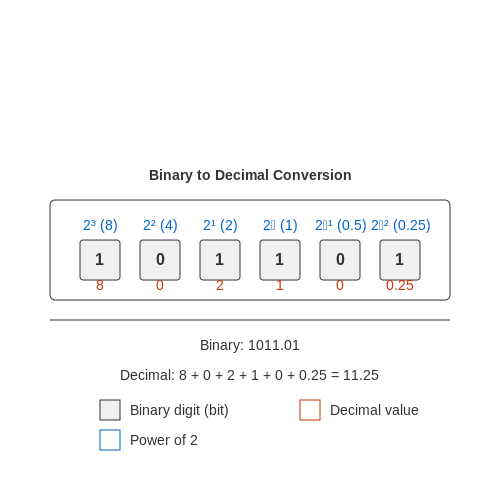
The conversion from binary to decimal plays a pivotal role in computing and programming, serving as a critical bridge between machine-level representations and human-readable formats. Understanding this conversion is essential not just for effective programming but also for engaging deeply with the fundamentals of computer architecture and data representation.The Importance of Binary Representation
At the core of computing lies the binary number system, a base-2 numeral system utilizing only two digits: 0 and 1. This system is foundational because most digital electronic systems, including computers and smartphones, operate using binary logic. Each binary digit, or "bit," represents an off (0) or on (1) state, an abstraction of electrical voltages present in transistors. In essence, binary encoding is a representation of data structures and instructions that machines can process. When we convert binary numbers to their decimal equivalents, we facilitate human interaction with machines, enabling programmers to use more intuitive numerical systems in their algorithms and applications. The decimal system, or base 10, uses digits from 0 to 9 and is familiar to most people. The ability to seamlessly switch between binary for processing and decimal for user interfaces is fundamental to software development.Mathematical Foundations
To understand binary to decimal conversion, consider how numbers are structured in various bases. In a positional numeral system, the value of each digit depends not only on its face value but also on its position. The conversion formula from binary (base-2) to decimal (base-10) is given by: $$ D = b_n \times 2^n + b_{n-1} \times 2^{n-1} + \cdots + b_1 \times 2^1 + b_0 \times 2^0 $$ where: - \(D\) is the decimal equivalent of the binary number, - \(b_n\) represents each binary digit (0 or 1), - \(n\) is the position of the digit from right to left, starting with 0. For example, to convert the binary number 1101 to decimal: 1. Identify the binary digits: \(b_3 = 1\), \(b_2 = 1\), \(b_1 = 0\), \(b_0 = 1\). 2. Apply the formula: - \(D = 1 \times 2^3 + 1 \times 2^2 + 0 \times 2^1 + 1 \times 2^0\) - \(D = 8 + 4 + 0 + 1\) - \(D = 13\) Thus, \(1101_2\) is equivalent to \(13_{10}\).Practical Relevance and Applications
In programming, knowledge of binary to decimal conversion is crucial for numerous practical scenarios. Here are a few noteworthy applications:- Data Storage: Understanding how binary data represents decimal values can improve performance in database indexing and retrieval.
- Networking: IP addressing employs binary coding, necessitating frequent conversion between binary and decimal for subnetting and address management.
- Low-level Programming: In systems programming and embedded systems, manipulation of binary data is commonplace, requiring extensive knowledge of numeric conversions for debugging and optimization.
- Cryptography: Many encryption algorithms depend on binary representations of data, where conversions play an integral role in the processes of encoding and decoding information securely.
3.2 Applications in Digital Electronics
The conversion from binary to decimal is a fundamental aspect in the realm of digital electronics. The profound understanding of this conversion not only enhances one's grasp of digital systems but also opens doors to myriad applications, ranging from computer architecture to control systems.
To appreciate the relevance of binary to decimal conversion, it’s crucial to consider how digital systems operate on binary numbers — utilizing sequences of 0s and 1s to represent complex information. At its core, digital electronics employs binary for data processing, storage, and transmission, hence necessitating efficient conversion methodologies for practical functionality.
Data Representation and Processing
In any digital electronic system, data must be readily represented in a meaningful way. Here, binary codes are converted to decimal to facilitate user interaction and interpretability. For example, when a user inputs a binary-encoded value (say, a binary number representing a temperature sensor reading), the system must convert it to a decimal format for display on user interfaces.
This conversion ensures that human operators can easily read and interpret data in a format they understand. Furthermore, when interfacing various modules in microcontrollers and digital signal processors, binary strings are often converted to decimal values to synchronize operations across hardware components.
Arithmetic Operations
Binary to decimal conversion underpins the arithmetic operations in digital systems, especially in arithmetic logic units (ALUs). The ALU performs operations such as addition, subtraction, multiplication, and division using binary arithmetic. However, to facilitate accurate computations, the binary values often need to be converted into decimal format for algorithmic implementation.
In this context, let's consider an example of how binary and decimal systems interact during addition:
Given two binary numbers, 11012 (which is 13 in decimal) and 1012 (which is 5 in decimal), the addition process in binary occurs as follows:
Upon conversion back to decimal, this results in:
Thus, any digital electronics design aimed at performing arithmetic operations must inherently account for binary to decimal conversions, ensuring seamless mathematical computations.
Control Systems and Feedback Loops
Control systems heavily rely on sensors that produce binary outputs. The digital signal generated often requires conversion to decimal for further processing and decision-making. For instance, in a temperature control system, a temperature sensor may output a binary value representing the current temperature condition. This value must be converted to decimal to implement control algorithms that adjust heating or cooling systems accurately.
By retaining precision in conversions, engineers can ensure that the control signals generated remain accurate and responsive to the feedback obtained from various sensors, thus maintaining system stability and efficiency.
Field Programmable Gate Arrays (FPGAs) and Digital Signal Processors (DSPs)
FPGAs and DSPs are pivotal in modern digital electronics, facilitating the implementation of complex algorithms in real-time. These devices require robust binary to decimal conversions to accurately process data and execute instructions. For example, DSPs may receive digital signals encoded in binary and perform transformations, resulting in outputs that need to be interpreted in decimal format for further applications.
Through effective use of these conversions, engineers can optimize algorithm performance, enhance signal processing capabilities, and achieve greater flexibility in design architecture, ultimately contributing to more powerful and efficient systems.
In summary, the binary to decimal conversion not only serves as a theoretical representation of data but also plays an essential role in the operational integrity of digital electronics. It is indispensable for user interface design, arithmetic operations, control systems, and advanced computational architectures, marking its vital presence in the fabric of modern technology.
3.3 Use in Networking and Data Transmission
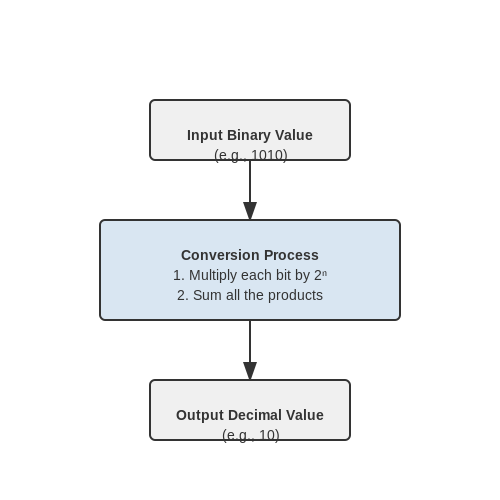
In the realm of networking and data transmission, converting binary data to decimal formats is crucial, especially when integrating with various communication protocols and addressing schemes. Networking devices such as routers and switches primarily operate in binary, yet human operators often require decimal representations for configuration and monitoring tasks. Understanding how these two formats interact enhances our ability to design robust networks and diagnose issues effectively.
Decoding Network Addresses
At the core of modern networking structures lies the binary system as the foundation for IP addressing, specifically in IPv4 (Internet Protocol version 4) and IPv6. Each address consists of a string of binaries that represent numerical values. For instance, the IPv4 address 192.168.1.1 is parsed into binary form as:
Each octet corresponds to a decimal value separated by a dot, which makes it simpler for network administrators to remember and configure devices.
The Role of Subnetting
Moreover, subnetting plays a significant role in optimizing network management and facilitating efficient data transmission. By dividing larger networks into smaller sub-networks, we enhance performance and security. This operation, akin to binary masking, relies heavily on converting decimal subnet masks back and forth into binary form.
For example, a subnet mask like 255.255.255.0 in decimal translates to:
To effectively manage address allocation, it is essential to grasp the conversions and implications behind these binary representations. The process of subnetting involves determining the range of available addresses within a given subnet, which fundamentally hinges on converting and calculating binary values.
Data Transmission Protocols
In practical applications, many data transmission protocols, such as TCP/IP, use binary codes to encapsulate routing information. Packet identifiers, relevant flags, and checksums are often rendered in binary format. However, for debugging and log analysis, engineers frequently convert these values into decimal for easier interpretation. This is integral when analyzing packet headers in tools such as Wireshark, where displaying values in decimal can illumine patterns or anomalies in traffic flow.
Furthermore, a grasp of hexadecimal representations—often used for compact notation of binary sequences—bridges the gap between binary and decimal formats. For instance, the binary sequence:
indicates that the decimal equivalent of the binary number 1101 is 13, while its hexadecimal notation is D. This interconnectivity of formats enhances the functionality and efficiency of data transmission protocols.
Conclusion
The conversion between binary and decimal is more than a mathematical exercise; it is a fundamental skill for anyone in the fields of networking and data transmission. Mastery of this process not only equips engineers with the tools to effectively design and manage networks but also embeds a deeper understanding of how data flows through modern systems. As technology continues to advance, so too will the intricacies of data representation, making proficiency in binary-decimal conversions an invaluable asset.
4. Binary Arithmetic
4.1 Binary Arithmetic
Binary arithmetic forms the cornerstone of digital electronics, establishing the framework for various computations carried out by microprocessors, logic circuits, and computer algorithms. This subsection delves into the principles of binary arithmetic, building upon the foundational understanding of binary and decimal systems previously explored.
Understanding Binary Operations
In binary arithmetic, operations such as addition, subtraction, multiplication, and division are performed using only two digits: 0 and 1. This is fundamentally different from decimal arithmetic, where ten digits (0–9) are used. The shift to a binary system simplifies the design and functioning of digital hardware since it can represent casting states easily (i.e., high or low voltages). Here, we'll focus primarily on the first two operations: binary addition and subtraction.
Binary Addition
Binary addition mirrors decimal addition but has a more straightforward carrying mechanism. The basic rules can be summarized as follows:
- 0 + 0 = 0
- 0 + 1 = 1
- 1 + 0 = 1
- 1 + 1 = 0 (carry 1)
- 1 + 1 + 1 = 1 (carry 1)
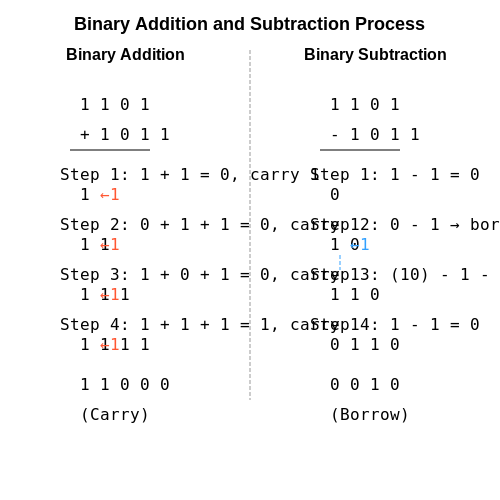
For example, let’s add the binary numbers 1011 (11 in decimal) and 1101 (13 in decimal):
   1  (carry)
   1011
 + 1101
 --------
  11000
In this case, starting from the least significant bit (rightmost) and moving left, the second column generates a carry, which is added to the next column, resulting in the final binary output of 11000 (24 in decimal).
Binary Subtraction
Subtraction in binary can be more complex, particularly when borrowing is involved, similar to decimal subtraction. The principal rules are:
- 0 - 0 = 0
- 1 - 0 = 1
- 1 - 1 = 0
- 0 - 1: borrow 1, which makes it 2 (10 in binary), resulting in 1 with a carry to the next column
Taking the same numbers from our earlier example, let’s perform the binary subtraction of 1101 (13 in decimal) from 1011 (11 in decimal):
   1  (borrow)
   1011
 - 1101
 --------
   1110
As illustrated, when we reach the leftmost point that cannot accommodate the subtraction (0 - 1), we borrow from the next column to perform the operation effectively.
Practical Relevance
Understanding binary arithmetic is crucial for several areas in modern engineering and computational design:
- Microprocessor Design: Binary arithmetic operations form the foundational blocks of instruction sets used in CPUs, influencing performance and efficiency.
- Data Encoding: Systems like JPEG, MP3, and network protocols utilize binary arithmetic to encode, process, and transmit digital data securely.
- Logic Circuits: Comprehending how to utilize binary operations assists in designing efficient circuits involving adders and subtractors, which are pivotal in digital electronics.
In essence, mastery of binary arithmetic opens the door to grasping more complex concepts in analog and digital systems, cryptography, and signal processing. Each operation becomes a building block for higher-level programming languages and computational theories.
Through this focus on binary arithmetic, we prepare ourselves to transition into further discussions of binary-to-decimal conversions, which will benefit from our understanding of binary operations.
4.2 Alternative Number Representations (Octal, Hexadecimal)
In the context of digital systems, understanding how to convert binary to various alternative numeral systems is essential. Two predominant representations beyond binary are octal and hexadecimal. Each has its own unique advantages, especially in the realms of computer science and electronics, where compactness and human readability are critical.
Understanding Octal Representation
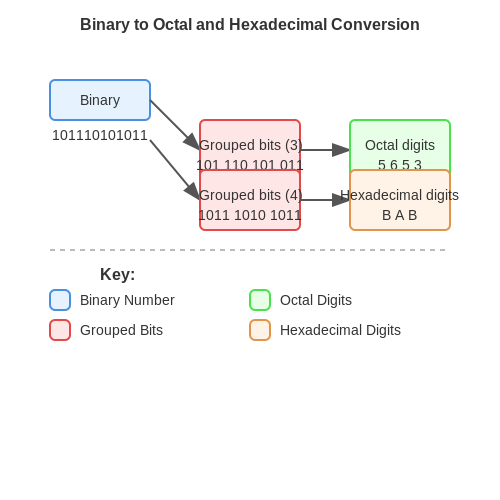
Octal, or base-8, employs the digits 0 through 7. This system became significant during the early computer era due to its simplicity in relation to binary. Specifically, a group of three binary digits translates directly into a single octal digit, allowing easier mental calculations and fewer opportunities for errors.
To convert a binary number into octal, one can segment the binary representation into groups of three, starting from the right (the least significant bit). If necessary, leading zeros can be added to complete each group. For instance, the binary number 101101 can be converted as follows:
- Group: 010 110 1 → 010 110 001 (adding leading zeros)
- Octal: 2 6 1
Thus, 101101 in binary becomes 261 in octal.
The Significance of Hexadecimal System
Hexadecimal, or base-16, expands the numeral range using digits 0-9 and letters A-F to represent values 10 through 15. This representation allows for a compact and efficient method of expressing binary data. Each hexadecimal digit corresponds to precisely four binary digits (a quartet), promising a straightforward transformation process.
The conversion from binary to hexadecimal is achieved by grouping binary digits into sets of four. For instance, consider the binary value 110101110111:
- Grouping: 0011 0101 1101 0111
- Hexadecimal: 3 D D 7
Thus, 110101110111 in binary converts to 3DD7 in hexadecimal. The practical uses of hexadecimal representations include simplifying memory addresses in programming and compactly representing binary values in computer architecture.
Real-World Applications
Both octal and hexadecimal formats are utilized extensively in computing:
- Octal: Commonly found in Unix file permissions, where three octal digits correspond to user, group, and other permissions.
- Hexadecimal: Ubiquitously employed in programming, especially in defining colors in web design (like
#FF5733) and in debugging memory addresses in various programming environments.
While octal usage has diminished in favor of hexadecimal, both number systems are pivotal in presenting binary information in a more human-friendly format. Understanding these conversions is crucial for anyone involved in electronic design, embedded systems, or computer engineering.
In conclusion, mastering binary-to-octal and binary-to-hexadecimal conversions equips engineers and researchers with powerful tools for effective communication in digital systems.
4.3 Conversions Beyond Decimal
Once we have a firm grasp of converting values between binary and decimal, the field of digital electronics offers further challenges by expanding beyond these two numeral systems. The implications of this span into numerous applications in engineering, computer science, and data communications. Here, we will explore conversions from binary to other numeral systems such as octal and hexadecimal, explaining their importance, applications, and practical implementations.
Understanding Alternative Base Systems
In the realm of digital systems, besides the binary (base 2) and decimal (base 10) systems, we commonly encounter the octal (base 8) and hexadecimal (base 16) systems. Octal is particularly useful in simplifying binary representations, as three binary bits can represent a single octal digit. On the other hand, hexadecimal condenses binary into even fewer digits, with each hex digit representing four binary bits. As computers and embedded systems grow in complexity, these systems facilitate more readable and compact programming and data representation.
Binary to Octal Conversion
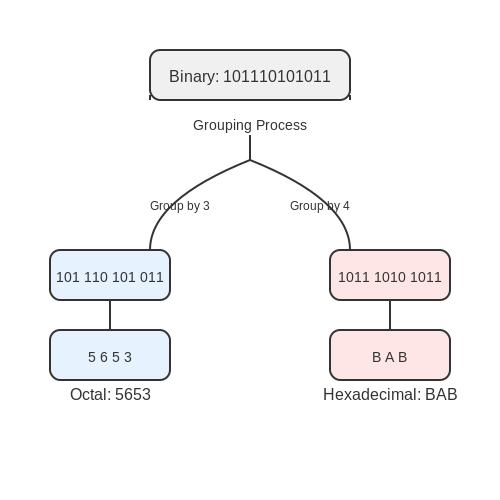
To convert a binary number to octal, we group the binary digits into sets of three, starting from the right. Each triplet corresponds to a single octal digit. Suppose we have the binary number 101110110. We can convert this by grouping as follows:
Step 1: Group the bits: 1 011 101 110 (we may add leading zeros to the left if necessary, yielding 001 011 101 110)
Step 2: Convert each group of three into its octal equivalent:
001→ 1011→ 3101→ 5110→ 6
Thus, the binary number 101110110 converts to the octal number 1356.
Binary to Hexadecimal Conversion
The process of converting binary to hexadecimal mirrors that of octal, with the difference being the grouping—this time in sets of four. Continuing with our earlier example 101110110, we group as follows:
Step 1: Group the bits: 10 1110 110 (adding leading zeros: 0010 1110 1100)
Step 2: Convert each group of four into its hexadecimal equivalent:
0010→ 21110→ E1100→ C
Therefore, the binary number 101110110 is converted into hexadecimal as 2EC.
Practical Relevance and Applications
Binary, octal, and hexadecimal numeral systems play a crucial role in the fields of computer science and electrical engineering. For instance, programmers often utilize hexadecimal representation for memory addresses and color codes in web design, where defining colors in RGB hexadecimal format is more convenient. Similarly, octal notation can be found in UNIX file permissions.
Furthermore, understanding these conversions is vital for engineers and computer scientists manipulating data storage, optimizing algorithms, and ensuring data integrity in transmission protocols. As the digital landscape continues to evolve, the importance of mastering these numeral systems cannot be overstated.
Conclusion
The ability to convert between binary, octal, and hexadecimal is an essential skill in advanced electronic and computing applications. As we progress into more complex numeric systems and their interactions, being comfortable with these conversions paves the way for greater insights into the architecture of modern computational technologies.
5. Books and Textbooks
5.1 Books and Textbooks
- Digital Design: Fundamentals of Binary Systems — This book provides thorough coverage of digital logic design, with emphasis on binary systems and conversion methods. It’s an essential reference for engineers seeking foundational and advanced knowledge in digital electronics.
- Logic and Computer Design Fundamentals — Focused heavily on computer architecture, this text explores binary, decimal, and other number systems, providing an excellent foundation for computer engineering disciplines.
- Digital Electronics: Principles and Integrated Circuits — Offers clear explanations of core principles in digital electronics, including binary to decimal conversions, making it ideal for graduate students and advanced researchers.
- Digital Circuit Design for Computer Science and Engineering — Tailored for computer science and engineering contexts, this text includes deep dives into binary numbers and their practical applications in circuit design.
- Fundamentals of Digital Logic with Verilog Design — This text combines binary system concepts with practical Verilog implementations; suitable for engineers working with hardware description languages.
- Digital Design: A Systems Approach — Besides detailed binary system discussions, this book introduces systems thinking in digital design, making it a valuable resource for engineers and system architects.
- Binary Decision Diagrams and Beyond — For researchers interested in binary decision diagrams and its connections to binary numbers and logic, offering a theoretical yet practical exploration.
5.2 Online Resources and Tutorials
- Khan Academy: Computer Science — Offers engaging tutorials on binary and number systems, including comprehensive lessons on binary to decimal conversion, suitable for those looking to enhance their understanding through interactive exercises.
- TutorialsPoint: Computer Number Systems — Provides a thorough overview of computer number systems, emphasizing binary to decimal conversion. Its detailed content caters to advanced readers with a focus on technical fundamentals.
- JavaTpoint: Binary Number System — Offers tutorials that span various number system conversions, including binary to decimal, enriched with examples and practice problems for advanced learners.
- SparkFun: Binary — A resource for electronics enthusiasts and engineers aiming to deeply understand binary numbers through practical examples, including the conversion of binary to decimal.
- Electronics Club: Binary Numbers — Offers clear explanations on binary numbers and their conversions, including detailed sections on binary to decimal, ideal for engineers involved in digital electronics.
- GeeksforGeeks: Binary to Decimal Conversion — This link provides a mathematical perspective on converting binary numbers to decimal, focusing on efficiency and algorithmic implementation, perfect for software developers and computer scientists.
- TutorialsPoint: What is a Binary Number System? — An informative resource that delves into the binary number system, with sections dedicated to explaining and demonstrating the binary to decimal conversion process for advanced students.
- Coursera: Representing Numbers — A comprehensive course module that covers number representation in computers, including binary to decimal conversion, suited to graduate students and computer engineering professionals.
5.3 Research Papers and Articles
- IEEE - Binary to Decimal Conversion Algorithms — This article provides insights into efficient algorithms used for binary to decimal conversions, focusing on the computational complexity and optimization strategies for digital computing systems.
- ACM Digital Library: Fast Integer Conversion Algorithms — Explore various fast binary-to-decimal conversion algorithms presented in the ACM Digital Library, discussing both theoretical and practical aspects of the conversions.
- ScienceDirect - Adaptive Conversion Techniques — This paper discusses adaptive approaches for binary to decimal conversions in large-scale computing applications, highlighting dynamic optimization methods.
- Google Books: Computer Arithmetic - Binary and Decimal Conversion — A thorough examination of computer arithmetic with a focus on binary and decimal conversion methods, providing historical context and applications in modern computing.
- JSTAGE: Binary Floating-Point Conversion Analysis — Provides an extensive analysis of binary floating-point to decimal conversion techniques and their impact on precision in scientific computations.
- ResearchGate - Fast Algorithms for Binary to Decimal Conversions — This research paper covers various algorithms designed for converting binary data to a decimal representation efficiently, suitable for high-speed computing environments.
- Elsevier - Information Processing Letters: Efficient Conversion Methods — An academic journal article discussing novel and efficient methods for binary to decimal conversions in data processing, emphasizing implementation in modern processors.