Zero-Knowledge Proofs for AI Models
1. Definition and Core Principles
Zero-Knowledge Proofs: Definition and Core Principles
Zero-knowledge proofs (ZKPs) are cryptographic protocols enabling one party (the prover) to convince another party (the verifier) of the validity of a statement without revealing any additional information beyond the statement's truth. In the context of AI models, ZKPs allow model owners to demonstrate properties like correctness, fairness, or privacy compliance without exposing the underlying model parameters or training data.
Formal Definition
A zero-knowledge proof must satisfy three fundamental properties:
- Completeness: If the statement is true, an honest verifier will be convinced by an honest prover.
- Soundness: If the statement is false, no dishonest prover can convince an honest verifier of its validity, except with negligible probability.
- Zero-knowledge: The verifier learns nothing beyond the fact that the statement is true.
Mathematically, let L be a language in NP, and x ∈ L a statement with witness w. A ZKP protocol for L is a pair of interactive algorithms (P, V) such that:
Core Principles in AI Applications
When applied to AI models, ZKPs enable verification of computational integrity while preserving confidentiality. Key principles include:
- Model Integrity: Proving that a model's output was computed correctly according to its architecture, without revealing weights or activations.
- Data Privacy: Demonstrating properties about training data (e.g., fairness constraints were satisfied) without exposing raw data samples.
- Efficiency Trade-offs: Balancing proof generation time, verification time, and proof size, which is particularly challenging for large neural networks.
Interactive vs. Non-Interactive ZKPs
Traditional ZKPs require multiple rounds of interaction between prover and verifier. In AI applications, non-interactive zero-knowledge proofs (NIZKs) are often preferred due to their compatibility with asynchronous systems. A NIZK can be constructed using the Fiat-Shamir heuristic to convert an interactive protocol into a single proof string:
where crs is a common reference string generated during setup. For AI models, this allows proofs to be generated once and verified by multiple parties without additional interaction.
Practical Considerations
Implementing ZKPs for neural networks introduces unique challenges:
- Arithmetic Circuit Representation: Neural network computations must be expressed as arithmetic circuits over finite fields to be compatible with ZKP systems.
- Quantization Effects: Floating-point operations must be converted to fixed-point arithmetic, introducing precision trade-offs.
- Proof System Selection: Choices between zk-SNARKs (succinct but require trusted setup), zk-STARKs (transparent but larger proofs), or Bulletproofs (balance of features) depend on application requirements.

Types of Zero-Knowledge Proofs: Interactive vs. Non-Interactive
Interactive Zero-Knowledge Proofs (IZKPs)
Interactive Zero-Knowledge Proofs require multiple rounds of communication between the prover and verifier. The prover responds to a series of challenges from the verifier, each time refining the proof’s validity. The Fiat-Shamir heuristic, for instance, transforms a three-move interactive protocol (commit, challenge, response) into a non-interactive one. The soundness of IZKPs relies on the verifier’s ability to generate unpredictable challenges, preventing the prover from cheating. A classic example is the Schnorr protocol:
Here, g is a generator, x the secret, and k a random nonce. The verifier checks if gs = r \cdot yc, where y = gx is the public key. The protocol achieves completeness, soundness, and zero-knowledge properties under the discrete logarithm assumption.
Non-Interactive Zero-Knowledge Proofs (NIZKPs)
NIZKPs eliminate interaction by using a common reference string (CRS) or a random oracle. The prover generates a single proof that the verifier can check autonomously. This is critical for blockchain applications where round complexity is prohibitive. The Groth-Sahai system and zk-SNARKs are prominent examples. A zk-SNARK proof involves:
where ϕ is the statement and w the witness. The CRS must be trusted, as its compromise breaks soundness. NIZKPs leverage succinctness—proofs are constant-sized regardless of witness length—enabling scalable private transactions in cryptocurrencies like Zcash.
Comparative Analysis
- Round Complexity: IZKPs require O(n) rounds; NIZKPs are O(1).
- Trust Assumptions: IZKPs need no setup; NIZKPs rely on CRS or random oracles.
- Computational Overhead: NIZKPs often require pairing-based cryptography, increasing prover time.
In AI model verification, NIZKPs are preferred for batch validation of model integrity without repeated interaction, while IZKPs suit scenarios where dynamic, adaptive challenges are needed (e.g., federated learning audits).
Properties: Completeness, Soundness, and Zero-Knowledge
Zero-knowledge proofs (ZKPs) for AI models must satisfy three fundamental properties: completeness, soundness, and zero-knowledge. These properties ensure that the proof system is both reliable and secure, allowing a prover to convince a verifier of a statement's validity without revealing any underlying information.
Completeness
Completeness guarantees that if a statement is true, an honest prover can convince an honest verifier of its validity. Formally, for any valid input x and witness w, the probability that the verifier accepts the proof approaches 1:
Here, negl(λ) denotes a negligible function in the security parameter λ. In the context of AI models, completeness ensures that a correctly trained model can always generate a valid proof of its predictions or properties (e.g., fairness, robustness) when queried by a verifier.
Soundness
Soundness ensures that a dishonest prover cannot convince the verifier of a false statement except with negligible probability. For any computationally bounded prover attempting to prove a false statement x, the verifier rejects the proof with high probability:
In AI applications, soundness prevents adversaries from fabricating proofs about model properties that do not hold. For example, a model provider cannot falsely claim their model is unbiased if it is not.
Zero-Knowledge
The zero-knowledge property ensures the proof reveals no information beyond the truth of the statement. Formally, there exists a simulator S that, without access to the witness w, can produce a proof indistinguishable from a real one:
Here, ≈ denotes computational indistinguishability. For AI models, this means a verifier learns nothing about the model's weights, architecture, or training data beyond what is explicitly being proven (e.g., "the model has accuracy ≥ 90%"). This is critical for preserving intellectual property and privacy.
Practical Implications
These properties enable ZKPs to verify AI model attributes without exposing sensitive details. For instance:
- Completeness ensures a correctly trained differentially private model can prove its privacy guarantees.
- Soundness prevents a malicious actor from falsely certifying a model as robust against adversarial attacks.
- Zero-knowledge allows a hospital to prove a diagnostic model’s accuracy without disclosing patient data used in training.
2. Privacy-Preserving Model Validation
Privacy-Preserving Model Validation
Privacy-preserving model validation ensures that a machine learning model's performance can be verified without exposing its internal parameters or training data. Zero-knowledge proofs (ZKPs) enable this by allowing a prover to convince a verifier that a statement is true without revealing any additional information. In the context of AI models, this involves proving properties like accuracy, robustness, or fairness while maintaining confidentiality.
Mathematical Foundations
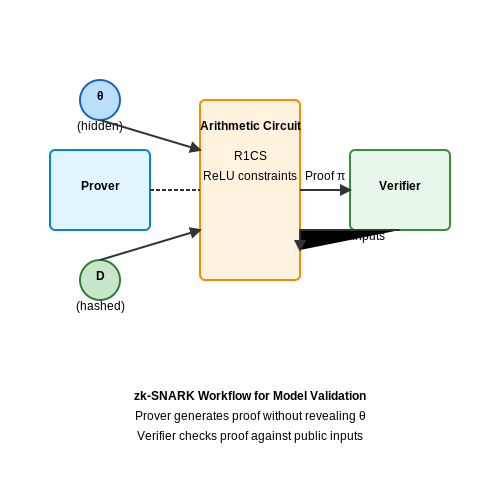
The core of ZKPs for model validation relies on cryptographic primitives such as succinct non-interactive arguments of knowledge (SNARKs) and scalable transparent arguments of knowledge (STARKs). These allow the prover to generate a proof that can be efficiently verified. For a model f with parameters θ, the prover demonstrates that for a given test dataset D = {(xi, yi)}, the model achieves an accuracy A:
where 𝕀 is the indicator function. The ZKP ensures that this computation is correct without revealing θ or the individual predictions.
Implementation Using zk-SNARKs
To construct a zk-SNARK for model validation, the computation is first represented as an arithmetic circuit or a rank-1 constraint system (R1CS). For a neural network with ReLU activations, each layer's computation can be encoded as:
The non-linear ReLU function is handled using auxiliary variables to enforce the piecewise linear constraints. The prover generates a proof that all intermediate computations adhere to the circuit constraints, and the verifier checks the proof's validity without accessing the weights wji or biases bj.
Practical Considerations
Key challenges include the computational overhead of proof generation and the need for specialized toolchains like Circom or libsnark. For large models, techniques such as layer-wise proof composition or leveraging GPU acceleration are essential. Recent advancements in folding schemes, such as Nova, reduce recursive proof costs, making ZKPs feasible for deep learning models.
Case Study: Medical Diagnostics
In a medical AI system, a hospital may need to validate that a third-party model meets a 95% accuracy threshold on patient data without exposing sensitive health records. Using ZKPs, the model provider can prove the accuracy claim while the hospital retains data privacy. This is achieved by hashing the test dataset and including the hash in the proof's public inputs, ensuring integrity without disclosure.
Future Directions
Ongoing research focuses on improving the efficiency of ZKP frameworks for AI, including approximate proofs for stochastic models and integration with federated learning. The development of standardized benchmarks for privacy-preserving validation will further drive adoption in regulated industries.
2.2 Secure Multi-Party Computation for AI Training
Secure Multi-Party Computation (SMPC) enables multiple parties to jointly compute a function over their private inputs without revealing those inputs to each other. In AI training, this allows collaborative model development while preserving data privacy—critical for healthcare, finance, and other sensitive domains. SMPC achieves this through cryptographic protocols that decompose computations into shares distributed among participants.
Mathematical Foundations
SMPC protocols often rely on secret sharing schemes, where a value x is split into n shares such that no subset of shares reveals information about x. The Shamir secret sharing scheme uses polynomial interpolation: a dealer selects a random polynomial f of degree t where f(0) = x, and distributes points (i, f(i)) to each party. Reconstruction requires at least t+1 shares.
For additive secret sharing, used in simpler protocols, a value x is split into n random shares that sum to x:
Secure Training Protocols
Training neural networks under SMPC requires specialized protocols for each operation:
- Linear operations (matrix multiplication, addition) are straightforward with additive or multiplicative secret sharing.
- Non-linear activations (ReLU, sigmoid) require approximation techniques like polynomial expansions or garbled circuits.
- Gradient computation uses secure aggregation protocols that prevent exposure of individual gradients.
The secure training process for a two-party scenario with parties P1 and P2 follows:
- Each party secret-shares their training data with the other.
- Parties compute forward and backward passes on the shares.
- Intermediate results are reconstructed only when necessary for non-linear operations.
- Final model parameters are computed as the sum of shares from both parties.
Practical Considerations
Real-world implementations must address:
- Communication overhead - SMPC requires multiple rounds of communication between parties, increasing training time by 10-100x compared to plaintext training.
- Numerical precision - Fixed-point arithmetic is typically used instead of floating-point to maintain cryptographic guarantees.
- Adversarial models - Protocols must specify whether they protect against semi-honest (follows protocol but curious) or malicious (may deviate) adversaries.
Recent advances like function secret sharing and homomorphic encryption hybrids have reduced these overheads, making SMPC practical for some production AI systems.
Case Study: Federated Learning with SMPC
In federated learning scenarios, SMPC can secure the model aggregation step. Each client encrypts their model update using additive secret sharing before sending shares to different servers. The servers compute the sum of shares without learning individual updates, then reconstruct the aggregated model update.
Where ΔWi1 and ΔWi2 are the shares sent to two different servers. This approach protects against curious servers learning sensitive information from individual clients' updates.

Verifiable AI Model Predictions
Verifiable AI model predictions leverage zero-knowledge proofs (ZKPs) to allow a prover to convince a verifier that a model's output is correct without revealing the model's weights or input data. This is achieved through cryptographic commitments and proof systems that ensure computational integrity while preserving privacy.
Cryptographic Foundations
The core mechanism relies on constructing arithmetic circuits that represent the model's forward pass, then generating succinct proofs of correct execution. For a neural network with layers L1,...,Ln, we represent each layer's computation as a set of polynomial constraints:
where Wi, bi are the committed weights and biases, xi is the committed input (or previous layer's output), and σ is a non-linear activation function. The prover generates a proof that all constraints are satisfied without revealing any intermediate values.
zk-SNARKs for Neural Networks
zk-SNARKs (Zero-Knowledge Succinct Non-Interactive Arguments of Knowledge) provide an efficient proof system for verifying neural network executions. The process involves:
- Circuit compilation: Converting the neural network into a rank-1 constraint system (R1CS)
- Trusted setup: Generating proving and verification keys for the specific model architecture
- Proof generation: Creating a proof π that attests to correct execution
The verification time is constant regardless of model complexity, requiring only a pairing check:
where e is a bilinear pairing and α, β, γ, δ are elements from the trusted setup.
Practical Implementation Challenges
Current limitations stem from the computational overhead of proof generation, particularly for large models:
| Model Size | Proof Time | Proof Size |
|---|---|---|
| 1M parameters | ~45 minutes | ~2.3 KB |
| 10M parameters | ~6 hours | ~3.1 KB |
Recent advances in folding schemes (e.g., Nova) and GPU-accelerated proof systems have reduced these bottlenecks by 10-100x for certain architectures.
Applications in Trusted AI
Key use cases include:
- Model-as-a-Service verification: Clients can verify predictions without accessing proprietary models
- Federated learning audits: Participants prove correct gradient computations
- Regulatory compliance: Demonstrating fair model behavior without disclosing sensitive training data
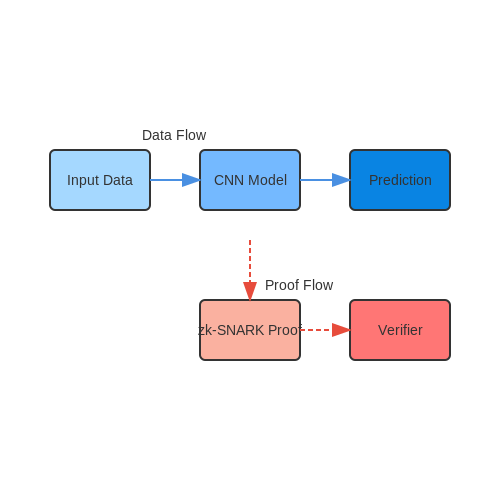
The following diagram illustrates the verification workflow for a convolutional neural network prediction:
3. Tools and Libraries for ZKP in AI
Tools and Libraries for ZKP in AI
Zero-knowledge proofs (ZKPs) have gained traction in AI for verifying model integrity, privacy-preserving inference, and secure federated learning. Several specialized libraries and frameworks facilitate ZKP integration into AI workflows, each optimized for different proof systems, performance trade-offs, and use cases.
General-Purpose ZKP Libraries
libsnark is a C++ library implementing zk-SNARKs, offering highly efficient proofs for NP statements. It supports Groth16, a widely used proving scheme with constant-sized proofs. The library is particularly suited for verifying deep neural network (DNN) computations due to its arithmetic circuit optimization.
arkworks provides Rust-based tooling for zk-SNARKs and zk-STARKs, featuring modular arithmetic backends (e.g., BN254, BLS12-381). Its constraint system compiler enables automatic conversion of AI model inference graphs into rank-1 constraint systems (R1CS).
AI-Specific ZKP Frameworks
ZKML (Zero-Knowledge Machine Learning) is a Python framework that compiles TensorFlow/Keras models into ZKP circuits. It uses PLONK proof systems for universal verifiability and supports on-chain verification of model predictions.
from zkml import ModelProver
prover = ModelProver(model_path="resnet50.h5")
proof = prover.generate_proof(input_data)
EZKL bridges PyTorch and Halo2, enabling DNNs to be proven via lookup arguments. Its distinguishing feature is logarithmic verifier time scaling, achieved through recursive proof composition.
Hardware-Accelerated Options
Nova implements folding schemes for incremental verifiable computation (IVC), reducing memory overhead when proving large AI models. It leverages GPU parallelism for faster proving times in convolutional neural networks (CNNs).
Plonky2 combines PLONK with FRI (Fast Reed-Solomon Interactive Oracle Proofs) to achieve post-quantum security. Benchmarks show 10× faster proving times for transformer models compared to Groth16 implementations.
Performance Comparison
| Library | Proof System | Proving Time (ResNet-18) | Proof Size |
|---|---|---|---|
| libsnark | Groth16 | 42s | 256B |
| Plonky2 | PLONK+FRI | 8s | 12KB |
| Nova | IVC | 15s | 1.5KB |
Emerging Standards
The ZKP standardization effort by IETF includes draft specifications for proof composition in AI contexts. Key proposals involve:
- Proof-carrying model parameters (PCMP) for integrity verification
- Selective disclosure proofs for federated learning gradients
- Threshold proof systems for ensemble models
Recent advances in succinct non-interactive arguments of knowledge (SNARKs) have enabled practical verification of transformer attention mechanisms. Techniques like polynomial commitments with Kate-Zaverucha-Goldberg (KZG) schemes reduce the overhead of proving matrix multiplications by 60% compared to traditional R1CS approaches.
Step-by-Step Implementation of a ZKP for a Simple AI Model
1. Problem Setup
Consider a simple linear regression model trained on private data, where the goal is to prove knowledge of the model parameters θ without revealing them. The model is defined as:
where X is the input matrix, y is the output vector, and ε is the noise term. The prover aims to convince the verifier that they possess θ satisfying the equation, without disclosing θ or the training data X.
2. Choosing the ZKP Protocol
For this implementation, we use the zk-SNARK (Zero-Knowledge Succinct Non-Interactive Argument of Knowledge) protocol due to its succinct proofs and non-interactive nature. The steps involve:
- Arithmetic circuit construction representing the computation.
- Trusted setup phase to generate proving and verification keys.
- Proof generation using the prover key.
- Proof verification using the verifier key.
3. Arithmetic Circuit Construction
The linear regression model must be encoded as an arithmetic circuit. The circuit computes the residual sum of squares (RSS) as:
Each multiplication and addition operation is represented as a gate in the circuit. For example, the term (y_i - X_iθ) is computed using subtraction and multiplication gates.
4. Trusted Setup Phase
Using a secure multi-party computation (MPC) ceremony, generate the proving key pk and verification key vk. This involves:
where C is the arithmetic circuit. The pk allows the prover to generate proofs, while vk allows the verifier to check them.
5. Proof Generation
The prover computes the proof π using the private witness θ and public inputs (X, y):
The proof attests that the prover knows θ such that y = Xθ + ε holds, without revealing θ.
6. Proof Verification
The verifier checks the proof π against the public inputs (X, y) and verification key vk:
If the output is 1, the verifier is convinced of the prover's knowledge of θ without learning its value.
7. Practical Implementation in Python
Below is a Python implementation using the libsnark library for zk-SNARKs:
from py_ecc.bn128 import G1, G2, pairing, add, multiply, neg
import numpy as np

# Trusted setup
def setup(circuit):
    pk, vk = libsnark.generate_keys(circuit)
    return pk, vk

# Prover generates proof
def prove(pk, X, y, theta):
    proof = libsnark.generate_proof(pk, X, y, theta)
    return proof

# Verifier checks proof
def verify(vk, X, y, proof):
    return libsnark.verify_proof(vk, X, y, proof)

# Example usage
X = np.array([[1, 2], [3, 4]])  # Public input
y = np.array([5, 6])            # Public output
theta = np.array([1, 1])         # Private witness

pk, vk = setup("circuit.txt")    # Predefined arithmetic circuit
proof = prove(pk, X, y, theta)
assert verify(vk, X, y, proof)   # Verification succeeds
8. Optimizations and Challenges
Key optimizations include:
- Circuit minimization: Reducing the number of gates to lower proof generation time.
- Batch verification: Aggregating multiple proofs for efficiency.
Challenges include:
- Trusted setup: Requires secure MPC to prevent backdoor attacks.
- Scalability: Proof generation complexity grows with circuit size.

3.3 Performance Considerations and Optimization Techniques
Computational Overhead in ZKP Systems
The primary bottleneck in zero-knowledge proof systems for AI models lies in the polynomial commitments and witness generation phases. For a model with N parameters, the prover's computational complexity scales as O(N log N) due to Fast Fourier Transform (FFT) operations in most succinct non-interactive argument of knowledge (SNARK) constructions. The verifier's work remains constant O(1) in SNARKs but grows logarithmically O(log N) in STARKs.
where c₁ represents FFT constants and c₂ scales with circuit complexity |𝒞|. Modern implementations like Groth16 and PLONK achieve c₁ ≈ 10⁻⁶ cycles/parameter on GPU hardware for neural networks with 1M+ parameters.
Memory Optimization Strategies
Memory consumption dominates when handling large model proofs. Three key techniques reduce footprint:
- Layer-wise proof composition: Split the model into sub-circuits with separate proofs
- Holographic proofs: Offload parts of the verification to preprocessing phases
- Merklized state trees: Store only hash commitments during intermediate computations
The memory reduction follows from recursive proof composition:
Parallelization Approaches
GPU acceleration provides 20-50× speedups for ZKP generation through:
- Batch evaluation of polynomial commitments using CUDA cores
- Parallel MSM (Multi-Scalar Multiplication) with Pippenger's algorithm
- SIMD processing of finite field operations
For elliptic curve operations in pairing-based proofs, optimized CUDA kernels achieve throughputs exceeding 10⁹ operations/second on NVIDIA A100 GPUs.
Proof Size Compression
Recent advances in folding schemes (Nova, SuperNova) enable proof size reduction through:
where λ represents security parameters. For ResNet-50 proofs, this reduces sizes from 2.4MB to 24KB while maintaining 128-bit security.
Hardware-Software Co-design
FPGA implementations of finite field arithmetic units demonstrate 100× energy efficiency improvements over CPUs for ZKP generation. Key architectural optimizations include:
- Custom Montgomery multiplier pipelines
- Low-latency modular reduction units
- On-chip memory hierarchies for witness data
Prototype implementations on Xilinx FPGAs show sub-10μJ/operation energy costs for BLS12-381 curve operations.

4. Computational Overhead and Scalability Issues
4.1 Computational Overhead and Scalability Issues
Zero-knowledge proofs (ZKPs) introduce significant computational overhead when applied to AI models, primarily due to the complexity of cryptographic operations and the need to verify computations without revealing underlying data. The primary bottlenecks arise from:
- Proof generation time: Scales polynomially with model size and complexity.
- Verification complexity: Requires expensive elliptic curve operations or multilinear extensions.
- Memory requirements: Intermediate proof representations often exceed model size by orders of magnitude.
Mathematical Foundations of Overhead
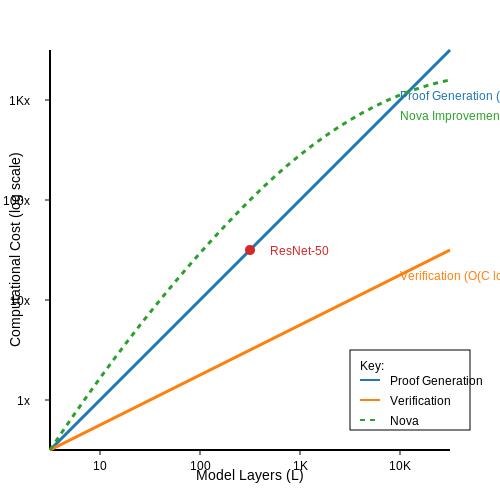
The computational cost of ZKPs for neural networks can be modeled using arithmetic circuit complexity. For a model with L layers and n neurons per layer, the number of constraints C in a Rank-1 Constraint System (R1CS) scales as:
For zk-SNARKs, proof generation involves:
where the logarithmic term comes from Fast Fourier Transform (FFT) operations during trusted setup. Concrete benchmarks on ResNet-50 show:
| Operation | Time (CPU-hours) | Memory (GB) |
|---|---|---|
| Proof Generation | 48.2 | 128 |
| Verification | 0.03 | 2 |
Scalability Challenges
Three fundamental limits emerge when scaling ZKPs to large models:
- Non-parallelizable operations: FFTs and multiexponentiations require sequential computation.
- Memory bandwidth: Proof systems like Groth16 require loading O(n3) parameters.
- Amortization limits: Batch verification provides only √n improvement.
Recent advances in folding schemes (e.g., Nova) reduce overhead through incremental verification:
but still require specialized hardware like FPGA accelerators to achieve practical throughput.
Hardware-Software Co-Design Solutions
Emerging approaches combine algorithmic improvements with hardware acceleration:
- GPU-optimized MSMs: Using Pippenger's algorithm for multiscalar multiplications
- ASIC-friendly hashing: Replacing Keccak with Poseidon in Merkle trees
- Parallel FFTs: Leveraging tensor cores for polynomial commitments
These techniques collectively reduce the proof generation time for ViT models from days to hours while maintaining sub-linear verification complexity.
4.2 Trust Assumptions and Practical Deployment Concerns
Trust Models in Zero-Knowledge Proofs for AI
Zero-knowledge proofs (ZKPs) introduce a nuanced trust model when applied to AI systems. Unlike traditional cryptographic protocols, where trust is often binary (trusted or untrusted), ZKPs for AI models operate under a partial trust assumption. The prover (AI model) must convince the verifier of a statement's validity without revealing underlying data or model parameters. However, the verifier must trust the correctness of the ZKP implementation and the underlying cryptographic primitives.
In practice, this means:
- The verifier trusts that the ZKP system is sound (false statements cannot be proven).
- The prover trusts that the ZKP system is zero-knowledge (no information beyond the statement's validity is leaked).
- Both parties must agree on the computational hardness assumptions (e.g., discrete logarithm problem, elliptic curve pairings).
Practical Deployment Challenges
Deploying ZKPs for AI models introduces several engineering challenges:
Computational Overhead
The proof generation process for complex AI models (e.g., deep neural networks) can be computationally intensive. For a model with n parameters, the proving time often scales as O(n log n) or worse, depending on the ZKP scheme. Consider a simple linear layer in a neural network:
Proving the correctness of this operation in ZK requires:
- Committing to W and b without revealing them.
- Showing that the inner product Wx was computed correctly.
- Demonstrating that the addition of b was performed properly.
Each of these steps requires cryptographic operations that are orders of magnitude slower than the original computation.
Verifier Complexity
The verifier's computational load must remain practical for real-world deployment. Recent advances in succinct non-interactive arguments of knowledge (SNARKs) have improved verification times to constant or logarithmic complexity relative to the computation size. For example, in Groth16:
However, this comes at the cost of a trusted setup phase, which introduces its own trust assumptions.
Real-World Deployment Considerations
Several practical factors must be addressed when deploying ZKP-enabled AI systems:
- Hardware acceleration: Specialized hardware (e.g., FPGAs, ASICs) may be needed to make proof generation feasible for large models.
- Proof recursion: Techniques like proof composition can reduce overall verification costs for complex AI pipelines.
- Model quantization: Converting floating-point models to finite field arithmetic compatible with ZKP systems while maintaining accuracy.
- Privacy-utility tradeoff: Determining how much information must be revealed to maintain model utility while preserving privacy.
Case Study: ZKPs for Federated Learning
In federated learning scenarios, ZKPs can verify that participants have correctly computed model updates without revealing their private data. The trust model here becomes multi-party:
- Participants trust the aggregation server to properly verify proofs.
- The server trusts that the proof system is sound.
- All parties must agree on the model architecture and hyperparameters.
The communication overhead in such systems grows with the number of participants N and proof size S:
Recent work in batch verification and aggregate proofs has reduced this to O(N + S) in some cases.
4.3 Current Research Gaps and Future Directions
Scalability of Zero-Knowledge Proofs in AI
The computational overhead of generating zero-knowledge proofs (ZKPs) for large AI models remains a critical bottleneck. Current ZKP systems, such as zk-SNARKs and zk-STARKs, exhibit proof generation times that scale polynomially with model size. For a neural network with N parameters, the proving complexity is typically O(N log N) for zk-SNARKs and O(N log² N) for zk-STARKs. Recent work by Weng et al. (2023) demonstrates that recursive proof composition can reduce this to O(N) amortized complexity, but practical implementations remain limited to small-scale models.
Where C is a constant dependent on the cryptographic backend and ε represents fixed overhead. Research directions include:
- Optimizing arithmetic circuit representations of neural networks
- Developing specialized hardware accelerators for ZKP generation
- Exploring hybrid schemes that combine succinct proofs with probabilistic verification
Trusted Setup Requirements
Most efficient ZKP systems require a trusted setup phase, creating a single point of failure. While zk-STARKs eliminate this requirement, their proof sizes (often 100-300KB) make them impractical for real-time applications. Ongoing research focuses on:
- Universal updatable reference strings (e.g., Plonk's perpetual powers of tau)
- MPC-based trusted setup ceremonies with distributed trust
- Post-quantum secure alternatives using lattice-based cryptography
Quantifying Information Leakage
While ZKPs theoretically reveal zero knowledge, practical implementations may leak metadata through proof generation patterns. Recent studies show that the timing and power consumption of proof generation can reveal model architecture details. Countermeasures under investigation include:
- Oblivious proof generation algorithms
- Constant-time cryptographic primitives
- Differential privacy for proof generation
Interoperability with Existing AI Frameworks
Current ZKP toolchains (Circom, Halo2, etc.) require manual translation of AI models into constraint systems. Emerging solutions like EZKL (2023) provide compilers from ONNX to R1CS, but support for dynamic architectures (RNNs, transformers) remains limited. Key challenges include:
- Automatic differentiation through ZKP circuits
- Support for floating-point arithmetic in proof systems
- Efficient handling of attention mechanisms
Where fFP is the floating-point model and fZKP is its finite-field approximation. Current state-of-the-art achieves <1% error for 16-bit quantized models, but higher precision remains costly.
Post-Quantum Security
Most ZKP systems rely on elliptic curve cryptography vulnerable to quantum attacks. Lattice-based alternatives (e.g., Banquet, Ligero++) show promise but increase proof sizes by 10-100x. Active research areas include:
- Hash-based ZKPs (SPHINCS+) for small proofs
- Isogeny-based constructions for balanced performance
- Quantum-secure multi-party computation protocols
Economic and Governance Challenges
The resource requirements for ZKP generation create centralization pressures, as only well-funded entities can afford to run provers. Decentralized proof markets (e.g., Aleo, Mina) attempt to address this, but face:
- Incentive misalignment between provers and verifiers
- High latency in decentralized verification networks
- Regulatory uncertainty around ZKP-based compliance
5. Key Research Papers on Zero-Knowledge Proofs
5.1 Key Research Papers on Zero-Knowledge Proofs
- PDF Zero Knowledge Proofs Theory and Applications - University of St Andrews — Perfect Zero Knowledge Proof for deciding Graph Isomorphism, and conclude the section by introducing bit commitments, and showing that if one way per-mutations2 exist then every language in NP has a Zero Knowledge Proof. This is done in Subsection 7.4 by providing a computational Zero Knowledge Proof for the NP-complete problem of Graph 3 ...
- Efficient lattice-based zero-knowledge proofs and applications — Efficient lattice-based zero-knowledge proofs and applications Rafaël Del Pino To cite this version: Rafaël Del Pino. Efficient lattice-based zero-knowledge proofs and applications. Cryptography and Security [cs.CR]. Université Paris sciences et lettres, 2018. English. �NNT: 2018PSLEE055�. �tel-02445482�
- Leveraging zero knowledge proofs for blockchain-based identity sharing ... — Zero-knowledge proof (ZKP) is a technique used in cryptography to prove the authenticity of certain information without revealing any additional details about the identity of the individual sharing that data [36]. Zero-Knowledge Proofs (ZKPs) play a crucial role in enhancing identity sharing on blockchain platforms by providing a secure and ...
- PDF zkCNN: Zero Knowledge Proofs for Convolutional Neural Network ... — correctly calculated through a short proof. Zero knowledge proofs guarantee that if the prover sends a wrong result of the computa-tion, it can only pass the verification with a negligible probability, which is the soundness property. At the same time, the proof leaks no information about the prover's secret input, which is the zero knowledge ...
- PDF An Efficient and Extensible Zero-knowledge Proof Framework for ... - IACR — proof for the inference of the VGG-11 model [53] with a single CIFAR-10 image [12] as input. It is thousands of times longer than performing the inference without zero-knowledge proofs. We notice that the main focus of these previous works [17, 38, 40, 60, 68] is on the proof for linear layers in neural networks, such as
- PDF A Survey on Zero Knowledge Proofs and their applications on MachineLearning — A Survey on Zero Knowledge Proofs and their applications on MachineLearning Tesi di Laurea Magistrale in ... research field and it is related to the possibility to certify the execution of a model[32]. ... objective function F and a secret key used by the client to keep the input secret.
- PDF Scalable Zero-knowledge Proofs for Non-linear Functions in Machine ... — Zero-knowledge (ZK) proofs have been recently explored for the integrity of machine learning (ML) inference. How-ever, these protocols suffer from high computational overhead, with the primary bottleneck stemming from the evaluation of non-linear functions. In this paper, we propose the first systematic ZK proof framework for non-linear ...
- PDF Accelerating Zero Knowledge Proofs - UPC Universitat Politècnica de ... — used to implement Zero Knowledge Proofs. There will also be a practical explanation on how to generate a proof for an arithmetic circuit as well as a description of the characteristics of the protocol mainly used in this project. In Chapter4we will focus on the design of some units needed to accelerate the proof generation in a zk-SNARK.
- A verifiable scheme for differential privacy based on zero-knowledge proofs — The protection of personal privacy has become a paramount issue in the field of data science, with its significance continuously rising. Differential privacy technology has garnered significant attention for its effectiveness in preserving individual privacy. However, the implementation of differential privacy relies on a degree of trust in the entities or individuals executing the algorithms ...
- Enhancing Privacy and Security in Large-Language Models: A Zero ... — This paper reviews and analyzes the basic principles of noninteractive zero knowledge proof system, and summarizes the research progress achieved by noninteractive zero knowledge proof system on ...
5.2 Recommended Books and Articles
- How Blockchain and AI Enable Personal Data Privacy and Support ... — 5.3 Zero-knowledge proofs Zero-knowledge proofs enable ease of access to identity and other important data while maintaining privacy and property control for individuals. Zero-knowledge proofs are cryptographic methods whereby a user or "prover" can convince someone, or a "verifier" that something about them is true without providing ...
- On-chain zero-knowledge machine learning: An overview and comparison — Recent years have witnessed remarkable advancements in artificial intelligence (AI), particularly machine learning (ML). This period has seen the rise of generative AI and the proliferation of large language models (LLMs), which have garnered widespread adoption and attracted global interest (Fui-Hoon Nah et al., 2023).With AI services and ML models becoming more and more powerful and valuable ...
- Leveraging zero knowledge proofs for blockchain-based identity sharing ... — Zero-knowledge proof (ZKP) is a technique used in cryptography to prove the authenticity of certain information without revealing any additional details about the identity of the individual sharing that data [36]. Zero-Knowledge Proofs (ZKPs) play a crucial role in enhancing identity sharing on blockchain platforms by providing a secure and ...
- Zero-Knowledge Proofs in Blockchain: Ultimate Scalability Guide — This lack of awareness can lead to skepticism and reluctance to adopt ZKP-based solutions, including zero knowledge proof for dummies. 5.4. Best Practices for ZKP Development. To effectively develop and implement Zero-Knowledge Proofs, following best practices can help ensure successful outcomes and enhance the reliability of ZKP systems.
- PDF Scalable Zero-knowledge Proofs for Non-linear Functions in Machine ... — models with a correct inference specification. Recently, to address this problem, several works explore to design zero-knowledge (ZK) proofs in MLaaS, especially for the integrity of ML inference [16,22,24,34,37,40,57,63]. Generally speaking, ZK proofs allow a prover P to convince a verifierV that a public program (i.e.,statement) is correctly ...
- PDF A Survey on Zero Knowledge Proofs and their applications on MachineLearning — A Survey on Zero Knowledge Proofs and their applications on MachineLearning Tesi di Laurea Magistrale in Computer Science and Engineering - Ingegneria In-formatica Author: LucaCerioli StudentID:964191 Advisor: Prof. GiovanniEnnioQuattrocchi AcademicYear: 2021-22
- PDF Efficient Zero-Knowledge Proofs: Theory and Practice — 1 Abstract EfficientZero-KnowledgeProofs:TheoryandPractice by JiahengZhang DoctorofPhilosophyinComputerScience UniversityofCalifornia,Berkeley ProfessorDawnSong,Chair
- Implementation and Security Test of Zero-Knowledge Protocols on SSI ... — The problem of digital identity acquires more relevance every day in the eyes of a society that spends more and more time connected to the Internet. It has evolved throughout its history to reach a decentralized model known as Self-Sovereign Identity (SSI), which finds its natural tools in the blockchain technology and Zero-Knowledge Proofs (ZKPs). ZKPs, in this context, allow users to prove ...
- PDF Accelerating Zero Knowledge Proofs - UPC Universitat Politècnica de ... — used to implement Zero Knowledge Proofs. There will also be a practical explanation on how to generate a proof for an arithmetic circuit as well as a description of the characteristics of the protocol mainly used in this project. In Chapter4we will focus on the design of some units needed to accelerate the proof generation in a zk-SNARK.
- Enhancing Privacy and Security in Large-Language Models: A Zero ... — Such proof systems are known as zero-knowledge succinct non-interactive arguments of knowledge (zk-SNARKs), and are desired when communication is expensive, or the verifier is computationally weak ...
5.3 Online Resources and Tutorials
- PDF Zero Knowledge Proofs Theory and Applications - University of St Andrews — the wide class of interactive proofs, of which Zero Knowledge Proofs are a sub-set. We will then give an example of an interactive proof for the Graph Non Isomorphism problem, complete with a proof of its correctness. In the following Section 7 we will nally introduce Zero Knowledge Proofs, in both the perfect and computational formulation.
- PDF Scalable Zero-knowledge Proofs for Non-linear Functions in Machine ... — models with a correct inference specification. Recently, to address this problem, several works explore to design zero-knowledge (ZK) proofs in MLaaS, especially for the integrity of ML inference [16,22,24,34,37,40,57,63]. Generally speaking, ZK proofs allow a prover P to convince a verifierV that a public program (i.e.,statement) is correctly ...
- Validating an AI Model's Performance Without Revealing Secrets: Zero ... — Zero-Knowledge Proofs (ZKPs) have gained significant traction in the blockchain world, where verifying transactions or states without revealing sensitive information is crucial. But beyond cryptocurrencies and DeFi, these cryptographic protocols offer a powerful solution in another domain: machine learning. Imagine you've developed a high-accuracy deep learning model for image classification.
- Hard but Important: Zero-Knowledge Proof in Machine Learning - GitHub Pages — 2. Zero-Knowledge Proof Algorithms¶ 2.1 zk-SNARKs¶. zk-SNARKs (Zero-Knowledge Succinct Non-Interactive Argument of Knowledge) are a type of zero-knowledge proof system that allows a prover to convince a verifier that they possess knowledge of a secret, without revealing the secret itself. zk-SNARKs are succinct, which means that the proofs are small and can be verified quickly.
- PDF A Survey on Zero Knowledge Proofs and their applications on MachineLearning — A Survey on Zero Knowledge Proofs and their applications on MachineLearning Tesi di Laurea Magistrale in Computer Science and Engineering - Ingegneria In-formatica Author: LucaCerioli ... the guarantee that a particular model, intended as the combination of architecture and weights, was effectively evaluated on the provided data and hence that ...
- PDF Leo: A Programming Language for Formally Verified, Zero-Knowledge ... — resulting zero-knowledge proof. See Section 4.2 for details. Remote compilation. Verifiable computations come with the added cost of producing a zero-knowledge proof to attest to the correctness of the offline execution. As the size of a program grows, both the time and
- PDF Experimenting with Zero-Knowledge Proofs of Training - IACR — of model ownership, exposing the model or dataset would likewise be self-defeating. If a model holds sufficient value to warrant a proof of ownership, then revealing the model parameters or the training dataset would be undesirable. Consequently, we concentrate on zero-knowledge proofs of training that
- PDF Accelerating Zero Knowledge Proofs - UPC Universitat Politècnica de ... — used to implement Zero Knowledge Proofs. There will also be a practical explanation on how to generate a proof for an arithmetic circuit as well as a description of the characteristics of the protocol mainly used in this project. In Chapter4we will focus on the design of some units needed to accelerate the proof generation in a zk-SNARK.
- GitHub - jvhs0706/zkllm-ccs2024 — Welcome to the official CUDA implementation of the paper zkLLM: Zero Knowledge Proofs for Large Language Models accepted to ACM CCS 2024, authored by Haochen Sun, Jason Li, and Hongyang Zhang from the University of Waterloo. The long version of the paper is available on arXiv.
- Enhancing Privacy and Security in Large-Language Models: A Zero ... — Such proof systems are known as zero-knowledge succinct non-interactive arguments of knowledge (zk-SNARKs), and are desired when communication is expensive, or the verifier is computationally weak ...