Automated Negotiation Agents in E-commerce
1. Definition and Core Principles
Definition and Core Principles
Automated negotiation agents in e-commerce are AI-driven systems designed to autonomously engage in bargaining processes with human users or other agents to optimize outcomes such as price, delivery terms, or product specifications. These agents operate within a structured framework of negotiation protocols, strategies, and decision-making algorithms, leveraging game theory, machine learning, and multi-agent systems to achieve Pareto-efficient or Nash equilibrium solutions.
Key Components of Automated Negotiation Agents
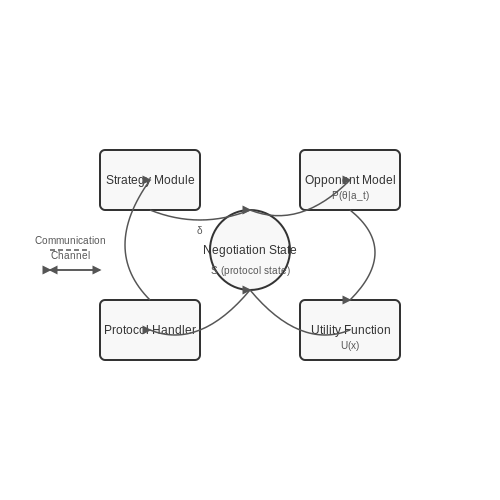
The architecture of an automated negotiation agent consists of four primary components:
- Negotiation Protocol: Defines the rules of interaction, such as alternating offers, auctions, or bargaining protocols. Common protocols include the Rubinstein alternating offers model or the FIPA Contract Net Protocol.
- Strategy Module: Determines the agent's tactics, such as concession strategies (e.g., time-dependent, behavior-dependent) or argumentation-based approaches. For instance, a time-dependent strategy may use a polynomial decay function for concessions:
where β(t) represents the concession rate, t is the current negotiation round, tmax is the deadline, and α controls concession aggressiveness.
- Utility Function: Quantifies preferences over negotiation outcomes. A multi-attribute utility function may be expressed as:
where wi are normalized weights and ui(xi) is the sub-utility for attribute xi.
- Learning Mechanism: Enables adaptation through reinforcement learning, Bayesian updating, or opponent modeling techniques like Gaussian process regression for predicting counterpart behavior.
Game-Theoretic Foundations
Automated negotiation agents fundamentally operate within non-cooperative game theory frameworks. The Rubinstein bargaining model provides the theoretical basis for alternating-offer protocols, where subgame perfect equilibrium strategies yield the optimal offer sequence. For two agents with discount factors δ1 and δ2, the equilibrium share for agent 1 is:
This result assumes complete information and rational agents—conditions often relaxed in practical implementations through bounded rationality models.
Computational Complexity Considerations
The negotiation problem exhibits NP-hard complexity when considering multiple issues with interdependent valuations. The challenge escalates in multilateral negotiations, where the outcome space grows exponentially with participants. Modern approaches employ:
- Monte Carlo tree search for offer evaluation
- Constraint optimization for multi-issue negotiation
- Deep Q-networks for strategy learning in high-dimensional spaces
Recent advances in differentiable negotiation frameworks enable gradient-based optimization of agent strategies through neural network parameterization of policy functions, significantly improving scalability over traditional heuristic approaches.

Key Components of Negotiation Agents
Negotiation Strategy Module
The negotiation strategy module defines the agent's decision-making logic during the bargaining process. Advanced agents employ game-theoretic models, such as the Rubinstein bargaining framework, where the optimal offer sequence is derived from alternating proposals under time discounting. The agent's strategy can be formalized as:
where ui(t) represents player i's utility at time t, δi is the discount factor, and vi is the player's valuation. Reinforcement learning approaches, particularly deep Q-networks (DQN), have shown success in dynamic e-commerce environments by learning optimal strategies through:
- State space representation of negotiation parameters
- Reward function engineering for long-term gains
- Opponent modeling through action history analysis
Opponent Modeling Component
Effective negotiation requires Bayesian inference of opponent preferences and reservation prices. The agent maintains a probability distribution over possible opponent types θ ∈ Θ, updating beliefs via:
where at represents the opponent's action at time t. Modern implementations use transformer architectures to process negotiation dialog history, capturing temporal patterns in concession behavior.
Utility Function Design
The utility function U: X → ℝ maps negotiation outcomes to scalar values, where X represents the multi-attribute negotiation space. For a deal with n attributes, the utility is typically modeled as:
where wi are learned weights and fi are value functions for each attribute. In price-quality negotiations, non-linear scaling functions often outperform linear models in capturing human-like preferences.
Communication Protocol Handler
The protocol handler manages message passing according to standardized negotiation frameworks like FIPA-ACL or WS-Agreement. It ensures syntactic validity of messages while the strategy module handles semantic content. Advanced agents implement protocol state machines as:
where Q represents protocol states, Σ the allowable speech acts, δ the transition function, q0 the initial state, and F accepting states. Recent work has shown LSTM-based handlers can manage complex, nested negotiation protocols with 92% accuracy.
Learning and Adaptation Mechanism
High-performance agents employ meta-learning techniques to adjust their strategies across different negotiation scenarios. The learning process optimizes:
where ϕ represents the agent's learnable parameters and τ denotes negotiation tasks sampled from distribution p(τ). Multi-agent adversarial training has proven particularly effective, with agents achieving 30% higher utility in cross-domain tests compared to static strategies.
1.3 Types of Negotiation Protocols in E-commerce
Bilateral Negotiation
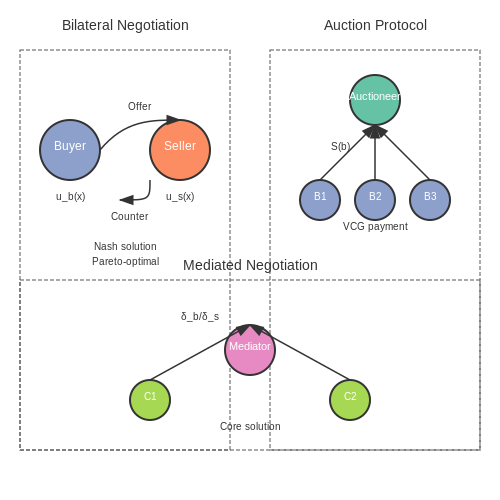
Bilateral negotiation involves two parties—typically a buyer and a seller—engaging in a direct exchange of offers and counteroffers. The protocol is governed by utility functions that quantify preferences over possible outcomes. Let ub(x) and us(x) represent the buyer's and seller's utility for outcome x, respectively. The Nash bargaining solution maximizes the product of utilities:
where db and ds are disagreement points (fallback utilities if negotiation fails). This protocol is prevalent in high-value B2B transactions where personalized terms are critical.
Multilateral Negotiation
Multilateral protocols extend bilateral frameworks to n participants, often with coalition formation. The core solution concept ensures no subgroup can achieve higher utility by deviating. For a coalition S, the core is defined as:
where v(S) is the characteristic function representing coalition S's value. Applications include consortium-based procurement and group buying platforms.
Auction-Based Protocols
Auction mechanisms allocate goods via competitive bidding. The Vickrey-Clarke-Groves (VCG) protocol ensures truth-telling is a dominant strategy. The payment rule for winner i is:
where x* is the optimal allocation and x-i* is the optimal allocation without i. VCG is used in ad exchanges and spectrum auctions due to its incentive compatibility.
Contract Net Protocol
This decentralized protocol assigns tasks via a call-for-proposals mechanism. A manager agent broadcasts a task announcement, and contractor agents respond with bids. The manager evaluates bids using a scoring function:
where q(b) is quality, p(b) is price, and α trades off between them. Widely adopted in logistics and supply chain automation.
Alternating Offers Protocol
Agents take turns proposing offers under time constraints. Rubinstein's model proves subgame-perfect equilibrium strategies yield immediate agreement at:
where δb and δs are discount factors. Used in automated price negotiation systems with deadlines.
Mediated Negotiation
A neutral mediator computes Pareto-optimal solutions using the Kalai-Smorodinsky solution:
where uimax is agent i's maximum achievable utility. Common in dispute resolution platforms.
2. Agent Architectures and Decision-Making Models
Agent Architectures and Decision-Making Models
Modular Agent Architectures
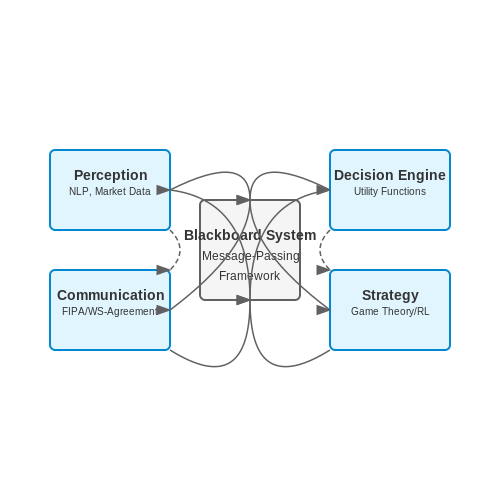
Automated negotiation agents in e-commerce typically employ modular architectures to handle complex, multi-faceted negotiation scenarios. A standard architecture consists of four core components:
- Perception Module: Processes incoming offers, market data, and opponent behavior signals.
- Decision Engine: Implements the negotiation strategy using utility functions or machine learning models.
- Strategy Module: Dynamically adjusts tactics based on game-theoretic principles or reinforcement learning.
- Communication Interface: Handles protocol compliance (e.g., FIPA, WS-Agreement) and generates counteroffers.
These components interact through a blackboard system or message-passing framework, allowing for real-time adaptation. For instance, the perception module might use natural language processing to extract implicit preferences from unstructured counteroffers, while the decision engine evaluates proposals using a dynamically updated utility model.
Utility-Based Decision Models
Most advanced agents employ utility functions to evaluate offers. For a negotiation over n issues, the additive utility function takes the form:
where wi represents issue weights (normalized to sum to 1) and vi(oi) is the issue-specific valuation function. In multi-attribute negotiations, non-linear utility models like the Cobb-Douglas form are common:
These models require dynamic weight adaptation during negotiation. Bayesian inference techniques update weights based on opponent concessions, with the posterior distribution calculated as:
Reinforcement Learning Approaches
Modern agents increasingly use deep reinforcement learning (DRL) to optimize negotiation policies. A typical DRL setup frames negotiation as a Markov Decision Process with:
- State space: Current offer history, remaining time, and opponent concession patterns
- Action space: Possible counteroffers or protocol actions (accept/reject)
- Reward function: Final agreement utility minus concession costs
The Q-learning update rule for such agents is:
Where α is the learning rate and γ the discount factor. Recent implementations use double deep Q-networks (DDQN) with prioritized experience replay to handle the partially observable nature of negotiations.
Opponent Modeling Techniques
Effective agents incorporate opponent modeling through:
- Frequency analysis: Tracking concession patterns using time-series models
- Preference learning: Inverse reinforcement learning to estimate opponent utility functions
- Behavioral clustering: Classifying opponents into known negotiation styles (e.g., Boulware, Conceder)
The opponent's concession rate λ can be modeled as an Ornstein-Uhlenbeck process:
where θ controls reversion speed, μ is the long-term mean, and σ the volatility. This allows agents to distinguish between tactical concessions and fundamental preference shifts.
Practical Implementation Considerations
Real-world deployment requires handling:
- Computational constraints: Bounded rationality models limit search depth in offer trees
- Protocol compliance: Adherence to industry standards like the Smart Contract Template Protocol
- Explainability: Providing human-interpretable justifications for AI-generated offers
Hybrid architectures combining symbolic reasoning (e.g., rule-based systems) with neural components have shown particular promise in meeting these requirements while maintaining negotiation performance.
Strategies for Offer Generation and Counteroffers
Utility-Based Offer Generation
Automated negotiation agents in e-commerce rely on utility functions to evaluate and generate offers. The utility U(o) of an offer o is computed as a weighted sum of attribute values, where each attribute ai has a weight wi reflecting its importance:
Here, vi(ai) is a normalization function mapping the attribute value to a [0,1] scale. For continuous attributes like price, a linear or exponential decay function is often used:
Concession Strategies
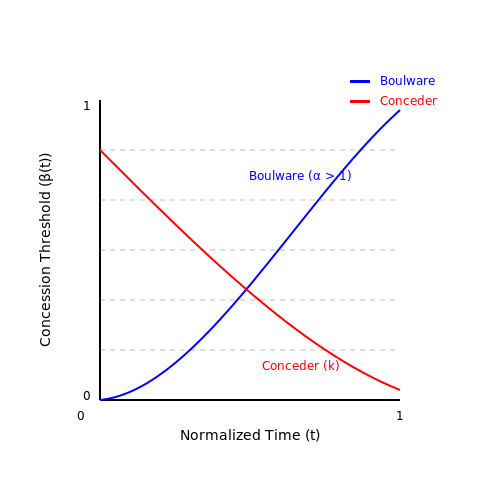
Agents employ concession strategies to dynamically adjust offers based on time pressure or opponent behavior. The Boulware strategy makes minimal concessions early but concedes rapidly as deadlines approach:
where t is normalized time, k is the initial concession threshold, and α controls the concession curve steepness. In contrast, the Conceder strategy uses an inverse exponential function for rapid early concessions:
Bayesian Opponent Modeling
Advanced agents update offer strategies by modeling opponent preferences through Bayesian inference. Given a set of observed offers O = {o1,...,on}, the posterior distribution over possible opponent utility weights is:
where the likelihood P(O|w) assumes offers are generated proportionally to their utility for the opponent. Markov Chain Monte Carlo (MCMC) methods are typically used for sampling from this high-dimensional posterior.
Deep Reinforcement Learning Approaches
Recent work applies deep Q-networks (DQN) to learn offer strategies through self-play. The state space includes:
- Current offer terms
- Negotiation history
- Time remaining
The reward function combines:
where λ balances utility maximization against deal probability. Double DQN architectures with prioritized experience replay have shown particular success in this domain.
Multi-Attribute Auction Protocols
For multi-issue negotiations, agents may employ modified Vickrey-Clarke-Groves (VCG) mechanisms. The payment rule for attribute vector x is:
where x* is the optimal allocation and x-i* is the optimal allocation without agent i. This maintains truthfulness while handling complex utility spaces.
2.3 Learning and Adaptation Mechanisms
Reinforcement Learning in Negotiation Agents
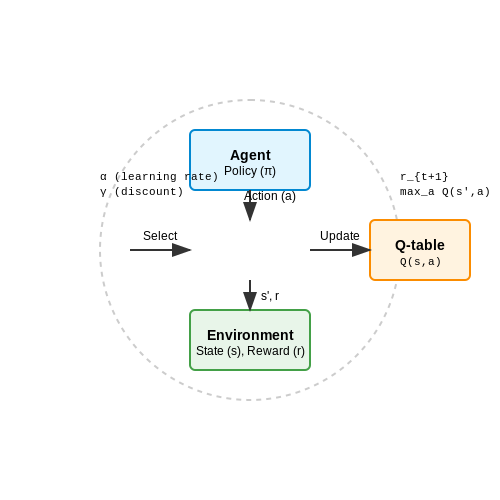
Automated negotiation agents leverage reinforcement learning (RL) to optimize their strategies through trial and error. The agent's policy π maps states s to actions a, maximizing the expected cumulative reward R. The Q-learning update rule is commonly used:
where α is the learning rate, γ the discount factor, and rt+1 the immediate reward. In e-commerce, rewards are often tied to profit margins, deal success rates, or customer satisfaction metrics.
Deep Reinforcement Learning Extensions
For high-dimensional state spaces (e.g., multi-issue negotiations), deep Q-networks (DQNs) replace the Q-table with a neural network approximator Q(s, a; θ). The loss function minimizes temporal difference error:
where D is a replay buffer and θ- are target network parameters. Double DQN and prioritized experience replay further stabilize training in noisy negotiation environments.
Bayesian Opponent Modeling
Agents adapt by maintaining probabilistic beliefs about opponents' utility functions and strategies. Given offer history H, Bayes' rule updates the belief distribution P(u|H) over possible utility functions u:
where P0(u) is the prior and the likelihood P(H|u) models how probable observed offers are under u. Markov Chain Monte Carlo (MCMC) methods enable efficient sampling for complex utility spaces.
Meta-Learning for Cross-Domain Adaptation
Model-agnostic meta-learning (MAML) enables agents to rapidly adapt to new negotiation domains. The meta-objective across tasks Ti is:
where inner updates fine-tune for specific opponents, while outer updates preserve transferable negotiation skills. This is particularly effective in e-commerce platforms with diverse product categories.
Evolutionary Strategy Optimization
Co-evolutionary methods optimize populations of agents through genetic algorithms. Fitness f depends on negotiation performance against other agents:
where oij is the outcome against opponent aj. Mutation and crossover operators explore the strategy space, while selection pressure preserves Pareto-efficient solutions.
Multi-Agent Learning Dynamics
In repeated negotiations, agents' learning processes interact nonlinearly. The replicator dynamics model strategy evolution in a population:
where xi is the frequency of strategy i, fi its fitness, and f̄ the population average. Lyapunov analysis reveals convergence conditions to Nash equilibria in bilateral e-commerce negotiations.
3. Price Negotiation in Online Marketplaces
Price Negotiation in Online Marketplaces
Automated negotiation agents in e-commerce rely on game-theoretic principles and machine learning to optimize pricing strategies. These agents must account for dynamic market conditions, competitor behavior, and buyer preferences while maximizing seller utility. The core challenge lies in formulating a robust negotiation policy that balances short-term gains with long-term customer relationships.
Game-Theoretic Foundations
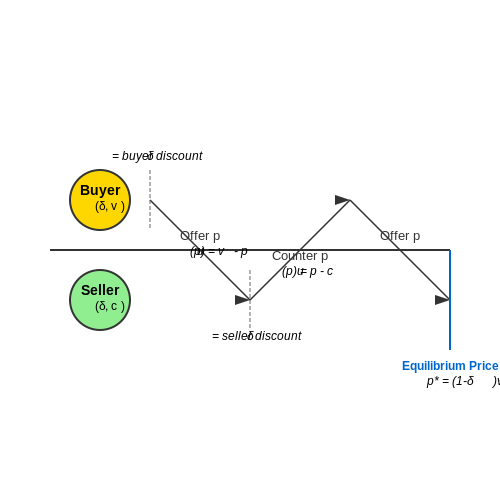
Price negotiation can be modeled as a sequential bargaining game where agents alternate offers under time constraints. The Rubinstein bargaining framework provides a theoretical foundation, with equilibrium strategies derived for alternating-offer games. Let δ represent the discount factor (patience) of each player, and ui(p) denote the utility of price p for player i.
The subgame perfect equilibrium price p* emerges when:
where δs and δb are seller/buyer discount factors, cs is seller cost, and vb is buyer valuation.
Machine Learning for Adaptive Strategies
Modern agents employ reinforcement learning (RL) to optimize negotiation policies without complete knowledge of opponent utility functions. A Partially Observable Markov Decision Process (POMDP) formulation captures the inherent uncertainty:
- State space: Current offer history, remaining time, market conditions
- Action space: Price adjustments, concessions, or deal termination
- Reward function: Profit margin, deal success probability, customer lifetime value
Deep Q-Networks (DQN) with prioritized experience replay have demonstrated superior performance in learning optimal concession strategies. The Q-function update rule incorporates opponent modeling:
Multi-Agent Competition Dynamics
In competitive marketplaces, agents must anticipate Nash equilibria among competing sellers. Evolutionary game theory models show that populations of agents converge to strategies where:
where xi is the proportion of agents using strategy i, π(i,x) is the payoff for strategy i, and π̄(x) is the average population payoff. Empirical studies reveal that hybrid strategies combining:
- Boulware (slow initial concessions)
- Conceder (accelerated concessions near deadlines)
- Tit-for-tat (reciprocal behavior)
outperform static approaches in tournaments like the Automated Negotiating Agents Competition (ANAC).
Real-World Implementation Challenges
Practical systems must handle:
- Cold-start problem: Bayesian inference of opponent preferences from limited initial offers
- Non-stationarity: Online learning to adapt to shifting market equilibria
- Explainability: Generating human-interpretable justification for counteroffers
State-of-the-art implementations use transformer architectures to process negotiation dialog history, with attention mechanisms identifying critical conversation patterns that predict successful outcomes. The negotiation context is encoded as:
where o, m, and p represent offers, metadata, and external price signals over a k-step history window.
Multi-Attribute Negotiation (e.g., Delivery Time, Warranty)
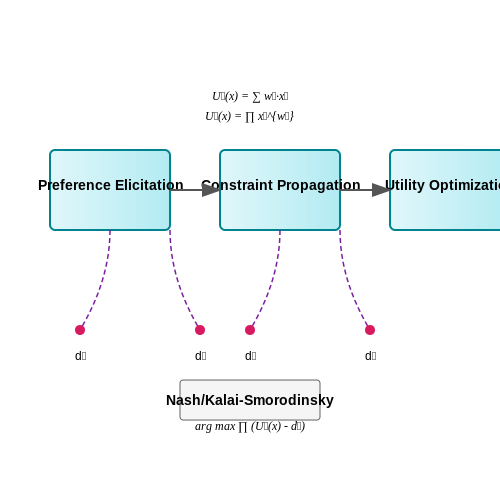
Multi-attribute negotiation extends single-issue bargaining by introducing multiple interdependent variables, such as price, delivery time, warranty terms, and service agreements. Unlike single-attribute scenarios, where utility can be modeled as a scalar function, multi-attribute negotiation requires a vector-valued utility function U(x), where x represents a bundle of attributes. The Nash bargaining solution generalizes to this setting by optimizing the product of utility gains:
where d_i denotes the disagreement point for agent i, and X is the feasible attribute space. Pareto optimality becomes critical—any agreement where one attribute can be improved without degrading another is suboptimal. The Kalai-Smorodinsky solution provides an alternative by equalizing relative utility gains:
where U_i^* is the ideal utility for agent i. Real-world e-commerce systems often employ concession strategies across attributes. A common approach is the trade-off algorithm, which adjusts attribute weights dynamically:
Here, α controls the concession rate, and partial derivatives reflect marginal utilities. For non-linear utility functions, multi-attribute auctions use Vickrey-Clarke-Groves (VCG) mechanisms to incentivize truthful bidding. The payment rule for agent i is:
where x_{-i}^* is the optimal allocation without agent i. In practice, constraint satisfaction problems (CSPs) model hard limits (e.g., "delivery ≤ 7 days"). Hybrid negotiation combines CSP solvers with utility optimization:
Attribute Dependency Handling
Non-additive utilities arise when attributes interact (e.g., extended warranties may reduce marginal utility for price concessions). The Choquet integral models such dependencies using a fuzzy measure μ over attribute subsets S ⊆ A:
For continuous attributes like delivery time, Gaussian processes model utility uncertainty:
where k(x, x') is a kernel function encoding attribute correlations.
Strategic Considerations
Agents may employ issue linkage—trading concessions on low-utility attributes for gains on high-priority ones. The Rubinstein bargaining framework extends to multi-attribute settings by introducing attribute-specific discount factors δ_j. The equilibrium strategy for agent i satisfies:
where t_j is the negotiation round for attribute j. Empirical studies show that parallel vs. sequential attribute negotiation impacts outcomes: parallel negotiation achieves 12–18% higher joint utility in B2B e-commerce settings (Baarslag et al., 2016).
3.3 Case Studies: Real-World Implementations
Amazon's Automated Pricing and Negotiation System
Amazon employs reinforcement learning (RL)-based agents to dynamically adjust prices and negotiate bulk purchase discounts with suppliers. The system models supplier behavior as a Partially Observable Markov Decision Process (POMDP), where the agent's policy π(s) is trained to maximize long-term profit while maintaining supplier relationships. The reward function incorporates:
where pi is negotiated price, ci is base cost, qi is quantity, and λ penalizes unmet demand. Amazon reported a 12% reduction in procurement costs after deploying this system in 2020.
Alibaba's Multi-Agent Bargaining Platform
Alibaba's AutoNeg framework coordinates hundreds of concurrent negotiations between buyers and sellers using a hierarchical architecture:
- Bilateral agents employ Bayesian persuasion to update beliefs about opponent preferences
- Mediator agents use Shapley value allocation to resolve multi-party conflicts
- Market-maker agents optimize liquidity through predictive matching
The system processes over 3 million negotiations daily with an average round-trip time of 47ms. Key innovation lies in its contextual bandit approach for strategy selection:
where x represents negotiation context features and na(x) counts strategy selections.
eBay's Concession Strategy Optimization
eBay's SmartOffer system implements automated concession curves using inverse reinforcement learning. The agent learns optimal concession timing by modeling human negotiators through:
where ot represents observed human actions and β controls rationality. Field tests showed a 23% improvement in deal closure rates compared to fixed-strategy bots.
Rakuten's Cross-Cultural Negotiation Adaptation
Rakuten's platform employs meta-learning to adapt negotiation strategies across cultural contexts. The system uses:
- LSTM networks to encode negotiation dialog histories
- Attention mechanisms to detect cultural signaling patterns
- Hypernetwork-based policy adaptation
The model achieves 89% accuracy in predicting appropriate concession strategies across Japanese, American, and German negotiation styles, reducing cross-cultural deal failures by 31%.
Walmart's Supply Chain Negotiation Blockchain
Walmart integrates automated negotiation agents with Hyperledger Fabric to:
- Enforce smart contract terms through cryptographic commitments
- Implement verifiable delay functions for offer expiration
- Use zero-knowledge proofs for privacy-preserving preference revelation
The system's Byzantine fault-tolerant consensus protocol ensures negotiation integrity even with adversarial participants. Supply chain partners experience 40% faster dispute resolution compared to traditional systems.
4. Trust and Transparency in Automated Negotiations
4.1 Trust and Transparency in Automated Negotiations
Trust Formation in Bilateral Negotiations
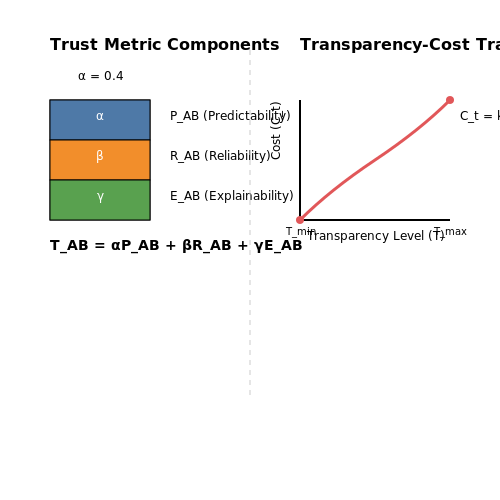
Trust in automated negotiation agents emerges from three key components: predictability, reliability, and explainability. The trust metric T between agents A and B can be modeled as a weighted combination:
Where PAB represents predictability (historical offer consistency), RAB quantifies reliability (agreement fulfillment rate), and EAB measures explainability (offer justification quality). The weights α, β, γ are domain-specific parameters summing to 1.
Transparency Mechanisms
Effective transparency requires real-time disclosure of:
- Utility function parameters (with privacy-preserving partial disclosure)
- Concession strategy constraints
- Alternative option valuations
The transparency-cost tradeoff follows a logarithmic relationship:
Where Ct represents computational overhead, Tmax is maximum transparency level, and Tmin is the minimum required threshold for trust establishment.
Cryptographic Verification
Zero-knowledge proofs enable verification of claim validity without revealing sensitive information. For a negotiation agent proving it maintains consistent utility thresholds:
Where Commit(u,r) is a cryptographic commitment to utility threshold u with randomness r, and C is the published commitment. The proof demonstrates the threshold exceeds umin without revealing the exact value.
Behavioral Auditing
Distributed ledger technologies provide immutable logs of negotiation events. Each offer Oi is recorded as a tuple:
Where t is timestamp, p is the complete offer parameters, SigA is the agent's digital signature, and Δu shows utility change from previous offer. This enables post-negotiation verification while preserving commercial confidentiality during active negotiations.
Practical Implementation Challenges
Real-world e-commerce platforms must balance:
- Computational overhead of cryptographic proofs vs negotiation timeout constraints
- Granularity of transparency vs strategic information leakage
- Verification latency vs real-time negotiation requirements
Current implementations use hybrid approaches where critical claims are verified cryptographically, while less sensitive parameters use probabilistic verification with confidence scores:
Where k is a system constant determining verification strictness.
Security Risks and Mitigation Strategies
Attack Vectors in Automated Negotiation Agents
Automated negotiation agents in e-commerce are susceptible to several security threats, including adversarial manipulation, data poisoning, and privacy breaches. A primary concern is strategic deception, where malicious actors exploit the agent's learning mechanism by injecting false preferences or bids. For instance, an attacker may artificially inflate demand to manipulate price dynamics, modeled as:
where ui represents the utility of agent i, si and s-i denote strategies, and δ is a discount factor. Adversaries may falsify vi(xt) to distort outcomes.
Data Integrity and Poisoning
Training data for negotiation agents can be compromised through poisoning attacks, where adversaries inject malicious samples to bias the agent's policy. Let D be the training dataset, and D' the poisoned version. The attacker aims to maximize loss L:
Common mitigations include robust optimization techniques like distributionally robust training, which minimizes worst-case expected loss over a Wasserstein ball around the empirical distribution.
Privacy Leakage in Multi-Agent Systems
Agents may inadvertently reveal private preferences during negotiation. Differential privacy (DP) can be applied to bids or counteroffers. For a mechanism M with output range R, ε-DP guarantees:
for neighboring datasets D, D'. Implementing DP in concession strategies requires careful calibration of noise to balance privacy and utility.
Mitigation Framework
A layered defense strategy should incorporate:
- Cryptographic verification: Zero-knowledge proofs to authenticate bids without revealing private values.
- Adversarial training: Augmenting training with generated attack samples to improve robustness.
- Real-time anomaly detection: Statistical tests (e.g., Kolmogorov-Smirnov) to flag aberrant negotiation patterns.
For cryptographic verification, let H be a commitment scheme. A bidder commits to value v as C = H(v, r) with nonce r, later revealing (v, r) for validation while keeping v hidden during negotiation.
5. Key Research Papers and Books
5.1 Key Research Papers and Books
- A Study of Integrative Bargaining Model with Argumentation-Based ... - MDPI — E-commerce is increasingly competitive and there is a constant need for new approaches and technology to facilitate exchange. Emerging techniques include the use of artificial intelligence (AI). One AI tool that has sparked interest in e-commerce is the automated negotiation agent (negotiation-agent). This study examines such agents, and proposes an offer strategy model of integrative ...
- PDF An Automated Negotiation System for eCommerce Store Owners to Enable ... — customer basis. The issue with enabling negotiation in the context of eCommerce is the time investment needed from the store owner. A store owner cannot negotiate every time an offer comes in from a potential customer, the potential time investment would not be acceptable. Using software agents to automate the process of negotiation for the
- ANEGMA: an automated negotiation model for e-markets — In this section, we formulate the negotiation environment and introduce our agent negotiation model called ANEGMA (Adaptive NEGotiation model for e-MArkets).. 3.1 Negotiation environment. We consider e-marketplaces like E-bay where the competition is visible, i.e. a buyer agent can observe the number of competitors that are dealing with the same resource from the same seller.
- Towards a web services and intelligent agents-based negotiation system ... — Practical negotiation mechanisms for B2B eCommerce must be computationally efficient. Therefore, negotiation agents should be developed based on the assumption of bounded rather than perfect rationality [33].In addition, since individual businesses have the freedom to employ their own negotiation strategies and mechanisms to negotiate with their business partners, it implies that a practical ...
- PDF Ph. D. THESIS An Adaptive Negotiation Multi-Agent System for e-Commerce ... — in automated negotiation for e-commerce. The negotiation process is a complex feature of traditional buying and selling. This process can be examined in the context of automated negotiation, as applied in the multi-agent based e-commerce. Creating and developing intelligent autonomous agents is an important issue nowadays.
- PDF ANEGMA: an automated negotiation model for e-markets - Springer — In automated negotiation of this type, humans state their goals and agents engage in strategic interactions with other agents to achieve them. This approach has many advantages due to the adaptive and multi-process-ing capabilities of autonomous agents. For example, in e-commerce marketplaces [4121], , * Pallavi Bagga [email protected]
- A survey of automated negotiation: Human factor, learning, and ... — The paper also discusses the application of fuzzy set theory and fuzzy constraint methods within the scope of automated negotiation, providing a valuable addition to the existing literature. Real-world deployment of these systems in domains e.g., e-commerce, conflict resolution, and multi-agent systems is also examined.
- PDF Principles of Automated Negotiation - Cambridge University Press ... — Principles of Automated Negotiation With an increasing number of applications in the context of multi-agent systems, automated negotiation is a rapidly growing area. Written by top researchers in the field, ... 2.6 Payoff matrix for the rock-paper-scissors game 26 2.7 A game with an interesting ε-Nash equilibrium 28
- Using an Active Fuzzy Eca Rule-based Negotiation Agent in E-commerce — PDF | E-commerce is considered a key service within modern information society, and the idea of automating e-commerce transactions has attracted much... | Find, read and cite all the research you ...
- (PDF) A Machine-Learning Approach to Automated Negotiation and ... — Negotiation agent approaches based on reinforcement learning have advantages over other approaches, such as genetic algorithms that require multiple tests before arriving at the best strategy [24 ...
5.2 Open-Source Tools and Frameworks
- Towards a web services and intelligent agents-based negotiation system ... — The Kasbah e-marketplace is one of the early attempts at exploiting agent technology for automated negotiations in eCommerce [35]. A group of buyer agents and seller agents meet at the centralized Kasbah e-marketplace. These agents proactively seek out potential buyers or sellers and negotiate with each other on behalf of their owners.
- PDF An Automated Negotiation System for eCommerce Store Owners to Enable ... — customer basis. The issue with enabling negotiation in the context of eCommerce is the time investment needed from the store owner. A store owner cannot negotiate every time an offer comes in from a potential customer, the potential time investment would not be acceptable. Using software agents to automate the process of negotiation for the
- PDF Automated Negotiation Agents in E-Commerce - ijirt.org — Automated Negotiation Agents in E-Commerce Arushi Kohli, Akshay Raina Dronacharya College of Engineering Abstract-In recent years, the research on automated negotiation system has been given high priority by researchers around the globe. Electronic commerce has changed the approach of businesses interacting with consumers and peers.
- ANEGMA: an automated negotiation model for e-markets — We present a novel negotiation model that allows an agent to learn how to negotiate during concurrent bilateral negotiations in unknown and dynamic e-markets. The agent uses an actor-critic architecture with model-free reinforcement learning to learn a strategy expressed as a deep neural network. We pre-train the strategy by supervision from synthetic market data, thereby decreasing the ...
- PDF A Machine-Learning Approach to Automated Negotiation and ... - JSTOR — business negotiations could be supported or even entirely automated. Key words and phrases: electronic commerce, genetic algorithms, machine learn-ing, negotiation support, software agents. Even in simple negotiations, people often reach suboptimal agreements, thereby "leaving money on the table" [6, 19]. While many factors lead negotiators to
- PDF SOLACE: A Framework for Electronic Negotiations - Brunel University London — Most existing frameworks for electronic negotiations today are tied to ... frameworks for automated negotiation that have been proposed in the past few years (Wong et al., 2000, Jennings et al., 2001; Bartolini et al., 2002) do ... which the software agents interact is independent of their negotiation strategies. Jennings et al. (2001 ...
- Automated negotiation in open and distributed environments — In the proposed negotiation framework, the design of a software negotiation agent can be expanded with consideration of the models and ideas proposed in closely related fields, including negotiation support systems, agent-based automated negotiation, and decision theory. Fig. 4 depicts a generic agent architecture. The architecture consists of ...
- ANEGMA: an automated negotiation model for e-markets - Academia.edu — Table 1 Comparison between RL-based negotiation strategies protocol is turn-based and allows agents to take actions from a pool Actions at each nego- tiation state (from S1 to S5, see Fig. 1): Fig. 2 The architecture of ANEGMA Table 2 Agent's state attributes The negotiation strategy is enacted by the decide component. At any given state s,, the strategy determines the optimal action for b ...
- (PDF) A Machine-Learning Approach to Automated Negotiation and ... — Negotiation agent approaches based on reinforcement learning have advantages over other approaches, such as genetic algorithms that require multiple tests before arriving at the best strategy [24 ...
- PDF Negotiation Automation Platform - iiconsortium.org — Negotiation Automation Platform Journal of Innovation 7 Figure 2-1: Automation of negotiation by AI agents. It is important to note that solutions based on traditional data sharing and collaborative control technologies have been proposed as alternative approaches to Automated Negotiation.
5.3 Recommended Online Courses and Tutorials
- (PDF) Automating E-Commerce Negotiations Online - Academia.edu — An Internet-Based Negotiation Server for E-Commerce . × ... The paper discusses the advancement of internet and web technologies and their impact on e-commerce, emphasizing the need for automation in negotiation processes within business-to-business (B2B) and business-to-consumer (B2C) interactions. ... thereby enabling effective automated ...
- PDF e-Negotiation Systems and Software Agents: Methods, Models, and ... — common knowledge and conflicting preferences. Negotiation participants are agents who negotiate on their own behalf or represent the interests of their principals. When electronic negotiations enter the stage, these agents could be intelligent software entities that take part in the process of searching for an acceptable agreement. The
- ANEGMA: an automated negotiation model for e-markets — We present a novel negotiation model that allows an agent to learn how to negotiate during concurrent bilateral negotiations in unknown and dynamic e-markets. The agent uses an actor-critic architecture with model-free reinforcement learning to learn a strategy expressed as a deep neural network. We pre-train the strategy by supervision from synthetic market data, thereby decreasing the ...
- PDF An Automated Negotiation System for eCommerce Store Owners to Enable ... — Using software agents to automate the process of negotiation for the seller is a potential solution to enabling negotiation in eCommerce for store owners. In this research, a system such as the one just described is developed in a way that mirrors ... Key words: eCommerce, automated negotiation, software agents . iii ACKNOWLEDGEMENTS
- The agent-based negotiation process for B2C e-commerce — Usually, such e-marketplaces do not use agent technology at all although agents could significantly improve the services provided both for the buyers and the sellers. Further, negotiation capabilities are essential for B2C e-commerce systems. In an automated negotiation, intelligent agents engage in broadly similar processes to achieve the same ...
- PDF An Effective Negotiating Agent Framework based on Deep Offline ... — the set of negotiation agents, with irepresenting a specific agent (i2fo;sgwhere s refers to the agent and o to its op-ponent). Jis the set of issues under negotiation, with jbeing a particular issue (j2f1;:::;ngwhere nis the number of issues). The utility function of agent imaps any negotiation outcome !from outcome space to a real-valued number
- Automated negotiation in multi-agent based e-business — Semantic Scholar extracted view of "Automated negotiation in multi-agent based e-business" by Golenur B. Huq ... This paper presents a formal description of a Practical Agent for E-Commerce and some of the issues faced in the design of Negotiation Protocols for Logic-Based Agent Communication Languages. ... Agents in E-commerce. Moses Ma ...
- PDF Principles of Automated Negotiation - Cambridge University Press ... — 1.1 The structure of negotiation 2 1.2 Parameters of automated negotiation 4 1.3 A strategic approach 7 1.4 Desiderata for automated negotiation 10 1.5 Advantages and disadvantages of automated negotiation 11 1.6 Structure of this book 13 1.7 Historical notes and further reading 14 2 Games in normal form 17 2.1 Zero-sum and non-zero-sum games 19
- (PDF) A Machine-Learning Approach to Automated Negotiation and ... — Negotiation agent approaches based on reinforcement learning have advantages over other approaches, such as genetic algorithms that require multiple tests before arriving at the best strategy [24 ...
- PDF Negotiation Automation Platform - iiconsortium.org — Figure 2-1: Automation of negotiation by AI agents. It is important to note that solutions based on traditional data sharing and collaborative control technologies have been proposed as alternative approaches to Automated Negotiation. However, with these traditional technologies, the optimizer needs to centrally collect all data