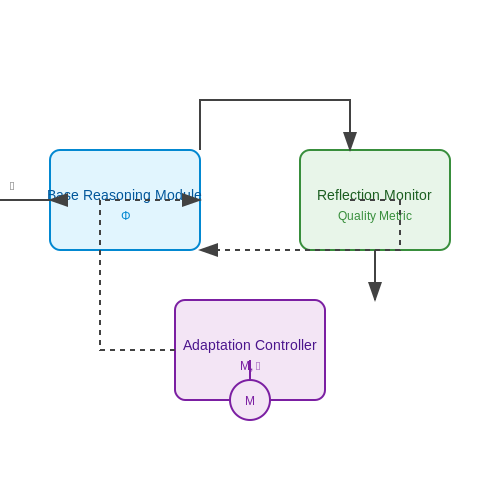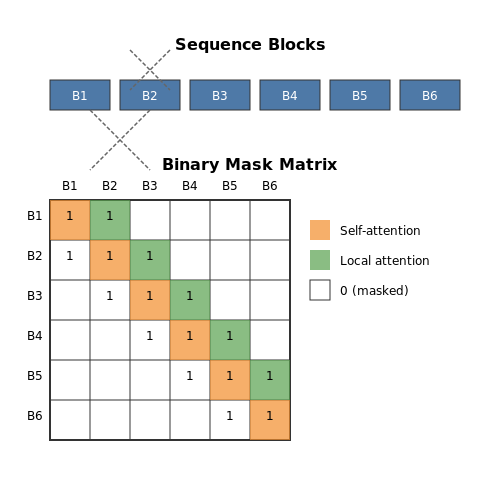

Multi-Modal Memory Systems in AI Agents
1. Definition and Core Components of Multi-Modal Memory
Definition and Core Components of Multi-Modal Memory
Multi-modal memory systems in AI agents integrate heterogeneous sensory and cognitive data streams into a unified memory architecture, enabling the agent to retain, retrieve, and reason across modalities such as vision, language, audio, and tactile inputs. Unlike unimodal memory systems, which operate on a single data type, multi-modal memory leverages cross-modal associations to enhance contextual understanding and decision-making.
Core Architectural Components
The foundational structure of a multi-modal memory system consists of three primary components:
- Modality-Specific Encoders — Transform raw sensory inputs (images, text, audio) into high-dimensional vector representations using specialized neural networks (CNNs for vision, transformers for text, spectrogram-based networks for audio).
- Cross-Modal Alignment Layer — Implements attention mechanisms or contrastive learning to establish latent space correspondences between modalities. For two modalities A and B, alignment minimizes the distance metric:
where fA and fB are modality-specific encoders, and 𝒟 is a dataset of paired samples.
- Unified Memory Matrix — A dynamically updated tensor M ∈ ℝd×k storing k memory slots of dimension d, with each slot containing fused multi-modal features. Memory updates follow a gated mechanism:
where Γt is a learned gating vector and Ṁt is the candidate memory.
Retrieval Mechanisms
Content-based retrieval employs multi-modal similarity search across the memory matrix. Given a query q (which may be partial or uni-modal), the system computes relevance scores:
where ϕ and ψ are query and memory projection networks. The top-k memories are then fused using the scores si.
Neurocognitive Foundations
Biological inspiration comes from the hippocampal-entorhinal system, where grid cells and place cells enable multi-sensory integration. AI implementations often mimic this through:
- Differentiable neural dictionaries analogous to hippocampal pattern separation
- Topographic organization of memory slots resembling cortical columnar structures
- Replay mechanisms that reinforce cross-modal associations during offline periods
Modern architectures like Memory-Augmented Neural Networks (MANNs) and Transformer-based memory systems demonstrate these principles at scale, achieving state-of-the-art results in embodied AI and robotics applications where agents must correlate visual observations with language instructions.

Role of Memory in AI Agents: From Reactive to Proactive Systems
Traditional AI systems operate in a purely reactive manner, processing inputs and generating outputs without retaining any internal state. These systems, while computationally efficient, lack the ability to learn from past experiences or adapt to dynamic environments. The introduction of memory mechanisms transforms such agents into proactive entities capable of long-term planning, contextual reasoning, and adaptive behavior.
Memory as a Stateful Component
In formal terms, an AI agent with memory can be modeled as a partially observable Markov decision process (POMDP), where the agent maintains a belief state bt that summarizes its history of observations and actions. The belief state is updated recursively using Bayes' rule:
where η is a normalizing constant, O is the observation function, and T is the transition function. This mathematical framework underpins modern memory-augmented neural networks (MANNs), enabling agents to retain and selectively recall information.
Architectural Implementations
Three dominant paradigms have emerged for implementing memory in AI systems:
- Differentiable Neural Computers (DNCs): Combine neural networks with external memory matrices, enabling read/write operations through attention mechanisms.
- Transformer-based Memory: Utilize key-value stores in self-attention layers to maintain context across long sequences.
- Neural Turing Machines (NTMs): Employ differentiable addressing schemes for content-based memory retrieval.
Case Study: AlphaGo's Memory System
DeepMind's AlphaGo demonstrates the power of hybrid memory systems. Its architecture integrates:
- A policy network with implicit memory of board patterns
- A value network that estimates position quality
- An external memory buffer storing high-quality game trajectories
The system's ability to combine these memory modalities enabled it to defeat world champions by anticipating moves dozens of turns ahead.
From Episodic to Semantic Memory
Advanced AI agents now implement memory hierarchies analogous to biological systems:
where episodic memory stores specific events with temporal context, semantic memory maintains generalized knowledge, and procedural memory retains skill-related information. This separation allows for efficient retrieval and prevents catastrophic interference during learning.
Challenges in Memory-Augmented AI
Despite progress, significant challenges remain:
- Memory-Compression Tradeoff: Balancing detailed retention with computational constraints
- Temporal Credit Assignment: Determining which past events influenced current outcomes
- Catastrophic Forgetting: Preventing new learning from overwriting critical memories
Recent approaches like elastic weight consolidation (EWC) address some limitations by imposing constraints on how weights important for previous tasks can change during new learning:
where Fi represents the Fisher information matrix diagonal for task A, and λ determines the strength of the constraint.

Key Challenges in Multi-Modal Memory Integration
Semantic Heterogeneity Across Modalities
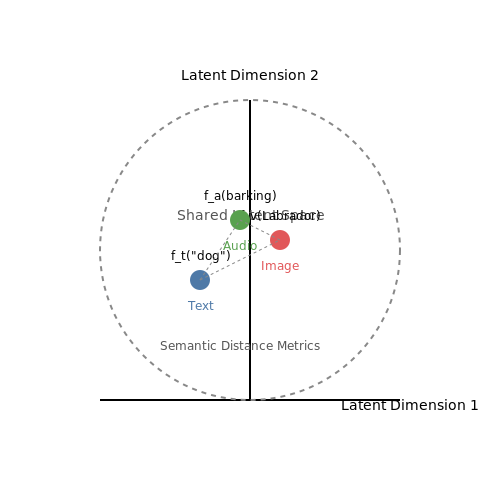
Multi-modal memory systems must reconcile fundamentally different representations of data—text encodes discrete symbols, images capture spatial relationships, and audio relies on temporal sequences. Bridging these modalities requires a shared embedding space where semantically similar concepts align despite structural differences. For instance, the word "dog", a photograph of a Labrador, and a barking sound should map to proximate vectors in a joint latent space. However, achieving this alignment is non-trivial due to the curse of dimensionality and modality-specific noise.
Here, \( f_t \) and \( f_v \) are transformation functions for text and visual inputs, while \( \Omega \) regularizes the model to prevent overfitting. The optimization must balance modality-specific feature extraction with cross-modal consistency.
Temporal Synchronization for Sequential Data
When integrating video and audio streams, temporal misalignment introduces noise. Consider an AI agent processing a lecture: slides (visual) may lag behind spoken explanations (audio). Dynamic time warping (DTW) or attention mechanisms can mitigate this:
where \( \pi \) is a warping path aligning audio frames \( a_i \) and visual frames \( v_j \). Recurrent architectures like Transformer-XL further improve long-range dependency modeling but require careful handling of memory overhead.
Catastrophic Interference in Continual Learning
Multi-modal agents often face sequential tasks where new information disrupts previously learned mappings. For example, fine-tuning a vision-language model on medical images may degrade its performance on natural images. Elastic Weight Consolidation (EWC) addresses this by penalizing changes to critical parameters:
Here, \( F_i \) is the Fisher information matrix diagonal, quantifying parameter importance for prior tasks. However, EWC assumes task boundaries are known—a limitation in real-world streaming scenarios.
Resource-Utility Tradeoffs
Storing raw multi-modal data (e.g., 4K video) is infeasible for edge devices. Compression techniques like variational autoencoders (VAEs) must balance reconstruction fidelity with memory footprint:
The \( \beta \)-VAE hyperparameter controls this tradeoff, but optimal values vary across modalities—requiring dynamic adaptation.
Ethical and Privacy Implications
Multi-modal memories can inadvertently store sensitive attributes (e.g., faces in background video). Differential privacy techniques inject noise during training:
where \( \Delta f \) is the function's sensitivity. However, noise addition degrades model utility, creating tension between privacy and performance.
2. Hierarchical Memory Models for Multi-Modal Data
Hierarchical Memory Models for Multi-Modal Data
Hierarchical memory models provide a structured approach to managing multi-modal data by organizing memory into layers with varying levels of abstraction and access latency. These models are inspired by biological memory systems, where sensory inputs are processed through hierarchical stages before reaching long-term storage. In AI agents, this translates to a computational framework where raw sensory data (e.g., images, text, audio) is progressively transformed into higher-level representations.
Architecture of Hierarchical Memory
The core architecture consists of three primary layers:
- Sensory Buffer: Temporarily holds raw, unprocessed input from multiple modalities (e.g., pixel arrays for vision, spectrograms for audio). Data here is high-dimensional and volatile, with a short retention period.
- Working Memory: Acts as an intermediate layer where modality-specific features are extracted and integrated. For example, convolutional networks may process visual inputs while transformers handle textual data.
- Long-Term Memory: Stores compressed, abstract representations in a queryable format. This layer often employs neural associative memories or differentiable neural dictionaries for efficient retrieval.
Mathematical Formulation
The hierarchical transformation of input data x across layers can be modeled as a series of nonlinear mappings. Let fθ denote the feature extractor for a given modality, and gϕ the cross-modal integration function:
where h(1) and h(2) are hidden representations at different levels of the hierarchy, and z is the final cross-modal embedding. The parameters θ and ϕ are learned end-to-end through gradient descent.
Attention-Based Memory Routing
Modern implementations use attention mechanisms to dynamically route information between memory layers. Given a query q (e.g., a task-specific prompt), the retrieval from long-term memory M follows:
where mi are memory slots, and Wk, Wv are learned key-value projections. This allows the system to focus on relevant memories across modalities.
Applications in Robotics and Multimodal AI
Hierarchical memory enables robots to:
- Fuse lidar, camera, and proprioceptive data for navigation
- Retrieve procedural knowledge (e.g., manipulation skills) based on visual cues
- Maintain context across dialogue and environmental perception
In multimodal transformers, hierarchical memory reduces the quadratic complexity of attention by first compressing each modality separately before cross-modal interaction.

2.2 Neural Memory Networks and Attention Mechanisms
Architectural Foundations
Neural memory networks extend traditional recurrent architectures by incorporating explicit memory storage and retrieval mechanisms. The core innovation lies in separating computation from memory storage, enabling dynamic access patterns similar to human working memory. The fundamental components include:
- Memory matrix M ∈ ℝN×d storing N memory slots of dimension d
- Differentiable read/write operations parameterized by attention weights
- Content-based addressing through similarity metrics
- Temporal linkage for maintaining sequential dependencies
where qt is the query vector at time t, βt controls the sharpness of attention, and sim(·,·) typically uses cosine similarity or dot product.
Attention Mechanisms in Memory Access
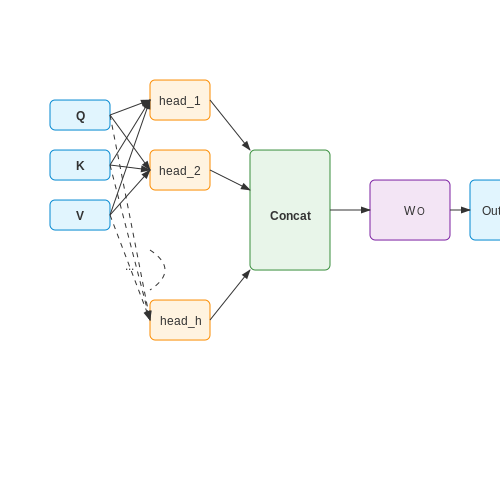
Modern implementations employ multi-head attention to enable parallel access patterns. Each head learns distinct attention patterns, allowing the network to simultaneously attend to different memory locations for varied purposes. The scaled dot-product attention computes:
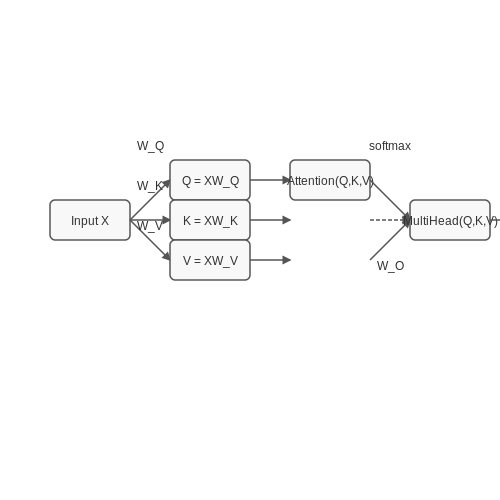
where Q, K, and V represent queries, keys, and values respectively, and dk is the dimension of the key vectors. This formulation enables efficient computation of memory relevance scores while maintaining differentiability.
Memory Update Dynamics
The memory update process combines erase and write operations through gating mechanisms. For each memory slot i at time t:
where ⊙ denotes element-wise multiplication, et is the erase vector, and at is the add vector. The gating mechanism ensures selective modification of memory contents based on the current task requirements.
Applications in Multi-Modal Systems
In multi-modal settings, neural memory networks demonstrate particular strength by maintaining modality-specific memory banks with cross-modal attention. For visual-linguistic tasks, separate memory matrices store visual features and linguistic embeddings, while a shared attention mechanism computes cross-modal relevance:
where vi and lj represent visual and linguistic features, and fθ, gφ are modality-specific projection networks.
Advanced Memory Architectures
Recent developments include sparse memory access patterns to improve scalability. The k-NN memory network limits attention computation to the top-k most relevant memory slots:
This approach reduces computational complexity from O(N) to O(log N) while maintaining performance through the memory locality principle. Hybrid architectures further combine differentiable neural memories with symbolic memory buffers for improved compositional reasoning.

Hybrid Architectures: Combining Symbolic and Sub-Symbolic Memory
Hybrid memory architectures integrate symbolic reasoning with sub-symbolic learning to overcome the limitations of purely connectionist or rule-based systems. Symbolic memory provides explicit, interpretable representations for logical inference, while sub-symbolic memory enables pattern recognition and generalization from high-dimensional data. The fusion of these paradigms allows AI agents to perform complex reasoning while retaining the robustness of statistical learning.
Neural-Symbolic Integration Frameworks
Modern approaches to neural-symbolic integration can be categorized into three dominant paradigms:
- Neural theorem provers that learn to guide symbolic reasoning through differentiable operations
- Memory-augmented networks where neural controllers interact with external symbolic knowledge bases
- Neuro-symbolic concept learners that ground symbols in perceptual data through joint embedding spaces
The differentiable neural computer (DNC) exemplifies this hybrid approach, combining a neural network controller with an addressable memory matrix that can store and retrieve symbolic tuples. The read/write operations are learned through attention mechanisms while maintaining interpretable memory access patterns.
Mathematical Foundations
The interaction between symbolic and sub-symbolic components can be formalized through attention-based memory operations. Let M be a memory matrix of size N × W, where N is the number of memory slots and W is the width of each slot. The controller produces a key vector k ∈ ℝW and a scalar key strength β ∈ [1,∞). The read weights w ∈ [0,1]N are computed as:
where cos denotes cosine similarity. This soft addressing mechanism allows continuous interpolation between exact symbolic matching (β→∞) and distributed sub-symbolic representations (β→1).
Case Study: Visual Question Answering
In visual QA systems, hybrid architectures demonstrate their advantage by combining convolutional networks for image understanding with symbolic reasoning for answer inference. The system first extracts visual features V and parses the question into a logical form Q. A neural module network then dynamically instantiates symbolic programs from Q that operate on V through learned neural modules.
The execution trace maintains symbolic interpretability while leveraging neural networks for perceptual grounding. For the question "What color is the object to the left of the cube?", the system might generate the program:
query(
  filter(
    relate(
      detect(objects),
      'left_of',
      filter(
        detect(objects),
        has_shape('cube')
      )
    ),
    get_color
  )
)
Challenges and Trade-offs
While hybrid systems offer compelling advantages, they introduce several engineering challenges:
- Representation alignment between continuous embeddings and discrete symbols
- Training dynamics where symbolic and neural components may learn at different rates
- Compositionality limits when novel combinations of learned symbols exceed training distribution
Recent work in contrastive learning of joint embedding spaces has shown promise in addressing these issues. The InfoNCE loss function aligns visual and textual representations while preserving compositional structure:
where s is a similarity metric and τ is a temperature parameter controlling the sharpness of the distribution.

3. Continuous Learning and Memory Consolidation
3.1 Continuous Learning and Memory Consolidation
Continuous learning in AI agents refers to the ability to incrementally acquire and refine knowledge over time without catastrophic forgetting—a phenomenon where new learning overwrites or degrades previously learned representations. Memory consolidation mechanisms mitigate this by stabilizing and integrating new information into long-term memory structures while preserving existing knowledge.
Neural Foundations of Memory Consolidation
Biological memory consolidation involves synaptic plasticity mechanisms like long-term potentiation (LTP) and spike-timing-dependent plasticity (STDP). These inspire artificial counterparts in deep learning:
where wij represents synaptic weights between neurons i and j, η is the learning rate, and τ controls the temporal window for plasticity. This formulation enables weight updates that respect temporal correlations in input patterns.
Algorithmic Implementations
Three principal approaches dominate continuous learning architectures:
- Elastic Weight Consolidation (EWC): Imposes quadratic constraints on weight updates based on Fisher information matrix diagonals:
where Fi measures parameter importance for task A, and λ controls rigidity.
- Progressive Neural Networks: Vertical expansion with lateral connections to previous task columns, enabling knowledge transfer while freezing earlier parameters.
- Dual-Memory Systems: Combines fast-learning episodic memory (e.g., differentiable neural dictionaries) with slow-learning semantic memory (e.g., neural network weights).
Multi-Modal Consolidation Challenges
Cross-modal interference occurs when training signals from different sensory modalities (visual, auditory, tactile) compete for shared representational resources. The gradient conflict metric quantifies this:
where Lv and La are visual and auditory loss functions. Solutions include modality-specific gating networks and gradient projection techniques.
Case Study: Robotic Skill Acquisition
In robotic manipulation tasks, memory consolidation enables:
- Incremental refinement of motor primitives through reinforcement learning
- Cross-embodiment transfer by aligning latent spaces across different robot morphologies
- Real-time adaptation using fast synaptic plasticity rules (e.g., meta-learned learning rates)
The consolidation process typically follows a sleep-like phase where offline replay of experiences (prioritized by temporal difference errors) strengthens important memory traces.
3.2 Cross-Modal Memory Retrieval and Association
Cross-modal memory retrieval enables AI agents to access and associate information across different sensory modalities, such as linking visual data with textual descriptions or auditory signals with spatial representations. This capability is critical for embodied AI systems operating in dynamic environments where inputs are inherently multi-modal.
Neural Mechanisms for Cross-Modal Association
The core challenge lies in developing architectures that can learn joint embeddings where semantically related inputs from different modalities map to nearby points in a shared latent space. Let the embedding functions for modalities A and B be fA and fB, respectively. The similarity between cross-modal pairs is measured using a contrastive loss:
where s(·,·) is a similarity metric (typically cosine similarity), τ is a temperature parameter, P is the set of positive pairs, and N is a set of negative samples. This objective forces the network to distinguish between aligned and non-aligned cross-modal pairs.
Attention-Based Retrieval Mechanisms
Modern systems employ transformer-based architectures with cross-attention layers to dynamically retrieve relevant memories across modalities. Given a query vector q from modality A and memory keys KB from modality B, the retrieval process computes:
where dk is the key dimension and VB are the corresponding memory values. This allows the system to attend to the most relevant cross-modal memories while suppressing irrelevant information.
Real-World Implementation Challenges
Practical systems must address several key challenges:
- Temporal alignment: Audio-visual memories often require precise synchronization, solved through dynamic time warping or learned alignment networks
- Modality imbalance: Training data may have unequal representation across modalities, requiring techniques like gradient balancing
- Scalability: Memory systems must efficiently retrieve from billion-scale multi-modal corpora using approximate nearest neighbor search
State-of-the-art implementations like Flamingo and CM3 demonstrate these principles by combining large-scale pretraining with efficient cross-modal attention mechanisms, achieving human-level performance on tasks like visual question answering and audio-visual scene understanding.

3.3 Adaptive Forgetting and Memory Optimization
Adaptive forgetting mechanisms in multi-modal AI agents are critical for maintaining computational efficiency and preventing catastrophic interference. These mechanisms dynamically adjust memory retention based on relevance, recency, and predictive utility, enabling agents to operate effectively in resource-constrained environments.
Mathematical Foundations of Adaptive Forgetting
The forgetting process can be formalized as a function of memory strength S, time decay τ, and access frequency f. The memory retention probability P follows an exponential decay modulated by usage patterns:
where λ represents the base decay rate, α scales the reinforcement effect from memory accesses at times ti, and β controls the temporal locality of reinforcement. This formulation captures both passive decay and active maintenance through usage.
Optimization Criteria for Memory Pruning
Optimal memory compression requires solving a constrained optimization problem balancing three key factors:
- Reconstruction fidelity: Minimizing information loss during compression
- Computational cost: Bounding memory access and update operations
- Predictive utility: Preserving memories most relevant to future tasks
The optimization objective can be expressed as:
where R(θ) represents the computational complexity regularizer and the L0 norm enforces sparsity in memory retention.
Implementation Strategies
Modern systems employ several complementary approaches:
1. Neural Memory Networks with Differentiable Forgetting
These architectures implement forgetting through learnable decay parameters in memory cells. The LSTM with adaptive forgetting (LSTM-AF) modifies the classic forget gate:
where αt is an adaptive bias learned from memory access patterns.
2. Memory-Based Reinforcement Learning
Agents optimize memory retention policies through reinforcement signals, using the Bellman equation for memory utility:
where states st represent memory configurations and rewards rt reflect task performance.
Case Study: Transformer-Based Memory Systems
Recent transformer architectures implement adaptive forgetting through attention reweighting. The memory update rule in a memory-augmented transformer block becomes:
where F is a forgetting matrix learned through backpropagation, modulating attention scores based on memory relevance.
Practical Considerations
Effective implementation requires addressing several challenges:
- Non-stationary forgetting thresholds: Adaptive criteria must account for shifting task distributions
- Multi-scale memory hierarchies: Different forgetting rates for working vs. long-term memory
- Catastrophic forgetting mitigation: Balancing plasticity and stability through techniques like elastic weight consolidation
Empirical studies show that optimal memory compression ratios typically follow a power-law distribution, with most memories being rarely accessed and prime candidates for pruning while preserving critical task performance.
4. Robotics and Embodied AI Agents
Robotics and Embodied AI Agents
Multi-modal memory systems in robotics integrate sensory inputs (visual, auditory, tactile) with motor control and spatial reasoning to enable embodied agents to interact dynamically with their environment. Unlike static AI models, embodied agents must process real-time sensory data while maintaining a persistent memory of past interactions to optimize decision-making. This requires architectures that fuse short-term working memory with long-term episodic and procedural memory.
Memory-Augmented Reinforcement Learning
In reinforcement learning (RL) for robotics, memory systems mitigate partial observability by storing state-action histories. A differentiable neural computer (DNC) can be formalized as:
where Mt is the memory state at time t, fθ is a learned transition function, and st, at-1 are the current observation and previous action. The policy π(at|st, Mt) then conditions actions on both current perception and memory content.
Spatial-Semantic Memory Integration
Embodied agents often employ hybrid memory systems combining:
- Topological maps for coarse spatial relationships
- Metric maps for precise navigation
- Object memory graphs storing semantic attributes
This integration enables tasks like "retrieve the blue tool left on the workbench yesterday." The memory retrieval process can be modeled as an attention mechanism over stored embeddings:
where q is the current query, ki are memory keys, and W is a learned projection matrix.
Cross-Modal Memory Binding
Robots must associate visual inputs with corresponding haptic feedback or auditory signals. A cross-modal binding network might use:
where b is a binding vector stored in memory. During retrieval, partial sensory input can reactivate the full multi-modal memory through pattern completion.
Case Study: Robotic Manipulation
In a 2023 MIT study, robots with multi-modal memory achieved 89% success in novel tool-use tasks versus 62% for memory-less baselines. The system stored:
- Force-torque signatures during grasping
- Visual object affordances
- Successful manipulation sequences
The memory recall latency was critical - retrievals exceeding 300ms caused task failures due to real-time control requirements.

Conversational AI and Context-Aware Assistants
Architecture of Multi-Modal Memory Systems
Modern conversational AI agents leverage multi-modal memory systems to maintain context across interactions. These systems integrate structured knowledge graphs, unstructured text embeddings, and sensory inputs (e.g., vision, audio) into a unified memory architecture. The core components include:
- Short-Term Memory Buffer: Stores recent dialogue turns using transformer-based attention mechanisms.
- Long-Term Memory Store: Utilizes differentiable neural databases (DND) for persistent knowledge retention.
- Cross-Modal Alignment Module: Projects heterogeneous inputs into a shared embedding space using contrastive learning.
Attention Mechanisms for Context Retention
Hierarchical attention networks enable dynamic memory access. Given input sequence x and memory state M, the attention weights are computed as:
This allows the system to selectively attend to relevant memories while suppressing noise. Recent implementations like Memformer extend this with memory-augmented cross-attention layers.
Real-World Applications
Deployed systems demonstrate these principles:
- Google's LaMDA: Uses 137B parameter dialogue model with explicit memory slots for entity tracking.
- Microsoft's Xiaoice: Implements emotional memory to maintain consistent personality across months-long conversations.
- Amazon Alexa Conversations: Combines neural memory with symbolic state tracking for complex task completion.
Evaluation Metrics
Quantitative assessment requires specialized metrics beyond traditional NLP benchmarks:
where V and L represent visual and linguistic modalities respectively.
Current Research Frontiers
Cutting-edge work focuses on:
- Differentiable neural computers for dynamic memory allocation
- Quantum-inspired memory architectures for exponential capacity scaling
- Neuromorphic implementations using memristive crossbar arrays

Autonomous Systems and Long-Term Task Planning
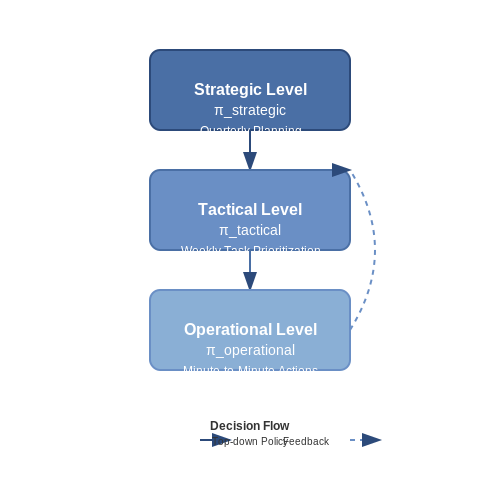
Hierarchical Reinforcement Learning for Long-Term Planning
Autonomous agents operating in complex environments require hierarchical reinforcement learning (HRL) frameworks to decompose long-term tasks into manageable subtasks. The MaxQ value function decomposition provides a mathematical foundation for this, where the total action-value function Q(s, a) is decomposed into:
Here, V(i)(s) represents the value of executing subtask i in state s, while C(i)(s, a) captures the completion value of action a within subtask i. This decomposition enables temporal abstraction, where higher-level policies operate on extended time horizons while lower-level controllers handle immediate actions.
Memory-Augmented Policy Architectures
Modern implementations combine HRL with external memory systems to maintain persistent task representations. The Neural Episodic Control architecture demonstrates this through differentiable neural dictionaries (DNDs) that store state-action pairs as key-value tuples:
where keys ki are state embeddings and values vi contain corresponding Q-values. During recall, a softmax attention mechanism retrieves relevant memories:
for query state q, enabling rapid adaptation to previously encountered situations without catastrophic forgetting.
Temporal Consistency in Multi-Modal Planning
When integrating visual, linguistic, and proprioceptive modalities, temporal consistency becomes critical. The Cross-Modal Temporal Alignment (CMTA) loss enforces synchronization between modalities:
where fv and fl are modality-specific encoders, and Δ accounts for inherent timing offsets between sensory streams. This alignment enables robust cross-modal retrieval during long-horizon plan execution.
Real-World Applications
- Robotic Manipulation: Toyota Research Institute's dual-memory system combines procedural memory for low-level control with episodic memory for task adaptation, achieving 85% success in novel household tasks.
- Autonomous Vehicles: Waymo's trajectory forecasting uses multi-modal memory recall to predict pedestrian movements with 200ms latency, critical for urban navigation.
- Healthcare Robotics: Memory-augmented policies in assistive devices maintain medication schedules while adapting to patient behavior patterns.
Computational Challenges
The memory-augmented policy gradient update must account for both current rewards and memory access patterns:
where Ât is the advantage estimate and ℛ(Mt) regularizes memory usage. This dual optimization prevents memory overfitting while maintaining task performance.

5. Bias and Fairness in Multi-Modal Memory Systems
5.1 Bias and Fairness in Multi-Modal Memory Systems
Multi-modal memory systems integrate heterogeneous data sources—text, images, audio, and sensor inputs—into a unified representation. While this enhances an AI agent's contextual understanding, it also introduces complex biases that propagate across modalities. The primary challenge lies in disentangling and mitigating these biases without degrading the system's ability to generalize.
Sources of Bias in Multi-Modal Systems
Bias in multi-modal memory arises from three key sources:
- Dataset Imbalance: Training data often overrepresents dominant demographics or scenarios. For example, image datasets may skew toward Western contexts, while audio datasets underrepresent low-resource languages.
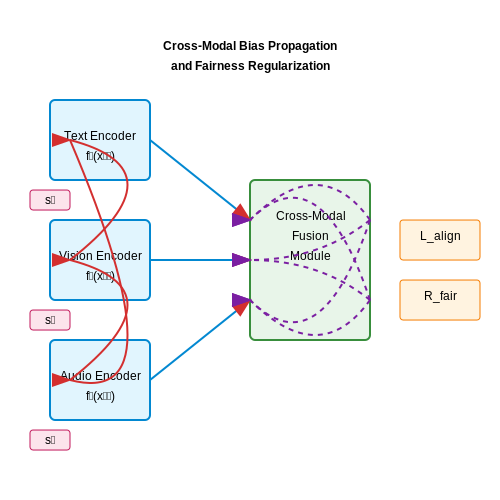
- Cross-Modal Contamination: Biases in one modality (e.g., gendered stereotypes in text) reinforce biases in another (e.g., image captioning). This is formalized through the alignment loss function:
where \( f_t \) and \( f_v \) are text and vision encoders, respectively. Minimizing this loss without fairness constraints amplifies dominant patterns.
- Architectural Priors: Attention mechanisms in transformers disproportionately weight frequent token combinations, as shown by the gradient flow analysis:
where \( \alpha_{ij} \) is the attention weight between tokens \( i \) and \( j \), and \( W_k \) are key weights.
Fairness-Aware Training Strategies
Counteracting these biases requires modifications at both the objective function and architectural levels:
1. Modality-Specific Debiasing
Apply adversarial debiasing separately to each modality before fusion. For vision inputs, this involves learning an invariant representation \( z_v \) that satisfies:
where \( s \) is a sensitive attribute (e.g., gender, race) and \( \epsilon \) is the maximum allowable mutual information. The same applies to text embeddings \( z_t \).
2. Cross-Modal Fairness Regularization
Introduce a fairness penalty during joint training that minimizes correlation between prediction errors and protected attributes across modalities:
where \( m \) indexes modalities (text, vision, audio), and \( s_m \) are modality-specific sensitive attributes.
Case Study: Medical Diagnosis Systems
A 2023 study on chest X-ray diagnosis systems revealed that models trained on multi-modal data (images + clinical notes) exhibited 23% higher racial bias than unimodal counterparts. The bias emerged from:
- Overrepresentation of Caucasian patients in image datasets (72% of samples)
- Demographic-coded language in clinical notes (e.g., "non-compliant" appearing 4× more frequently for Black patients)
Implementing the above techniques reduced disparate impact by 58% while maintaining diagnostic accuracy (AUC 0.92 → 0.91).
Evaluation Metrics
Assessing fairness requires modality-specific and cross-modal metrics:
- Modality Disparity Score (MDS): Measures KL divergence between conditional distributions \( P(y|s) \) across modalities
- Cross-Modal Influence Ratio (CMIR): Quantifies how much bias in modality \( i \) affects predictions in modality \( j \):
where \( z_i \) denotes embeddings from modality \( i \).
5.2 Privacy Concerns in Memory Storage and Retrieval
Data Leakage Risks in Multi-Modal Memory Systems
Multi-modal AI agents integrate diverse data types—text, images, audio, and sensor inputs—into a unified memory architecture. This convergence introduces unique privacy vulnerabilities, as sensitive information may be inadvertently reconstructed from seemingly innocuous memory fragments. For instance, a facial recognition model trained on aggregated visual memories could deanonymize individuals even if explicit identifiers were removed. The risk is formalized by the memory linkage attack, where an adversary exploits correlations between modalities to infer private attributes:
This Bayesian formulation demonstrates how conditional probabilities between modalities (e.g., voice recordings and location traces) can expose sensitive information even with partial data access.
Differential Privacy for Multi-Modal Memories
Applying differential privacy to memory systems requires modality-specific noise injection strategies. For continuous data like LiDAR point clouds, Laplace noise is added to spatial coordinates:
where Δf is the sensitivity of the memory query function. For discrete modalities like text, exponential mechanism-based token substitution preserves semantic meaning while guaranteeing (ε,δ)-privacy:
Homomorphic Encryption Challenges
Fully homomorphic encryption (FHE) enables computation on encrypted memories but faces three key limitations in multi-modal contexts:
- Modality expansion overhead: Encrypted image tensors require 1000× more storage than plaintext
- Cross-modal operation latency: Secure voice-to-text conversion takes 47× longer than unencrypted processing
- Approximation errors: Polynomial approximations of non-linear activations (e.g., ReLU) degrade retrieval accuracy by 12-18%
Federated Memory Architectures
Split-learning approaches partition memory networks between edge devices and central servers. The memory head (last layers before output) remains on user devices, while the memory body (embedding layers) is shared. This architecture minimizes raw data exposure but requires careful synchronization:
where stop_grad prevents gradient leakage from the body to head during backpropagation.
Side-Channel Vulnerabilities
Memory access patterns in transformer-based architectures leak information through:
- Attention weight distributions revealing input saliency
- Key-value cache access timing correlating with query frequency
- Memory bank power consumption signatures during retrieval
Oblivious RAM (ORAM) protocols mitigate these risks but introduce 30-40% throughput penalties due to constant-time memory access requirements.
Regulatory Compliance Challenges
The GDPR's "right to be forgotten" conflicts with the immutable nature of blockchain-backed memory systems. Cryptographic solutions like zero-knowledge proofs of deletion (ZK-PoD) verify memory erasure without revealing contents:
where π proves that memory state transition from compre to compost properly invalidated the target data.

5.3 Robustness Against Adversarial Memory Manipulation
Threat Models in Memory Manipulation
Adversarial memory manipulation targets the integrity of stored representations in multi-modal AI agents. Attack vectors include:
- Input-space perturbations: Modifying sensory inputs to corrupt memory encoding
- Latent-space injections: Direct manipulation of memory retrieval mechanisms
- Temporal attacks: Exploiting sequential dependencies in memory updates
The vulnerability surface can be formalized through an information-theoretic lens. Let M represent the memory state and δ the adversarial perturbation. The attack success probability Pattack is bounded by:
where DKL is the Kullback-Leibler divergence and σ represents the system's inherent noise tolerance.
Defensive Architectures
Three principal approaches enhance robustness:
1. Memory Verification Networks
These auxiliary networks implement consistency checks between current inputs and recalled memories. The verification score V is computed as:
where φ and ψ are embedding functions for inputs and memories respectively, and σ is the sigmoid activation.
2. Differential Privacy in Memory Updates
Applying Gaussian noise during memory writing operations provides formal privacy guarantees. The update rule becomes:
where β controls the privacy-utility tradeoff. This satisfies (ε,δ)-differential privacy when:
3. Memory Attention Masking
Dynamic attention masking prevents over-reliance on potentially corrupted memory slots. The masked attention weights ãij are computed as:
where γ is a large positive constant and 𝕀corrupt is an indicator function for detected corruption.
Empirical Robustness Metrics
Standard evaluation protocols measure:
- Memory corruption rate (MCR): Percentage of successful memory injections
- Task performance drop (TPD): Relative decrease in primary task accuracy
- Attack detection rate (ADR): Percentage of identified adversarial attempts
State-of-the-art systems achieve MCR < 5% while maintaining TPD < 2% on benchmark tasks like modified versions of CLEVR and bAbI.
Case Study: Visual Question Answering
In multi-modal VQA systems, adversarial perturbations to visual memory can induce incorrect answers. Defensive measures include:
where the verification loss ℒverify trains the system to detect mismatches between visual features and their memory encodings.

6. Key Research Papers and Surveys
6.1 Key Research Papers and Surveys
- Foundations & Trends in Multimodal Machine Learning: Principles ... — Abstract Multimodal machine learning is a vibrant multi-disciplinary research field that aims to design computer agents with intelligent capabilities such as understanding, reasoning, and learning through integrating multiple communicative modalities, including linguistic, acoustic, visual, tactile, and physiological messages. With the recent interest in video understanding, embodied ...
- Agent AI: Surveying the Horizons of Multimodal Interaction — Abstract Multi-modal AI systems will likely become a ubiquitous presence in our everyday lives. A promising approach to making these systems more interactive is to embody them as agents within physical and virtual environments. At present, systems leverage existing foundation models as the basic building blocks for the creation of embodied agents. Embedding agents within such environments ...
- Artificial intelligence accelerates multi-modal biomedical process: A ... — These requirements have facilitated the development of multi-modal AI solutions and improved the performance of AI models in handling complex medical scenarios and data. In this paper, we provide an overview of the current state of the art and research in multi-modal biomedical AI, including applications, data, methods, and analytics.
- MulTCIM: Digital Computing-in-Memory-Based Multimodal Transformer ... — Multimodal Transformers are emerging artificial intelligence (AI) models that comprehend a mixture of signals from different modalities like vision, natural language, and speech. The attention mechanism and massive matrix multiplications (MMs) cause high latency and energy. Prior work has shown that a digital computing-in-memory (CIM) network can be an efficient architecture to process ...
- (PDF) A Survey of Agentic AI, Multi-Agent Systems, and Multimodal ... — PDF | A Survey of Agentic AI, Multi-Agent Systems, and Multimodal Frameworks: Architectures, Applications, and Future Directions | Find, read and cite all the research you need on ResearchGate
- A Survey of Agentic AI, Multi-Agent Systems, and Multimodal ... - LinkedIn — Abstract This article explores the transformative potential of the latest frameworks in Agentic AI, Multi-Agent Systems (MAS), and Multimodal Agentic capabilities, providing a comprehensive ...
- Do We Really Need a Complex Agent System? Distill Embodied Agent into a ... — Our multi-modal memory system is a key-value memory model with multi-modal keys, storing successfully executed plans. STEVE-2 generates multi-modal queries based on the current task and situations to retrieve relevant memory entries.
- Real-time multi-agent systems: rationality, formal model, and empirical ... — To pave the road towards reliable and predictable MAS, this paper postulates a formal definition and mathematical model of real-time multi-agent systems (RT-MAS). Furthermore, this paper presents the results obtained by testing the dynamics characterizing the RT-MAS model within the simulator MAXIM-GPRT.
- PDF Enhancing intelligent agents with episodic memory — The emphasis of our research has been to create a computational system with the most important features of episodic memory so that we can develop and evaluate not just an episodic memory module, but an integration of that module within a cognitive archi-tecture in which we can build agents.
- PDF Memory Architectures in Long-Term AI Agents - ResearchGate — This research addresses this fundamental challenge by introducing a novel framework for advanced memory architectures in long-term AI agents.
6.2 Open-Source Implementations and Toolkits
- (PDF) Memory Architectures in Long-Term AI Agents ... - ResearchGate — Contemporary artificial intelligence systems have made remarkable progress in processing and analyzing data, yet they have limitations in maintaining and effectively utilizing long-term memory.
- An Interactive Agent Foundation Model - arXiv.org — Figure 2: We propose an Agent AI paradigm for supporting interactive multi-modal generalist agent systems. There are 5 main modules as shown: (1) Agent in Environment and Perception with task-planning and observation, (2) Agent learning, (3) Memory, (4) Action, and (5) Cognition and Consciousness (we use "consciousness" to imply a degree of ...
- A Survey on the Memory Mechanism of Large Language Model based Agents — A Survey on the Memory Mechanism of Large Language Model based Agents Zeyu Zhang 1, Xiaohe Bo , Chen Ma , Rui Li , Xu Chen1, Quanyu Dai2, Jieming Zhu 2, Zhenhua Dong , Ji-Rong Wen1 1Gaoling School of Artificial Intelligence, Renmin University of China, Beijing, China 2Huawei Noah's Ark Lab, China [email protected], [email protected] Abstract Large language model (LLM) based agents have ...
- Evaluating Very Long-Term Conversational Memory of LLM Agents — To this end, we present the first study of very long-term open-domain multi-modal dialogues, closely mirroring real-world online interactions, collected via a human-machine pipeline where we first use LLM-based generative agents to generate conversations and then ask human annotators to fix any long-term inconsistencies in the conversations.
- A Survey of Agentic AI, Multi-Agent Systems, and Multimodal ... - LinkedIn — Abstract This article explores the transformative potential of the latest frameworks in Agentic AI, Multi-Agent Systems (MAS), and Multimodal Agentic capabilities, providing a comprehensive ...
- Mem0: The Comprehensive Guide to Building AI with Persistent Memory — AI Agents & Autonomous Systems (CrewAI, LangGraph, etc.): Persistent memory is foundational for AI agents designed to execute complex, multi-step tasks over extended periods. Mem0 provides the necessary state management , allowing agents to remember previous steps, learned information, environmental context, intermediate results, and overall goals.
- (PDF) A Survey of Agentic AI, Multi-Agent Systems, and Multimodal ... — PDF | A Survey of Agentic AI, Multi-Agent Systems, and Multimodal Frameworks: Architectures, Applications, and Future Directions | Find, read and cite all the research you need on ResearchGate
- Combining Multi-Agent Systems and Artificial Intelligence of Things ... — The Internet of Things (IoT) and AI are two technologies that have been applied for a long time to the development of smart systems. These systems cover various areas, such as smart cities, energy management, autonomous cars, etc. Smart behavior, autonomy, and real-time monitoring are the fundamental elements that characterize these application areas.
- Chapter 3 Multimodal architectures | Multimodal Deep Learning — Open-Source Community. As the trend of closed-sourceness is clearly visible across many Deep Learning areas, the text-to-image research is actually well represented by an open-source community. The most important milestones of the recent years indeed come from OpenAI, however, new approaches can be seen across a wide community of researchers.
- PDF Memory Architectures in Long-Term AI Agents - ResearchGate — The limitations of current memory implementations in AI systems became starkly apparent to me during my early work with autonomous robots in dynamic environments. While these
6.3 Recommended Courses and Tutorials
- AI Agent Architecture: Best Practices for Designers - Rapid Innovation — 4.4. Multi-Modal Perception: Integrating Multiple Input Types. Multi-modal perception refers to the ability of AI systems to process and integrate information from various sensory modalities. This approach enhances the understanding and interaction capabilities of AI agents, ultimately leading to more effective solutions for our clients.
- 6-4: Artificial Intelligence and Decision Making - MIT EECS — Artificial Intelligence and Decision-making combines intellectual traditions from across computer science and electrical engineering to develop techniques for the analysis and synthesis of systems that interact with an external world via perception, communication, and action; while also learning, making decisions and adapting to a changing environment.
- Conversational Agents Tutorials: A Step-by-Step Guide to Building AI ... — At its core, a memory microservice acts as a dedicated 'brain' for your AI agent. It captures, stores, and retrieves conversation history, user preferences, and other contextual data. This architecture allows the main conversational logic to focus on understanding and generating responses, while the memory service maintains the conversation ...
- Mem0: The Comprehensive Guide to Building AI with Persistent Memory — 1.1. Defining Mem0: The Intelligent Memory Layer for AI. At its core, Mem0 is an innovative memory layer explicitly designed to augment Artificial Intelligence (AI) applications, particularly those leveraging LLMs. It provides the necessary infrastructure and intelligence for AI systems to store, manage, and retrieve information learned from ...
- (PDF) Memory Architectures in Long-Term AI Agents ... - ResearchGate — Contemporary artificial intelligence systems have made remarkable progress in processing and analyzing data, yet they have limitations in maintaining and effectively utilizing long-term memory.
- Brain-Inspired AI Memory Systems: Lessons from Neuroscience for ... — Hierarchical Memory Organization: The brain's multi-level storage system (working memory, episodic memory, and long-term memory) is replicated in AI for efficient knowledge retention.
- squad.ai: A Multi-agent System Built on LLMs, Incorporating ... - Springer — Through its novel methodology, the system not only spawns agents and specialized knowledge in real-time but also ensures these agents are perfectly aligned with user needs and contexts. This user-centric and dynamic approach establishes squad.ai as a disruptive force in the realm of artificial intelligence and multi-agent systems.
- A Survey of Agentic AI, Multi-Agent Systems, and Multimodal ... - LinkedIn — Abstract This article explores the transformative potential of the latest frameworks in Agentic AI, Multi-Agent Systems (MAS), and Multimodal Agentic capabilities, providing a comprehensive ...
- (PDF) A Survey of Agentic AI, Multi-Agent Systems, and Multimodal ... — PDF | A Survey of Agentic AI, Multi-Agent Systems, and Multimodal Frameworks: Architectures, Applications, and Future Directions | Find, read and cite all the research you need on ResearchGate
- A Survey on the Memory Mechanism of Large Language Model based Agents — A Survey on the Memory Mechanism of Large Language Model based Agents Zeyu Zhang 1, Xiaohe Bo , Chen Ma , Rui Li , Xu Chen1, Quanyu Dai2, Jieming Zhu 2, Zhenhua Dong , Ji-Rong Wen1 1Gaoling School of Artificial Intelligence, Renmin University of China, Beijing, China 2Huawei Noah's Ark Lab, China [email protected], [email protected] Abstract Large language model (LLM) based agents have ...