


Five pairs of fluorescent tubes emergency circuits

Description: The 786A multi-functional double-tube fluorescent emergency circuit is illustrated in Figure 2-129. This circuit shares similarities with Figure 2-125.
The 786A multi-functional double-tube fluorescent emergency circuit is designed to provide illumination during power outages or emergencies. It utilizes two fluorescent tubes to deliver bright, energy-efficient lighting. The circuit operates by switching between normal and emergency modes, ensuring that the fluorescent tubes remain illuminated even when the main power supply fails.
In normal operation, the circuit draws power from the mains supply, allowing the fluorescent tubes to function as standard lighting. During a power outage, the circuit automatically transitions to emergency mode, drawing power from an internal battery or backup power source. This seamless switch is facilitated by a relay or solid-state switch that detects the loss of mains power.
Key components of the circuit include a battery charger, which maintains the charge of the backup battery during normal operation, and a control circuit that manages the transition between modes. The circuit may also incorporate a low-voltage disconnect feature to prevent battery over-discharge, ensuring the battery remains functional for future emergencies.
The design of the circuit emphasizes safety and reliability, with provisions for thermal management to prevent overheating of components. Additionally, the use of double tubes increases redundancy, allowing for continued operation even if one tube fails. Overall, the 786A circuit is an effective solution for emergency lighting needs in various settings, including residential, commercial, and industrial environments.786A multi-functional double-tube fluorescent emergency circuit shown in Figure 2-129. This circuit is similar to Figure 2-125.
The 786A multi-functional double-tube fluorescent emergency circuit is designed to provide illumination during power outages or emergencies. It utilizes two fluorescent tubes to deliver bright, energy-efficient lighting. The circuit operates by switching between normal and emergency modes, ensuring that the fluorescent tubes remain illuminated even when the main power supply fails.
In normal operation, the circuit draws power from the mains supply, allowing the fluorescent tubes to function as standard lighting. During a power outage, the circuit automatically transitions to emergency mode, drawing power from an internal battery or backup power source. This seamless switch is facilitated by a relay or solid-state switch that detects the loss of mains power.
Key components of the circuit include a battery charger, which maintains the charge of the backup battery during normal operation, and a control circuit that manages the transition between modes. The circuit may also incorporate a low-voltage disconnect feature to prevent battery over-discharge, ensuring the battery remains functional for future emergencies.
The design of the circuit emphasizes safety and reliability, with provisions for thermal management to prevent overheating of components. Additionally, the use of double tubes increases redundancy, allowing for continued operation even if one tube fails. Overall, the 786A circuit is an effective solution for emergency lighting needs in various settings, including residential, commercial, and industrial environments.786A multi-functional double-tube fluorescent emergency circuit shown in Figure 2-129. This circuit is similar to Figure 2-125.

Emergency lighting circuit diagram
The device circuit operates as illustrated in Figure 11. Power outages are a common occurrence, but in certain situations, maintaining power is critical, such as during ongoing surgeries. The circuit employs a simple design that is fully automated. When 220V...
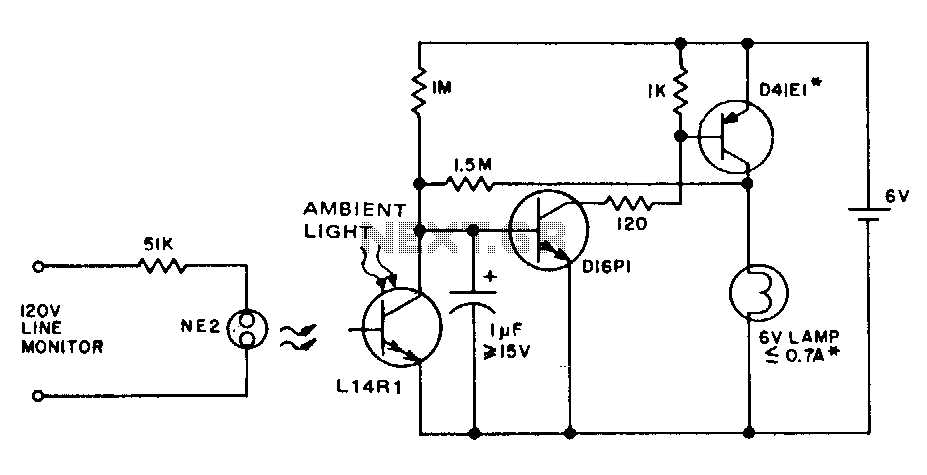
Line-operated-power-outage-light
This circuit provides emergency lighting during a power outage. The phototransistor should be positioned to maximize the coupling of both neon light and ambient light into the pellet, without allowing self-illumination from the 6-V lamp. Many circuits of this type...

LES produced using blackout emergency lighting
The circuit operation principle of the device illustrated in Figure 11 addresses the frequent occurrence of power outages, particularly in critical situations where continuous power supply is essential, such as during surgeries. The circuit employs a simple design that is...

Automatic emergency lighting circuit
An automatic emergency lighting circuit is presented, suitable for self-installation in households. It utilizes smaller components, resulting in a lower cost. Under normal conditions, the 220V AC mains voltage is reduced by capacitor C1, and then processed through a half-wave...

Automatic Emergency Lighting Unit
This unit utilizes a NiCad battery to supply power to an emergency lighting system. During a power failure, transistor T1 becomes forward biased, activating lamps L1 and L2. The batteries are typically maintained in a charged state. When the power...

Emergency Lighting circuit
The circuit of automatic emergency light presented here has the following features: 1. When the mains supply (230V AC) is available, it charges a 12V battery up to 13.5V and then the battery is disconnected from the charging section. 2....

Blackout emergency lights circuit 3
Figure 283 illustrates a blackout emergency lighting controller designed for straightforward external installation with two leads. This controller can directly replace the P Chan Tong Ge opening. Under normal power conditions, it functions like a conventional switch to control lamp...

Single source emergency lighting system
This emergency lighting system maintains a 6-volt battery at full charge and automatically switches from the AC supply to the battery.
The emergency lighting system is designed to ensure reliable illumination during power outages or failures. It consists of a 6-volt...