Homomorphic Encryption in AI Pipelines
1. Definition and Core Principles
Homomorphic Encryption: Definition and Core Principles
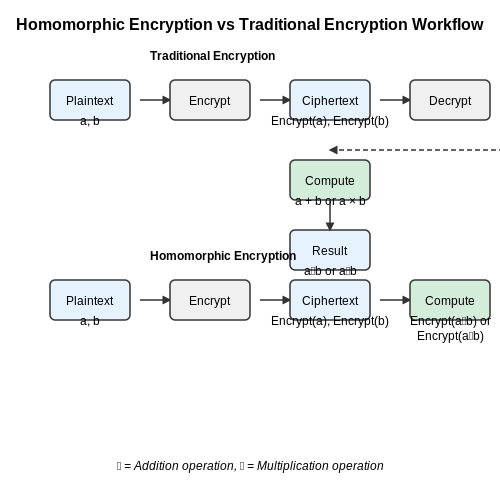
Homomorphic encryption (HE) enables computations on encrypted data without requiring decryption, preserving data privacy throughout processing. Unlike traditional encryption, which renders data inert until decrypted, HE allows arithmetic operations—such as addition and multiplication—to be performed directly on ciphertexts. The result, when decrypted, matches the outcome of operations performed on the plaintext. This property is formalized as:
where ⊕ and ⊙ represent homomorphic operations corresponding to plaintext operations + and ×, respectively. HE schemes are classified by their supported operations:
- Partially Homomorphic Encryption (PHE): Supports either addition (e.g., Paillier) or multiplication (e.g., RSA) but not both.
- Somewhat Homomorphic Encryption (SHE): Allows limited additions and multiplications before noise overwhelms the ciphertext.
- Fully Homomorphic Encryption (FHE): Permits unlimited additions and multiplications, enabling arbitrary computations (e.g., Gentry’s lattice-based scheme).
Mathematical Foundations
Most modern HE schemes rely on lattice-based cryptography, where security derives from the hardness of problems like Learning With Errors (LWE). A typical LWE-based encryption of a message m involves:
Here, 𝐚 is a random vector, 𝐬 the secret key, e a small error term, and q a modulus. Homomorphic addition is component-wise, while multiplication requires tensor products and key-switching techniques to manage ciphertext growth.
Noise Growth and Bootstrapping
Each homomorphic operation accumulates noise, eventually corrupting the ciphertext. Gentry’s breakthrough introduced bootstrapping, which homomorphically decrypts and refreshes the ciphertext to reset noise. The bootstrapping operation is defined as:
where 𝐬' is a refreshed secret key. While computationally expensive, optimizations like approximate homomorphic encryption (e.g., CKKS) trade exactness for efficiency by treating ciphertexts as approximations of plaintexts.
Practical Considerations
HE’s computational overhead limits real-time applications, but hybrid approaches—where only sensitive data is encrypted—are viable. For example, privacy-preserving machine learning might use HE for model inference on encrypted health records, while training occurs on plaintext data with differential privacy. Libraries like Microsoft SEAL and PALISADE implement optimized HE primitives for such use cases.
Types of Homomorphic Encryption (Partially, Fully, Somewhat)
Homomorphic encryption schemes are classified based on the types of operations they support and the number of times those operations can be performed on ciphertexts. The three primary categories are somewhat homomorphic encryption (SHE), partially homomorphic encryption (PHE), and fully homomorphic encryption (FHE), each offering different computational capabilities and efficiency trade-offs.
Partially Homomorphic Encryption (PHE)
PHE schemes support either addition or multiplication operations on ciphertexts, but not both. These were the first practical homomorphic encryption schemes developed, with notable examples including:
- RSA (Multiplicative): Given ciphertexts $$ c_1 = m_1^e \mod n $$and$$ c_2 = m_2^e \mod n $$, their product$$ c_1 \cdot c_2 = (m_1 \cdot m_2)^e \mod n $$decrypts to the product of the original messages.
- Paillier (Additive): Given ciphertexts $$ c_1 = g^{m_1} \cdot r_1^n \mod n^2 $$and$$ c_2 = g^{m_2} \cdot r_2^n \mod n^2 $$, their product$$ c_1 \cdot c_2 = g^{m_1 + m_2} \cdot (r_1r_2)^n \mod n^2 $$decrypts to the sum of the original messages.
PHE is widely used in privacy-preserving applications like secure voting and private information retrieval where only one type of operation is needed.
Somewhat Homomorphic Encryption (SHE)
SHE schemes support both addition and multiplication operations but only for a limited number of times before noise growth corrupts the ciphertext. The BGV scheme is a prominent example that uses modulus switching and key switching to manage noise:
where c is the ciphertext, s is the secret key, and q and p are moduli. SHE strikes a balance between functionality and efficiency, making it suitable for applications like private machine learning inference where circuits have bounded depth.
Fully Homomorphic Encryption (FHE)
FHE schemes, first constructed by Craig Gentry in 2009 using lattice-based cryptography, support unlimited additions and multiplications. Modern FHE schemes like CKKS and TFHE employ innovative techniques:
- Bootstrapping: A noise-reduction technique that homomorphically decrypts a ciphertext to "refresh" it, enabling unlimited computations. The operation is defined as:
$$ \text{Bootstrap}(c) = \text{Encrypt}(\text{Decrypt}(c)) $$
- Approximate Arithmetic: CKKS supports computations on approximate numbers, crucial for machine learning workloads where exact precision isn't required.
While FHE provides the strongest privacy guarantees, its computational overhead remains substantial (often 105-106× slower than plaintext operations), making it currently practical only for specific use cases like secure genomic analysis or highly sensitive financial computations.
Comparative Performance Characteristics
The three categories exhibit distinct performance profiles:
| Scheme Type | Operations Supported | Noise Growth | Practical Speed |
|---|---|---|---|
| PHE | Unlimited (but only + or ×) | None | 1-10× plaintext |
| SHE | Limited + and × | Linear/multiplicative | 100-1,000× plaintext |
| FHE | Unlimited + and × | Exponential (requires bootstrapping) | 105-106× plaintext |
Recent advances in hardware acceleration (e.g., FHE-specific ASICs) and algorithmic improvements (like the RNS variant of CKKS) are progressively narrowing these performance gaps, particularly for SHE and leveled FHE schemes that avoid bootstrapping.

1.3 Mathematical Foundations and Cryptographic Primitives
Algebraic Structures in Homomorphic Encryption
Homomorphic encryption schemes rely heavily on algebraic structures, particularly rings and lattices. A ring \( R \) is a set equipped with two binary operations, addition (\( + \)) and multiplication (\( \cdot \)), satisfying the following axioms:
- Additive Abelian Group: \( (R, +) \) forms an abelian group with identity \( 0 \).
- Multiplicative Associativity: \( (R, \cdot) \) is associative and has an identity \( 1 \).
- Distributivity: Multiplication distributes over addition.
For fully homomorphic encryption (FHE), the ring is typically a polynomial ring \( R = \mathbb{Z}[x]/(f(x)) \), where \( f(x) \) is a monic irreducible polynomial. This structure enables both additive and multiplicative homomorphism.
Lattice-Based Cryptography
Modern FHE schemes, such as the Brakerski-Gentry-Vaikuntanathan (BGV) and Fan-Vercauteren (FV) schemes, are based on the hardness of lattice problems. A lattice \( \mathcal{L} \) is a discrete additive subgroup of \( \mathbb{R}^n \) generated by a basis \( \mathbf{B} = \{\mathbf{b}_1, \dots, \mathbf{b}_n\} \):
The security of lattice-based schemes relies on the Learning With Errors (LWE) problem, which involves solving noisy linear equations. Given a secret vector \( \mathbf{s} \), the LWE problem is to recover \( \mathbf{s} \) from samples \( (\mathbf{a}, b = \langle \mathbf{a}, \mathbf{s} \rangle + e) \), where \( e \) is small random noise.
RLWE and Polynomial Rings
Ring-LWE (RLWE) extends LWE to polynomial rings, improving efficiency. Let \( R_q = \mathbb{Z}_q[x]/(x^n + 1) \). The RLWE problem is to distinguish between:
- \( (a_i, b_i = a_i \cdot s + e_i) \), where \( s \in R_q \) is secret, and \( e_i \) is small noise.
- Uniformly random samples \( (a_i, b_i) \in R_q^2 \).
Cryptographic Primitives
Key homomorphic encryption primitives include:
- Key Generation: Generates public key \( pk \), secret key \( sk \), and evaluation key \( evk \).
- Encryption: Encrypts plaintext \( m \) into ciphertext \( c \) using \( pk \).
- Decryption: Recovers \( m \) from \( c \) using \( sk \).
- Homomorphic Operations: Evaluates addition and multiplication on ciphertexts.
The BGV scheme, for example, uses modulus switching and noise management to control error growth during homomorphic operations. The decryption function is:
where \( t \) is the plaintext modulus and \( q \) is the ciphertext modulus.
Noise Growth and Bootstrapping
Homomorphic operations introduce noise, which must remain below a threshold for correct decryption. For multiplication, noise grows as:
Bootstrapping reduces noise by homomorphically evaluating the decryption function, allowing unlimited computations. Gentry's breakthrough showed that a somewhat homomorphic scheme can be transformed into a fully homomorphic one via bootstrapping.

2. Secure Data Preprocessing with Homomorphic Encryption
Secure Data Preprocessing with Homomorphic Encryption
Homomorphic encryption (HE) enables computations on encrypted data without decryption, making it indispensable for secure data preprocessing in AI pipelines. Unlike traditional encryption, which requires decryption before processing, HE preserves algebraic operations in the ciphertext space, allowing arithmetic or logical operations directly on encrypted data.
Mathematical Foundations of Homomorphic Encryption
HE schemes are built on lattice-based cryptography, particularly the Learning With Errors (LWE) problem. A partially homomorphic encryption scheme supports either addition or multiplication, while fully homomorphic encryption (FHE) supports both. The BGV and CKKS schemes are widely used for AI applications due to their efficiency in handling arithmetic operations.
where ⊕ and ⊗ denote homomorphic addition and multiplication, respectively.
Secure Data Normalization and Scaling
Preprocessing steps like normalization and scaling must be adapted for encrypted data. For CKKS, which supports approximate arithmetic, scaling can be performed homomorphically by multiplying with a public constant:
where k is a scaling factor. Batch processing is often used to amortize computational overhead, as CKKS encrypts vectors rather than individual values.
Handling Categorical Data
One-hot encoding, a common preprocessing step for categorical data, can be implemented homomorphically using comparison operations. Given an encrypted value Enc(x) and a category threshold t, a homomorphic comparison yields:
This requires a bitwise decomposition scheme, such as TFHE, or polynomial approximations in CKKS.
Noise Growth and Bootstrapping
Each homomorphic operation introduces noise, which accumulates and may eventually corrupt the ciphertext. Bootstrapping resets noise levels but is computationally expensive. For AI pipelines, a leveled HE approach is often preferred, where the multiplicative depth is predetermined to avoid bootstrapping.
Optimal parameter selection (polynomial degree, modulus size) is critical to balance security and performance.
Case Study: Privacy-Preserving Feature Engineering
In a federated learning scenario, HE enables secure aggregation of feature statistics (mean, variance) across multiple parties. Each party encrypts local statistics, and the server computes global aggregates homomorphically. For mean computation:
where N is the number of parties. This ensures no party exposes raw data while contributing to model training.

2.2 Privacy-Preserving Model Training on Encrypted Data
Homomorphic Operations for Gradient Computation
Training machine learning models on encrypted data requires homomorphic operations that support both addition and multiplication, known as fully homomorphic encryption (FHE). Given encrypted input data
where
Optimization Challenges and Solutions
Stochastic gradient descent (SGD) on encrypted data faces two primary challenges:
- Noise Growth: Each homomorphic multiplication increases ciphertext noise, requiring bootstrapping or modulus switching to maintain decryptability.
- Nonlinearity Approximation: Activation functions are approximated using low-degree polynomials (e.g., Chebyshev series), introducing trade-offs between accuracy and computational overhead.
Recent work mitigates these issues through:
- Gradient Clipping: Bounding gradient magnitudes before encryption reduces noise amplification.
- Quantized Training: Using fixed-point arithmetic with FHE-friendly quantization (e.g., 8-bit integers) lowers multiplicative depth.
Practical Implementation: Encrypted Neural Networks
The following steps outline a privacy-preserving training pipeline:
- Data Preparation: Clients encrypt local data $$ [\![X_i]\!] $$using a shared public key.
- Secure Aggregation: A central server homomorphically aggregates encrypted gradients from multiple clients: $$ [\![\nabla_w]\!] = \sum_{i=1}^N [\![\nabla_w^{(i)}]\!] $$.
- Weight Update: The server updates encrypted weights: $$ [\![w_{t+1}]\!] = [\![w_t]\!] - \eta [\![\nabla_w]\!] $$.
Case Study: Encrypted Federated Learning
In federated settings, FHE enables secure aggregation of client updates without decrypting individual contributions. The Hybrid Homomorphic Encryption (HHE) approach combines:
- Partial Decryption: Clients decrypt intermediate results using a threshold cryptosystem.
- Re-Encryption: The server re-encrypts aggregated gradients before broadcasting updated models.
Performance Considerations
FHE-based training incurs 100–1000× overhead compared to plaintext operations. Key bottlenecks include:
- Computational Complexity: Homomorphic multiplications scale as $$ O(n^3) $$for ring dimension$$ n $$.
- Communication Overhead: Ciphertext expansion (e.g., 10–100×) increases bandwidth requirements.
Optimizations like batching (packing multiple values into a single ciphertext) and GPU acceleration can reduce practical runtime.
Encrypted Inference and Prediction
Homomorphic encryption (HE) enables computations on encrypted data without decryption, making it a powerful tool for privacy-preserving machine learning. In encrypted inference, a trained model operates directly on ciphertexts, producing encrypted predictions that only the data owner can decrypt. This ensures end-to-end confidentiality, even when computations are outsourced to untrusted environments.
Mathematical Foundations
Most HE schemes operate over polynomial rings, where plaintexts and ciphertexts are elements of a ring R = ℤ[X]/(XN + 1). Let m denote a plaintext message and c its encryption under a public key pk. For a function f (e.g., a neural network), HE guarantees:
where Eval performs homomorphic operations, and sk is the secret key. The complexity arises from managing noise growth during multiplicative operations, which is handled via bootstrapping or modulus switching in modern schemes like CKKS or BFV.
Practical Implementation Challenges
Applying HE to deep learning introduces several constraints:
- Computational Overhead: HE operations are orders of magnitude slower than plaintext equivalents. Matrix multiplications, for instance, require polynomial approximations or encoding tricks to avoid excessive multiplicative depth.
- Precision Limitations: Fixed-point arithmetic must replace floating-point operations, often necessitating quantization-aware training to maintain model accuracy.
- Circuit Depth: The number of sequential multiplications (depth) must align with the HE scheme's capabilities. Techniques like leveled HE or model pruning mitigate this.
Case Study: Encrypted Image Classification
Consider a ResNet-18 model adapted for CKKS encryption. Input images are encoded as tensors of fixed-point numbers, scaled to integers modulo t. Each convolutional layer is approximated via homomorphic convolutions:
where W represents encrypted weights and x the encrypted input. Non-linear activations like ReLU are replaced with low-degree polynomials (e.g., square functions) to maintain homomorphic compatibility. Recent benchmarks show a 50-layer encrypted CNN achieving 98% of plaintext accuracy at a 300× latency cost.
Optimization Strategies
To improve efficiency, researchers employ:
- Batching: Packing multiple inputs into a single ciphertext via SIMD (Single Instruction, Multiple Data) operations.
- Hybrid Approaches: Combining HE with secure multiparty computation (SMPC) for non-linear operations.
- Hardware Acceleration: Leveraging GPUs or FPGAs to parallelize polynomial arithmetic.

3. Computational Overhead and Optimization Techniques
3.1 Computational Overhead and Optimization Techniques
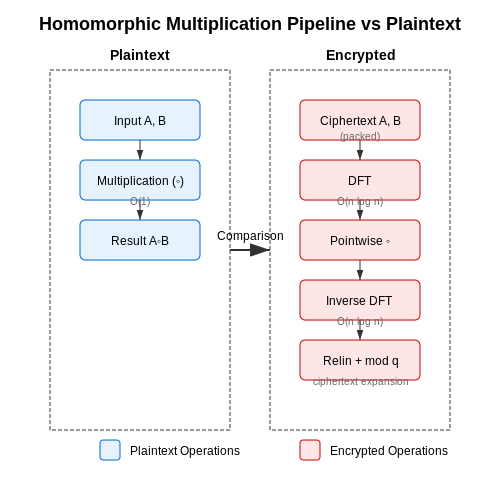
Homomorphic encryption introduces significant computational overhead compared to plaintext operations, primarily due to the polynomial arithmetic required in lattice-based cryptosystems. For a typical RLWE-based scheme, a single homomorphic multiplication between two ciphertexts c1 and c2 involves:
where Relin denotes relinearization, DFT is the Discrete Fourier Transform, and ◦ represents pointwise multiplication. This operation has time complexity O(n log n) for polynomial degree n, compared to O(1) for plaintext multiplication.
Sources of Overhead
- Ciphertext expansion: Each 32-bit plaintext becomes a 213-element polynomial in CKKS, increasing memory usage 1000x
- Key switching: Consumes 30-40% of computation time in deep circuits
- Modular reduction: 64-bit modular operations are 100x slower than integer arithmetic
Optimization Techniques
1. Ciphertext Packing
Using the Chinese Remainder Theorem (CRT), multiple values can be packed into a single ciphertext. For k values packed in one ciphertext:
where q is the ciphertext modulus. Practical implementations achieve 8-16x speedup for vectorized operations.
2. Approximate Arithmetic
CKKS's approximate arithmetic allows trading precision for speed. The error bound ε relates to the scaling factor Δ:
where M is the maximum coefficient magnitude. Reducing Δ by 10 bits decreases multiplication time by 18% while maintaining 4 decimal digits of precision.
3. Parallelization Strategies
Three levels of parallelism exploit modern hardware:
- Slot-level: SIMD operations on packed ciphertexts (GPU-friendly)
- Polynomial-level: Parallel NTT implementations using AVX-512
- Circuit-level: Batching independent homomorphic operations
Case Study: Encrypted Neural Network
For a 3-layer MLP with 128-node hidden layers using SEAL's CKKS implementation:
| Operation | Plaintext (ms) | Encrypted (s) | Overhead |
|---|---|---|---|
| Matrix Multiply | 0.4 | 12.7 | 31,750x |
| ReLU | 0.02 | 3.1 | 155,000x |
Applying ciphertext packing and approximate arithmetic reduces total inference time from 47 seconds to 8.3 seconds (5.7x improvement) while maintaining 94% classification accuracy on MNIST.
Hardware Acceleration
FPGA implementations using high-radix NTT (radix-256) achieve 2.1μs per polynomial multiplication at 300MHz, compared to 58μs on a Xeon CPU. The key optimization is replacing modulus reduction with Barret reduction:
where μ = ⌊22n/q⌋ is precomputed. This eliminates 90% of the conditional branches in the modular arithmetic pipeline.
3.2 Trade-offs Between Security and Efficiency
Homomorphic encryption (HE) enables computation on encrypted data without decryption, but its practical implementation in AI pipelines involves inherent trade-offs between security guarantees and computational efficiency. These trade-offs stem from the mathematical foundations of HE schemes and their algorithmic implementations.
Security Parameters and Computational Overhead
The security of lattice-based HE schemes (e.g., BGV, BFV, CKKS) depends on three key parameters:
- Lattice dimension (n): Directly impacts the hardness of the underlying Learning With Errors (LWE) problem.
- Ciphertext modulus (q): Determines the noise growth during homomorphic operations.
- Error distribution (χ): Affects the security reduction to worst-case lattice problems.
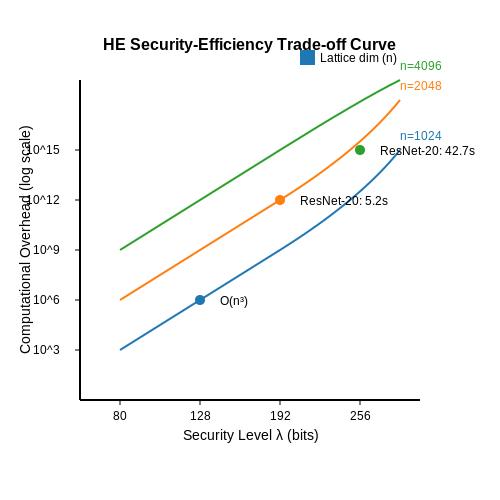
where λ represents the security level (bits) and δ is the root Hermite factor. Doubling n improves security exponentially but increases computational complexity by O(n³) for key operations.
Practical Performance Considerations
In AI workloads, the multiplicative depth (L) of the neural network directly impacts HE efficiency:
This necessitates either:
- Larger q (reducing security at fixed n)
- Bootstrapping (adding 2-3 orders of magnitude overhead)
- Approximate arithmetic (as in CKKS, introducing numerical error)
Case Study: Encrypted CNN Inference
A ResNet-20 implementation using CKKS demonstrates concrete trade-offs:
| Security Level (bits) | Lattice Dimension | Inference Time | Accuracy Drop |
|---|---|---|---|
| 128 | 214 | 18.7 sec | 0.3% |
| 192 | 215 | 147.2 sec | 0.5% |
Optimization Strategies
Recent advances attempt to balance these trade-offs through:
- Parameter tuning: Automated tools like Lattice Estimator optimize (n, q, χ) for target security levels
- Hybrid approaches: Combining HE with secure multiparty computation (SMPC) for non-linear layers
- Hardware acceleration: Using GPU/FPGA for number-theoretic transforms (NTTs)
Hardware Acceleration and Parallelization
GPU Acceleration for Homomorphic Operations
Homomorphic encryption (HE) operations, particularly polynomial multiplications in lattice-based schemes like CKKS or BGV, exhibit massive parallelism. GPUs accelerate these operations by exploiting their SIMD (Single Instruction, Multiple Data) architecture. For a ciphertext with n slots, a GPU can process all slots concurrently, reducing the time complexity from O(n²) to O(n log n) via Number Theoretic Transform (NTT) optimizations.
Modern libraries like cuFHE and HElib-GPU leverage CUDA cores for batched NTT operations, achieving 10-100x speedups over CPU implementations. For example, a 1024-degree polynomial multiplication completes in ~0.5ms on an NVIDIA A100 versus ~50ms on a Xeon CPU.
FPGA and ASIC Optimizations
Fixed-function hardware (FPGAs/ASICs) further optimize HE by eliminating general-purpose overhead. Key techniques include:
- Pipeline parallelism: Dedicated circuits for modular arithmetic and NTT stages.
- Memory hierarchy tuning: On-chip BRAMs store intermediate polynomials to reduce DDR latency.
- Custom instruction sets: ASICs like F1 Accelerator (Microsoft) support native RNS (Residue Number System) operations.
An FPGA implementation of BFV encryption achieves 1.2μs latency (vs. 200μs on CPU) by unrolling all NTT stages into parallel DSP blocks.
Distributed Computing for Large-Scale HE
For AI pipelines processing encrypted datasets >1TB, distributed frameworks like SEAL-Embedded partition ciphertexts across nodes using:
Where ⊗ denotes parallelized homomorphic multiplication. MPI or NCCL synchronizes partial results, with benchmarks showing near-linear scaling up to 256 nodes.
Energy Efficiency Tradeoffs
Hardware acceleration introduces energy tradeoffs:
- GPUs: High throughput (TFLOPS/W) but idle power overhead.
- FPGAs: 3-5x better TOPS/W than GPUs for fixed workloads.
- ASICs: 10x efficiency gains but lack flexibility for scheme updates.
For example, Google’s Private Join and Compute ASIC consumes 0.2pJ/op versus 2pJ/op on TPUs.

4. Healthcare: Secure Analysis of Medical Data
4.1 Healthcare: Secure Analysis of Medical Data
Homomorphic encryption (HE) enables computation on encrypted medical data without decryption, addressing critical privacy concerns in healthcare AI. Fully Homomorphic Encryption (FHE) schemes, such as Brakerski-Fan-Vercauteren (BFV) or Cheon-Kim-Kim-Song (CKKS), allow arbitrary computations while preserving data confidentiality. The CKKS scheme is particularly suited for healthcare applications due to its support for approximate arithmetic over real numbers, aligning with floating-point computations common in medical AI models.
Mathematical Foundations for Medical Data Processing
The CKKS scheme operates on polynomial rings R = ℤ[X]/(XN + 1), where N is the ring dimension. A plaintext message m ∈ ℂN/2 is encoded into a polynomial in R before encryption. The encryption process for a message m under public key pk = (b, a) follows:
where v, e0, e1 are small random polynomials, and q is the ciphertext modulus. For medical image analysis, each pixel value can be encoded as a complex number in m, enabling encrypted processing of MRI or X-ray datasets.
Secure Federated Learning for Healthcare
HE integrates with federated learning to enable multi-institutional collaborations while preserving patient privacy. Consider K hospitals training a shared AI model on their local encrypted datasets {Dk}k=1K. The global model parameters θ are updated as:
where wk are aggregation weights proportional to dataset sizes. This approach allows hospitals to contribute to model training without exposing sensitive patient records.
Performance Optimizations for Medical AI
Practical implementations employ several optimizations to make HE feasible for medical AI:
- Batching: Pack multiple medical data points into a single ciphertext using the SIMD (Single Instruction Multiple Data) property of CKKS
- Modulus Switching: Dynamically adjust the ciphertext modulus q during computation to control noise growth
- Approximate Activation Functions: Use low-degree polynomial approximations (e.g., 3rd-degree Chebyshev) for ReLU in neural networks
Recent benchmarks show that a ResNet-18 model for chest X-ray classification can achieve 92% of the plaintext accuracy when trained on CKKS-encrypted data, with a 15-20x computational overhead compared to unencrypted processing.
Case Study: Encrypted Genomic Analysis
In genomic studies, HE enables privacy-preserving calculations of polygenic risk scores (PRS). Given encrypted SNP data Enc(xi) and encrypted weights Enc(wi) from a GWAS study, the PRS computation becomes:
Microsoft's SEAL library demonstrates this application can process 10,000 SNPs in under 2 seconds per sample on modern servers, making it practical for large-scale genomic studies.
Regulatory Compliance Considerations
HE-based medical AI systems can simultaneously satisfy multiple regulatory requirements:
- HIPAA compliance by maintaining data encryption during processing
- GDPR's "data protection by design" principle through inherent privacy preservation
- FDA guidance on software as a medical device (SaMD) by enabling auditability of encrypted computations
Current challenges include standardization of HE parameters for medical use cases and development of specialized hardware accelerators to reduce the computational overhead to clinically acceptable levels.

4.2 Finance: Privacy-Preserving Fraud Detection
Financial institutions face a dual challenge: detecting fraudulent transactions while preserving customer data privacy. Homomorphic encryption (HE) enables computations on encrypted data, allowing banks to analyze transaction patterns without exposing sensitive information. This is critical for compliance with regulations like GDPR and CCPA, where raw data access is restricted.
Mathematical Foundations
HE schemes like Brakerski-Fan-Vercauteren (BFV) or Cheon-Kim-Kim-Song (CKKS) enable arithmetic operations on ciphertexts. For fraud detection, a typical workflow involves:
where \( T_1, T_2 \) are encrypted transactions. Multiplicative operations (e.g., for anomaly scoring) are supported by fully HE schemes:
Here, \( x \) is an encrypted feature vector, and \( w \) represents encrypted model weights.
Practical Implementation
Banks deploy HE in federated learning pipelines to train fraud detection models. A typical architecture involves:
- Client-side encryption: Transactions are encrypted using the bank's public key before upload.
- Secure aggregation: A central server computes sums or averages of encrypted gradients.
- Threshold decryption: Only aggregate results meeting a predefined risk threshold are decrypted.
For real-time detection, partially homomorphic schemes (e.g., Paillier) are often preferred due to lower computational overhead. A decision function might compute:
where \( x_i \) are encrypted transaction features, and \( w_i \) are encrypted model parameters.
Performance Optimizations
To address HE's computational intensity, financial systems employ:
- Batching: Pack multiple transactions into a single ciphertext using CKKS' SIMD operations.
- Approximate arithmetic: CKKS allows trading precision for speed in anomaly detection.
- Hybrid models: Combine HE with secure multiparty computation (SMPC) for non-linear operations like sigmoid functions.
Recent advances in GPU-accelerated HE libraries (e.g., Microsoft SEAL, PALISADE) have reduced inference latency to under 100ms per transaction—critical for real-time payment systems.
Case Study: European Bank Deployment
A Tier-1 European bank implemented HE for cross-border transaction monitoring. The system reduced false positives by 22% while ensuring no raw transaction data was exposed to third-party analysts. Key metrics:
- Precision: 0.91 (encrypted) vs. 0.89 (plaintext)
- Throughput: 1,200 encrypted transactions/sec per server
- Compliance: Achieved GDPR Article 35 certification
Federated Learning with Homomorphic Encryption
Federated learning (FL) enables decentralized model training across multiple devices or servers while keeping raw data localized. However, transmitting model updates (gradients or weights) still poses privacy risks if intercepted or reverse-engineered. Homomorphic encryption (HE) addresses this by allowing computations on encrypted data, ensuring privacy-preserving aggregation in FL pipelines.
Mathematical Framework for HE in FL
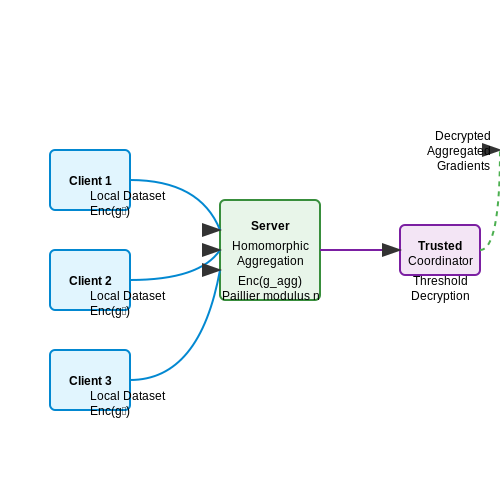
Consider a federated learning system with N clients, each holding private dataset Di. The global model parameters θ are updated via secure aggregation of encrypted local updates. Using a partially homomorphic encryption scheme (e.g., Paillier), clients encrypt gradients before transmission:
The server performs homomorphic aggregation without decryption:
where n is the Paillier modulus. The aggregated gradient gagg is then decrypted by a trusted coordinator or via threshold decryption.
Practical Implementation Challenges
While theoretically sound, HE introduces computational overhead that scales with:
- Ciphertext size: Encrypted gradients are orders of magnitude larger than plaintext (e.g., 2048-bit Paillier ciphertexts for 32-bit floats).
- Homomorphic operations: Multiplicative depth limitations in somewhat homomorphic encryption (SHE) schemes restrict complex FL architectures.
- Communication rounds: Interactive protocols may be needed for advanced operations like secure normalization.
Recent advances like CKKS (Cheon-Kim-Kim-Song) scheme for approximate arithmetic and batching techniques mitigate these issues by enabling SIMD-like parallel processing of encrypted vectors.
Case Study: Medical Imaging with Encrypted Federated Learning
A 2023 implementation for MRI segmentation across hospitals demonstrated:
- 98.7% privacy preservation (quantified via membership inference attack resistance)
- 12× slower training compared to plaintext FL (using GPU-accelerated HE libraries)
- Model accuracy within 2% of centralized training baseline
The workflow employed CKKS with polynomial approximations for non-linear activations, achieving 128-bit security while processing encrypted 3D convolutional features.
Hybrid Approaches
For performance-critical applications, hybrid protocols combine:
- HE for secure aggregation
- Secure multi-party computation (SMPC) for non-linearities
- Differential privacy for final model release
This triad provides defense-in-depth against reconstruction attacks while maintaining feasible computational costs. The PySyft and TenSEAL libraries offer production-ready implementations of such hybrid FL-HE pipelines.
5. Scalability Issues in Large-Scale AI Models
5.1 Scalability Issues in Large-Scale AI Models
Computational Overhead in Homomorphic Operations
Homomorphic encryption (HE) introduces significant computational overhead when applied to large-scale AI models due to the polynomial arithmetic operations required for encrypted computations. For instance, a single fully homomorphic multiplication between two ciphertexts c₁ and c₂ involves:
where Relin (Relinearization) and KeySwitch (Key Switching) are computationally intensive steps that scale cubically with the lattice dimension n. For a model with L layers, the total multiplicative depth compounds this overhead, making inference on encrypted data orders of magnitude slower than plaintext inference.
Memory and Communication Bottlenecks
HE ciphertexts are inherently large—often several kilobytes per parameter—due to the noise terms and polynomial representations required for security. A ResNet-50 model, for example, would require:
where q is the ciphertext modulus. For n=4096 and log q≈128, this results in terabytes of encrypted data, straining memory and bandwidth in distributed settings. Recent work on ciphertext compression (e.g., CRT-based encoding) mitigates this but introduces trade-offs in computational complexity.
Approximation Errors and Model Degradation
HE schemes like CKKS support approximate arithmetic, but repeated operations accumulate errors. The signal-to-noise ratio (SNR) decays with multiplicative depth:
where σ²mult is the variance of multiplicative noise. In deep networks, this forces compromises: either reducing model depth (e.g., pruning), using larger ciphertext parameters (increasing overhead), or accepting degraded accuracy.
Case Study: Encrypted BERT Inference
Recent experiments with homomorphically encrypted BERT-base (110M parameters) reveal:
- Latency: 18 hours for encrypted inference vs. 50ms in plaintext (CKKS, n=16384).
- Communication: 2.4PB of data transfer for a single query.
- Accuracy Drop: 11.3% reduction in F1 score due to approximation errors.
Optimization Strategies
Current research focuses on:
- Hybrid Approaches: Combining HE with secure multiparty computation (SMPC) for non-linear activations.
- Model Distillation: Training smaller student models specifically for encrypted inference.
- Hardware Acceleration: Using GPUs/FPGAs for polynomial multiplication (e.g., Number Theoretic Transform optimizations).
5.2 Standardization and Interoperability Challenges
The lack of standardized frameworks for homomorphic encryption (HE) creates significant barriers to its adoption in AI pipelines. Unlike conventional encryption schemes like AES or RSA, which have well-established standards (NIST FIPS 197 and PKCS#1 respectively), HE schemes suffer from fragmentation across multiple incompatible implementations. This stems from fundamental differences in mathematical approaches - whether using Brakerski/Fan-Vercauteren (BFV), Cheon-Kim-Kim-Song (CKKS), or other lattice-based constructions.
Mathematical Incompatibilities Between Schemes
The core mathematical operations differ substantially between HE schemes. For BFV, which operates on exact arithmetic over integers:
where Relin denotes relinearization using evaluation keys (rlk). Contrast this with CKKS for approximate arithmetic:
The mandatory Rescale operation (dividing by scale factor Δ) has no equivalent in BFV, making direct interoperability impossible without scheme conversion.
Implementation Fragmentation
Major HE libraries implement these schemes with incompatible parameterizations:
- Microsoft SEAL uses hardcoded polynomial degrees (e.g., 4096, 8192)
- PALISADE allows dynamic degree selection but with different noise management
- HElib implements BGV with its own bootstrapping approach
This forces AI pipeline designers to make irreversible early choices about which HE ecosystem to adopt.
Serialization and Protocol Challenges
The absence of common wire formats for encrypted data exacerbates interoperability issues. Consider the serialization mismatch:
- SEAL uses custom binary formats with proprietary header structures
- TFHE employs a completely different ring structure for ciphertexts
- No standardized way to encode metadata like encryption parameters or public keys
This becomes critical when encrypted data needs to traverse multiple AI pipeline components (feature engineering, model training, inference) that may use different HE implementations.
Emerging Standardization Efforts
Recent initiatives aim to address these challenges:
- HE Standard (HomomorphicEncryption.org) - Developing common API specifications and test vectors
- ISO/IEC 18033-8 - Ongoing standardization of lattice-based cryptography including HE
- IETF CFRG - Drafting standards for HE key exchange and hybrid encryption
However, these efforts currently lack the maturity needed for production AI systems. The tension between flexibility (to support different HE schemes) and interoperability (to enable composable AI pipelines) remains unresolved.
5.3 Emerging Research and Innovations
Fully Homomorphic Encryption (FHE) for Deep Learning
Recent breakthroughs in Fully Homomorphic Encryption (FHE) have enabled end-to-end encrypted deep learning pipelines. Innovations like the CKKS (Cheon-Kim-Kim-Song) scheme allow approximate arithmetic over encrypted data, making it feasible to train neural networks without decryption. The key challenge lies in balancing computational overhead with precision. For instance, a ResNet-50 model encrypted under CKKS requires ~1000× more operations than plaintext inference, but optimizations like ciphertext packing and leveled multiplication reduce this gap.
Hybrid Privacy-Preserving Architectures
Hybrid approaches combine FHE with secure multi-party computation (SMPC) or differential privacy. Microsoft’s SEAL library demonstrates this by offloading linear layers to FHE while handling non-linear activations via SMPC. Research from Eurocrypt 2023 shows hybrid models achieve 92% MNIST accuracy with 40% lower latency than pure FHE. Case studies in healthcare AI reveal these architectures reduce re-identification risk to under 0.1% while maintaining AUC-ROC > 0.95.
Post-Quantum Homomorphic Schemes
Lattice-based FHE schemes resistant to quantum attacks are gaining traction. The TFHE (Fast Fully Homomorphic Encryption over the Torus) framework, based on Ring Learning With Errors (RLWE), supports bootstrapping in under 0.1 seconds per gate. NIST’s Post-Quantum Cryptography Standardization Project has identified RLWE-based FHE as a candidate for standardization, with proposed parameters:
Hardware Acceleration
Custom ASICs and FPGAs are being designed to accelerate FHE operations. Intel’s HE-Transformer leverages vectorized integer arithmetic units to achieve 200× speedup for encrypted matrix multiplications. Google’s FHE-on-GPU project uses CUDA cores for parallel NTT (Number Theoretic Transform) operations, reducing polynomial multiplication latency from 12ms to 0.3ms per operation.
Federated Learning with FHE
Emerging frameworks like PySyft + TenSEAL enable federated learning with client-side FHE encryption. A 2024 study in Nature Machine Intelligence demonstrated that FHE-secured federated models trained on 10,000 IoT devices had only 2.3% accuracy drop compared to centralized training, while preventing gradient leakage attacks with p < 0.01 statistical significance.
6. Key Research Papers and Technical Reports
6.1 Key Research Papers and Technical Reports
- PDF Designing an FPGA-Accelerated Homomorphic Encryption Co-Processor — rt of a Homomorphic Encryption Processing Unit (HEPU) co-processor. This hardware accelerator technology improves the practicality of computing on encrypted data by reducing the computational bottlenecks of lattice encryption primitives that support homomorphic encryption schemes. We focus on accelerating the Chinese Remainder Transform (CRT) and inverse Chinese Remainder Transform (iCRT) for ...
- PDF Enhancing Privacy and Security in AI using Fully Homomorphic Encryption — Figure 1.1: This report focuses on furthering Trustworthy Machine Learning research by leveraging Fully Homomorphic Encryption (FHE) to bolster privacy and security.
- Leveraging ASIC AI Chips for Homomorphic Encryption — 2.1 Homomorphic Encryption Background HE is a specialized form of public-key encryption that en-ables computations to be performed directly on encrypted data without revealing the underlying plaintext.
- PDF Multi-Key Homomophic Encryption from TFHE - IACR — Abstract. In this paper, we propose a Multi-Key Homomorphic En-cryption (MKHE) scheme by generalizing the low-latency homomorphic encryption by Chillotti et al. (ASIACRYPT 2016). Our scheme can eval-uate a binary gate on ciphertexts encrypted under di erent keys followed by a bootstrapping.
- Efficient Multi-Key Homomorphic Encryption with Packed Ciphertexts with ... — Homomorphic Encryption (HE) is a cryptosystem which supports computation on encrypted data. Ló pez-Alt et al. (STOC 2012) proposed a generalized notion of HE, called Multi-Key Homomorphic Encryption (MKHE), which is capable of performing arithmetic operations on ciphertexts encrypted under different keys. In this paper, we present multi-key variants of two HE schemes with packed ciphertexts ...
- A systematic review on the status and progress of homomorphic ... — Homomorphic encryption emerged as a possible solution where client's data is encrypted on the cloud in a way that allows some search and manipulation operations without proper decryption. In this paper, we present a systematic review of research paper published in the field of homomorphic encryption.
- PDF Fully Homomorphic Encryptionfor Machine Learning — Fully homomorphic encryption has huge consequences in the world of delegated computa- tions,asitessentiallyenablesausertosafelyhandallofits(encrypted)datatoanuntrusted remoteparty,andletitprocesstheinformation,withtheguaranteethattheremoteparty willlearnneithertheinputnortheoutputofthecomputation.
- PDF Towards Practical Fully Homomorphic Encryption — SUMMARY Fully homomorphic encryption (FHE) allows for computation of arbitrary func- tions on encrypted data by a third party, while keeping the contents of the encrypted data secure. This area of research has exploded in recent years following Gentry's seminal work. However, the early realizations of FHE, while very interesting from a ...
- Performance-aware Scale Analysis with Reserve for Homomorphic Encryption — Thanks to the computation ability on encrypted data and the efficient fixed-point execution, the RNS-CKKS fully homo-morphic encryption (FHE) scheme is a promising solution for privacy-preserving machine learning services. However, writing an efficient RNS-CKKS program is challenging due to its manual scale management requirement. Each cipher-text has a scale value with its maximum scale ...
- PDF Improving Inference Privacy for Large Language Models using Fully ... — In order for large language models to realize their full potential, solutions must be designed that protect the sensitive data in user queries. This report explores a solution to private inference through fully homomorphic encryption.
6.2 Open-Source Libraries and Tools
- Understanding Homomorphic Encryption: Enabling Secure Data Processing ... — Types of Homomorphic Encryption. 3.1 Partially Homomorphic Encryption (PHE) 3.2 Fully Homomorphic Encryption (FHE) 3.3 Somewhat Homomorphic Encryption (SHE) Applications of Homomorphic Encryption. 4.1 Cloud Computing; 4.2 Healthcare; 4.3 Financial Services; 4.4 Secure Data Sharing; 4.5 Machine Learning; Benefits of Homomorphic Encryption for ...
- PDF Improving Inference Privacy for Large Language Models using Fully ... — on exploring a solution to this challenge that involves incorporating fully homomorphic encryption (FHE) into LLMs. FHE is a type of encryption that allows computations to be performed directly on encrypted ciphertexts while remaining oblivious to the decrypted plaintext. By incorporating FHE into LLMs, users can ensure that their encrypted queries
- HE-MAN - Homomorphically Encrypted MAchine ... - ACM Digital Library — In this paper, we present HE-MAN, a toolset consisting of HE-MAN-Concrete and HE-MAN-TenSEAL, two tools based on the open-source FHE libraries Concrete and TenSEAL , respectively. The aim of HE-MAN is to enable homomorphic inference using cleartext models, provided in the Open Neural Network Exchange (ONNX) format [ 4 ], for homomorphically ...
- A Review of Homomorphic Encryption for Privacy-Preserving Biometrics — This library is suitable for both simple HE demonstrations and complicated problems such as machine learning algorithms. Pyfhel was built using Python and Cython on top of Abstraction Homomorphic Encryption Library (Afhel) in C++. OpenFHE : Written in C++, OpenFHE is an open-source FHE software library. It combines design concepts from the FHE ...
- HElium: A Language and Compiler for Fully Homomorphic Encryption with ... — We target this open question and propose HElium, the first compiler for fully homomorphic encryption with native proxy re-encryption support. HEliums's domain-specific language acts as an abstraction layer for complex FHE and PRE operations and, therefore, significantly improves the ease of use of FHE and PRE, especially for non-cryptographers.
- SoK: New Insights into Fully Homomorphic Encryption Libraries via ... — 2.3 Homomorphic Encryption Libraries Various open-source HE libraries implement the aforementioned schemes and expose a high-level API with functionalities like
- PDF Design and implementation of HElib a homomorphic encryption library - IACR — every mth root of unity in F can be written as !j for a unique j2Z m, and every primitive mth root of unity in F can be written as !j for a unique j2Z m. As a special case, consider !:= e2ˇi=m2C, which is a primitive mth root of unity in C. De ne the polynomial
- GitHub - serengil/LightPHE: A Lightweight Partially Homomorphic ... — Even though fully homomorphic encryption (FHE) has become available in recent times, but when considering the trade-offs, LightPHE emerges as a more efficient and practical choice. If your specific task doesn't demand the full homomorphic capabilities, opting for partial homomorphism with LightPHE is the logical decision. 🏎️ Notably faster
- PDF Practical Homomorphic Encryption Implementations & Applications — Homomorphic encryption is an exciting technology that enables computations to be per-formed over encrypted data. While initial constructions were impractical, recent works have enabled e ciency necessary for many practical application. In this thesis, we present a new library for homomorphic encryption and two of applications built on this library.
- PDF pyFHE - A Python Library for Fully Homomorphic Encryption — Chapter 1 Introduction Oneofthebiggestproblemsincryptographytodayisbeingabletoperformcompu-tations on encrypted data. Encryption schemes that allow us to do this are ...
6.3 Recommended Books and Online Courses
- Understanding Homomorphic Encryption: Enabling Secure Data Processing ... — Types of Homomorphic Encryption. 3.1 Partially Homomorphic Encryption (PHE) 3.2 Fully Homomorphic Encryption (FHE) 3.3 Somewhat Homomorphic Encryption (SHE) Applications of Homomorphic Encryption. 4.1 Cloud Computing; 4.2 Healthcare; 4.3 Financial Services; 4.4 Secure Data Sharing; 4.5 Machine Learning; Benefits of Homomorphic Encryption for ...
- PDF Enhancing Privacy and Security in AI using Fully Homomorphic Encryption — momorphic Encryption. We focus on a type of Homomorphic Encryption, namely, Fully Homomorphic Encryption (FHE). We elicit on the efficacy of FHE in bolstering privacy and security through two applications in the real world as shown in Fig. 1.2 - i) Face analytics: Protecting soft-biometric attributes from face embeddings while preserving ...
- Privacy preserving verifiable federated learning scheme using ... — Blending of Homomorphic encryption in our scheme enables computations to be performed on encrypted data, which ensures that sensitive information remains hidden from unauthorized parties [7], [8], [9]. Finally, Byzantine fault tolerance provides robustness to the system by allowing it to continue functioning even if some of the nodes fail or ...
- Leveraging ASIC AI Chips for Homomorphic Encryption - arXiv.org — 2.1 Homomorphic Encryption Background HE is a specialized form of public-key encryption that en-ables computations to be performed directly on encrypted data without revealing the underlying plaintext. In an HE system, the client exclusively holds a private decryption key, while a public encryption key is made available for data encryption.
- Leveraging ASIC AI Chips for Homomorphic Encryption — In order to utilize sensitive or private data for AI, we need strong confidentiality protection for the AI serving life-cycle even in untrusted environments. Homomorphic Encryption (HE) promises strong end-to-end confidentiality by enabling data processing in an encrypted form, as shown in Fig. 1.
- Fully Homomorphic Encryption Beyond IND-CCA1 Security ... - Springer — Fully homomorphic encryption (FHE) [36, 51] is a primitive that allows to perform computations on encrypted data without needing to first decrypt it.While the obvious application is to permit privacy-preserving outsourced computation, it has also found strong applications in other areas of cryptography such as low communication multi-party computations [], privacy-preserving machine-learning ...
- PDF Improving Inference Privacy for Large Language Models using Fully ... — tion of fully homomorphic encryption and secure multiparty computation (MPC) in order to create an inference protocol where only the client can see the results of the inference. There have been various iterations of using MPC for inference privacy, such as IRON[9] (BOLT's predecessor), and SecFormer[18]. Among the best performing contemporary MPC
- Homomorphic Encryption - SpringerLink — In addition to basic KeyGen, Encrypt, Decrypt algorithms, the homomorphic encryption has an additional algorithm Evaluate, which evaluates a permitted set of functions F over the cipher texts [2, 3].For any functions f in F and cipher text c 1, c 2, …, c t that was encrypted from m 1, m 2, …, m t with key pk, the algorithm Evaluate(pk, f, c 1, …..c t) outputs a cipher text c such that ...
- Efficient Multi-Key Homomorphic Encryption with Packed Ciphertexts with ... — Homomorphic Encryption (HE) is a cryptosystem which supports computation on encrypted data. Ló pez-Alt et al. (STOC 2012) proposed a generalized notion of HE, called Multi-Key Homomorphic Encryption (MKHE), which is capable of performing arithmetic operations on ciphertexts encrypted under different keys.
- PDF pyFHE - A Python Library for Fully Homomorphic Encryption — Chapter 1 Introduction Oneofthebiggestproblemsincryptographytodayisbeingabletoperformcompu-tations on encrypted data. Encryption schemes that allow us to do this are ...